Hindu Joint Family, Village, and communities as a healthcare ecosystem
This text was machine-transcribed from the printed book and may contain errors. Select the words and choose “Report a mistake”.
In the Hindu healthcare system, the cost of health care is extremely low – as healthcare is considered a noble profession that cannot be traded for money, only barter and charity are allowed. For instance, the village doctor would have a share in the village harvest, it would be given to the village doctor as his share. In exchange, the village doctor would ensure that each person in the village is kept healthy. The indigenous Hindu medical fraternity included – traditional doctors (Vaidya), traditional mid-wives (Dais/Maruttuvacci), traditional vaccination inoculators, traditional surgeons (Nayis), etc. The indigenous village doctors were not "paid" or "remunerated" for the treatment of sick people, rather they were given their fair share of the combined village harvest for preventing people from falling sick. What it meant was, that it would have been more likely that the interest of the village doctors was to keep people at the top of their health, so that they were most productive, which translated to a higher annual yield in grains and thus a higher total share grains and other products or the village medical fraternity, rather than when they were sick, because doctors were not paid for attending to sick – medical care in Hindu ecosystems is always free. In fact, in traditional indigenous Hindu ecosystems, and some villages even today, the indigenous doctors consider it immoral to charge the sick for any treatment as healthcare is seen as a noble profession. This attitude is still alive even in urban settings, where Hindu doctors generally do not charge poor or underprivileged patients.267 This culture is alive amongst Hindu doctors even in western countries. This trend is also observed in Hindu doctors in the west, who tend to charge less, a practice slowly declining because of detachment from tradition. Doctors of Indian origin are almost a brand in the United States268 as more than 7% of the doctors in the USA are Hindus, though Hindu constitute merely 1% of the total US population269, similarly, more than 9% of the doctors in the UK are Hindus, thought Hindu constitute merely 1.32% of the total UK population.
As illustrated, since the cost of healthcare in Hindu ecosystems has to be maintained low to allow access to affordable health care to all, and mainly with the context to aid people to live a hundred years as per Hindu principles, a massive focus in Hindu healthcare ecosystems is on prevention of diseases and cultivation of healthy lifestyle in people. Families are the center of this, as families are where our roots take hold and from there we grow. In nations with a high Hindu population such as India, the joint family system has been in existence since ancient times. However, with time, the joint family system has disintegrated, giving rise to the nuclear family system. A study found 68% male and 50% females in nuclear families and 18% males and 67% females in joint families were heavily loaded with work responsibility; in nuclear families, 38% males and 42% females had poor health status, 47% and 39% males of nuclear families had alcohol and smoking habits respectively, 96% of females of nuclear families had awareness of Antenatal care.
https://indianexpress.com/article/cities/kolkata/rs-5-is-this-doctors-fee/
https://www.thehindu.com/news/cities/Thiruvananthapuram/doctors-of-indian-origin-almost-a-brand-in-the-united-
states/article4259746.ece
https://economictimes.indiatimes.com/news/international/world-news/every-7th-doctor-in-us-is-indian-and-theyre-
working-as-soldiers-fighting-covid-19-aapi-president/articleshow/75406158.cms
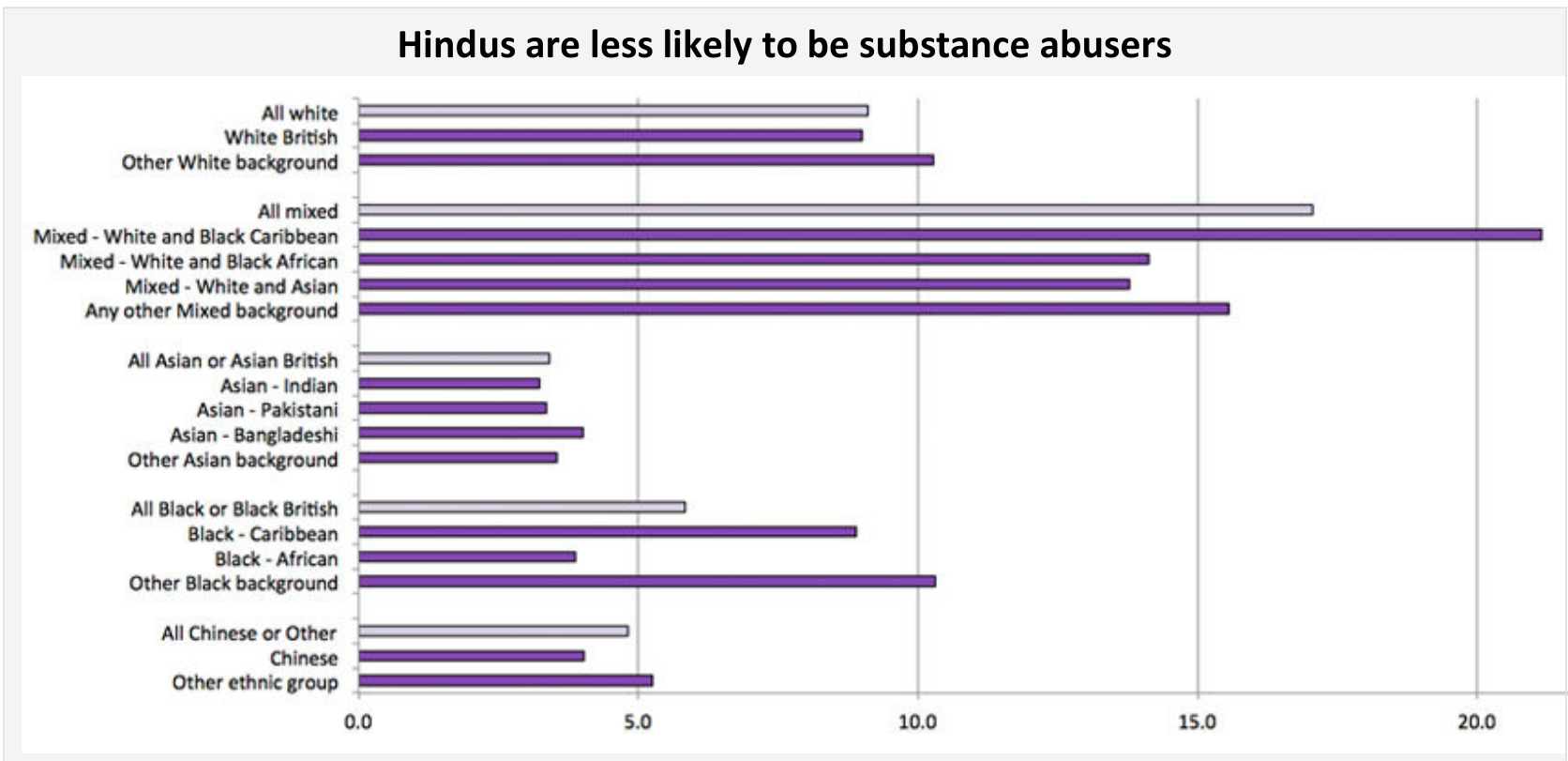
Adults from the Asian or Asian British and Chinese or other ethnic groups generally had the lowest levels of last year drug use. Levels were similar among those identifying as Asian-Indian (3.2%)a majority of whom are Hindus ( 80%) had the lowest likeliness of being substance abusers amongst all.270 The Hindu health values such as strict emphasis on a healthy diet, vegetarianism, organic diet, etc., sustained through Hindu family ecosystems is responsible for this.
The overall picture of health status that came out of this study was that the health status of members of nuclear families was poor as compared to members of joint families.271 Not only more healthy it was also found in a study conducted in the UK by the Office for National Statistics (ONS) found that Hindus in the UK were the happiest people in the country.272 The role of family seniors, grandparents cannot be emphasized enough as a lynchpin in the Hindu system of health care at the level of the family. International studies on indigenous social support networks have also concluded along similar lines.273 This is one amongst several reasons why Hindu family systems are considered an extremely important part of the Hindu health care ecosystems, and the SPH Nithyananda Paramashivam has spent His entire life emphasizing the need for joint families and enlightenment ecosystems for good health, well being, and enlightenment.
“कुलक्षये प्रणश्यन्ति कुलधर्माः सनातनाः।
धर्मे नष्टे कुलं कृत्स्नमधर्मोऽभिभवत्युत ॥1.40 ॥”
“With the destruction of the dynasty, the age-old family traditions die, and the virtue having been lost, vice overtakes the entire race.” 274
https://www.gov.uk/government/statistics/drug-misuse-findings-from-the-2013-to-2014-csew/drug-misuse-findings-
from-the-201314-crime-survey-for-england-and-wales.
"A study to compare various aspects of members of joint and nuclear family", JEMDS ISSN-2278-4802, Jan 2014, Vol-3,
Issue-3, Pg 641-648, https://jemds.com/latest-articles.php?at_id=2997
www.newsgram.com/hindus-are-the-happiest-people-in-uk-study
(i) https://gh.bmj.com/content/6/2/e003808 , (ii) https://www.ncbi.nlm.nih.gov/pmc/articles/PMC5025375/
http://nithyanandapedia.org/September_02_2011
– Bhagavat Gita, (Ch. 1 Verse 40)
Through more than 10,000 hours of Presidential addresses and religious discourses, the SPH Nithyananda Paramashivam has constantly encouraged billions of Hindus to continue living a stable join-family lifestyle. The SPH has appreciated His disciples who stay in joint families, especially the ones who take care of their aged parents and in-laws, “Whenever I see our devotees take care of their parents, I am so happy, ‘Eh, you are living real Hindu culture’, because that is our culture.”275
The SPH Nithyananda Paramashivam has declared the indigenous joint family system in Hinduism as one amongst the four pillars of KAILASA, yet he also warned how the Hinduphobic elements were disrupting this system276 – “The best 401(k)277, Vedic tradition created respect for parents and maintaining them for your whole life. I tell you, if the Hindu tradition did not have the concept of joint family, in India, the Indian elders will be the largest number of human beings dying. India would have reeled, because developed countries are spending billions of dollars taking care of their elders, they can afford it, India doesn’t have that kind of money. But still, if you see the lowest elders’ suicide, due to left out is in India. Go to the internet and see the statistics, lowest almost negligible, because still, the values are there in us. and I am afraid I may not be able to make this statement proudly after 50 years, because the speed with which we are destroying our own traditions, moving out of our own traditions is shocking, terrorizing.”278
The SPH Nithyananda Paramashivam has also modeled KAILASA – the greatest and the only Hindu nation on the planet, around this indigenous family system – “I will revive these four and demonstrate to the world the original authentic Hindu scriptures and the success of the Hindu lifestyle, principles, everything; how to give superconscious breakthrough as a natural lifestyle. I was successful in my pilot study in Adi Kailash.”279
The SPH Nithyananda Paramashivam joyfully recounts the large family He lived in, “I grew up in a large joint family. Twenty-seven of us grew up together. So it’s almost like one school, a small school.”280 The SPH Nithyananda Paramashivam has also expressed how the large joint family environment contributes in making sure everyone is attended to and never there was a reason to feel depressed or alone, “You should be born in a Hindu village where people are temple centric and it is literally like a joint family. I had a large joint family. Uncles – means 20 uncles! Aunts – means 20 elders! Elder brothers – means 10! Elder sister – means 20 elder sisters! Younger brothers – means 10! We do not call only our biological siblings – brothers and sisters. What is a person? A person is a permutation and combination of various aptitudes and attitudes. At least more than 15 grandfathers have impacted, influenced my life and thinking. At a young age, you are grounded with multiple relationships - father, mother, aunts, uncles, grandfather, grandmother, the temple centric Hindu villages.”281
http://nithyanandapedia.org/index.php?title=June_29_2016
http://nithyanandapedia.org/April_28_2020
In the United States, a 401(k) plan is an employer-sponsored defined-contribution pension account defined in
subsection 401(k) of the Internal Revenue Code. https://www.law.cornell.edu/uscode/text/26/401#k
http://nithyanandapedia.org/index.php?title=September_14_2016
http://nithyanandapedia.org/index.php?title=April_28_2020
http://nithyanandapedia.org/index.php?title=August_27_2016
http://nithyanandapedia.org/index.php?title=August_26_2020
The SPH Nithyananda Paramashivam has reiterated the fulfillment of growing up in a large family several times in several of His Presidential Addresses and religious discourses – “I always had the fortune of living with a large number of people. I am born in a joint family, large joint family, and grew up among a large number of sadhus and sannyasis and spiritual seekers, devotees. All the time I will be with at least fifty to a hundred people only. There was no such thing as ‘aloneness’ in my life other than the little time I spent in meditation and Samadhi.”282
Role of Mother, Traditional home remedies, and Haritaki
Most indigenous Hindu traditions, like the ASMT, are “Mother worshippers”. It is a deep belief in indigenous Hindu traditions that mother always does good, nurtures, and can heal any disease; nature and planet earth283 are respected as living divine mother energies capable of providing us with all our survival needs – food, medicines, etc. Though traditional medicines such as TCM284 and Ayurveda285 are effective in addressing COVID-related issues, and a few years ago a Nobel prize was awarded for scientific work based on traditional medicine286 the mainstream western medicine has chosen to characterize Ayurveda as pseudoscience287 and TCM as unscientific288. Such demeaning of traditional medicine systems has led nations to consider taking defensive unilateral decisions to protect their interests.289 Outright rejection of traditional medicine is not wise and such policies should be revisited especially as these medicine systems are time tested and have kept people healthy for several generations. The SPH Nithyananda Paramashivam has made recommendations and formally urged to the United Nations bodies and governments worldwide through submissions recommending all human beings should be provided access to traditional health care systems free from policies that are prejudicial and discriminatory towards these systems and also urged countries to offer solutions like KAILASA’s Hindu Medical care (which includes completely free of charge services such as Ayurveda,
http://nithyanandapedia.org/index.php?title=January_22_2015
ॐ वसुंधराय विद्महे भूतधत्राय धीमहि तन्नो भूमिः प्रचोदयात्। “Om, let me meditate on the Earth the One who provides all, bless
us with abundance, And let the Goddess of Earth illuminate my mind” (Bhumi Devi Gayatri Mantra)
Zhao Z, Li Y, Zhou L, et al. Prevention and treatment of COVID-19 using Traditional Chinese Medicine: A review.
Phytomedicine. 2021;85:153308. doi:10.1016/j.phymed.2020.153308
(i) https://www.thehindu.com/news/national/kerala/many-patients-turn-to-ayurveda-for-post-covid-
care/article34755600.ece (ii) https://www.thehindubusinessline.com/news/mix-of-modern-ayurvedic-medicine-helps- treat-covid-19/article34701852.ece
https://www.nobelprize.org/womenwhochangedscience/stories/tu-youyou
(i) Semple D, Smyth R (2019). Chapter 1: Thinking about psychiatry. Oxford Handbook of Psychiatry (4th ed.). Oxford
University Press. p. 24. doi:10.1093/med/9780198795551.003.0001. ISBN 978-0-19-879555-1. (ii) Sujatha, V (July 2011). "What could 'integrative' medicine mean? Social science perspectives on contemporary Ayurveda". Journal of Ayurveda and Integrative Medicine. 2 (3): 115 - 23. doi:10.4103/0975-9476.85549. PMC 3193682. PMID 22022153. (iii) Manohar, PR (April 2013). "Uniform standards and quality control of research publications in the field of Ayurveda". Ancient Science of Life. 32 (4): 185 - 6. doi:10.4103/0257-7941.131968. PMC 4078466. PMID 24991064. (iv) Bausell, R. Barker (2007). Snake Oil Science: The Truth About Complementary and Alternative Medicine. Oxford University Press. p. 259. ISBN 978-0-19- 538342-3.
(i) Singh S, Ernst E (2008). Trick or Treatment: Alternative Medicine on Trial. London: Bantam. ISBN 978-0593061299. (ii)
"Hard to swallow". Nature. 448 (7150): 105–6. July 2007. Bibcode:2007Natur.448S.105. doi:10.1038/448106a. PMID 17625521 (iii) Shang A, Huwiler K, Nartey L, Jüni P, Egger M (October 2007). "Placebo-controlled trials of Chinese herbal medicine and conventional medicine comparative study". International Journal of Epidemiology. 36 (5): 1086–
92. doi:10.1093/ije/dym119. PMID 17602184
https://www.bmj.com/content/369/bmj.m2285
Yoga, Siddha, Western medicines, and multi-layered quarantine) for complementing their ongoing public health efforts especially in the context of this ongoing pandemic.290
Nature and planet earth are also considered divine mother energies that always do good, nurture, can heal any disease, and are capable of providing us with all our survival needs – food, medicines, etc. Indigenous Hindu healing tradition of Ayurveda is more than 5000-year-old - it has a vast body of healing knowledge - sometimes referred to as “Mother of all healing”. According to World Health Organization, about 80% of the world population rely chiefly on plant-based traditional medicine, such as Ayurveda, for their primary healthcare need291. Traditional healing system around the world that utilizes herbal remedies are an important resource for the discovery of modern drugs292. The role of the mother in healing as per indigenous Hindu traditions cannot be emphasized enough, the mother is highly revered. Even if somebody is a Sannyasi (a renunciate monk), and he sees the mother, he is supposed to touch her feet for blessings, however, if he sees the father, he does not need to touch; rather the father must touch his feet. The reverence given to mother in Hindu tradition is highest or all relationships, however, as per indigenous Hindu medicine (Ayurveda), there is only one object that is revered, respected more than mother as indigenous scriptures say – Haritaki does much more good to you than your mother.
“यस्य माता गृहे नास्ति, तस्य माता हरीतकी। कदाचिद् कुप्यते माता, नोदरस्था हरीतकी ॥“
“For humans, Haritaki is like the mother who always does good to you. Sometimes even mother may get enraged, but ingested (consumed) Haritaki can never do anything bad or harmful”.
- Nighantu (Dictionary) of Ayurveda by Raaj Baalabha.
The word Haritaki means, “the drop of the nectar fell from Indra’s cup (Indra is the prime Demi-God of heaven)”. In indigenous Hindu traditions, Haritaki is known as a mother, “mother of herbs”293, “सर्व रोग निवारणी” – “That Which Heals All Diseases”.
Since last two decades, the Guru of two billion Hindus – the SPH Nithyananda Paramashivam – as someone more than a father figure, as someone more than a mother figure, has been diligently ensuring all His disciples, devotees, followers, practicing Hindus, and as many people as possible who listen to Him, consume Haritaki as an herb for prolonged healthy life.
Recent studies have found that extracts from Haritaki, have the potential to act as therapeutic options against COVID-19 infection.294 Haritaki has established antiviral activity particularly against viral
https://www.ohchr.org/EN/Issues/IntOrder/Pages/cfi-covid19-multilateralism.aspx
World Health Organization. Traditional Medicine Strategy 2002-2005 (WHO/EDM/TRM/2002.1). Geneva, Switzerland:
World Health Organization; 2002
Koehn FE and Carter GT. The evolving role of natural products in drug discovery. Nat. Rev. Drug Discov 2005; 4: 206-220.
(i) https://www.planetayurveda.com/chebulic-myrobalan/ (ii) www.imedpub.com/articles/pleiotrophic-evaluation-of-
haritaki.pdf
(i) https://www.thehindu.com/news/national/tea-haritaki-extracts-may-act-as-potential-therapeutic-options-against-
covid-19-iit-delhi-study/article31971504.ece (ii) Upadhyay, Saurabh et al. “Evaluation of medicinal herbs as a potential therapeutic option against SARS-CoV-2 targeting its main protease.” Phytotherapy research: PTR vol. 34,12 (2020): 3411-
Traditionally Haritaki is known as the “king of herbs”297, something which is confirmed by contemporary studies also – leaves, bark, and fruit of Haritaki have antioxidant and free radical scavenging properties, phenolics of Haritaki have Anticarcinogenic properties, hydrolyzable tannins of Haritaki have antimutagenic, radioprotective and chemopreventive properties, ethanolic extract of Haritaki have Hepatoprotective properties, extracts of Haritaki have cardioprotective properties, Haritaki derivatives have cytoprotective, antidiabetic, renoprotective, antibacterial, antifungal, antiprotozoal, anti-inflammatory, anti-arthritic, adaptogenic, anti-anaphylactic, hypolipidemic, hypocholesterolemic, gastrointestinal motility improving, anti-ulcerogenic, antispasmodic, anticaries, wound healing, purgative, immunomodulatory and anti-allergic properties.298
The SPH Nithyananda Paramashivam has spoken more than a hundred hours299 on Haritaki alone in His public presidential addresses and religious discourses and spoken more than a thousand hours in other settings. The SPH Nithyananda Paramashivam has been extremely diligently, patiently, with extraordinary love managing and supervising the health of His monks, nuns, children of the community, devotees, disciples, and followers by having an extremely prudent follow up to ensure everybody took Haritaki and other natural herbs such as Neem and Castor Oil daily. At the surface level, this may seem insignificant detail however the consumption of Haritaki amongst other several measures by the residents of the KAILASA ecosystems and monasteries spiritually headed by the SPH has been the reason why even in two years of the COVID-19 pandemic the entire community in several monasteries witnesses zero cases of COVID-19 infections let alone deaths. Add statistics of global per capita COVID deaths. This speaks volumes by making it amply evident that the priorities of the SPH Nithyananda Paramashivam and KAILASA nation are driven to ensure long healthy lives for its people and ensuring that people of KAILASA do live a hundred years blissfully to their fullest.
Food as medicine
In KAILASA the SPH Nithyananda Paramashivam has developed the Ayurvedic indigenous medicine system as a lifestyle, not as an FMCG or drug market. As per indigenous Hindu health sciences, “Food is medicine”. There is also a popular proverb in Ayurvedic literature, “When diet is wrong, medicine is of no use. When diet is correct, medicine is of no need.”
https://www.researchgate.net/publication/348137919_CAN_TERMINALIA_CHEBULA_HARITAKI_STOP_COVID-19
https://timesofindia.indiatimes.com/city/ahmedabad/herbs-can-complement-covid-
antivirals/articleshow/82691994.cms
Karta Singh Khalsa & Micheal Tierra (2008), “The way of Ayurvedic herbs”, ISBN 978-0-9409-8598-8, p. 215
https://www.ncbi.nlm.nih.gov/pmc/articles/PMC3631759/
2020 [Nov 3, Oct 4, Aug 27, Aug 26, Aug 24, Aug 23, Aug 17, Aug 12, Jul 29, Jul 24, Jul 18, Jul 12, Jul 6, Jul 5, Jul 2, Jun
27, Jun 18, Jun 12, Jun 7, Jun 7, May 6, May 2, Mar 28, Jan 13], 2019 [Dec 22, Dec 16, Dec 16, Dec 4, Nov 14, Nov 13, Oct 2, Oct 1, Sep 29, Sep 4, Feb 19, Jan 17],2018 [Nov 1, Mar 12], 2017 [Sep 9, Sep 1, Aug 26, Aug 10, Aug 2, Jul 26, Jul 24, Jul 18, Jul 15, Jul 12, May 30, Feb 27], 2016 [Dec 14, Dec 7, Dec 4, Dec 4, Dec 4, Nov 9, Sep 26, Sep 7, Aug 31, Aug 23, Aug 17, Aug 4, Jun 27, Mar 5, Mar 1], 2015 [Oct 19, Mar 28, Feb 25, Feb 7],2014 [Nov 24, Nov 17],2013 [Dec 11, Nov 2, Oct 17, May 18, Apr 2, Feb 5, Jan 28], 2012 [Oct 8, Sep 27, Sep 23, Sep 22], etc.
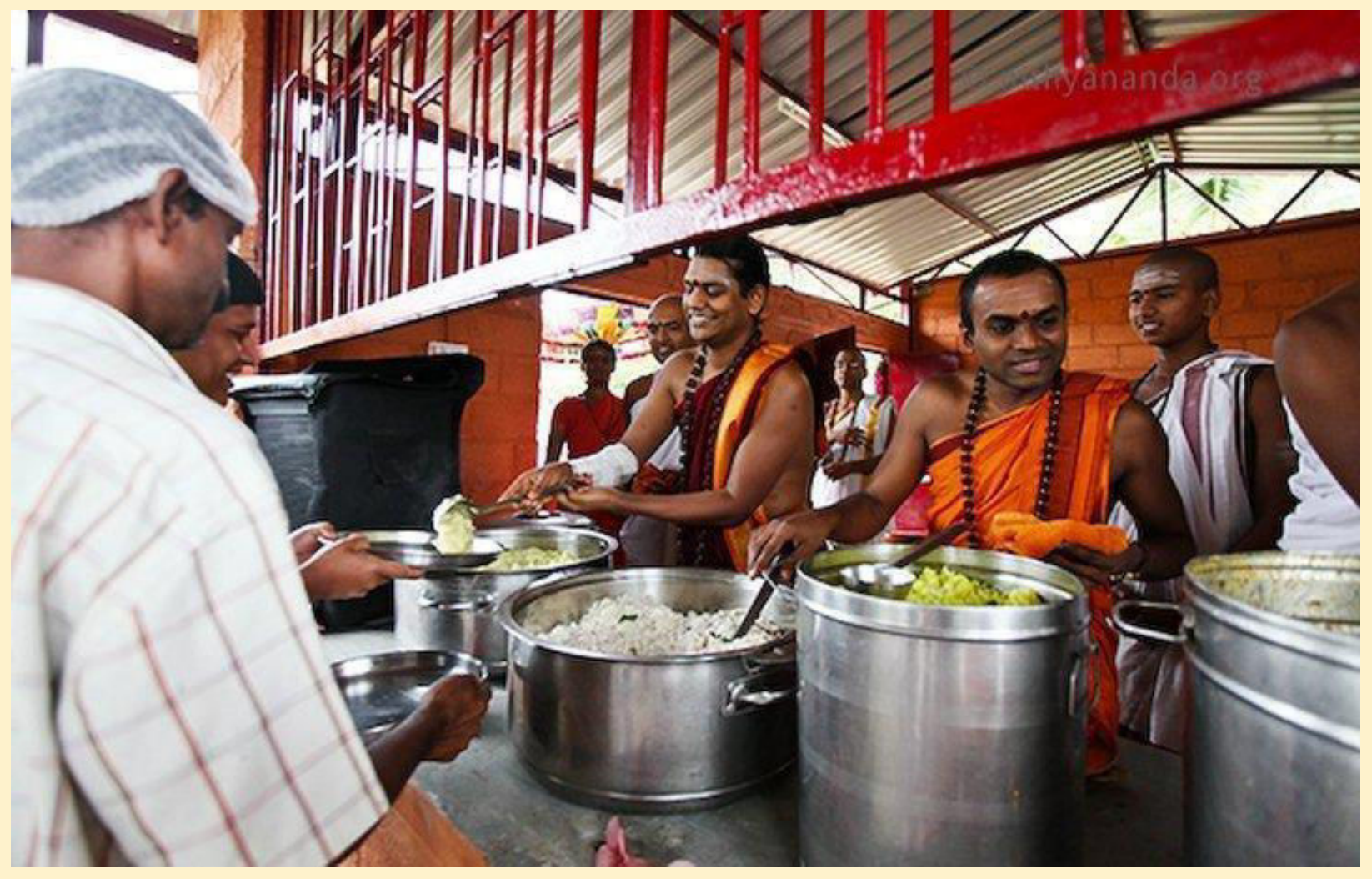
The picture above shows how even with a fractured hand, the SPH Nithyananda Paramashivam is engaged in selfless work day and night, leading the nation of KAILASA by example, inspiring the volunteers and citizens of KAILASA to engage in selfless service, to follow principles in action, and not just in theory. In 2011, the SPH Nithyananda Paramashivam had a multiple compound fracture with the bone protruding out of the skin. In 2013, two steel implants that were fastened in 2011 were removed as the bones had healed completely. This picture is after that surgery. The SPH Nithyananda Paramashivam has said that when we serve others – say yes to the life of others – that same life positiveness is triggered in us, giving us good health, healing of ailments, and longer life – “By giving, you say ‘YES’ to life. And I tell you when you start giving from this context – ‘By giving this Daana (charity), I am saying YES to his life’ – you will see the life energy, ‘saying YES to life’, will be awakened not only in you but even in him (the person to whom you are giving)!”300
The SPH Nithyananda Paramashivam explained His vision for the services that had been a prime focus of KAILASA – “All these thousand and eight Kailaasa will have temple-on-wheels - Rathams, which I started from 2001. Deities will be installed on Rathams and that will go from place to place and invoke intense devotion and spread the glory of Paramashiva in people. Second, Annalayas (food banks) - all Annalayas will have mobile free Annadhans – free food serving as per Paramashiva’s Bhaga Shastra – and reach people wherever they are. And third, the mobile holocaust museums will go from place to place wherever people gather and tell the story of the Hindu Holocaust to the world. You may be thinking, ‘Why I am not having mobile dispensaries?’ – In Hinduism, Hindu food is medicine. You don’t need medicine if you eat Hindu way. Eat Hindu way as per Paramashiva, you don’t need medicine! That is why I am not adding medical mobile vans, understand. Kailasa has too much to offer to all of you and the world. Kailasa has so much to offer to the world and all of you. Let’s make Kailaasas all over the world.”301
http://nithyanandapedia.org/index.php?title=February_23_2015
http://nithyanandapedia.org/index.php?title=March_04_2019
The purpose of Annadaan – free organic food serving as per indigenous Hindu scriptures such as Bhaga Shastra – is not just tackling hunger, but to supply the body with all-natural, non-toxic, organic supplements, nutrients, and herbs to enable it to treat itself from any disease and ailments completely naturally. For 27 years, every month the Hindu ASMT community has served more than 3 million302 Annadaans (free organic meals as per tradition) in religious gatherings to everyone without discrimination and has served over 1 billion303 free meals in total.
Annadaan is an integrated policy of KAILASA to tackle both hunger and address the health needs of the people. All meals cooked for Annadaan are made from herbs and natural medicine which are part of a daily diet. The method followed is as per indigenous scriptures related to – food as a medicine – Bhaga Shashtra. As part of KAILASA’s Hindu Compliance Systems (HCS), KAILASA has documented these recipes and special diet plans from the scriptures into standards that can be replicated by anyone to achieve the same good taste and health benefits simultaneously.304 When these standards – which are based on scriptures revealed by Paramashiva (primordial Hindu Divinity) – are followed in letter and spirit – the results are phenomenal. HCS is a compilation of ancient wisdom and best practices that have kept indigenous people healthy for thousands of years.
Apart from food as a medicine, KAILASA also offers free medical aid comprising of natural indigenous Ayurvedic medicines and contemporary western medicines as and when required. All these services are offered for free. KAILASA has provided free medicines and complete health care as part of the KAILASA’s COVID care centers.