Centering Meditation
This text was machine-transcribed from the printed book and may contain errors. Select the words and choose “Report a mistake”.
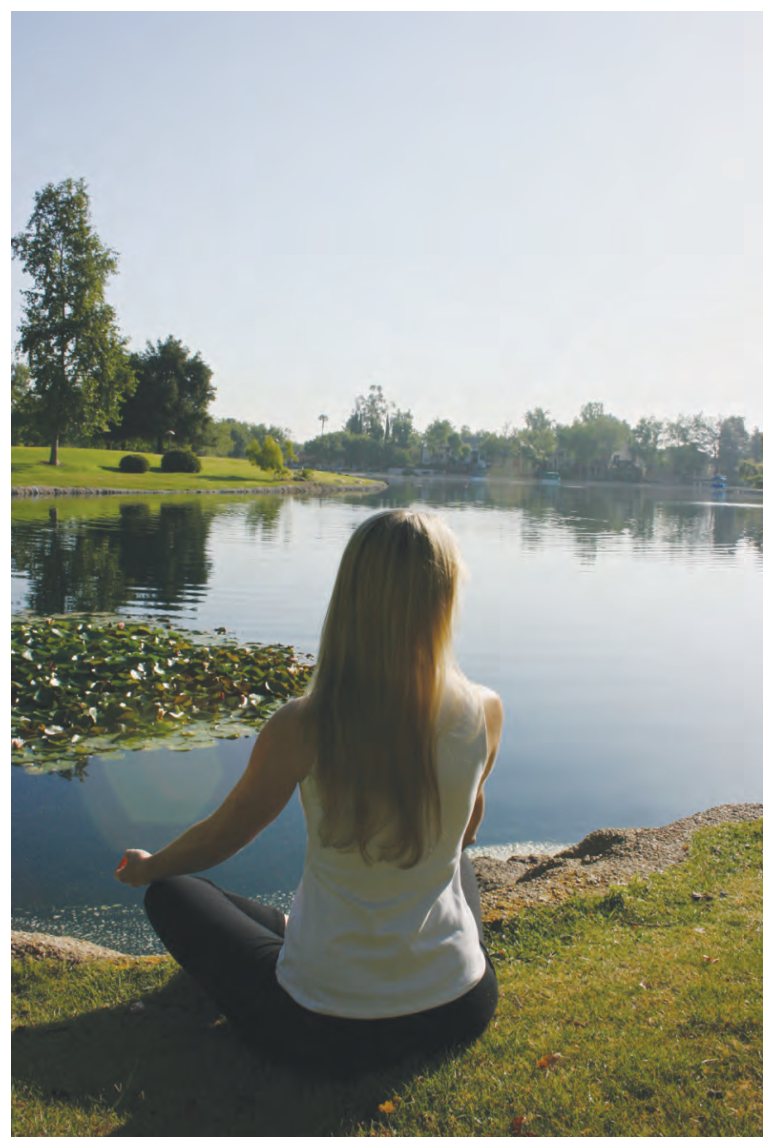
At the commencement of any Nithya Yoga class, we start with a passive centering meditation. Passive meditation can be described as one that doesn't require physical or active use of our body. Passive meditation is generally a meditation whereby you can rest with yourself. Usually done in a sitting position, with eyes closed, it promotes a very relaxing and calming effect. Passive style of meditation is perfect before bedtime.
Most students, when they come
in to do their daily yoga class,
will more often than not be
rushing in from somewhere
else at the last minute. They
may have come directly from
work, or they may have just
dropped their kids somewhere
or they may even be coming to
class fresh from a conflict they
have had with another.
Therefore at the beginning of
the class, students are asked to
sit comfortably in sukhasana
(cross-legged on the floor) and
simply bring the awareness to
the subtle breath entering and
exiting the nostrils. Their focus
which has been directed
outwardly for a large
percentage of the day, is
immediately turned inward.
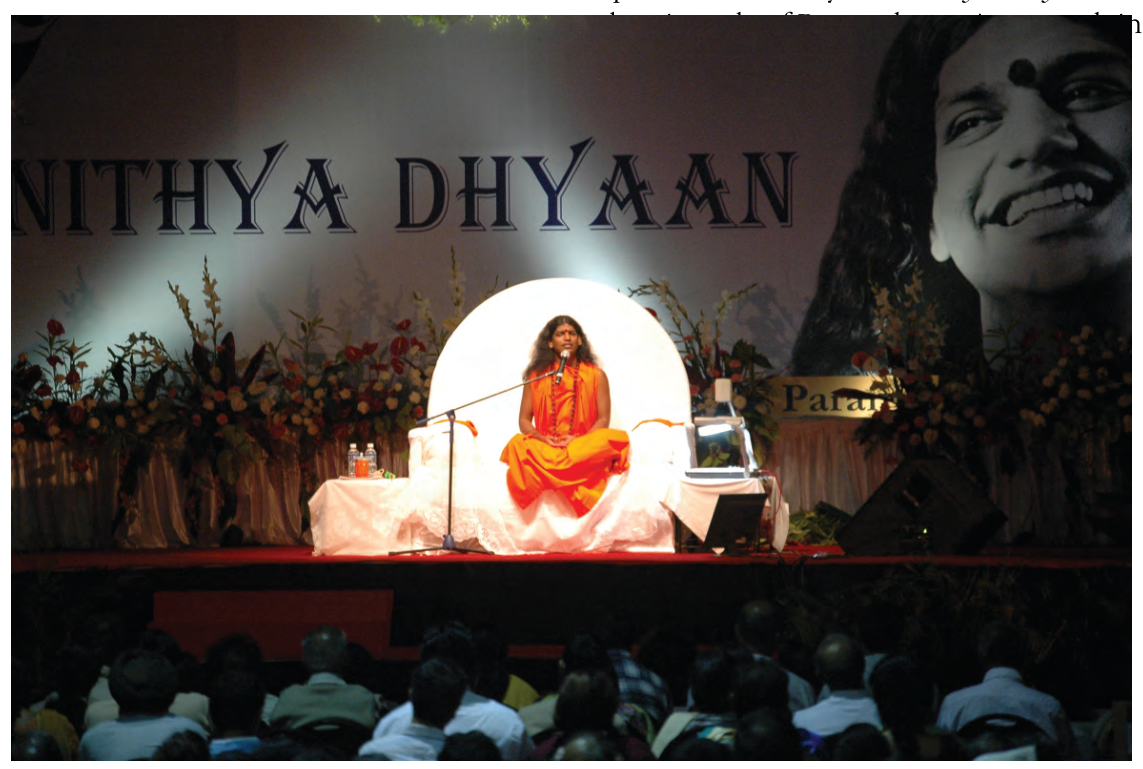
Dynamic Meditation Nithya Dhyaan (Life Bliss Meditation)
Why Dynamic Meditation?
Almost all of us carry the impressions of the previous night or the happenings of the day to our yoga class. If they are negative, it is like an energy block in our system. If we don't clear this first in a direct and effective manner, whatever we may do throughout our yoga session will not have the result that should be there. On the other hand, if we walk in brimming with positive energy, the yoga session will help intensify that feeling.
Take a situation like this. If we need to carry sand to our house, we take a container that is big and empty so we would be able to collect sand quickly and with less effort. Similarly, when we clear muck in our inner space, through dynamic meditation, we will benefit enormously from our daily yoga session. We will be able to take in more with less effort and energy. Progress will happen at a faster pace.
With this new approach to the understanding and practice of yoga, a whole new pathway can be created by the mind at the level of brain neurology.
In one of the most stunning studies in the field of cognitive science, neurologist and neuro-psychiatrist Dr Richard Restak has expounded on the plasticity of the human brain. What is this plasticity? It is the brain's inherent capacity to adapt to change. Till recently many neuro-scientists believed that brain plasticity largely ceased by adolescence or by early adult hood at the latest. The common theory was that the brain became fixed in its structure and function. Not anymore.
Genetic mapping, imaging techniques and studies in psychopharmacology have led to an unprecedented understanding of how the brain works and how we can affect its functioning. In the language of yoga, earlier long-standing assumptions have been made to do a headstand!
The physical brain of man a century ago and the one today is very different. Neurologists report that new synaptic connections and neural pathways have formed a new layer called the cerebral layer.
How and why this has happened?
There has been an enormous and dramatic change in human lifestyles in the last century. Like no other time in human history, mankind has been flooded with a bewildering array of stimuli. We have had to cope with the boom in information technology, handling the flood of images through the print and visual media, be victims of violence and mayhem on a day-to-day basis and witness some extraordinary events in our collective history.
These dramatic changes have led to coping behavior at the level of neurons and synapses. The scientists concluded that the brain never loses the power to transform itself on the basis of experience. Thoughts, feelings and actions determine the health of our brain. Our belief systems are greatly responsible for the experiencing of well-being. What we hear on a daily basis gets recorded in the brain and an electro-chemical circuit is established.
Training can activate a distinct population of neurons and lead to a gradual strengthening of their connection. In fact just by training, we can bring about changes in key areas of the brain. These changes are evident even a year after the training has stopped. Therefore, engraved memories, samskara, do have physiological support. If the information input is positive, then it transfers itself at the deepest level into a source of empowerment. Otherwise, it can be a source of energy disruption and depletion.
It is very difficult to cut across this cerebral layer and clear the numerous energy blocks through mild means, which is what most traditional practices of yoga are. By beginning the class with a dynamic meditation technique, we open ourselves to a powerful, swift and effective way of clearing all the physical and psychological toxins from our system. It is similar to the effect sweeping a room with a vacuum cleaner as against using a traditional broom.
After the centering meditation, Paramahamsa's revolutionary Nithya
Dhyaan (Life Bliss Meditation) is practiced at the commencement of every Nithya Yoga session so students are able to achieve the following;
i) The energy blocks which manifest themselves as toxins at the physical level and emotional grime at the mental are removed, ii) The dormant nadis (energy channels) are reactivated and revitalized, iii) An abundance of energy is made available to them, and iv) Nithya Dhyaan allows students to unclutch from the mind so that one can start moving beyond it. Unclutching from the mind influences the rate at which the physical body can rejuvenate, transform and set itself free from the clutches of physical and mental disease. Samskaras
Nithya Dhyaan Explained
Before we explain what Nithya Dhyaan is,
we would first like to give a brief
background about how this revelation
happened to Paramahamsa. Post
enlightenment, Paramahamsa was in
silence for an extended amount of time,
doing research on meditation techniques,
to see how he could reproduce the same
experience that happened in him, in
others.
The first outcome of his research was the Ananda Spurana Program (Life Bliss Program Level One) where he worked on the seven energy centers (chakra) and devised a meditation technique to energize and cleanse each of the energy centers. This was followed by the Nithyananda
Spurana Program (Life Bliss Program Level Two) where he devised meditation techniques for each of the seven bodies to help one have a peaceful and a blissful death. Since then, he has come up with different programs like Dhyaan Spurana Program, Atma Spurana Program all in an effort to help the individual attain perfection and realize the true self in all possible ways and paths. He came up with around hundred different meditation techniques in all of his programs and each meditation technique was an attempt to raise the individual consciousness by working on some aspect of the Being.
People started asking Paramahamsa if he had one particular meditation technique that he would recommend for everybody and which they can practice daily? When this question was raised again and again, he started pondering over it. Paramahamsa pondered deeply to come up with a technique which is a complete representation of his philosophy, teachings and his experience. He had envisioned a meditation technique, which is holistic and complete by itself and instead of focusing on any particular aspect of the being; it should work on the entire being to transform it and make is ready for the ultimate experience to dawn. And one day, this meditation technique Nithya Dhyaan (Life Bliss Meditation) was revealed to him in a flash. In an instant, Paramahamsa could clearly see the different parts of this technique; how each part relates to the other and helps one to raise the individual consciousness. This was all visualized by him in his inner space. We can say that Nithya Dhyaan is
Part One - CHAOTIC BREATHING:
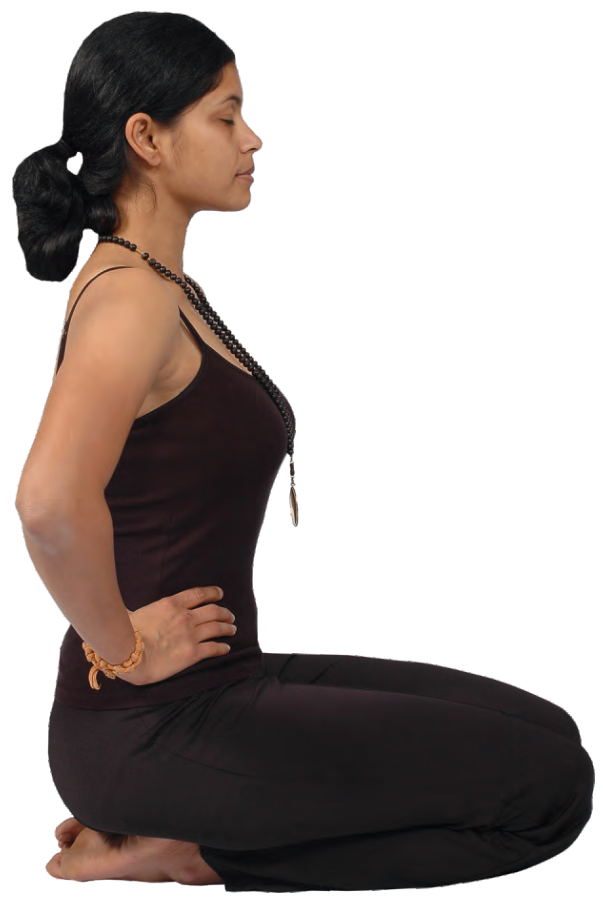
For the first seven minutes we will sit in vajrasana with our eyes closed and our hands on your hips and breathe chaotically. Normally in our body, the energy flows from the sahasrara chakra (crown center) to the muladhara chakra (root center). We sit in vajrasana because this posture helps with the upward movement of energy.
Inhale and exhale deeply and chaotically and completely focus on the breathing. Our entire being should become the breathing. Breath is the best place from where one can start any spiritual practice. There are different kinds of meditation techniques. Some techniques focus on witnessing, some focus on repeating a word or a mantra, however, Paramahamsa suggests that the breath is the best place to begin any spiritual practice.
We have two types of systems in our body. One is voluntary and other is involuntary. The movement of hands and legs is an example of voluntary action. When required, we can move our hands and legs, but we cannot directly control the functioning of our brain, or beating of our heart. Those movements are involuntary movements.
Breathing however, is one system that is voluntary as well as involuntary. Even if we are not aware, the breathing mechanism never fails. We don't stop breathing when we focus our attention on something else, otherwise that would be a calamity. Likewise, we can also control our breathing. The whole science of Pranayama emphasizes on control of breath. We can breathe deeply, slowly as and when required. We can hold our breath for long durations or even stop breathing for few minutes. The breath is a link between our voluntary and involuntary systems.
We can never stop breathing and die because then it would be a fight between our survival instinct and our will. Our survival instinct is much stronger than our will. In fact all involuntary movements in
our body happen due to the survival instinct. We are living due to our very desire to live. Our very breathing happens due to the desire to live. We might not have observed but our quality of breathing changes depending on your state of mind. Our emotions have an impact on the breathing process. When we are in anxiety our breathing changes, when we are angry our breathing changes and if we are aroused sexually our breathing changes. When we are in love there is a qualitative change in our breathing. Our breathing is directly related to our emotions and it continuously changes as and when the state of the mind changes. When we are in tension the normal advice given is to take a deep breath. The moment we take a deep breath we feel light, more relaxed and the tension releases. Mind and breath are closely inter-related. We can see that when we stop breathing, it becomes very difficult to think. Breath becomes the fuel for the mind. Actually in Sanskrit we use the word Prana. Prana does not directly mean breath. It means the energy that flows through breath. That energy itself is the life force.
The pranamaya kosha or the breath sheath is the where all of our desire memories are stored. Depending on our desires, our prana, the breath gets modulated. Our breathing and our desires are tightly coupled. It can be observed that when we have too many desires we breathe very fast and heavily. When we have few desires, we breathe in a more relaxed way. As the breath and the mind are inter-related, changing one automatically changes the other. We have already discussed how our emotions affect the breathing pattern. Likewise, if we were to control our breathing or bring about some change in our breathing pattern it will directly have an impact on our emotions; our state of mind.
All of our memories are stored in our muscles. Paramahamsa strongly believes that if some part of our body is amputated, we would eventually lose the memory related to that part of the body. We can do this small experiment. We can try remembering some past incident in our life without remembering our form. It is impossible. Our form is necessary for us to remember any incident in our life because all of our memories are stored in our form.
We have suppressed many emotions in our being and as a result we are not able to breathe normally. We always breathe shallow. When we breathe shallow, we never release these suppressed emotions and memories that are stored in our muscles. The breathing never touches each and every part of the body. We always breathe in a fixed pattern. Our past samskaras, our past memories which are suppressed in our Being create a particular type of breathing pattern in our system. And as a result we attract similar emotions and samskaras. Anything within our system has a survival instinct. So anything that is suppressed in our system creates favorable circumstances for it to stay and grow inside our system. If we have suppressed anger in our system, it will keep surfacing itself and create a breathing pattern for its survival. This is a vicious cycle. Our breathing is nothing but a cumulative effect of the past samskaras.
Nithya Dhyaan begins with chaotic breathing. We have to breathe as deeply as possible and as chaotically as possible. Our entire being should become the breathing. Understand that the breathing has to be deep. The chaotic breathing should not be shallow. The deep chaotic breathing will start releasing the tension in our muscles and body parts and will start releasing the engraved memories. Normally our muscles are always under stress. Chaotic breathing will loosen the muscles and start clearing the samskaras.
Each emotion within us gives rise to a particular breathing pattern. If you observe children, they breathe deeply and blissfully. They don't breathe shallow. But as they grow, they get conditioned by the society, by their pains, pleasures, guilt's, beliefs, stress and other emotions and the quality of the breathing totally changes. Now if we have to shake this pattern; something that has been created due to the emotions suppressed in our system for so many years, we have to insert chaos and we have to create turmoil. Inserting another pattern is not the solution. We have to create utter chaos in our system to dig out all the past impressions. Paramahamsa does not recommend any rhythmic breathing pattern like pranayama in this meditation, just chaotic breathing.
This chaotic breathing will destroy all of our past samskaras. It is like shaking a tree with dead leaves; all the dead leaves will fall down. Similarly, chaotic breathing is like shaking our suppressed system. All the past engraved memories will be released.
Deep chaotic breathing will also infuse tremendous oxygen and release carbon dioxide from the body. It creates hyperventilation as a result we will feel more vibrant and fresh. Through the increased intake of oxygen in the blood, automatically all the body parts become alive and that creates more bio-energy in the body cells. Normally we always feel ourselves as heavy dead mass and that is because our body is never alive. It is always under stress and tension and something that is tense can never be alive. If the body is made alive with increased flow of oxygen, we will start feeling light, then we will start experiencing ourselves as energy rather than matter. We feel heavy because of the engraved memories.
In fact, in some Buddhist monasteries they use this as a technique to ordain people as monks in the monastery. After you are done with your spiritual disciplines, you are made to walk on grass. If you make a path (grass below your feet dies), then you are not initiated as a monk and more spiritual discipline is prescribed. A person with less samskaras will never make a path on the grass when he walks because he always feels light within his system. The burden of engraved memories is less. With
Part Two - INTENSE HUMMING:
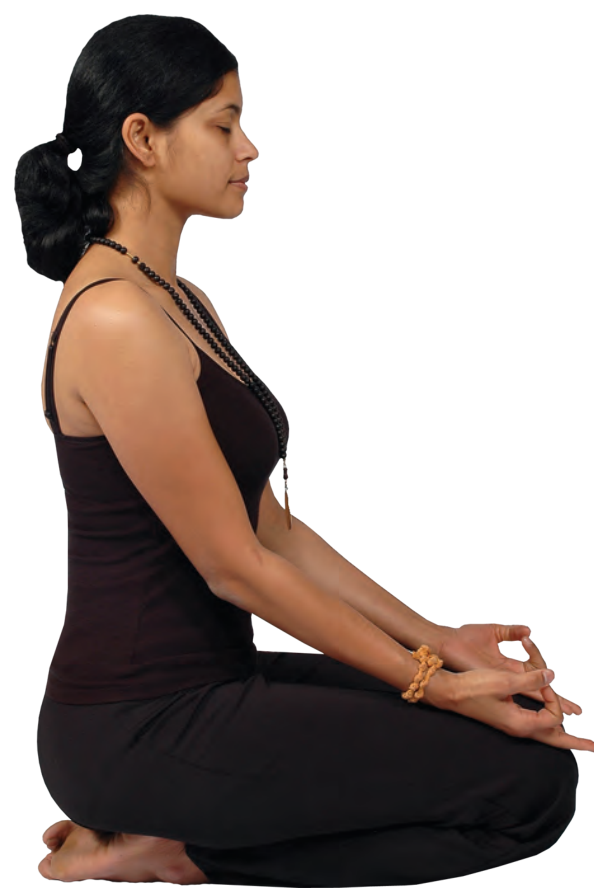
In the second step, stay seated in vajrasana, form chin mudra with your fingers and place your hands on your knees. Chin mudra is the hand gesture where you touch the tip of the thumb with the tip of the index finger. The other three fingers remain unfolded. The chin mudra helps to maintain a balance in the energy flow in the body and keeps the energy within the body by creating a circuit. It prevents the energy from being dissipated out of the body.
In this posture, we should produce a humming sound as intensely as possible, as loudly as possible and as lengthily as possible. We should put our complete awareness on the humming. We should become the humming.
Humming reduces our inner chatter. Continuously there is talking going on within our minds. We may not be talking to anybody external but internally there is always something that is going on. Humming is an excellent technique to reduce this inner chatter. Normally people find it very difficult to sit without thoughts.
When we suddenly venture into meditation in our middle age, the first thing we would notice is resistance from the mind. Mind will revolt because it does not want to sit silently. When it has been habituated to run for so many years and suddenly it is made to sit silent, obviously it will revolt. In fact people often complain that in an attempt to be thoughtless, they encounter more thoughts. Mind is not accustomed to be silent for so many years and any initial attempt to make it silent is like swimming opposite to the river current; obviously the river is going to protest. This is the time when most people simply give up drop meditation because they become discouraged. They think that meditation is not possible at all for them. However, Paramahamsa says that this is the experience of all the seekers initially. At first we have to make the effort and this very effort is what Paramahamsa defines as tapas (austerity). If we feel discouraged by the initial resistance, then we can never succeed.
There is a mythological story where all the gods and demons are together trying to churn the ocean to extract divine nectar. To their surprise the first thing that comes out after the churning is deadly poison. Later many other things appeared as a result of the churning and finally the last thing to come was divine nectar. This is a very metaphorical story which has a deep significance in the process of meditation. When the mind is churned in the process of meditation to extract the experience of enlightenment, the first thing to come out is always the negativity that was suppressed in the past. We should not feel discouraged because this is an indication of progress that the negativity is been thrown out. We should continue our effort with the meditation until we experience the supreme state.
In this initial stage when the inner chatter can potentially bother us, intense humming can be an extremely useful tool. It helps us to silence the mind. Our inner chatter is created between the manipuraka chakra and the swadhistana chakra. This area is also called as hara. When we hum intensely, so intensely that we create the vibration of the humming right below our navel, then we stop this process of continuous inner chatter. It is like shaking the hara. So the humming should happen from below the navel.
The inner chatter is the sole reason for the mind. Mind is nothing but the inner chatter. And through humming when the inner chatter reduces, automatically we start progressing towards no-mind. We start experiencing a different dimension of our Being.
A good car driver always knows intricate details about his car. Like the noise the car makes at different speeds. If there is any malfunction in the engine and the car noise changes, a good driver immediately senses and takes corrective action. The passengers won't realize anything but a good car driver certainly will.
Similarly, when we start practicing this meditation regularly, based on the intensity and the quality of our humming, we can start understanding our body functions well. If we over eat certain kinds of foods that do not suit us that well, we will see a difference in the quality of our humming. Automatically, we would adjust our body's needs to make sure that the humming is smooth.
Humming gives us an insight into the subtle vibrations of the body and helps us to take corrective action if necessary. It happens automatically and need not be enforced. Our body and the mind are always out of sync. Paramahasa always tells people that if our body is here then it's almost certain that we are not here. Our body has its own innate intelligence which is functioning all the time. It's just that the mind refuses to corroborate with that intelligence. It forces the body into certain actions which later on manifests as disease. Disease means absence of ease. If the body is made to run forcibly, then it is 'Mmmm...' sound. going to revolt some time or the other.
So many times we overeat. The body is giving us the signals that it is full however, the mind is not satisfied. It wants more. And then it goes on filling the body creating more and more damage. The repercussions are then felt later. Creating a harmony between the body and the mind is important for going beyond both. Else we would be caught in this psycho-physical entity and transcendence would be difficult. Humming is one of the best techniques to make a bridge between the body and the mind.
Humming allows us to feel our body as energy. The moment we start humming we start feeling light; as if we are floating. We don't feel the heaviness in the body because humming matches the vibrations of the mind with the vibrations of the body. Body and the mind become harmonious and we start experiencing ourselves as energy.
In this step, we will put our lips together and produce the sound 'Mmmm...' from inside. If we were to put your face inside an empty aluminum vessel and make a humming sound, the sound generated will be similar to this. Note that this is not 'Humm...' or 'Omm...', it is simply keeping your lips together and producing
The humming should be as lengthy as possible between breaths; it should be as deep as possible (from the navel center) and as loud as possible. There is no need to make an effort to take in deep breaths as the body itself will take breaths when needed.
We shouldn't become tense however, just do it in a relaxed manner. We should immerse our whole being and energy into creating this vibration. Try to minimize the gap between the humming sounds. After some time, we will feel that the humming continues without our effort and that we
Part Three - CHAKRA AWARENESS:
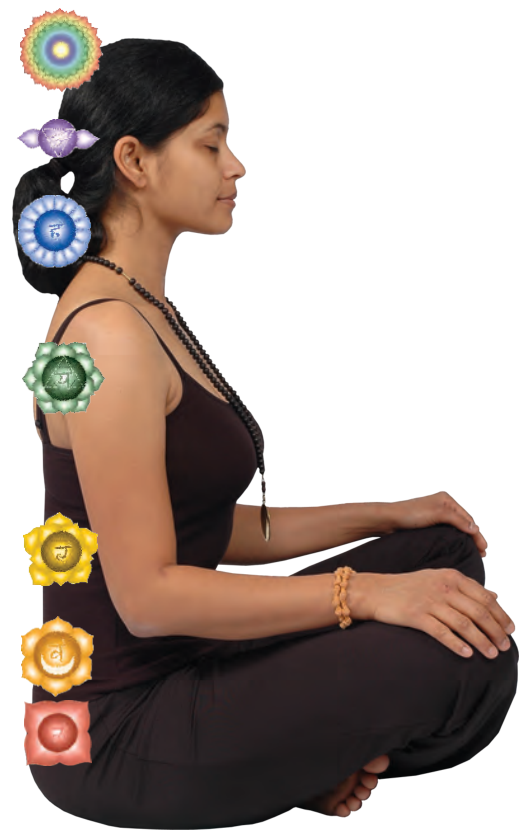
In this step we can continue to sit in vajrasana or sit crossed-legged if that is more comfortable. In this part of the meditation, we will put our awareness on each chakra (energy center) starting from the muladhara chakra (root center) to the sabasrara chakra (crown center).
We have seven energy centers in our body
and we need to understand the meta-
physical location of these seven energy
centers.
Our personality is made up of three bodies or shariras. The physical body (sthul sharira), mental body (sukshma sharira) and the causal body (karana sharira). Similarly there are three states of consciousness. The waking state, the dream state and deep sleep. Beyond these three bodies and the three states of consciousness lies the true self or Atman, whatever you may choose to call. In Sanskrit we call the supreme state as Sharira Traivalaxana, Panchakosha Teetha, Avastha Trya Sakshi (Witness of the three bodies, beyond the five sheaths and the witness of the three states of consciousness).
The physical body is the body that we know, which eats, moves etc in the waking state. The mental body is that we use when we dream. We might be lying in our house in the U.S.A however our mind may be in some other country. That time we are employing our mental body in the waking state as our faculty of thinking is going on continuously in the waking state. The causal body is that we use when we are in deep restful dreamless sleep. During the entire sleeping cycle there are phases when the mind becomes dormant and there are no thoughts. This is the time when we experience the causal body.
These three bodies are not separate as we may think. They are tightly coupled. Consider two curved lines drawn on a piece of paper in such a way that they intersect at seven different points. If one of the lines represent the physical body, the other line represents the subtle body and the paper represents the causal body, the
seven points at the physical body and the subtle body meet the causal body are the locations of the seven energy centers. These seven energy centers are present at the intersection of the physical, subtle and the causal body. They exist at a metaphysical plane. Some recent research in aura photography has been able to even photograph these energy centers.
These seven energy centers are associated to particular emotions in our Being. These emotions are a result of the engraved memories or samskaras which we have accumulated in the past. These samskaras block the particular energy center causing physical and mental disturbances. The samskaras are present in our being because of the absence of awareness.
When we flood awareness on these energy centers, the energy center starts becoming unblocked from negative emotions and then we start emitting positive emotions like love and compassion. Most of our diseases are psychosomatic. They have their roots in the mind. What we see is just the effect and so we never really understand this mind-body connection. When a particular energy center gets blocked, the part of the body near that energy center gets affected. We can see when we worry too much our stomach gets upset. It is important to keep the energy centers cleansed to promote mental health.
All of these emotions like fantasies, imaginations, fear, worry, attention need, jealousy, ego and discontentment have negative existence. If there is some object in the room and you are asked to take the object out of the room, you can pick up the object and take it out. In this case, the object has positive existence. However, let us say that there is a dark room and you are asked to take the darkness out of room. You cannot really take out the darkness because darkness has negative existence and therefore cannot be taken out. If we turn on a light however, the darkness will be removed automatically. All of these emotions have negative existence just like the darkness in the room and we cannot really take them out. What we have to do is bring in the light of awareness in our being and the negative emotions will disappear automatically.
Once Buddha tied a knot and asked one of his disciples to untie the knot. The disciple tried to pull the knot hard making the knot tighter. Then Buddha asked another disciple to untie the knot. This disciple first looked at the knot carefully. Then he slowly untied the knot. Buddha then explained that if you have to untie the knot of ignorance in your Being, you first have to learn to look carefully. You have to flood your Being with awareness and the negativity will be instantaneously obliterated.
In this step we will put our complete
awareness on each energy center starting
from the muladhara chakra to the
sahasrara chakra. This way, step by step
we move upwards, reaching the crown
center. We should become the energy
center when we are asked to put
awareness on the energy center. We
should feel the energy center completely
Part Four - 'BE UN-CLUTCHED'
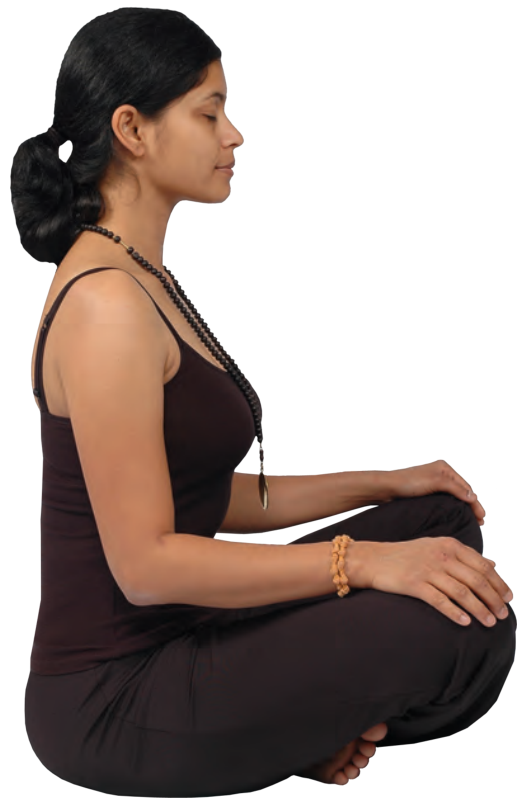
Just be un-clutched for the next seven minutes.
The mind is nothing but a collection of thoughts. One thought after the other coming in succession. By our very nature our thoughts are unconnected. They are like bubbles in a fish tank. The bubbles in the fish tank are not connected, they are distinctly separate. But they just appear to be connected. In a similar manner our thoughts are not connected though they appear to be connected.
You can try this small exercise. Sit for ten minutes silently and simply start recording your thoughts. Write down all your thoughts as and when they come. Don't try to control or stop thinking. Just be silent and witness the thoughts coming. The moment a thought comes quickly write it down on paper. Do this for ten minutes. At the end of ten minutes read out whatever is written. You will see that it's a mad man's diary. There is utter chaos. There is no connection between the previous thought and the next thought. All the thoughts are un-clutched and unconnected. Only when you write down your thoughts you come to know that the thoughts have no real connection. You may be thinking about having a cup of coffee and the next moment you may think about some office work, which is pending. There is no real connection between having a cup of tea and the office work. Both are independent events. Even if there are two consecutive thoughts about the same event the thoughts are unconnected as there is no continuity. There is always a gap between these thoughts.
There is a time of silence between the thoughts. The thoughts by their very nature are un-clutched. The problem happens when we connect these thoughts. We connect these unconnected thoughts and suffer. For example; we might have eaten ice cream ten years ago, we might have eaten ice cream two years ago and we might have eaten ice cream yesterday. All these experiences might have been very pleasurable for us. We might have enjoyed the ice cream each time we ate. The trouble is that we connect these experiences and create an imaginary shaft or an understanding that eating ice cream makes us happy. So we try to repeat this experience in the future. We always connect similar thoughts and create a shaft. It might be our experience that sometimes we don't enjoy the ice cream as much as we enjoyed it some days ago or a year ago. Even if we don't enjoy the ice cream we will make ourselves believe that we like the ice cream. Because we have got into the habit of connecting the thoughts; we unconsciously start accepting that we enjoy ice cream.
Similar is the case with painful experiences. The pain which we experienced ten years ago, the pain which we experienced seven years ago, the pain which we experienced three years ago and the pain which we experienced yesterday are independent events. There is no connection between these events. But we create an imaginary shaft and start thinking that our life is a pain. If we have had many pleasurable experiences in our life we say that our life is a pleasure. But actually neither of it is true. Our life is neither pleasure nor pain because the very process of connecting these events is a mistake. The idea that the thoughts are connected is a misconception. And that too we don't connect all the thoughts. We connect only those thoughts that we remember and create the shaft. Just as from a bunch of flowers we pick up few flowers and create a garland, from millions of
[footer: THE NITHYA YOGA PRACTICE]
give to this process of creating a shaft. A sense of continuity is created because of this shaft. This gives us the illusion of the ego.
Right now, all of our thoughts clutch because we think that we have an ego. All of our thoughts by their very nature are independent so the idea of the ego is also imaginary as there cannot be anything connecting these thoughts. So by our very nature we are un-clutched. We are enlightened and just we have to realize it.
Once a disciple goes to a Zen master and asks him 'how can I become Buddha?' The master gives him a tight slap on his face and says that you are already a Buddha. If Buddha comes and asks you that how should he become Buddha what would be your reaction? Same is the reaction of the Zen master. We are un-clutched by our very nature however, this just needs to be understood.
A person based on one's destiny experiences pleasure and pain. We don't have a choice. We cannot choose either pleasure or pain. But we have the choice of not connecting these experiences and creating imaginary shafts. We are attached to a person or a thing because we create shafts. The relationship, which you experienced three years ago, the relationship, which you experienced a year ago and the relationship which you are experiencing now are independent events. The moment we connect these events, we are trying to extend or break the shaft. If the relationship is a pleasurable relationship, we expect the relationship to be pleasurable even in the future. If the relationship is a painful relationship we try to break the relationship or we create an idea that the relationship is not good for us. What we don't realize is that at each instant we are experiencing a new relationship. Because at each instant two new people are associating as by our very nature we are unclutched. The real problem is not caused because of pleasure or pain. The real problem is caused due to our incorrect understanding of both and eventually the creation of imaginary shafts. In the case of a sage, if there is pleasure he will enjoy the pleasure and forget it. If there is pain, he will suffer the pain and forget it. He does not carry these experiences in horizontal time. The moment we carry an experience in horizontal time we suffer.
We can experience life living in this world and still be centered in peace and harmony. There is no need to renounce anything external. The smaller self has to be renounced. Once we stop creating these shafts, we will realize that the identity, which we were trying to hold on to, was the very reason for suffering.
The moment we drop that identity, we enter into bliss, then the outer incidents won't affect us because we have given up the habit of connecting these incidents. Every incident is a new incident for us and we start seeing life in a much more beautiful way. Everything seems joyful and blissful. We stop taking things for granted.
Once we start accepting life from moment to moment, bliss happens to us naturally. External circumstances can impact us only if you allow them to. Nobody can disturb us without our silent permission. People complain that we may live our life in the moment but if others around don't, they will exploit us. We should be very clear that nobody can exploit us or disturb us without our silent permission. Once we understand that we are un-clutched, bliss naturally follows.
Sankara says in Nirvanashatkam 'sada me samatvam na muktir na bandbah, chidananda roopa shivoham shivoham', 'I am neither in bondage nor liberated, I am always in the state of equilibrium. I am of the nature of pure auspiciousness, the energy of Shiva.' Both bondage and liberation are concepts created by the mind. Liberation exists as long as there is bondage however, if there is no bondage, liberation will also loose its meaning. That is what Sanakara is referring to. If we are trying to go inward or outward, as long as we are going somewhere we are missing the truth. The very process of traveling or going takes us away from the truth. Truth is here and now and there is no need to go anywhere and no need to travel anywhere. Again, the very process of traveling shows that we have created a shaft. We are seeing some progress. There cannot be any progress, because there is nobody who is progressing. The individual is dying at every instant. Then who will progress?
When we are un-clutched, automatically we will explode in 360°. Then the question of being material or being spiritual won't arise. Sankara says that he is neither in bondage nor liberated. He has gone beyond both and both are just concepts. Our self can never be improved. Some people work on self development. What self will you develop? Is there a self to be developed in the first place? A sequence of un-clutched thoughts is all that we are. If we try to develop the self all you would end up doing is to create a shaft of the idea that my self is developed. It will give you a good feeling. There might be one thought that thinks that the self is developed. But it's merely a feel good feeling. Really speaking the self cannot be developed, the imaginary self can only be eliminated. As long as we are trying to develop the self, we are creating a shaft.
As long as the mind is present the identification with the unreal continues. Sankara says that 'Brahma satya jagat mithya, jivo brahmaiva na aparah' which means that 'Brahman is real, the world is unreal and the individual soul is non-different from Brahman.' What he means here is that only when the mind ceases to exist, the Brahman shines forth. The reality shines in its own glory. As long as there is mind, there are thoughts. Thoughts always hover in the past or the future. There can never be a thought about the present. In the present there can only be consciousness. So as long as thoughts are present we will continue to create shafts. We will connect these thoughts and create imaginary shafts of either pleasure or pain.
The moment a shaft is created there is identification with the unreal. The reason is that we connect these unconnected thoughts. The very process of connecting thoughts is reason for misery in this samsara sagara (world). Because we connect thoughts, the imaginary identity (which Sankara calls as Jiva) comes into existence. When the Jiva appears the world of mithya (made of unreal) appears. When we un-clutch automatically the false identity disappears and the Brahman consciousness is revealed.
We have two types of identities. One is the identity that we show to the outer world and other is the identity that we show to the inner world. The identity that we show to the outer world is called ahankar. The identity, which we show to the inner world, is called as mamakar. Both of these identities are in constant conflict with each other. For e.g. outwardly we may project that we are such and such person but inwardly we know that we are lacking in someway or the other. There is always a discrepancy between these two identities. The identity, which we project to the outer world, is always more than what we actually are. A person always tries to prove superior in front of others. Identity, which we project to ourselves, is always less than what we actually are. You might have observed that we are never satisfied with our own selves. Constantly we are trying to improve ourselves in some way or the other. Either we are dissatisfied spiritually or we are dissatisfied materially.
This inner identity that we carry always lacks something and the outer identity that we carry always exceeds the normal. Hence both these identities are always in conflict. That is the reason we have to be very careful when we talk because we rarely talk what we think. If we start directly reproducing our thoughts into words people around us will start running away from us.
Ramakrishna used to say that bringing your thoughts and words together is true spirituality. That will happen when we go beyond these two identities. Both of these identities are false identities. These identities are a result of the shaft we create. They don't exist in reality. As long as we are associating with these identities we are caught up in samsara. Once we go beyond these two identities, we become enlightened. All the time we are creating, sustaining and destroying thoughts. The process of creation (Brahma), sustenance (Visbnu) and destruction (Mahesh) is constantly going on. When we stop creating, sustaining and destroying, we go
Part Five - Listen to the Guru Pooja Mantra
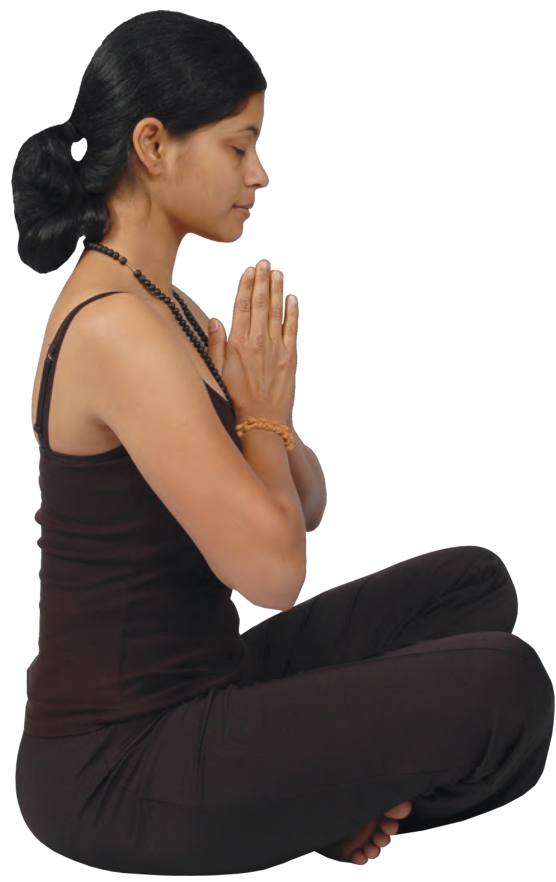
In the final step, we just sit silently with a blissful mood and listen to the mantra chanting. We should just feel connected to existence and feel the vibrations of the powerful mantra within our being.
The mantra are a way to express gratitude to existence or the Master for endowing upon us this great wisdom, which liberates us from ignorance and helps us attain the state of eternal bliss, Nithyananda.
If you are interested in rituals, you can also perform the guru pooja (offering gratitude to the Master) in this step by yourself reciting the mantra and performing the ritual.
If you are not interested in rituals, you can just be silent and listen to the mantra. Even by just listening to the mantra it would do you immense good. Mantra carry vibrations, which can transform your Being to make it more pure and blissful.