CURE FOR ARTHRITIS
This text was machine-transcribed from the printed book and may contain errors. Select the words and choose “Report a mistake”.
Disease Description
Arthritis is a form of joint disorder that involves inflammation of one or more joints.
There are over 100 different forms of arthritis. The most common form, osteoarthritis (degenerative joint disease), is a result of trauma to the joint, infection of the joint, or age. Other arthritis forms are rheumatoid arthritis, gout, psoriatic arthritis, and related autoimmune diseases. Septic arthritis is caused by joint infection.
The major complaint by individuals who have arthritis is joint pain. Pain is often a constant and may be localized to the joint affected. The pain from arthritis is due to inflammation that occurs around the joint, damage to the joint from disease, daily wear and tear of joint, muscle strains caused by forceful movements against stiff, painful joints and fatigue. Arthritic disorders like lupus and rheumatoid can also affect other organs in the body with a variety of symptoms like inability to use the hand or walk, feeling of tiredness, fever, weight loss, muscle aches and pains, tenderness.
Arthritis can make it very difficult for the individual to remain physically active, contributing to an increased risk of obesity, high cholesterol or vulnerability to heart disease. Individuals with arthritis are also at increased risk of depression, which may be related to fear of worsening symptoms.
STEPS TO BE FOLLOWED
- ARDHA PADMA ASANA
- BHOOTA SHUDDHI KUMBHAKA
- BHRAAMAREE KUMBHAKA
- ANTARANGA KUMBHAKA
- BHASTRIKAA KUMBHAKA
1. ARDHA PADMA ASANA Practising Padma asana half way through is called Ardha PADMA ASANA
हठप्रदीपिका उपदेशं २ स्लोक ३१-३३
उत्तानौ चरणौ कृत्वा चोरु संस्थौ प्रयत्नतः ।
ऊरुमध्ये ततोत्तानौ पाणी कृत्वा तु तादृशौ ॥
दृष्टिं विन्यस्य नासाग्रे दन्तमूलं च जिह्वया ।
उत्तप्य चिबुकं वक्षस्युत्ताप्य भवनं शनैः ॥
इदं पद्मासनं प्रोक्तं सर्व व्याधि विनाशनम ।
दुर्लभं येन केनापि धीमता लभ्यते भुवि ॥
Uththanau Charanau Kruthvaa choru-Samsthau Prayathnathaha |
Oorumadhye Thathoththaanau Paanee Kruthvaa Thu thaadrushau ||2.31||
Drushtim vinyasya naasaagre Dantamoolam cha jihvayaa |
Uttapya chibukam vakshas Yuttaapya bhavanam shanaihi ||2.32||
Idham Padmaasanam Proktham Sarva-Vyaadhi-Vinaashanam |
Durlabham yena kenapi Dheemataa labhyate bhuvi ||2.33||
TRANSLATION
One should with effort place the upward facing feet on the thighs, and place the upward-facing palms between the thighs.
Concentrating on the tip of the nose, keep the tongue pressed on the upper teeth, press the chin on your chest, push the air slowly upward, that is slowly pull the prana upward.
This asana called as Padma asana destroys all diseases, filled with power. Though difficult to be obtained by everyone, some intelligent people learn it.
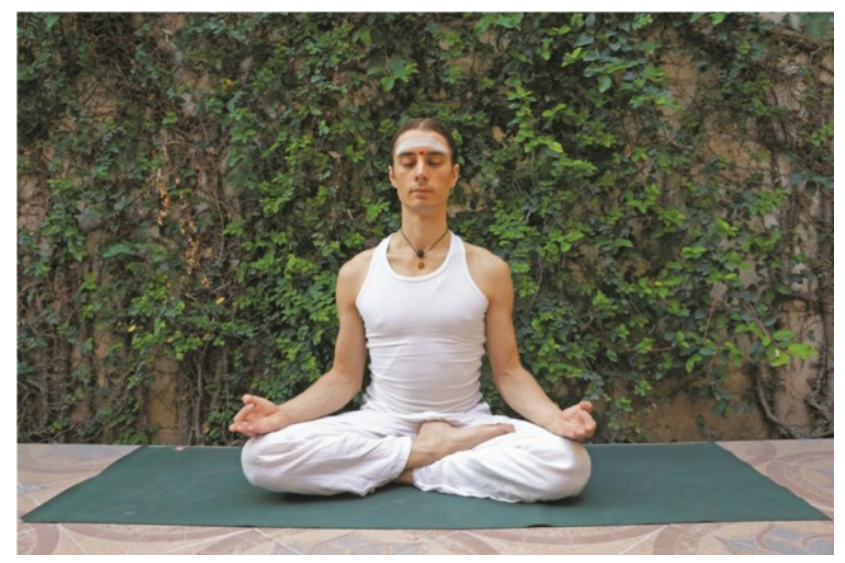
TECHNIQUE for Ardha PADMA ASANA
- Place the right foot on the left thigh
- Now Place the left foot under the right thigh
- Concentrate on the tip of the nose. Keep your hands on your thighs in chin mudra
- Settle in this posture for 30 seconds
IN ARDHA PADMA ASANA, NEXT –
2. BHOOTA SHUDDHI KUMBHAKA
KUMBHAKA PADDHATI, VERSES: 153-157
टभभऋभभ थभभन्नठहृशभमभद्रश्न धरभद्द्रयभभिद्र्थथमथर्यभिद्र म्द्रह्रटपभम्म्रह्र ञ ऋभद्रऋभशभस्व्रभचभम्प्रह्र मभन्नभर्ऋह्रभ्र टभभऋभभम्द्रह्रटपभम् ध्मटभद्धद्भिभ्र ॥
टभभऋभभम्द्रह्रटपभम्र द्यद्धस्म्प्रह्रारिभ् शभमन्नथभम्म्ह्रा ध्मटमभव्रम्ह्रारूिमिश्रभ्रि ञ स्मथ्ह्ललभमन्न लभभद्रपमद्यभत्रद्यजभभलभभन्न टभभऋभभम्द्रह्रटपभभन्न मभव्रम्ह्रारूिमिश्रभ्रि ॥
धुभमद्धकभन्नलभभ्रुद्धाम्रभभरभत्र मसमभुभलभभश्च्ट्टभ्रभिधमन्नचभलभ्र ञ टभद्रसभभकमभून्न म्प्रहाभिन्नभभरभत्र म्ह्मद्रस्द्धलभद्धम्भूह्मभभन्न टभभि्र ञज
मभद्धल्लभ्र म्हारूव्हलभभ्रुद्धामभन्न मभगचमु्रभद्रथ्ह्लम्र धरमभभिन्न ध्म म्द्रह्रटपभम्हा्र।
खभव्रङ्गधजमभलभद्धलभभरमभ्नाम्रन्नलभ टभ्द्रद्धह्लस्त्र मभव्रम्ह्रारूिमिश्रभ्रि ॥
रुध्वा घोनायुगं कुर्याद्युगपद्यदि षट्क्रमात् ।
भूतशुद्धिरिति प्रोक्त आदिनाथेन शम्भुना ॥
Maatraa shodashapoore syushcatushshashtyastu kumbhake |
Dvaatrimshadrechake prktaah maatraakumbhaha sameeritaha || 153 ||
Maatraakumbho hrudikritaha shoshakah samprakeertitah |
Daahano naabhisamsthaano maatraakumbho prakeertitah || 154 ||
Svaadhishtaanugashchaayam plaavano(a)mrutasechanah |
Moolaadhaare krutashchaayam katineekarano matah || 155 ||
Punah kantanugo panja vyoohanah syat sa kumbhaka |
Brahmasthaananiyogena muktitah parikeerthitah || 156 ||
RudhvaaGhonaayugamKuryaath YugapadyadiShatkramaath |
Bhootha-ShuddhirithiProkthaha AadhinaathenaShambhunaa ||157||
TRANSLATION
Inhale upto 16 matras, retain the breath inside for four times that time and then release the breath with the time of 32 matras (153)
When you practise this matra kumbhaka in your heart center it merges you in a state beyond the body consciousness, when you practise it in the navel center it creates heat (154)
When you practise it in the svadhistana center it increases the flow of nectar and when practised in the muladhara center the person gains stable temperament (155)
When practised in the throat center the five elements in the body become balanced; when practised in the eyebrow center it takes one to the state of liberation (156)
When both the nostrils are closed and the kumbhaka is practised in the six centers one by one, it is called Bhutashuddhi Kumbhaka as explained by Adinatha Shambhu – Shiva. (157)
TECHNIQUE
- Inhale (for 16 matras)
- Hold the breath (for 64 matras)and retain the awareness at the same time in your heart, navel, svadishtana, muladhara, throat center and the eyebrow center
- Exhale (in 32 matras)
- Do this 7 minutes
IN ARDHA PADMA ASANA, NEXT –
3. BHRAAMAREE KUMBHAKA
KUMBHAKA PADDHATI, VERSE: 169
अलिशब्दयुतं वेगात् पूरयेत् कुम्भयेत्ततः।
सालिशब्दाच्छनै रेकात् भ्रामरीकुम्भको मुनेः॥
Alishabdhayutham Vegaath Poorayeth Kumbhayeth-Thathaha |
SaalishabdhaathShanai Rekaath Bhraamareekumbhako Munehe ||169||
TRANSLATION One should inhale rapidly producing the sound of male bee, then hold and then exhale slowly with the sound of female bee. This is called Bhraamaree Kumbhaka.
TECHNIQUE
- Inhale rapidly with the sound ‘mmm’ of a bee
- Hold
- Exhale steadily and slowly with the sound of a ‘mmm’ of a bee
- Do this 21 times
(you have to take something to eat within 10-15 minutes after doing this kumbhaka)
IN ARDHA PADMA ASANA, NEXT –
4. ANTARANGA KUMBHAKA
KUMBHAKA PADDHATI, VERSE: 168
सकृद् रेचपूरा यां कुम्भोऽयं चान्तूङ्ग्हम्म्ञ्
Sakrud-Rechapoorabhyaam Kumbho'yamChaantharangakaha ||168||
TRANSLATION Retention of breath suddenly after inhalation and exhalation is called Antaranga Kumbhaka.
TECHNIQUE
- Hold the breath outside after suddenly exhaling
- Then Hold the breath inside after suddenly inhaling
- Do this 21 times
IN ARDHA PADMA ASANA, NEXT –
5. BHASTRIKAA
GHERANDA SAMHITA, UPADESHA-5, VERSES 75- 77
॥ अथ भस्त्रिकाकुम्भकः ॥
भस्त्रैव लोहकाराणां यथाक्रमेण संभ्रमेत्।
तथा वायुम् च लभभधभभपरभभटभद्द्पभभपरभभत्र चालयेच्छनैः ॥
एवंविम्शतिवारं च कृत्वा कुर्यांच कुम्भकम्।
तदन्ते चालयेद्वायुं पूर्वोक्तं च यथाविधि ॥
त्रिवारं साधयेदेनं भस्त्रिकाकुम्भकं सुधीः।
न च रोगो न च क्लेश आरोग्यं च दिने दिने ॥
Bhastraiva lohakaaraanaam Yathaa-kramena sambhramet | Tathaa vaayum cha naasaabhyaam Ubhaabhyaam Chaalayet shanaihi || 5.75 ||
Vimshati-vaaram Cha Krutvaa Kuryaachcha Kumbhakam | Tadante Chaalayet Vaayum Poorvoktam Cha Yathaavidhi || 5.76 ||
Trivaaram SaadhayetEnam Bhastrikaa-Kumbhakam Sudheehi | Na Cha Rogo Na Cha Klesha Aarogyam Cha Dhine Dhine || 5.77 ||
TRANSLATION
As the bellows of the ironsmith constantly dilate and contract, similarly let him slowly draw in the air by both the nostrils and expand the stomach; then exhale slowly.
Having thus inhaled and exhaled twenty times as stated above, perform Kumbhaka and then let throw it out quickly (the wind making sound like bellows). This completes one round of Bhastrikaa. Let the wise one perform this Bhastrikaa Kumbhaka thrice; he will will never suffer any disease and will be always healthy.
TECHNIQUE
- Inhale slowly expanding the stomach
- Exhale slowly
- Do this 21 times
- After 21 times, now inhale slowly
- Hold the breath as long as you can
- When you feel you can't hold quickly expel the air with the sound of bellows. At this moment the stomach should contract to touch the back (This is one Bhastrikaa)
- Do this complete sequence three times
END OF KRIYA
Kriya Date 02-Dec-2011