CARE FOR ASTHMA
This text was machine-transcribed from the printed book and may contain errors. Select the words and choose “Report a mistake”.
Disease Description
Asthma is the common chronic inflammatory disease of the airways characterized by variable and recurring symptoms, reversible airflow obstruction, and bronchospasm. Symptoms include wheezing, coughing, chest tightness, and shortness of breath.
Asthma is clinically classified according to the frequency of symptoms, forced expiratory volume in 1 second (FEV1), and peak expiratory flow rate. Asthma may also be classified as atopic (extrinsic) or non-atopic (intrinsic). It is thought to be caused by a combination of genetic and environmental factors.
Treatment of acute symptoms is usually with an inhaled short-acting beta-2 agonist (such as salbutamol). Symptoms can be prevented by avoiding triggers, such as allergens and irritants, and by inhaling corticosteroids. Leukotriene antagonists are less effective than corticosteroids and thus less preferred. Its diagnosis is usually made based on the pattern of symptoms and/or response to therapy over time.
The prevalence of asthma has increased significantly since the 1970s. As of 2010, 300 million people were affected worldwide. In 2009 asthma caused 250,000 deaths globally.
STEPS TO BE FOLLOWED
- SIDDHAASANA
- NAAGA KUMBHAKA
- TRINETRA KUMBHAKA
- TRISHOOLA KUMBHAKA
- KOORMA KUMBHAKA
- SAMA KUMBHAKA
1. SIDDHAASANA,
अथ सिद्धासनं
योनिस्यानकमङ्घ्रिमूल घटितं संपीड्य गुल्फेतरं
मेढ्रोपर्यथ सन्निधाय चिबुकं कृत्वा हृदि स्थापितं ।
स्थाणुः संयमितेन्द्रियोऽचल दृशा पश्यन् भ्रुवोरन्तरम्
एतन्मोक्षकपाटभेदनकरं सिद्धासनं प्रोच्यते ॥
Yonisthaanamanghri moola gatitam sampeedya gulphetaram
Medroparyatha sannidhaapya chibukam kritvaa hrudi sthaapitam | Sthaanuh samyamitendriyo'cala drushaa pashyan bhruvorantaram Etanmokshakapaata bhedanakaram siddhaasanam procyate ||
TRANSLATION The practitioner who has subdued his passion, having placed one heel at the anal aperture should keep the other heel on the root of the generative organ; afterwards he should affix his chin upon the chest, and being quiet and straight, gaze at the spot between the two eye-brows. This is called the Siddhasana and leads to emancipation.
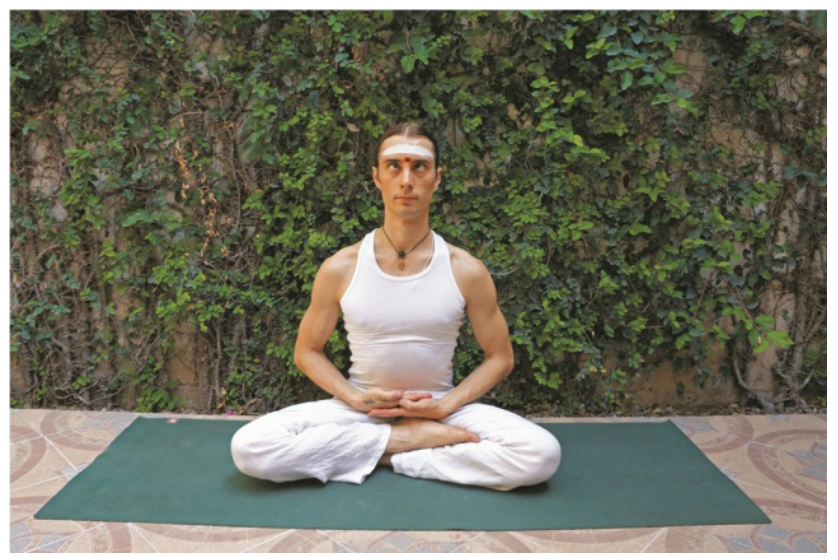
TECHNIQUE
- One heel should be placed in the space between the genitals and anus and the other heel should be placed on the genitals.
- The chin should be placed on the chest.
- Keep the backbone straight
- Gaze through the third eye .
- Maintain the pose for 30 seconds
IN SIDDHA ASANA, NEXT
2. NAAGA KUMBHAKA KUMBHAKA PADDHATHI, VERSES: 77 & 78
ओदनग्रासवद्वायुं कण्ठेनापूरयेच्छनैः।
तं रोधयेद्यथाकालं बध्वा जालन्धरं दृढम्॥
कण्ठेन रेचनं कुर्यात् नागकुम्भः शिवोदितः।
क्षुधां जयेत् पिपासां च फलमस्य समीरितम्॥
Odhana-Graasavath-Vaayum Kantena-Aapoorayeth Shanaihi |
Tham RodhayethYathaa-Kaalam Badhvaa Jaalandharam Dhrudam ||77||
Kantena Rechanam Kuryaath NaagaKumbhaha Shivodithaha |
Kshudhaam Jayeth Pipaasaam Cha Phalamasya Sameeritham || 78 ||
TRANSLATION One should fill the air slowly into the throat like swallowing a morsel of rice and should retain it for maximum possible time, with firm application of Jaalandhara Bandha and then should exhale it from the throat. This is Naaga kumbhaka explained by Shiva. By this practice one is able to win over hunger and thirst.
TECHNIQUE
- Swallow air very slowly and let the air go little by little like eating rice morsel by morsel.
- Once you are full, immediately contract the throat, place the chin on the chest
- Hold the breath in this posture as long as possible
- Then release the lock and exhale slowly from the throat
- Do this 21 times
IN SIDDHA ASANA, NEXT
3. TRINETRA KUMBHAKA
KUMBHAKA PADDHATHI, VERSE: 192
सकृच्चन्द्रेण चापूर्य धार्यं सूर्येण पूरयेत् ।
नियम्य पूरयेन्नो यां धारयित्वा यथाविधि ॥
त्रिनेत्रकुम्भकः प्रोक्तः त्रिनेत्रेण त्रिसिद्धिदः ॥
SakruthChandrenaChaapoorya DhaaryaSooryenaPoorayeth | NiyamyaPoorayennobhyaam DhaarayithvaaYathaa-Vidhi || Thrinethra-KumbhakahaProkthaha ThrinethrenaThrisiddhidhaha ||
TRANSLATION Inhale through the left nostril and retain, inhale through the right nostril and retain and then inhale through both the nostrils, retain the breath (all these in one shot before exhalation). This is the Trinetra Kumbhaka – the giver of three siddhis – as explained by the three-eyed Shiva.
TECHNIQUE
- Inhale through the left nostril
- Hold the breath as long as you can judiciously
- With out exhalation, inhale through the right nostril
- Hold the breath as long as you can judiciously
- Again without exhaling, inhale through both the nostrils
- Hold the breath as long as you can judiciously
- Now exhale through both the nostrils slowly 8. Do this 21 times
IN SIDDHA ASANA, NEXT
4. TRISHOOLA KUMBHAКА
KUMBHAKA PADDHATHI, VERSE: 193
घोणा यां च मुखेनापि युगपत् पूरयेत् सदा ।
त्रिशूलिना त्रिशूलाख्यः कुम्भ उक्तस्त्रिशूलनुत् ॥
Ghonaabhyaam Cha Mukhenaapi YugapathPoorayethSadhaa |
ThrishoolinaaTrishoolaakhyaha KumbhaUkthas-Trishoolanuth ||193||
TRANSLATION Always inhale through the nostrils and mouth together at a time. This is called the Trishoola Kumbhaka – the remover of triple sufferings – as explained by the Thrishooli Shiva.
TECHNIQUE
- Inhale through the nostrils and also through the mouth simultaneously
- Hold the breath as long as you can judiciously
- Now exhale through the nostrils slowly and relax
- Do this 21 times
IN SIDDHA ASANA, NEXT
5. - KOORMA KUMBHAКА
KUMBHAKA PADDHATHI, VERSE: 79
निमीलोन्मीलने त्यक्त्वा पीठे काष्ठमिव स्थितिः ।
नेत्रयोश्च शरीरस्य कूर्मकुम्भः स उच्यते ॥
Nimeelon’meelaneThyakthvaa PeeteKaashtam Iva Sthithihi |
Nethrayoshcha Shareerasya Koormakumbhaha Sa Uchyathe ||79||
TRANSLATION Having stopped the blinking of eyes, (the kumbhka that happens) when the eye balls and body are perfectly steady without any movements, like a log of wood, is called Koorma Kumbhaka.
TECHNIQUE
1. Continue to be seated in the same asana
- Fix your sight at one point and stare
- Do not blink your eyes
- Do not allow your eye balls to move.
- Do not move your body.
- While you stare intensely, automatically the breathing will stop. Hold the breath as long as you can.
- When you can't hold anymore, relax
- Then again stare
- Do this 21 times.
IN SIDDHA ASANA, NEXT
6. SAMA KUMBHAKA, KUMBHAKA PADDHATI, VERSE: 99
आरेकपूरतमनसा ना यादाशुगं धृतिः।
समः कुम्भो भगवता प्रोक्तः श्रीचन्द्रमोलिना ॥
Aarekapooraa-Manasaa Naabhyaadhaashugam Dhruthihi | Samaha Kumbho Bhagavathaa Prokthaha ShreeChandramoulinaa ||99|
TRANSLATION Mentally holding the breath in places like navel without actually inhaling and exhaling is called Sama Kumbhaka by Sri Chandramouli Shiva.
TECHNIQUE
- Stop inhaling and exhaling
- Hold the breath and mentally retain the breath
- As you are holding bring your awareness to heart
- When you can not hold any more relax
- Do this 21 times
END OF KRIYA
Kriya Date
13-Feb-2012