CARE FOR HOT FLASHES IN MENOPAUSE
This text was machine-transcribed from the printed book and may contain errors. Select the words and choose “Report a mistake”.
Disease Description
Hot flashes (also known as hot flushes, or night sweats if they happen at night) are a symptom of the changing hormone levels that are considered to be characteristic of menopause.
Hot flashes, a common symptom of menopause and pre-menopause, are typically experienced as a feeling of intense heat with sweating and rapid heartbeat, and may typically last from two to thirty minutes for each occurrence. The sensation of heat usually begins in the face or chest, although it may appear elsewhere such as the back of the neck, and it can spread throughout the whole body. Some women pass out if the effects are strong enough. In addition to being an internal sensation, the surface of the skin, especially on the face, becomes hot to the touch. This is the origin of the alternative term "hot flush," since the sensation of heat is often accompanied by visible reddening of the face. Excessive flushing can lead to rosacea.
The hot-flash event may be repeated a few times each week or constantly throughout the day, with the frequency reducing over time.[citation needed] Hot flashes may begin to appear several years before menopause starts and last for years afterwards. Some women undergoing menopause never have hot flashes. Others have mild or infrequent flashes. The worst sufferers experience dozens of hot flashes each day.
In addition, hot flashes are often more frequent and more intense during hot weather or in an overheated room, the surrounding heat apparently making the hot flashes themselves both more probable and more severe. Severe hot flashes can make it difficult to get a full night's sleep (often characterized as insomnia), which in turn can affect mood, impair concentration, and cause other physical problems. When hot flashes occur at night, they are called "night sweats." As estrogen is typically lowest at night, some women get night sweats without having any hot flashes during the daytime.
STEPS TO BE FOLLOWED
- BHAGA ASANA
- SAMA KUMBHAKA
- SHANTA KUMBHAKA
- GADAA KUMBHAKA
- UJJAAYEE KUMBHAKA
- SEETHKAAREE KUMBHAKA
1. BHAGA ASANA YOGAASANANAM, VERSES: 23 & 24
वामपार्ष्णौगुदं स्थाप्य दक्षाङि्घ्रं वामजघने ।
मध्यमातेभश्रलर्भुद्वह्वन्नभ्र नासादृष्टि श्रुतीः क्रमैः ॥
च्छाद्यजपेज्जिनं भ्रुवि मनोलात्वास्थिरं मनः ।
एवंविधासनं यत्र तत्र साधो भगासनम् ॥
Vaamapaarshnaugudam Sthaapya Dakshaanghrim Vaamajaghane | Madhyamaatarjanyagushtai Naasaadrishti Shruteeh Kramaih ||
Chchaadyajapejjinam Bhruvi Manolaatvaasthiram Manah | Evamvidhaasanam Yatra tatra Saadho Bhaga asana m ||
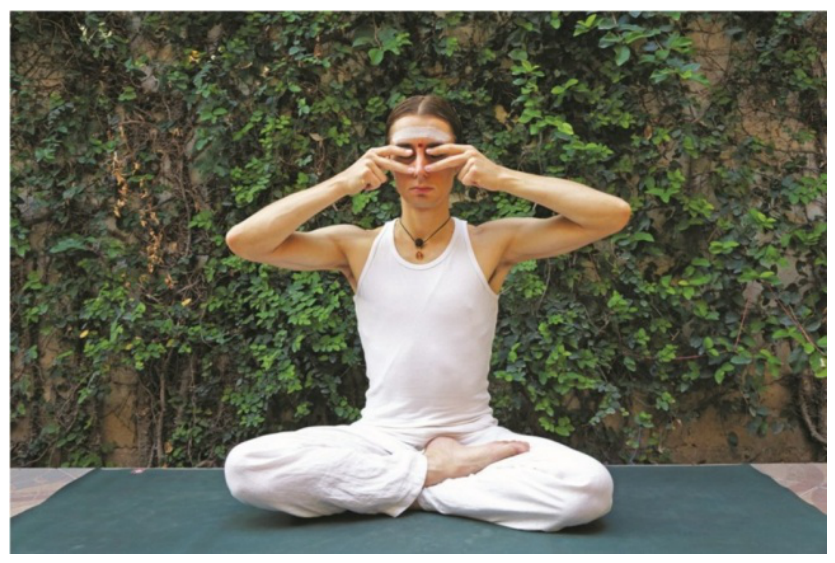
TRANSLATION-cum-TECHNIQUE
- Sit with left heel at the anus and right foot on the left thigh
- Close the eyes with index fingers, nose with middle fingers, and ears with thumbs
- Bring your awareness to the eye brow center
- Meditate on the Master or Deity
- Remain in this posture for 60 seconds
IN BHAGA ASANA, NEXT –
2. – SAMA KUMBHAKA, KUMBHAKA PADDHATI
VERSE: 99
आरेकपूरामनसा ना यादाशुगं धृतिः ।
समः कुम्भो भगवता प्रोक्तः श्रीचन्द्रमोलिना ॥
Aarekapooraa-Manasaa Naabhyaadhaashugam Dhruthihi | Samaha Kumbho Bhagavathaa Prokthaha ShreeChandramoulinaa ||99|
TRANSLATION Mentally holding the breath in places like navel without actually inhaling and exhaling is called Sama Kumbhaka by Sri Chandramouli Shiva.
TECHNIQUE
- Stop inhaling and exhaling
- Hold the breath and mentally retain the breath in throat
- When you can not hold any more relax
- Do this 21 times
IN BHAGA ASANA NEXT –
3. – SHANTHA KUMBHAKA KUMBHAKA PADDHATI, VERSE: 90
कायस्यान्तर्बहिर्व्याप्तिः शान्तकुम्भक उदाहृतः।
स्थानयोरन्तरे रुध्वा कुम्भयेद्यदि मारुतम् ॥
Kaayasyaanthar-Bahih-Vyaapthihi Shaantha-Kumbhaka Udhaahruthaha | Sthaanayoranthare Rudhvaa Kumbhayeth Yadhi Maarutham ||90||
TRANSLATION If the breath is restrained inside and visualized to be inside and outside the body, it is called Shanta Kumbhaka.
TECHNIQUE
- Hold the breath inside
- Visualize the breath inside and outside the body
- Hold as long as possible
- Relax when you can not hold any more
- Do this 21 times
In BHAGA ASANA NEXT
4. GADAA KUMBHAKA KUMBHAKA PADDHATHI, VERSE 112
उभा यां पूरणं यत्र रेचनं सूर्यवर्त्मना।
गदाकुम्भः शिवेनोक्तो योगिनो बलकारकः॥
Ubhaabhyaam Pooranam Yathra Rechanam Soorya-Vartmanaa| Gadaakumbhaha-Shivenoktho Yogino Balakaarakaha||112||
TRANSLATION
When the inhalation is performed through both the nostrils and exhalation through the right one, it is called Gadaakumbhaka explained by Shiva and strenghthener of Yogis.
TECHNIQUE
- Inhale through both the nostrils
- Hold the breath
- Exhale through the right nostril
- Do this 21 times
IN BHAGA ASANA NEXT
5. -UJJAAYEE KUMBHAKA
KUMBHAKA PADDHATHI, VERSES 131 & 132
मुखं नियम्य नाडी याम् आकृष्यासुं नियोजयेत् ।
कुण्डलीपाश्र्वयोः पश्चात् कुम्भयेदुदरस्थितम् ॥
रेचयेत् इडया वायुं गच्छन्तिष्ठन्यदा चरेत् ।
उज्जायीकुम्भकः प्रोक्तः शिवेनाखिलवेदिना ॥
Mukham Niyamya Naadeebhyaam Aakrushyaasum Niyojayeth | Kundalee-Paarshvayoho Pashchaath Kumbhayeth Udharasthitham ||131||
Rechayeth Idayaa Vaayum Gachchan Thishthan Yadhaa Chareth | Ujjaayee-Kumbhakaha Prokthaha Shivenaakhila-Vedhinaa ||132||
TRANSLATION
One should inhale through both the nostrils and closing the mouth and retain the breath along the Kundalini and exhale through the left nostril. This is the Ujjaayee Kumbhaka explained by Shiva.
TECHNIQUE
- Close your Mouth
- Inhale through both the nostrils
- Hold as long as you can judiciously
- Exhale slowly through the left nostril
- Do this 21 times
IN BHAGA ASANA NEXT
6. – SEETHKAAREE KUMBHAKA
KUMBHAKA PADDHATI, VERSES: 137&138
रसनामुन्मुखीकृत्य सीत्कारं कुर्वता मरुत्।
पीयन्ते कुम्भके यस्मिन् नासिका यां विरेचनम् ॥ १३७ ।
रसनां प्राणसंयुक्तां पीड्यमानां विचिन्तयेत्।
सीत्कारीकुम्भकः प्रोक्तः सर्वसिद्धिकरः सताम् ॥ १३८ ॥
Rasanaamunmukhee-Kruthya Seethkaaram Kurvathaa Maruth |
Peeyanthe Kumbhake Yasmin Naasikaabhyaam Virechanam ||137||
Rasaanaam Praana-Samyukthaam Peedyamaanaam Vichinthayeth |
Seethkaaree-Kumbhakaha Proktaha Sarva-Siddhikaraha Sathaam ||138||
TRANSLATION
Having turned the tongue upwards, inhaling the air by producing the sound "seeth(hiss)" (because of inhalation), hold the breath and then exhale through both the nostrils. Concentrate on the tongue and the sound created by the air. This is called Seethkaaree Kumbhaka – the bestower of great Siddhis to the sadhus.
TECHNIQUE
- Turn and Raise the tongue upwards
- Inhale the breath with a sound "seeth"(hiss) and be aware of the tongue and the hissing sound created by the air going in
- Hold the breath as long as you can judiciously
- Exhale through both the nostrils slowly
- Do this 21 times
END OF KRIYA
Kriya Date 13-Jan-2012