How Religious Persecution of Guru Tegh Bahadur
This text was machine-transcribed from the printed book and may contain errors. Select the words and choose “Report a mistake”.
destroyed the Mughal kingdom in 1600 AD
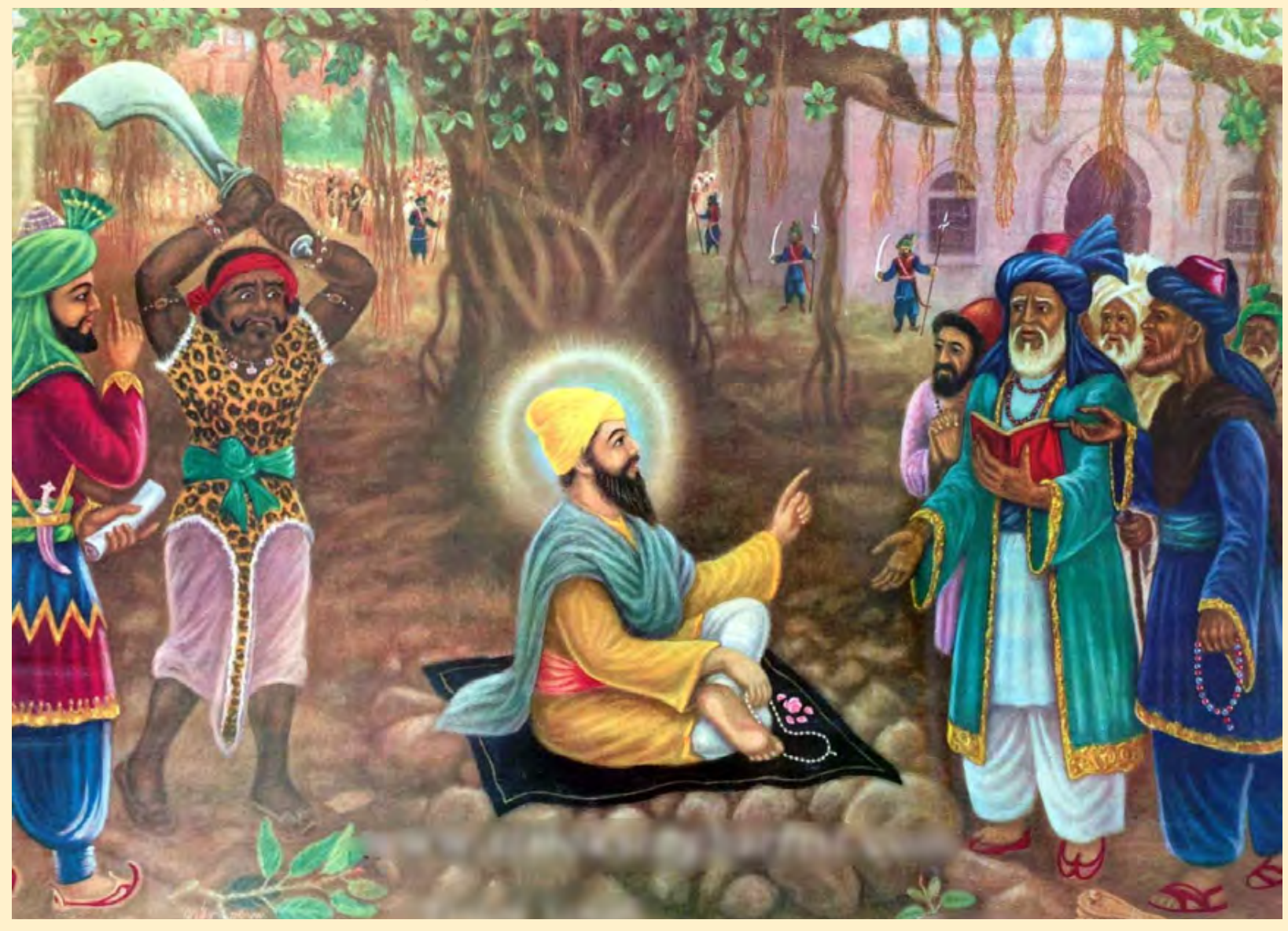
In the painting, the artist has depicted the execution (observed as martyrdom) of 9th Sikh Guru - Guru Teg Bahadur, while sitting under a Banyan tree near Kotwali in Delhi, conversing with Kazis (civil judge) to infuse courage and confidence in Sikh and Adi-Shaiva Hindu community to face the persecution boldly.
1600 AD : Mughal king Aurangzeb was terrorizing the common people, and forcibly converting Hindus and non-muslims to Mughal Religion. It included imposing of Jazia Tax on non-muslims to
Victims of persecution Adi-Shaivites seek help from Guru Tegh Bahadur
A deputation of Adi-Shaivites from Kashmir met the ninth Sikh Guru, Guru Tegh Bahadur seeking help. Guru Tegh Bahadur listened to their problems. It is said that the Guru felt only a supreme sacrifice made by a holy person could save them.
Why Guru decided to Sacrifice himself
The Mughal rulers believed that executing the Guru would instill fear in the population and they would decide to convert to the religion of the Mughal rulers. However just the reverse would happen, and Guru Tegh Bahadur already could see it happening. Guru Tegh Bahadur knew that a sacrifice by someone like Him would result in a huge antagonism against the barbaric rulers. Guru Tegh Bahadur knew he wouldn't be back alive and he performed the ceremony of naming His son, Gobind, who at that time was just a young boy, as his successor.
The Illegal Arrest
The Guru readied himself for the journey to Delhi. In the meantime, the Mughals arrested the Guru along with Bhai Mati Das, Bhai Sati Das, Bhai Dayal Das.
Mughal State gives 2 choices - Convert to our Mughal Religion or Die
As was usual with the Mughals, a choice was offered to the Guru and his companion between acceptance of Islam or death. When the Guru refused, the offer was converted to miracle or death.
Refusal results in disciple being cut into two slowly by a saw while alive
When Guru Tegh Bahadur refused Bhai Mati Das was sawn alive.
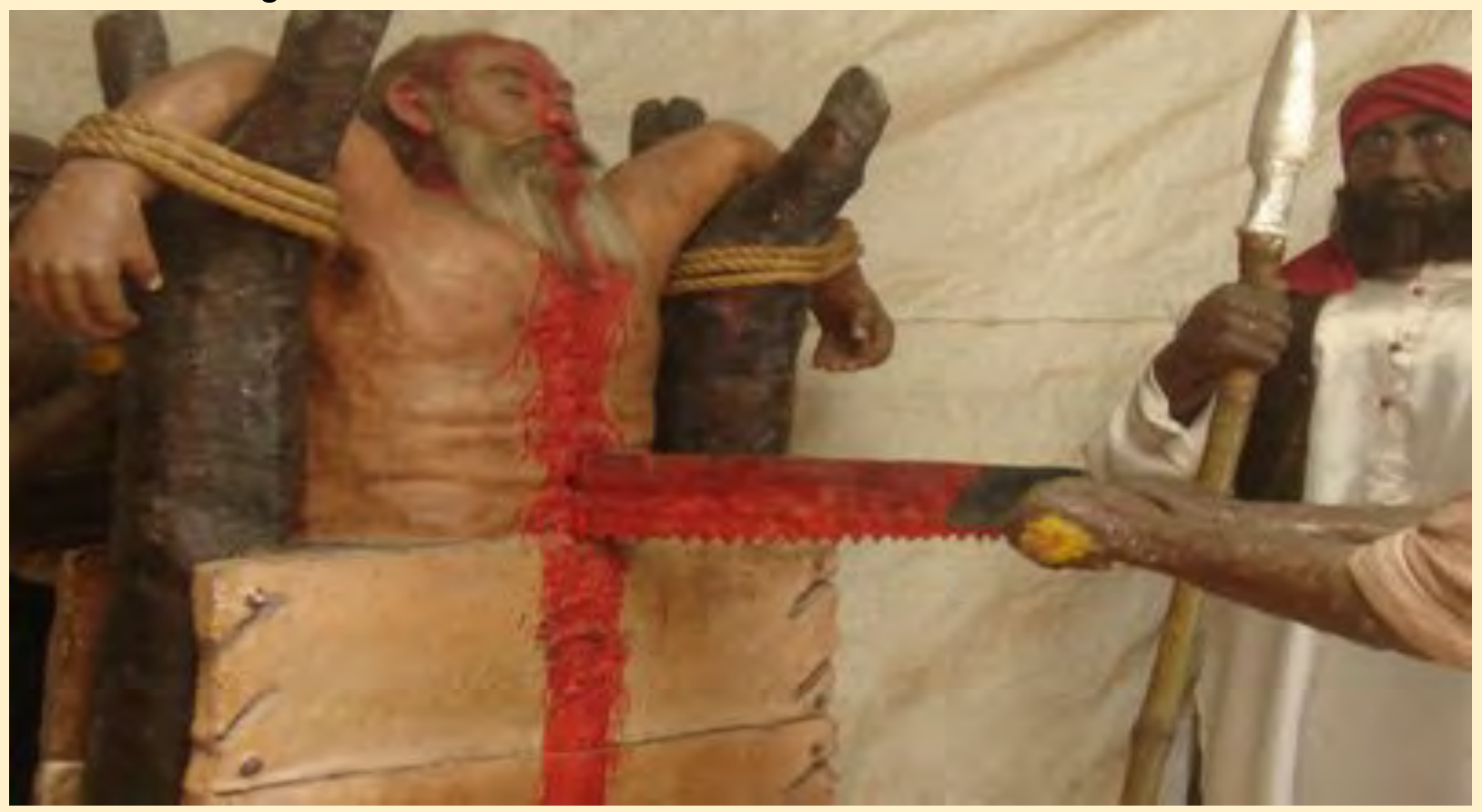
A model showing execution of Bhai Mati Das - Sikh Museum (situated at Balongi village, Punjab, India) as he refused to convert to one-ideology Islam.
Second refusal results in disciple being boiled to death
Guru Tegh Bahadur still refused, Bhai Dyala Das was boiled to death.
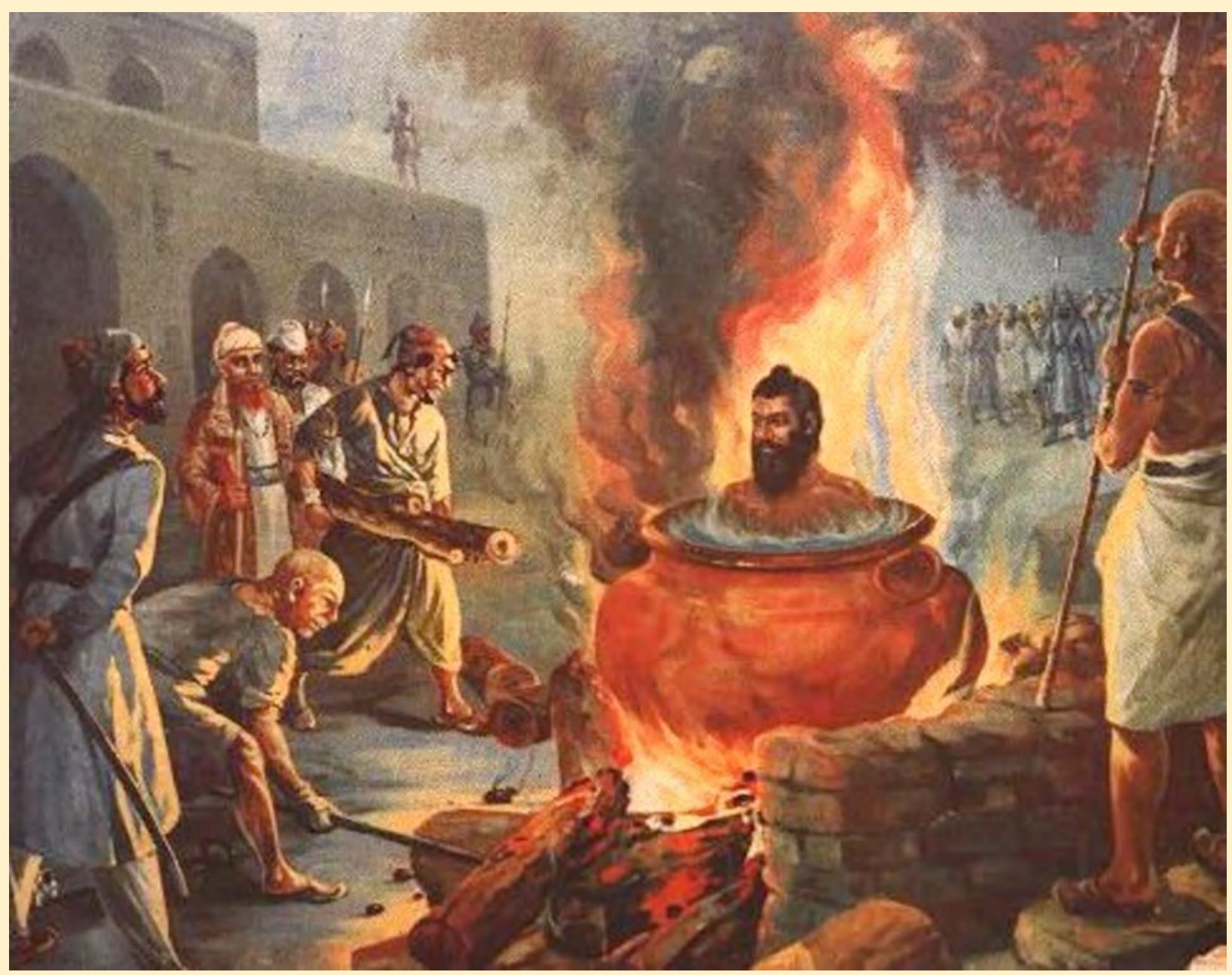
Picture depicting how Bhai Dyala Das was boiled to death as he and His Guru both refused to convert to one-ideology Islam.
Third refusal results in disciple being burnt alive
Guru Tegh Bahadur still refused, Bhai Sati Das was burnt to death wrapped all over with cotton.
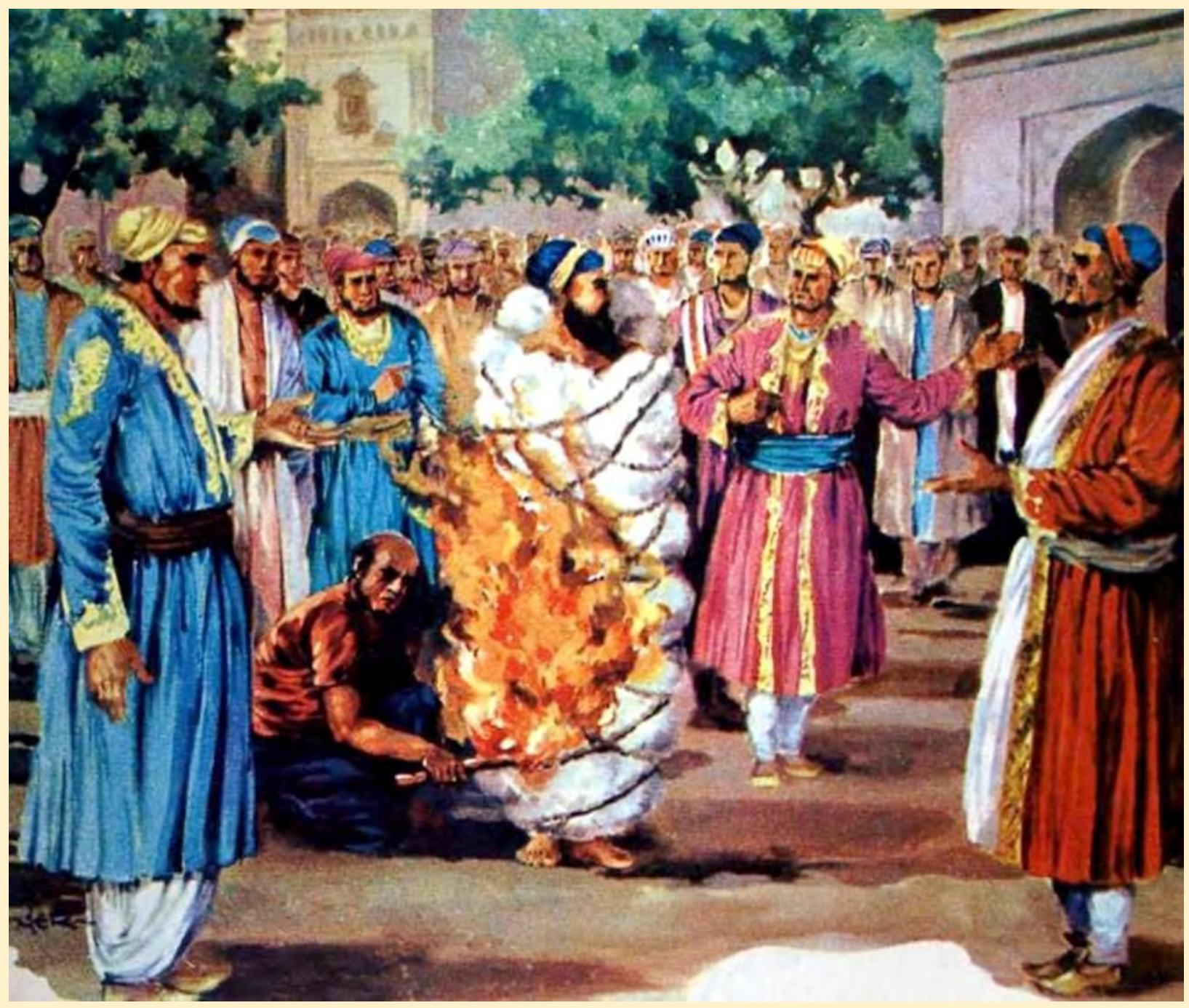
Picture depicting how Bhai Sati Das was burnt to death wrapped all over with cotton, as he refused to convert to one-ideology Islam
Unable to break the Guru, they cut His head off the body All this happened in front of the Guru but nothing could unnerve him or shake his resolve. He offered himself for the execution in a spirit of complete resignation to the Will of God. As recorded by son of Guru Tegh Bahadur, Guru Gobind Singh, the Guru confident, courageous and ready for submission to Cosmic Will neither accepted to perform miracle nor to convert to their religion, the Guru chose the path of supreme sacrifice to save Hinduism and infuse courage and confidence in the persecuted Adi-Saivite and Sikh community to face the religious persecution boldly. On 11 November 1675 after months of torture during unlawful imprisonment Guru Tegh Bahadur was executed in Delhi.
Official Justification Propaganda - How they tried to cover up
According to the official account of the Mughal Empire, written 107 years later by Ghulam Husain of Lucknow in 1782 -
> Tegh Bahadur, the eighth successor of (Guru) Nanak became a man of authority with a large number of followers. (In fact) Several thousand persons used to accompany him as he moved from place to place. His contemporary Hafiz Adam, a faqir belonging to the group of Shaikh Ahmad Sirhindi's followers, had also come to have a large number of murids and followers. Both these men (Guru Tegh Bahadur and Hafiz Adam) used to move about in Punjab, adopting a habit of coercion and extortion. Tegh Bahadur used to collect money from Hindus and Hafiz Adam from Muslims. The royal waqia navis (news reporter and intelligence agent) wrote to the Emperor Alamgir [Aurangzeb] of their manner of activity, added that if their authority increased they could become even refractory. > > — Ghulam Husain, Mughal Empire records, (The Propaganda to Justify Persecution)
Failure of Brutal Strategy - How persecution of Guru Tegh Bahadur worked against the Mughal State
The story of the persecution of Guru Tegh Bahadur spread like wildfire. It filled the entire Hindu community with strong desire to dethrone Aurangzeb. The Mughal Empire soon collapsed, and disintegrated to several princely States.
A Sikh Empire came into being and took over Northern Western parts of the country - Punjab, upto Kashmir. Hinduism survived in Kashmir for next few centuries until 1990. Adi Saiva community continued their peaceful existence during the Sikh rule.
In 17th century the Mughal persecuted the ancient Hindu communities to destroy Indian culture at the grassroots levels completely. The Mughal Era ended with brutal destruction of all temples - the first pillar of Hinduism. They were followed by the British rulers who destroyed the Gurukul Education System, the second pillar of Hinduism. In 21st century the same was continued by the Extremist Hindu Militant Forces - BJP, RSS, VHP to create one-ideology 'guruless' Hinduism which they can exclusively control and lead. Thus they are now attacking and destroying the final pillar of Hinduism - The Gurus, and the unbroken multi-millenia old lineage.