LESSON: 5
This text was machine-transcribed from the printed book and may contain errors. Select the words and choose “Report a mistake”.
Introduction: Review the yesterday's topic and talk about Worry Vs Happiness.
Goals: To make them aware of the fact that worries prevent us from being happy
Click: Worry Vs Happiness.
About the topic: Worry is nothing but your response to an event .Whether a situation makes you worry or not depends entirely on how you choose to react to the situation. As a child each of us is strongly centered in our own being. Have you ever seen any child worrying about what people will think of him? No! A child is beautiful because he has no worries. Society makes us dependent on external support, certificates from others for each of our actions and words. Without a reason to worry, your ego loses its reason for existence that is why you choose to remain in the dimension of worry. The way to worry is through the mind and the way out can also be only through the mind. The solution cannot be found in outer world things. It can be found only inside ourselves. Depression or negativity is nothing but a collection of negative thoughts which you speak to yourself. Crying to get things shuts our inner space. By going behind the past or thinking about the future you miss the present. When you are in the present, every moment will become a celebration and you will not be searching for past incidents to celebrate. Words are the units of worry. Happiness is different from bliss. Bliss is a beautiful and intense feeling inside you
WORRY?

that makes you feel that you are on a different plane of existence. Happiness or pleasure are most often related to the outer world objects and create pain continuously for us as well. Happiness is relative while bliss is absolute. Bliss is something that has no opposite. Complaining is related to worry because you are uneasy and caught up with words. When we worry, we try to be in future. We carry our worries with us everywhere we go and feel comfortable nurturing them. Bliss attracts fortune. This is a great truth. When you are blissful, automatically, existence showers on you. The whole of existence is taken for granted because of the so called knowledge. We run behind worldly things that give only more and more greed, worry and fear. These things make us to look outside instead of inside. They make us sway between depression and joy alternatively, instead of being centered upon permanent bliss.
Assessment: • Does a child feels worry? • What is Depression? • What is worry? • What happens when you go behind to the past? • Is happiness different from bliss? • What happens when you cry to get things? • What is the solution of worry?
Evaluation: Evaluate how well they understood the topic by asking them multiple questions.
Conclusion: The way to worries, is through the mind and the way out can also be only through the mind.
WORRY

Art of the day: Thoughts as pictures
Materials needed: Plain sheet, sketch pen or pencil
Procedure: Explain the children about drawing their thoughts as pictures. Ask the children to picture what comes in their mind as thoughts. Encourage children to explain what they have drawn.
Inference: When the children analyze what they have drawn they can understand how thoughts are created, how our mind enjoys thoughts. How we connect the thoughts and create problems.
WORRY?
Activity of the day: No negative answers
Goals: To make the children understand the topic of worry.
Preparation: Introduce to the children the game of answering questions without negative answers
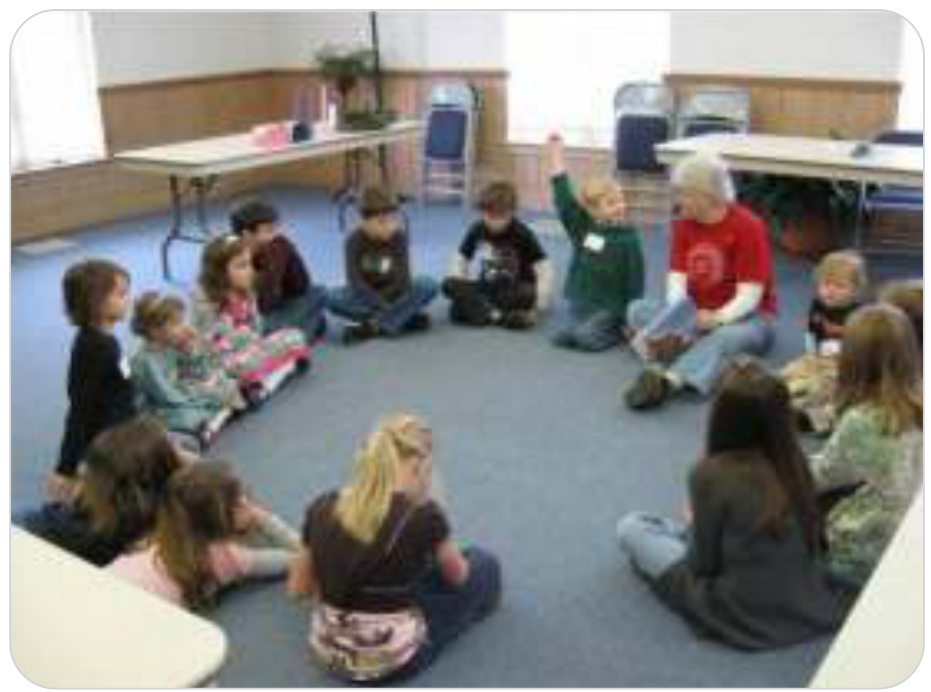
Presentation: Encourage all the children to sit in a circle and each child will get his turn to answer the questions asked but he has to answer the questions without using any negative answers.
Interpretation: Connect this game to the fact that negative thoughts and negative words create worry and stress. We will be very much refreshed when we use positive answers.
Extension: Same game can be played by including components like not repeating the same answer, not repeating any ones answer, no one word answers.
© 2011 Copyright Nithya Gnanadhan Trust