LESSON: 2
This text was machine-transcribed from the printed book and may contain errors. Select the words and choose “Report a mistake”.
Introduction: Revise and ask questions about day 1 topic. Introduce the cause of worry.
Goals: To make them aware of the causes of the worry about negative thought, how worry differs from person to person.
Click: Mind is an excellent recording system.
About the topic: Words and thoughts are the 'building blocks' that make up worry. Worry takes root from our own thoughts or words. Worries are spikes in the current of thoughts constantly moving within us. These thoughts are mostly negative. Even when we are at the peak of the joy, we always worry about when the joy will end. On a beautiful white board if there is a small black dot, we always see the black dot first and then only we see the big white space surrounding it. Worries are like that small black dot and the happiness is the big white space surrounding it. Worries vary from person to person; the reason or cause that worries one person will be comforting for other person and vice versa. When we start thinking positively the worries will come down. If you don't think about the past or future what would happen to your inner chatter? When you do something spontaneously, do you worry? Mind is an excellent recording system. It stores your negative thought patterns and repeats it. We always take so much care in how we speak to others, but we never care about how we speak to ourselves. Everything is auspicious. We manifest what we think and end up in problems because we only think negatively. Cosmos is very intelligent it can take care of everything.
© 2011 Copyright Nithya Gnanadhan Trust
WORRY
Assessment: • Why do we worry? • When do we have negative thoughts? • How is inner chatter related to worry? • What are the building blocks of worry? • Do worries differ from person to person? • Is there any big worry better than small worry? • Does worry speed the process of solving our problems? • When do we start worrying? • What can change worrying? • What does a black dot on the white board signify?
Evaluation: Evaluate how well they understood the topic by asking questions, their views on the topic.
Conclusion: Conclude the topic by reinforcing the fact – start looking at the happiness around us instead of thinking the minute worries. Try not to allow your mind to wander to the past/ future.
WORRY

Art of the day: Chakra drawing or coloring – worry chakra
Materials needed: Plain sheet, worry chakra picture (Manipuraka), sketch pen or pencil, poster colors
Procedure: Give each child plain sheet and ask them to draw the worry chakra by seeing the picture or give them the chakra picture and ask them to color with poster colors or crayons. The Manipuraka chakra is located in the navel region. In Sanskrit, Manipuraka means 'The City of Jewels'. This chakra is locked when you constantly worry and it flowers when you stop worrying about your worries! Most of the time, we talk in the air without getting down to the actual facts. If we get down to the bottom of our so-called worries, we will understand that we are simply magnifying things that are not so bad at all. Alright, now let us analyze what actually happens inside your mind when you are worrying. Just watch your mind when you are worrying about something. You will see that a continuous stream of thoughts is being generated in your mind - totally disconnected thoughts - and usually negative thoughts. An influx of negative and repetitive words will be like a current in your mind.

© 2011 Copyright Nithya Gnanadhan Trust
WORRY
Activity -1- De-stress with Balloons
Material required: One balloon per person
Preparation: Gather everyone together and give each person a balloon.
Presentation: Ask each child to blow the balloon as big as they can and then tie it. If they want they can also create a face on the balloon using sketch pen. Now explain that they are going to shout, rant and scream at the balloon, talk in gibberish about all the nonsense that is stored up inside. Then take the balloon and burst it. This is letting out with it pop all the built up stress in us and we feel free. While they are getting out all the negativity, they can be standing in separate corners in order to lessen the feelings of self consciousness.

Discussion: If we keep adding on more stress, eventually it will break our system Burst the stress and be free from worry and any thoughts, get it out of your system and you will be instantly lighter and more clear.
After that let them talk about how they felt and what was their experience. Lots of noise is stored in our mind and this helps us let it out. What was your feeling inside your stomach?
WORRY?
Activity -2- Worry Jar
Material required:
• Pieces of paper
• Pencils
• Container or Jar
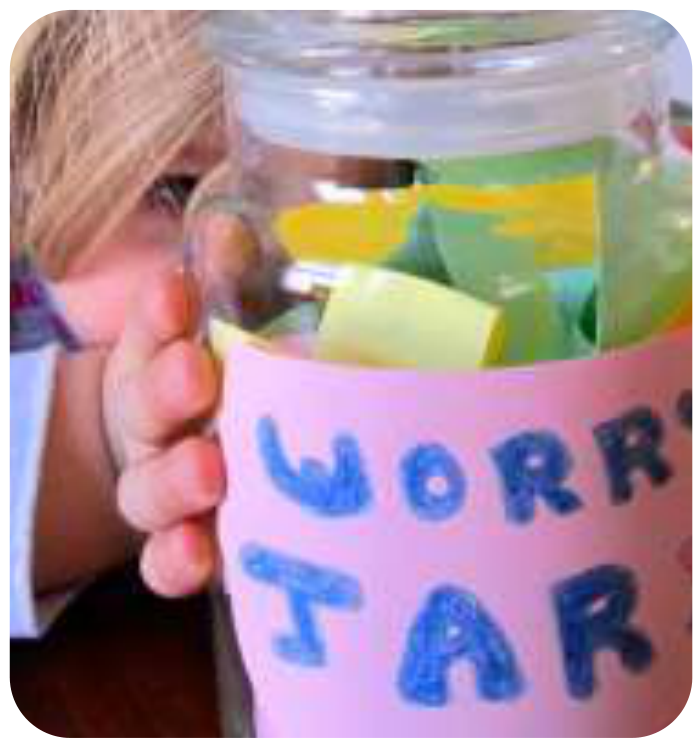
Preparation: Have enough pencils and small pieces of paper for everyone. Make a label "WORRY JAR" for the Jar and stick it on.
Presentation and Discussion: Talk about how we are always carrying around our worries and it blocks up the path to happiness. How can we be in bliss if we are thinking like.... "Oh I'm so blissful! But Tommy really made me angry yesterday by calling me names!" We are constantly thinking about the past or the future, but what about now? Let's focus on what we are doing today and leave the past behind and we'll cross the bridge of the future when we get there.
Show the worry jar and give each person a paper and pencil. Ask them to write something that is bothering them right now. Ask them if it is a real worry or something that is not worth worrying about. If it is not worth worrying about, write it down and drop it in the worry jar and don't worry about it again!
© 2011 Copyright Nithya Gnanadhan Trust
WORRY