You Are God
This text was machine-transcribed from the printed book and may contain errors. Select the words and choose “Report a mistake”.
It is here that we enter into the real Gītā. It is from here that Bhagavān or God, Nārāyaṇa starts speaking and singing the Gītopaniṣad into the listening of Nara Arjuna, and through Arjuna into the listening of the whole of humanity.
Until now Kṛṣṇa was speaking as a man, as Vāsudeva Kṛṣṇa, in His human form, but it is only from here that Kṛṣṇa sings as Parabrahma Kṛṣṇa, in His divine state as Bhagavān, the universal Kṛṣṇa.
Understand, only an intelligent man will allow the other person to speak. Only a man of completion will provide integrated listening to himself and others. We all speak continuously to each other, but a conversation does not really happen. When the other person speaks we do not listen; we are busy preparing our own reply. We never speak into the listening of others, we just speak into the non-listening of others! We need intelligence; we need integrity to allow the other person to speak into our listening.
In the first chapter, Kṛṣṇa does not say a word to interrupt Arjuna. He allows Arjuna to speak fully into His listening for one whole chapter of Arjunaviśāda Yogaḥ. He keeps quiet, even on seeing the depth of Arjuna's confusion and depression. He consciously analyzes the root of Arjuna's thoughts, his root thoughts patterns to determine the platform of powerlessness upon which Arjuna is standing.
Listening is directly connected to your ability to handle reality as it is, without creating your own unconscious ideas and conclusions.
Please listen, the moment you start talking to somebody, when you don't have listening, you start coming to your own conclusion even before the information is cognized in you, either by rejecting that person or taking that person as a big threat. Both will lead you to suffering.
That is why the very first step of Hindu spiritual practice is Śravaṇa, Integrated Listening. It is possible to become a successful businessman just by studying the first few chapters of Gītā. You can reach the peak possibility of your profession and of your life just by learning the art of integrated listening from Śrī Kṛṣṇa. Once you provide your integrated listening to yourself and others, you will automatically be able to speak into the listening of others and thus communicate to enrich yourself and commune to enrich others as well.
When you experience the words you utter to you and to others as the extension of your life, they directly affect you. When the words uttered by you are not listened to, the completion is disturbed. I tell you, if the person to whom you are talking to is not in the space of listening, the ideas you want to express will never be delivered. It may lead to an argument, but it may never lead to intelligence transfer.
Listen! Information transfer is argument. Intelligence transfer is Listening. In arguments, information can be transferred, but never intelligence. Only in integrated listening can intelligence be transferred.
In Vedānta, the first principle is Śravaṇa—Integrated Listening; the second principle is Manana— Intranalyzing, meaning analyzing the truth for the sake of internalizing it not for rejecting it; and the third principle is Nididhyāsana—Living and radiating the truth!
Any transmission of knowledge, energy or experience happens between a Master and disciple only when the disciple gives his or her listening! Even Vedic Ṛṣis start with this chant: śrunvantu viśve amṛtasya putrāḥ— Oh! Sons of Immortality, please listen to me!
Here, Kṛṣṇa is giving His integrated listening to Arjuna! He is interested in the real problem and not in expressing what He knows. He wants Arjuna to learn the ability to give integrated listening to himself, to have the clarity of mind. He is interested in enriching him to find a solution to his own problem. He allows Arjuna to speak so that He can listen and transmit the ultimate knowledge and experience of completion to him.
One needs intelligence, or I may say enlightenment, the space of completion to listen. Unless you start living completion, you will not even be able to maintain listening. Even listening is achieved with completion. Completion brings listening to you. Only an Enlightened Master, an Incarnation like Kṛṣṇa can listen, only He can speak into the listening of others. In the first chapter He listens fully and completely. Even in this second
chapter named Sāṅkhya Yogaḥ, He allows Arjuna to speak into His listening in many verses. Please understand the definition of Listening. Let me define what Right Listening is, śravaṇa.
Right listening means allowing the words to enter your inner space automatically; letting them cognize, without you constantly interfering with your incompletions, is Listening.
You can open up to the Master at three levels. You can converse and convey through words and the Master will listen. At the next level you can communicate from the heart in silence; you can visualize instead of verbalizing in speech. Finally, you can commune in silence through Upaniṣad and the Master will grasp this even more powerfully.
Here Kṛṣṇa allows Arjuna to verbalize, He allows him to speak into His pure listening, so that to begin with, Arjuna himself will develop the ability to have integrated listening and understand his problem. Once Arjuna cognizes and expresses his confusion, he can relapse into silence and commune with the Master of completion in the space of Upaniṣad.
DROP THE POWERLESSNESS AND STAND UP
2.1 Sañjaya said: As Arjuna’s eyes overflowed with tears of pity and despair, Madhusudana (Kṛṣṇa) spoke to him thus.
2.2 Bhagavān Kṛṣṇa says: Where from have these impurities descended on you at this critical time, Arjuna!
You behave unlike a nobleman and this will keep you away from realization.
2.3 Do not yield to fear, Pārtha! It does not befit you. Drop this powerlessness of heart and stand up,
O Parantapa, destroyer of enemy.
Arjuna was distraught with pity and despair. His pity was for his opposition that consisted of his svajanam, kinsmen, elders, teachers, relatives and friends. He despaired at the thought of what would happen if he did have to kill them. He had collapsed in his chariot and his bow and arrow had slipped from his hands.
Kṛṣṇa allowed Arjuna to exhaust himself, physically, emotionally and spiritually. He listened to him carefully, completely. Kṛṣṇa wanted to give Arjuna time to open his mind, heart and being to Him, Arjuna’s friend, guide and master, so that His answers would penetrate Arjuna’s very being.
Then He spoke for the first time, as if opening His being directly. Bhagavān Kṛṣṇa says, ‘My dear Arjuna, how have you acquired these impurities? They do not at all befit a man who knows the value of life. They lead not to higher planes but to infamy, akīrti karam arjuna.’
śrī bhagavān uvāca
kutas tvā kaśmalam idaṁ viṣame samupasthitam |
anārya juṣṭam asvargyam akīrti karam arjuna || 2.2
This verse is connected to the next one.
‘O Pārtha! Do not yield to this degrading impotence. It does not befit you. Give up such petty powerlessness of heart and arise, O Parantapa, destroyer of enemy.’
klaibyaṁ mā sma gamaḥ pārtha naitat tvayy upapadyate |
kṣudraṁ hṛdaya daurbalyaṁ tyaktvottiṣṭha parantapa || 2.3
Kṛṣṇa gives the direction to the whole Gītā with this one truth to awaken Arjuna from his delusory incompletions. Kṛṣṇa is the true Master and does not beat around the bush. Understand that Kṛṣṇa is not a philosopher; He addresses the dilemma of Arjuna straightaway.
Kṛṣṇa asks Arjuna directly, ‘How did such impurities, such incompletions come upon you? They are not for a man like you. They will not lead you to higher planes but only defame you.’ In the next verse He asks Arjuna to give up this powerlessness and asks him to arise, addressing him as ‘Parantapa, destroyer of the enemy.’
Kṛṣṇa knows Arjuna’s root thought pattern. Please understand that Arjuna is not depressed because of a spiritual search. It is just that he does not want a solution; he wants only support.
Understand, asking for solutions and asking for support are two different things. What Arjuna needs is support, not a solution. This is why Kṛṣṇa does not speak of spirituality in these two verses. Arjuna’s root thought pattern originates from fear and worry. His maṇipūraka cakra (navel center) and svādiṣṭhāna cakra (being center), energy centers that get locked due to worry and fear, are now completely locked! Because of his fear pattern, he has deep seated incompletions, stress and worry.
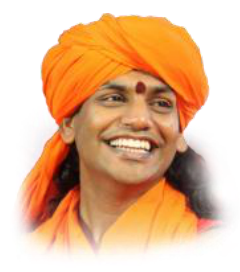
Kṛṣṇa addresses Arjuna’s deep fear and powerlessness straightaway without any philosophy, and asks him to give up his foolish weakness and get up and fight—tyaktvottiṣṭha parantapa. He does not offer any consolation, just a straightforward scolding, and a slap to awaken him!
KṚṢṆA hits Arjuna’s root pattern
If Arjuna had been in a mood of stotra, meaning devotional surrender that he reaches only later on, these two verses would have served as sūtra or techniques for him. Had he been without fear and expressed full faith and devotion in Kṛṣṇa, these two verses would have been enough to wake him up and stand powerfully.
At this point, Arjuna is in the state to be intellectually convinced and Kṛṣṇa employs śāstra as the right approach. Since he was not in the mood of stotra, not yet ready with devotion and faith, Kṛṣṇa had to create the śāstra or method, to bring him to the stotra state. The whole issue was due to his root pattern of fear plus worry and powerlessness because of this fear.
All our depression, worry patterns are nothing but the root``` pattern of a deep fear of life, a deep self-doubt, fear of expansion and fear of losing something. You need to stand up and complete with your root thought patterns to be rid of them. Please understand, even your ignorance is nothing but your fear of expansion. Many times, you continue to pretend to be in ignorance, because of your fear of failure.
There are many levels of fear: fear of losing our wealth and status, fear of losing a limb or our health, fear of losing our near and dear ones and fear of the unknown or death. That is why Kṛṣṇa says that Arjuna is not behaving as an ārya, a word that can be interpreted as a nobleman; an integrated human, not a particular race or caste. Vedic literature says that an ārya is one who is evolved, cultured, integrated and authentic, a prince amongst men.
Arjuna is confronted with all the four fears: fear that he may lose whatever he possesses, that he may be maimed in the war, that he may lose his near and dear ones, and fourth, that he may lose his very life. These fears have in turn led to his powerlessness of heart. Understand, all your fears, all your anxieties, all your patterns are directed only in one line—fear of your possibilities!
Your bigness frightens you. You always believe that you are suffocated by your smallness. NO! You are suffocated by your bigness! Whenever bigness is demanded of you, whenever you feel you are being ‘forced’ to expand, you shrink even further into your comfort zone. Arjuna’s tiredness, his weakness, his powerlessness all these are nothing but the resistance he has to seeing his own bigness!
That is why, when someone tells you that you are weak, poor and a sinner, it is so easy to accept it. But if someone tells you that you are Divine, you are powerful, you are complete, your whole identity starts trembling with fear! Arjuna trembles and collapses totally fearing his bigness, shrinking into his weak-heartedness!
But life always demands your expansion, because expansion is the natural law of life. Here, Kṛṣṇa, the source of life, demands Arjuna to stand up and expand into his powerfulness, and give up his degrading powerlessness unbefitting an ārya prince, who is also famous as parantapa, conqueror of enemies.
But Arjuna is carrying such a deep fear of life, especially fear of life in the form of other people—because people are the most living expression of Life! The whole Kaurava army and his dear ones are the people who now represent his deepest fears of life.
Listen! The more you engage with life, the greater the expansion that will be demanded of you. Whenever you are feeling weak, tired, and powerless, the first thing you should do is this: immediately take on ten responsibilities and commit to fulfill them within an impossibly short time! Shake your inner space so powerfully with that commitment that there will be no way for weakness and tiredness to grow inside you.
Kṛṣṇa directly addresses this weakness, powerlessness in Arjuna and the fear of life in the form of his kinsmen with the śāstra, the explanation of wisdom that is directed to the head, the intellect. He shakes Arjuna’s inner space demanding of him to take up the responsibility to stand up and commit to powerfully uproot all his impossibilities, and fight— tyaktvottiṣṭha parantapa!
Continuously human beings resist expansion. Incarnations happen on the
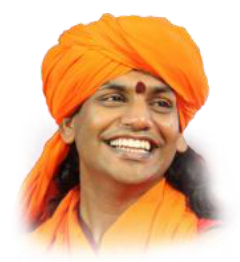
planet to remind human beings about their possibilities, to expand human consciousness. That is why again and again they are doubted. Arjuna is Nara, human being who resists his expansion, and Śrī Kṛṣṇa is Nārāyaṇa, Divine Incarnate who reminds him of his highest possibility of expansion—that he is God, that Nara is the reflection of Nārāyaṇa, who is mirroring the infinite inner space of God!
It is the authority with which Kṛṣṇa is seen transmitting the Gītā that makes it a scripture. ‘I am the Divine,’ says Kṛṣṇa. ‘If you believe in Me, you too shall realize your inner divinity.’ It is this profound and yet simple message that has resounded so deeply in the hearts, minds and beings of generations of Hindus, in turn establishing the scriptural sanctity of the Gītā.
Possibility of Sudden Enlightenment
Here all the verses of the Gītā are reduced to just two verses by Kṛṣṇa.
He straightaway addresses and completes the root pattern where Arjuna is stuck, that is in his need for name and fame or rajas. A man who is centered on satva, goodness, who has neither greed nor lethargy but a neutral attitude, will work out of compassion. A man who is centered on rajas will work only for name and fame. A man who is centered on tamas, lethargy, will work only for sensual pleasures.
Duryodhana works only through tamas, which explains his cruel and gross behavior. Dharmarāja Yudhiṣṭira works on satva, out of compassion. Here Arjuna is centered on rajas, therefore he is working only for name and fame. This is why Kṛṣṇa asks him not to work in this way as it would ultimately bring Arjuna a bad name, akīrti karam arjuna. This is how He straightaway puts His hand on the tumor, the tumor that is the subtle root pattern working within Arjuna.
All Western philosophies begin with logical analysis and end with the conclusion. All Eastern processes begin with the conclusion and then give the analysis. Eastern masters are compassionate. They first give us the option of grasping the solution, if we have the intelligence. They expect us to transform with just the trust in them. If we don’t have this qualification of grasping and trusting, they have no other option but to go into detailed explanation, they start the regular process.
Here Kṛṣṇa tries the first method of sudden enlightenment, the immediate liberation, the ultimate possibility but Arjuna is not mature enough to receive it or comprehend it. So Kṛṣṇa now starts the process of explaining it to him stepby-step.
Surrender Is Not Based On Powerlessness

Arjuna says:
O Madhusūdana (killer of demon, Madhu), how can I oppose in battle, Bhīṣma and Droṇa,
who are worthy of my worship?
I would rather beg for my food in this world than kill the most noble
of teachers.
If I kill them, all my enjoyment of wealth and desires will be stained with
blood.
I cannot say which is better; their defeating us or us defeating them. We do not wish to live
after slaying the sons of Dhṛtarāṣṭra who stand before us.
My heart is overwhelmed with pity and my mind is confused about what my duty is. I beg of You,
please tell me what is best for me.
I am your disciple. Instruct me, as I seek refuge in You.
Even if I were to attain unrivalled dominion and prosperity on Earth or even lordship
over the Gods,
How would that remove this sorrow that burns my senses?
Despite what Kṛṣṇa had said with total clarity, that Arjuna should get up and fight, Arjuna now recounts all his previous arguments. It is as if he had not listened to Kṛṣṇa at all.
He once again implores Kṛṣṇa, 'You, as the Lord of the Universe, have the right to destroy what you please. As the Lord, You destroyed the demons Madhu and Keśin and many other enemies. How can I, a mere mortal, be bold enough to wage war against my grandfather and my teacher, with the intent to kill them? They are ones I should worship, not destroy. I shall be condemned if I fight them.'
Take Decisions out of Completion
Arjuna is now pleading Kṛṣṇa, 'Oh Lord, leave me now! I will beg and eat becoming a Sannyāsi.' He continues, 'It is better for me to seek alms as an ascetic or even a beggar than kill these elders—śreyo bhoktuṁ bhaikṣyam apīha loke (2.5). Once my hands are stained with their blood, how can I enjoy worldly pleasures? I am confused as to which would be better, for them to slay me or for me to slay them, yadvā jayema yadivā no jayeyuḥ (2.6). How can we live after slaying our kinsmen and elders?—yān eva hatvā na jijīviṣāmas.'
Understand, Bhagavān is not against Arjuna's Sannyāsa. He does not want Arjuna to take Sannyās out of powerlessness.
Arjuna says, 'Oh Lord, leave me. I will beg and eat—bhoktuṁ bhaikṣyam.' No! I tell you, Arjuna would not have become a sannyāsī. He would have gone and asked for food in a royal way, 'Hey, give me food.' If somebody doesn't give, he would have picked up his gāṇḍīva bow and arrow to shoot the person for his food.
To become a Sannyāsi, Śrī Kṛṣṇa says, 'Go to Sannyāsa out of completion.' Bhagavān is only saying one thing, 'Out of completion, take any decision. Out of completion, take any decision!'
Listen. Bhagavān denies Arjuna even his decision to take Sannyāsa because Arjuna takes that decision out of powerless pattern. He accepts Arjuna's decision to fight, because he took the decision out of powerfulness, completion! Whether it is Sannyās or fight, powerlessness never leads your life to any next steps.
Arjuna says further, 'Now I am confused about my duty and have lost all composure because of misery and weakness—kārpaṇya doṣopahata svabhāvaḥ (2.7). I can see no solution to my dilemma. Even if I slay these people and gain control over the earth, or even control over the heavens,
what good will it do me? In this condition, I ask you to tell me, for certain, what is best for me, yat śreyaḥ syān niścitaṁ brūhi tanme. Now I am your disciple and the soul is surrendered unto you. Please instruct me—śiṣyas te’haṁ sādhi māṁ tvāṁ prapannam (2.7).’
I must now tell you an important truth.
Here Arjuna says, ‘My soul is surrendered unto you—māṁ tvāṁ prapannam.’ This is a lie. Had his soul been truly surrendered to Kṛṣṇa, he would simply have followed what Kṛṣṇa said and would not have waited for an intellectual explanation.
Arjuna says his soul is surrendered to Kṛṣṇa but when Kṛṣṇa asks him to do His bidding, he is not ready to do so and is confused! Surrender out of confusion is not surrender, as you do not even know if you are doing the right thing.
Understand that surrender after clarity, intelligence of śāstras, out of completion, is true surrender.
Here Arjuna surrenders only verbally as he says that he is confused, that his mind is bewildered, sammūḍha cetāḥ. You must either do what you think is right or do as the Master instructs. Here Arjuna wants the Master to say what he wants to hear, not what the Master wants to say. So, although Arjuna says he has surrendered, he has not done so.
Kṛṣṇa, fully aware of Arjuna’s dilemma, moves forward in his mission to destroy Arjuna’s identity, the root pattern. The Guru, Master is a surgeon who removes the cancer of ego, the root thought pattern. This is what Kṛṣṇa does throughout the Gītā dialogue. To give Arjuna credit, he stays through this surgery. Many weaker men would have run away from the operation theatre, this battlefield, with no desire to let go of their identities. Arjuna’s greatness lies in his integrity, his powerful determination, his decision to listen to his Master and be guided by Him.
Arjuna decides to surrender Powerlessness
So, Arjuna implores his Master, ‘Kṛṣṇa, please tell me what to do. I am your disciple. You are my refuge.’
Arjuna’s integrity lies also in not making any decision when he is feeling powerless. When you are in the space of powerlessness, the only one decision you have to make is to come out of powerlessness. No other decision should be made. When you are in powerlessness, any decision made leads to more and more powerlessness, more and more suffering.
In his deepest powerless moments, the only decision Arjuna takes is to come out of his powerlessness. He declares to Kṛṣṇa that he is His disciple and exposes his inauthenticities to Kṛṣṇa. It is this readiness to surrender to the Master that brings completion to Arjuna and enriches him to take the responsibility to win the war, which in reality is the war within himself. This is the war that each one of us is fighting each day with our powerlessness, if we are truly aware. This is the war that we need to fight to drop our root pattern, our mind, and the identity that binds us to all the bondages upon this earth.
Listen! Whatever you think is yours and whatever you think is you, is different from the truth. It is the Master who can lead you through the path of self-completion, as Kṛṣṇa is now leading Arjuna. To be led, you need the attitude of surrender, the decision to surrender your powerlessness.
We NEVER Cease To Exist
2.9 Sañjaya said: Guḍākeśa (Arjuna) then said to Hṛṣīkeśa (Kṛṣṇa), ‘Govinda, I shall not fight,’ and fell silent.
2.10 Then, Hṛṣīkeśa, Kṛṣṇa smilingly spoke the following words to the grief- stricken Arjuna, as they were placed
in the midst of both armies.
Bhagavān said:
You grieve for those who should not be grieved for and yet, you speak words of wisdom.
The wise grieve neither for the living nor for the dead.
Never was there a time when I did not exist; nor did you, nor all these rulers,
And nor shall any of us ever cease to be hereafter.
Just as the spirit in this body passes through childhood, youth and old age, so does it pass
into another body; the man centered within himself does not fear this,
or deluded by this .
Even though it is written here in the past tense, I feel Kṛṣṇa should always be addressed in the present tense. He is still relevant, present to each of us today. We cannot say, ‘Kṛṣṇa was’ but ‘Kṛṣṇa is’, not ‘Kṛṣṇa said’ but ‘Kṛṣṇa says.’
Once again, having lamented about what he is being forced to do, and not wishing to do what he is expected to do, Arjuna, like a petulant child sits down saying, ‘Govinda, I am not going to fight, na yotsya iti govindam (2.9).’ It is as if Arjuna is waiting to be persuaded. He is seeking an explanation.
Kṛṣṇa says to him gently and smilingly, ‘While speaking learned words, you are mourning for what is not worthy of grief—aśocyān anvāśocas tvaṁ prajñā-vādāṁś ca bhāṣase. Those who are wise lament neither for the living nor for the dead—gatāsūn agatāsūṁś ca nānuśocanti paṇḍitāḥ (2.11).’
Again, Kṛṣṇa addresses Arjuna’s incompletion directly, ‘O Arjuna! You speak as if you are intelligent, enlightened, prajñā-vādāṁś. You speak the words without having experienced them. Therefore, your words do not carry conviction. Your emotion, your being, shows that you are not enlightened, that you have not understood. A truly enlightened person will never worry for the living or the dead.’ If you worry for somebody living or dead, you cannot be an intelligent person. What is death and life after all? There are thousands, rather millions, who have lived and gone.
KṚṢṆA’s first Enriching Words are Sānkhya
See the brilliance of Śrī Kṛṣṇa! He is so soaked in the space of completion. The moment Kṛṣṇa opens His mouth, the first truth that comes out from Him is Sānkhya Yogaḥ. I can be sure that Kṛṣṇa is filled with Kapila.
Kṛṣṇa is the greatest follower of Sānkhya Yogaḥ. Please understand, when you are in a crisis, the first few words you utter are the words with which you solve your own problem. When somebody asks you for advice, what comes up first? The words that you use to enrich yourself, will only come out to enrich others.
You exist in past, present and future
Sañjaya says Kṛṣṇa was smiling as He uttered these words. Kṛṣṇa must have been laughing at Arjuna. ‘You fool; you pretend to be wise and quote the scriptures. Who do you think you are quoting the scriptures to? What can you understand of what I Myself have said?’
Kṛṣṇa continues: ‘Never was there a time when I did not exist, nor you and all these kings, and never in the future shall any of us cease to be.’
na tv evāhaṁ jātu nāsaṁ na tvaṁ neme janādhipāḥ /
na caiva na bhaviṣyāmaḥ sarve vayam ataḥ paraṁ // 2.12
With this verse begins the essence of the whole Gītā. This is ātmajñāna, Self-Realization, the knowledge of completion. If you can understand this one verse, you can become enlightened straightaway and enter into eternal bliss.
If you think our souls will also die with our bodies, you are wrong. We were there before our birth and will remain after death. It is not true that any of us will not be in the future.
Listen. You existed in the past, exist in the present and will exist in the future. Your face and body may change but you continue to exist. Then why do we think we will die and why do we fear death? If what Kṛṣṇa says is true, why are we worried about this life and about death? You need to first understand the concept of the past, present and future to enable you to understand what Kṛṣṇa says.
Let me explain this concept of time first. Time is like a shaft continuously moving from the future on the right into the past on the left (see diagram). The future is on your right and the past is on your left. The future is continuously moving into the past; every moment and every second it is turning into the past. The present is the point where the future and the past meet.
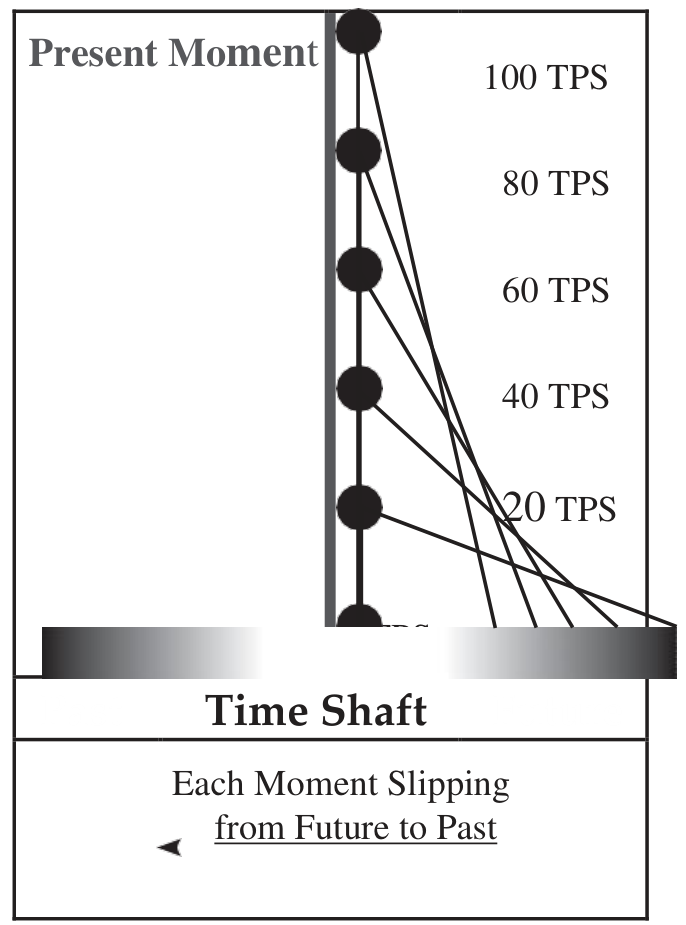
Your mind as such is nothing but movements between the past and the future. You cannot have any thoughts if you stop thinking about the past and the future. Your thoughts consist of nothing but the constant movements between the past and the future. The more your thoughts shift from past to future or future to past, the higher the frequency of thoughts. The less you shift from past to future or future to past, the lesser the number of thoughts. Try to think of something in the present, you will find that you cannot. You can think of it only by taking it into the past or future. You are either worrying about the future or remembering the past.
The higher the frequency of thoughts, the more you are caught in the physical and material world. For example, if you have 100 Thoughts Per Second (TPS,) it means you have jumped 100 times back and forth between the past and future in one second! If you have 80 TPS, it means you have jumped 80 times between these two dimensions. The higher the frequency, the more you will be away from the present and more problems you have. If the number of thoughts reduces, you fall into the present moment.
The past, present and future, all the three put together are eternal, Nitya or Ātman. Only when you come to the present moment do you experience Ātman—your true Self, but as of now you are constantly shuttling between the past and future. When the number of thoughts reduces, you will not even be aware of the passage of time. For example, when you are with someone you love, even two or three hours will seem like a short while. But, when you are with someone whose company is boring, even a short time seems very long.
Time is more psychological than chronological. That is why, in our scriptures or Vedas, we have the word kṣaṇa to describe the unit of time. Kṣaṇa does not denote one second, but is defined as the gap or time interval between two thoughts. The larger the kṣaṇa or the gap between two thoughts, the more in the present we are. Each person's kṣaṇa will be different depending on how busy his mind is! When our TPS is lower, we will naturally be in completion, in ecstasy, in bliss.
Kṛṣṇa says beautifully, 'You were there in the past, you are in the present and you will be in the future; you do not die. You existed before birth and will remain after death. Whatever dies, can never live. Whatever lives can never die.' When Kṛṣṇa says, 'You are the eternal soul,' He means that as a being, you are beyond time.
Here, your deep consciousness says that something is living in you. This quality you wrongly attribute to your body and mind. You are not the body or the mind. As long as you are caught in the past and the future incompletions, you think that you are the body-mind. The moment you come down to the present moment, you are in the eternal space of completion, you experience that you are beyond the body, beyond the mind.
The gist of the second chapter, Sāṅkhya Yogaḥ is that you are the soul, that you are complete, that you are divine and that you are God.
Completion is the only methodology where you can complete with your past and future incompletions. You need to know that when you do completion now, don't think that only your future will be in completion and complete. No! Even your past gets altered. Even your past becomes complete! The moment you create the space of completion, what Kṛṣṇa declares, 'you are the eternal soul, beyond your body and mind,' becomes reality in your life.
Kṛṣṇa is established in the space of Sāṅkhya knowledge. Kapila Muni, the founder of Sāṅkhya, does not elaborately talk about God, but he talks about the methodology to reach God. Sāṅkhya does not speak about God, because completion itself is given the place of God. Please understand, Sāṅkhya does not have the system of God because the methodology to reach God is made as God. It is a lifestyle. The methodology of completion is God. Completion is God!
THE ONLY REALITY IS IMPERMANENCE
O Kaunteya (son of Kuntī), contact with sense objects causes heat and cold, pleasure and
pain, and these have a beginning and an end. O Bhārata, these are not permanent; endure them
bravely.
O Purṣurṣabha, chief among men, these surely do not afflict the brave person who is
centered and complete,
Pleasure and pain are the same to him and
he is certainly ready for immortality, amṛtatvā.
The non-existent (asat) has no being;
that which exists (sat) never ceases to exist;
This truth about both is perceived and concluded by the Seers of Truth.
Know It to be indestructible, by which all this body is pervaded. Nothing can destroy It, the
Imperishable.
These bodies of material energy are perishable.
The energy itself is eternal, incomprehensible and indestructible. Therefore, fight, O Bhārata.
Kṛṣṇa says here that the sensory experiences, mātrā-sparśhaḥ are all temporary. Feelings of hot and cold, śītoṣṇa, sweet and sour, wet and dry, experiences of pain and pleasure, sukha-duḥkha, as well as other experiences of like and dislike are all temporary, anityāḥ. These experiences do not affect the centered person who is qualified to be enlightened, so amṛtatvāya kalpate.
Make your perception pure and patternless
Nitya and anithya do not translate into real and unreal. In the same way māyā , loosely translated as illusion, is not unreal. Māyā and anitya are real and perceived by our senses but they refer to things that are not true, that are not lasting. They are factually real but truthfully unreal! That which is true will always be true; it cannot cease to exist. Truth here refers to the state of permanence, of being eternal.
I tell you, if there is fire burning and you sit at a distance and just go on gazing at the fire, you will feel the heat in your body! If you just turn your eyes away while maintaining the same distance—you will not see the burning and no more experience the burning in your body! How? The seeing has reduced the distance between you and the fire! That is perception and reality!
This is what Śrī Kṛṣṇa means when He says, ‘O son of Kuntī, contact with sense objects causes heat and cold, pleasure and pain, and these have a beginning and an end.’
Understand, a pattern is any action that is unfulfilled as per your fantasy, either because of an outside hindrance or an inside hindrance, and is in incompletion!
Please listen! Now, I am defining perception.
The way your patterns react and respond to the facts is perception. Perception is nothing but processed facts. There are three levels of perception:
- No pattern, no perception—that is the worst.
- Pattern with perception—that is okay.
Perception but with no pattern—that is the best.
If only facts are playing a hundred percent role, you don’t have any pattern. These are the non-responders who are soaked in dullness. They neither have patterns nor have consciousness. The vast eleven lakh (one hundred and ten million) army of Kauravas signifies this dull unconscious space of ‘no pattern, no perception.’ They lived in stupid materialism with their life philosophy as stupid atheism. That is why Duryodhana is never attacked by any pattern or dilemma that overpowers Arjuna.
Then, there are responders who have ‘patterns with perceptions.’ The moment Arjuna sees the vast Kaurava army, his whole body and being shiver with the fear pattern. His patterns do not let him see the army as army and just fight as per his natural perception of himself as a warrior. No! He sees relatives, friends and teachers and wants to escape the war; he wants to shrink from life!
Ultimately, we have the Lord of all perceptions, the one with complete consciousness, Bhagavān Kṛṣṇa Himself! His very existence is the pure space of perception. He is the destroyer of all patterns, who enriches Arjuna in destroying and completing with the army of root patterns by transforming Arjuna’s own perception!
As long as we are in this present moment, we have a pure perception without any patterns, only then we are truly complete and integrated. The present moment never ceases to exist. In fact, that is all that does exist. The present moment alone is sat, truth, everything else is asat, untruth.
The process where we perceive or receive information through five senses, internalize it with our root thought patterns, and respond based on our patterns is Cognition. Now it is proven that it is our root thought pattern that leads to our cognition and thereafter determines our genetics.
In these verses, Kṛṣṇa says first that the spirit pervades the body— avināśi tu tad viddhi yena sarvam idaṁ tatam. His definition of body is the body-mind system. Secondly, He states that the body and mind are destroyed at death—antavanta ime dehā nityasyoktāḥ śārīriṇaḥ. Thirdly, He declares that the spirit does not die at death—vināśam avyayasyāsya na kascit kartum arhati. Fourthly, He explains that the spirit is beyond our mental comprehension—anāśino prameyasya.
When death happens, bodily functions stop and the senses, which are a function of the mind, stop working. The entire body-mind system is then left by itself and it degenerates. This part is clear to all of us who have seen death. What is unclear or unknown to us is that there is something within us that does not perish at death. Kṛṣṇa clarifies here that this is the Self, Ātman, the energy that never dies.
Kṛṣṇa urges Arjuna to fight saying, ‘Therefore, fight, O Bhārata, tāsmad yudhyasva bharāta’, with the full understanding that what he thinks of as real is unreal, that what he thinks of as permanent, Nitya is impermanent, Anitya and what he thinks he is about to destroy can, in truth, never be destroyed.
Kṛṣṇa tells him to open his eyes and see with pure pattern less perception; that what he is about to do will only destroy that which is going to perish anyway. Even if he wants to, Arjuna cannot destroy the imperishable, avināśi spirit that lives on.
Arjuna’s concern about the death of his kinsmen and elders arises out of his root pattern of fear and insecurity about his own death. He does not realize his true imperishable nature and therefore he is afraid of dying. By extension of this fear, he is afraid of others’ deaths as well, especially at his own hands. Kṛṣṇa tells him that there is no such thing as death and that death is unreal, anāśinaḥ.
Sāṅkhya is reality. What exists as reality is perceived by you without the interference, perversions created by your powerless patterns. Sāṅkhya is the philosophy of reality—ultimate existentialism. Completion will lead you to experience that Sāṅkhya, the reality, existential reality—Tattva Satya, Satya Tattva!
YOU ARE IMMORTAL

Neither understands, he who takes the Self to be slayer nor he who
thinks he is slain.
He who knows the Truth understands that the Self does not slay, nor is It slain.
The Self is neither born nor does It ever die. After having
been, It never ceases not to be.
It is Unborn, Eternal, Changeless and Ancient. It is not killed when the body is killed.
O Pārtha, how can man slay or cause others to be slain, When he knows It to be
indestructible, eternal, unborn, and unchangeable?
Just as man casts off his worn-out clothes and puts on new ones, The Self casts off worn-out bodies
and enters newer ones.
Weapons do not cleave the Self, fire does not burn It, water does not moisten It. And
wind does not dry It.
The Self can neither be broken, nor burnt, nor dissolved, nor dried up.
It is Eternal, All-pervading, Stable, Immovable and Ancient.
The Self is said to be unmanifest, unthinkable and unchangeable and able. Knowing this to be such, you should not grieve.
Understand, the moment Bhagavān is opening His mouth, you are given an amazing introduction about you!
Kṛṣṇa is one of the greatest followers of Kapila, the celebrated Incarnation of Mahādev and Viṣṇu in Śrīmad Bhāgavatam. Kapila is the first thinking man on the planet who experienced completion, the founding father of this great Sāṅkhya philosophy, the founder of Mahānirvaṇi Pīṭha. That is why even when Bhagavān addresses His own glory later, when He introduces Himself, He says, ‘siddhānāṁ kapilo muniḥ (10.26) - Among the great perfect beings, the complete beings, I am Kapila.’ ‘I am Kapila among the siddhas, the great incarnations!’
Siddha means a complete being. This means that in Śrī Kṛṣṇa’s time, Kapila was the star of the spiritual world. That is why He remembers Kapila. That is why I say that Bhagavān Śrī Kṛṣṇa is also the Mahāmaṇḍaleśvar (spiritual head) of Mahānirvaṇi Pīṭha. Śrī Kṛṣṇa also studied Sāṅkhya; He is a follower of Sāṅkhya philosophy.
There is no Death in Reality
Kṛṣṇa directly addresses some of Arjuna’s earlier doubts in these verses. Arjuna has claimed that destroying his people, svajanam will bring him untold grief, not only in this world but in future births as well. Kṛṣṇa explains to Arjuna that all his fears are misplaced. There is no death in reality. What is seen as death is the destruction of the impermanent body. No one therefore can kill another person or be killed by another person. Both are illusions.
Here Kṛṣṇa is talking to someone who has witnessed death. So, He has to explain to him that death does not exist. It is the individual’s attachment to the body that creates the illusion that the individual also perishes with the body. Attachment to the body is the most intense of all attachments. We also get attached to material possessions as well as our relationships. The potential loss of these leads to fears similar to that of losing one’s body. One who understands that all these attachments are temporary and are the cause of all our suffering, understands the truth. Understanding this truth removes all fears.
In some cultures, people are bred on the pattern that one’s life ends at death. This pattern leads to desperate inadequate cognition, as if there is no further time to seek happiness. Once a person understands that death, like birth, is merely a passage, and sees the continuity of being, the fear of losing one’s identity disappears along with fears of sin and hell.
This is why religions that accept the continuance of life after death, as Hinduism and Buddhism do; breed a culture of tolerance amongst their followers. There is no rush to live and extract the maximum juice out of one’s life in a single birth. They propound that we all come from a common energy source and we go back to this source, and the cycle continues. Those who understand this spiritual truth teach completion, inclusion and compassion, and they have no desire to convert others to their beliefs.
Here Kṛṣṇa reveals to him a more subtle level of truth that he hasn’t yet grasped. Arjuna shies away from killing, not because of his conviction of ahiṁsā, non-violence, but because of his root thought pattern that he identifies with the people he has to destroy. His hesitation is from his delusory incompletions, ignorance, attachment and fantasy, not from the wisdom of non-violent compassion.
You may ask, ‘If nothing is destroyed and nothing can be destroyed, is there no sin in killing at all? So Kṛṣṇa is indifferent to mass violence? No, He is not. For one thing, Kṛṣṇa speaks as an enlightened Master from an existentialist perspective and declares that, even when the body perishes, the spirit lives on, and therefore, there is no death.
Completion with Violence
Violence and killing are not merely physical acts. They are psychological compulsions acted out of incompletion in the physical realm. The ruler of a country who orders warfare against others is the violent one, even if he hides behind his throne. Violence of the mind carries on as the vāsana or desires; the essence of the spirit, that incarnates from birth to birth. That is the horror that does not end with death. The spirit is violated, degraded, and degenerated by this attitude of violence.
A violent man is always a coward, an inauthentic person who does not have the courage to face the truth. He does not have the sensitivity to treat others as he expects to be treated. He goes out-of-integrity, losing his power of words, isolating himself in a cocoon of lies, using the excuse of defending himself, and commits violence against others.
When we become aware and conscious that the person next to us is actually an expression of the energy of God, how can we possibly respond with violence? It has nothing to do with whether someone is family, part of our culture, religion or nation; or part of our history, habits or beliefs. The other person may oppose all that we believe in. Yet he is as much a part of this Universe as we are.
If this message of Kṛṣṇa is truly understood, there can be no violence in this world, no self-hatred and no killing at all. You will not even kill an insect. You will not kill even in self-defense because once you are in completion, your space of completion is transmitted to the other being and that being will not even attack you.
One of the important secrets I want to share with you.
Any root pattern you carry can be destroyed if you just have love for people. Decide to go on enriching everyone who is happening in your life. When you enrich others, be very clear, you are constantly getting enriched. Decide life is for others. Life is for enriching. Enriching is life!
Enriching is you taking the responsibility with integrity and authenticity that you are continuously committed to enriching, which is expanding yourself and life in and around you.
Listen! The purpose for which you are born is enriching yourself and others. When you operate out of this understanding, you are most alive, at your peak and living enlightenment!
Just decide that life is for others! All the best things will be showered on you. You will get back to the space you were in when you were born— the purest space of life, the imperishable space! This is the jumpstart technique for enlightenment. Decide from this moment, ‘Life is for Others! Life is for Enriching!’ All your insecurity, fear, anger, greed, all your root patterns will become rootless patterns. Kṛṣṇa is giving this jump-start technique of enlightenment to Arjuna so that he enriches himself and others and fights to destroy the very root of his root pattern of fear and violence .
Do not fear Death, you are Imperishable
Kṛṣṇa continues with Sāṅkhya, the knowledge of completion:
Just as man casts off his worn-out clothes and puts on new ones, the Self casts off worn-out bodies and enters newer ones, anyāni saṁyāti navāni dehī (2.22).Weapons do not cleave the Self, fire does not burn It, water does not moisten It, and wind does not dry It. The Self can neither be broken, nor burnt, nor dissolved, nor dried up. It is eternal, all pervading, stable, immovable and ancient.
nainaṁ chindanti saśtrāṇi nainaṁ dahāti pāvakaḥ |
na cainaṁ kledayanty āpo na śoṣayati mārutaḥ || 2.23
These verses are amongst the most quoted verses of Bhagavad Gītā. Here, in very few words, Kṛṣṇa expounds upon the entire truth of life and death, mind, body and spirit. He clarifies why we should accept death gladly, as a matter of fact and course, instead of grieving over it. He says this so simply that even an innocent child can understand this truth.
Kṛṣṇa says, ‘O Arjuna, the Soul is not destroyed at all. No astra, no brahmāstra, no nuclear weapon can destroy the energy within the body. Fire cannot burn It, water cannot wet It, and air cannot dry It. It is not made of the elements and cannot be destroyed by the elements. It is the energy behind the elements that creates the elements. How can It then die?’
‘It cannot be disintegrated in any manner, by breaking, dissolving, burning or drying, acchedyo ’yam adāhyo ’yam akledyo ’soṣya eva ca. It is eternal. It transcends all the elemental powers. It pervades the Universe, nityaḥ sarva gataḥ sthānuṛ (2.24). It has been there always, sanātanaḥ. Therefore, It never can be destroyed.’
Death Is But A Passage
O Mahābāho (mighty-armed), even if you should think of the Soul as being
constantly born and constantly dying, Even then, you should not lament.
Indeed, death is certain for the born and birth is certain
for the dead.
Therefore, you should not grieve over the inevitable.
O Bhārata, all beings are unmanifest in their beginning, seemingly manifest in their
middle, and unmanifest again in their end.
So, what need then for grieving?
One sees It as a wonder, another speaks of It as a wonder, another hears of It as a wonder.
Yet, having heard, none understands It at all!
O Bhārata, This that dwells in the body of everyone
can never be slain; Therefore, do not grieve for any living being.
Death is inevitable for the born, jātasya hi dhruvo mṛtyur; and birth is certain for the dead, dhruvaṁ janma mṛtasya ca. Whether the spirit lives on after the body perishes and locates itself in another body may be a debatable point to some. Kṛṣṇa says that this is not a reason to lament death, na tvaṁ śocitum arhasi (2.27). In either case, death can be a passage that one can look forward to. Bringing the dead back to life is not a wonder or miracle. The real wonder and mystery though, is the transformation of individuals instilling in them the truth of completion to live integrity, authenticity, responsibility and enriching, and causing these four powers of words, thinking, feeling and living as reality. This indeed is the miracle that only a true Master can perform.
I tell you, mystery school is nothing but the Master's inner space with his vast responsibility—whoever comes inside, in whatever form is processed, transformed and released!
Fear of Unfulfilled Desires
The illustrious King Yayāti lived for hundreds of years.
Bhāgavatam, the great Hindu epic, says that when Yama, the god of death, came to Yayāti at his appointed time of death, Yayāti begged to be allowed to live on. Due to his deep incompletions with life, he said he had not lived life enough and he needed more time. Yama relented and said that if one of his sons would give Yayāti the rest of his life, then he could live that long. Using the life span of his son, Yayāti lived many more years but with more and more incompletions.
Finally the realization dawned on him that no matter how long he lived, his incomplete desires would never cease and that his completion would never happen through material enjoyment. Yayāti completed with his root pattern and gave himself up to Yama once he realized this truth.
It is not death that frightens us. It is leaving our incomplete desires and unlived life that frightens us. The problem is that we do not know how to live a fulfilled life in the space of completion. All our desires are partially fulfilled or incomplete because, before they are fulfilled, we move on to other desires. The hangover of that past incomplete desire continues to chase us as a pattern in the present. The simple fact is that we do not know how to be complete, joyful.
Please listen. Every thought, every desire you have is a commitment you have given to yourself. Every thought you complete is a word you have given to you. You have to honor it. You cannot entertain any thought of fear or greed, doubt or denial because you are literally sitting under a kalpataru, a wish-fulfilling tree, all the time!
Completion means feeling empowered, feeling powerful, without any hangover, without feeling powerless, during and after every situation in your life! If you are powerful, you won't be violent. You will not be in guilt, fear or carry incomplete desires.
Kṛṣṇa reveals that to be truly complete, joyful, to be eternally blissful, is to cognize the truth that you are indestructible, that your spirit lives on, and that life and death are but a mere passage. When you cognize this truth and start living it with integrity and authenticity, you will be living death. If not, you will be dead living.
Kṛṣṇa declares to Arjuna, ‘O Bhārata, whatever is permanent and real was unmanifest before it became manifest in the middle—avyaktādīnī bhūtani vyakta-madhyāni bharāta and again it will become unmanifest— avyakta-nidhanāny eva. Therefore, what is the need to lament, tatra kā paridevanā (2.28).’
Everything is in a state of becoming something else. At every moment we die and are reborn; millions of cells in our body-mind system die every day and are reborn. Yet, through all this change there is continuity. There is a continuity that we cannot see, touch or feel. What we see as manifested, as this body and mind, hides from us the process of constant change that happens within us, as well as the continuous thread that holds the whole process together.
RESPONSIBILITY Of The KṢATRIYA
2.25 You should look at your own responsibility [svadharma} as a kṣatriya. There is nothing higher for a kṣatriya than a righteous war. You ought not to hesitate.
2.26 O Pārtha, happy indeed are the kṣatriya who are called to fight in such a battle without seeking;
This opens for them the door to heaven.
2.27 If you will not fight this righteous war, then you will incur the sin of having abandoned your own responsibility [svadharma], and you will lose your reputation.
2.28 People, too, will remember your everlasting dishonor, and to one who has been honored, dishonor is worse than death.
2.29 The great generals will think that you have withdrawn from the battle because you are a coward.
You will be looked down upon by those who had thought much of you and your heroism in the past.
2.30 Many unspeakable words would be spoken by your enemies reviling your power. Can there be anything more painful than this?
2.31 Slain, you will achieve heaven; victorious, you will enjoy the earth. Therefore, O Kaunteya (son of Kuntī), stand up determined to fight.
Pleasure and pain, gain and loss, victory and defeat—treat them all the same. Do battle for the sake of battle. You shall incur no sin.
Kṛṣṇa addresses Arjuna’s fears about killing his svajanam, his relatives, elders and teaches him that what he considers to be the end of life for these people is just one step in their journey.
Kṛṣṇa then descends to the practical level at which Arjuna exists and begins addressing his svadharma, Arjuna’s own dharma, the natural path of his responsibility. Kṛṣṇa explains to Arjuna why, from a societal point of view, he should not run away from the battlefield, but instead, stay on and fight as behaves a warrior. Kṛṣṇa here addresses Arjuna as kṣatriya, the warrior.
To Fight Is Your Responsibility, O Arjuna
When Kṛṣṇa refers to Arjuna as a kṣatriya, he is referring to the entire personality of Arjuna, the great warrior, which has been decided only partly by birth and mostly by training based on his aptitude. Arjuna is the quintessential warrior who knows no fear, and yet is now disturbed by issues of whether he is doing right or wrong by fighting against his kinsmen.
Kṛṣṇa says, ‘Fight! You are a kṣatriya. By fighting as your own responsibility demands, svadharmam api cāvekṣya (2.31), you earn merits and go to heaven. If you run away from this war, you commit a sin for being out-of-integrity with your responsibility, hitvā pāpam avāpsyasi (2.33). You will also be termed a coward and people who know you will laugh at you, akīrtim cāpi bhūtani kathayiṣyanti te ‘vyayām (2.3). You will be dishonored, and for a kṣatriya, dishonor is far worse than death, sambhāvitasya cākīrtir maraṇād atiricyate (2.34).
‘Do not worry about victory or defeat. If you are defeated and slain you will ascend to heaven. If you are victorious, you will enjoy material benefits in this world itself. Therefore, O Kaunteya, fight as it is your responsibility as a kṣatriya.’
hato vā prāpsyasi svargaṁ jitvā vā bhokṣyase mahīm ।
tasmād uttiṣṭha kaunteya yuddhāya kṛta-niścayaḥ ॥ 2.37
Kṛṣṇa says to treat pain and pleasure, gain and loss, victory and defeat all the same. He says to fight without worrying about the outcome. To fight is your responsibility. You shall incur no sin.
sukha-duḥkhe same kṛtvā lābhālābhau jayājayau |
tato yuddhāya yujyasva naivaṁ pāpam avāpsyasi ||
Kṛṣṇa's exhortation is beyond human rationale. It is not what you do that matters; it is who you are being that matters. It is your space that matters.
Kṛṣṇa is not worried about what you do, He is concerned only about who you are being. If your actions are from completion, if they are innocent of motives, whatever you do is right. If what you do is motivated by patterns of fear and greed, pain and pleasure, victory and defeat, you can do nothing right. Whatever you do for gain is sinful.
Understand, if the gap between who you are and who you want to be is without responsibility, it is greed. If it is with responsibility, it is possibility! When there is no responsibility-bridge, it is greed. When you are building the responsibility-bridge to achieve what you want to be, then it becomes a possibility; it is no more greed!
We always feel that responsibility is a burden. NO! It is a power!
Responsibility directly leads you to leadership consciousness. As long as you feel responsible only for your family, you remain as the head of your family. When you feel responsible for the community, you become a leader of the community. As your feeling of responsibility expands, your leadership quality also expands.
The decision to feel responsible for the whole Cosmos is Enlightenment! Feeling responsible for the Whole and declaring to live by your feeling is responsible declaration, known in Hindu spiritual practice as nididhyāsana.
Responsible declaration unlocks the power of feeling, prema śakti in you. But the moment you hear that you are responsible for everything happening around you, you think, ‘If I feel responsible for all the garbage on the streets, I will be stuck cleaning it up the whole day! I will not be able to do anything else!’
Please listen!
I am not saying that if you feel responsible for the streets, you will need to clean them yourself. I am also not saying that you will NOT clean them yourself. Anything may happen, but don't be afraid to dive into the feeling of responsibility just because of your imaginary complications. Don’t stop yourself from feeling it at all.
Understand the science of feeling. You can feel anything as joy or anything as pain—it is your freedom! Even the greatest achievement can bring pain to you, and even the worst experience can be a joyful learning. You have the ability to decide how you want to feel!
All your suffering pain, anger, guilt, fear, jealousy, frustration is nothing but powerlessness expressing in different ways! When you feel responsible for everything that happens in your life, you will feel that everything is joyful—because nothing can make you powerless. So, empower yourself with responsibility and unlock the power of feeling.
When you take responsibility to fulfill what others expect from you, the whole Cosmos expresses through you! You will have extraordinary powers, because it is directly seva, enriching others. Whenever you enrich others with a feeling of responsibility, without having any other motive, the Cosmos celebrates your Existence. It just celebrates your Existence!
Kṛṣṇa, as the transcendental Parabrahman, is not concerned about the practical and societal consequences of Arjuna walking out of the battlefield. He is only concerned about what that would do to Arjuna’s inner self. He wants Arjuna to reclaim his inner space, which is occupied by his self-doubt.
EXPERIENCE MATTERS NOT KNOWLEDGE
Thus far, what has been taught to you concerns the wisdom of Sāṅkhya. Now,
listen to the wisdom of yoga [buddiyoga].
Having known this, O Pārtha, you shall cast off the bonds of action.
There is no wasted effort or dangerous effect in this path of yoga. Even a little
knowledge of this, even a little practice of this dharma, protects and releases one from very great
fear.
O Joy of Kuru, on this path (of yoga), the intelligence is resolute with a single-
pointed determination. The thoughts of the irresolute are many, branched and endless.
Men of little knowledge, who are very much attached to eulogizing the flowery words of the Vedas,
O Pārtha, argue that, ‘there is nothing else’; these advocates of Vedas (vādīna) look upon and
recommend various fruitful actions for elevation to heavenly planets, resulting in high birth,
power, and so forth. Thus being desirous of sense gratification and opulent life, they say that there
is nothing more than this to living.
Those whose minds are attached to sense pleasures and lordship, who are diverted by such
teachings, for them, the determination for steady meditation and samādhi, fixed intelligence does
not happen.
O Arjuna! Be you above the three guṇas (attributes) that the Vedas deal in: free yourself from the
pairs-of-opposites and be always in satva (goodness), free from all thoughts of acquisition (yoga)
or preservation (kṣema), and be established in the Self.
The Brāhmaṇa (sage), who has known the Self, has little use for the vedic scriptures, as these are like a pool of water in a place that is already in flood, overflowing with a great water reservoir.
All the great scriptures, Vedas, Upaniṣads and Gītā, exist at different levels of understanding, seven levels, to be precise, depending on the energy level that one dwells in. At the highest level one understands that all that there is, is INFINITE, each one infinitely powerful. There is no experiencer, experienced or experience as separate entities at the highest energy level; ALL is INFINITE.
Kṛṣṇa refers to that truth here in these verses, the truth of the highest energy. ‘Do not be carried away by the apparent ritualistic approach of the Vedas as propounded by half learned scholars,’ the Master says, ‘go beyond; go beyond duality, nirdvando. All these seem to bring joy but are transient; that joy is the brief intermission between periods of sorrow. Go beyond the three attributes, nistrai-guṇyo bhavārjuna and seek the firm truth of the Infinite, the Union, that is Yoga,’ He says to Arjuna.
Act Without Worry About Results
2.44 You have a right only to work,
but never to the fruits (outcome) of action. Never let the fruit of
action be your motive; and never let your attachment be to inaction.
2.45 O Dhanañjaya!
Do your actions dropping all attachment to the outcome, being centered and
complete in Yoga.
Be balanced in success and failure. Such evenness of mind is Yoga.
The entire teaching of Bhagavad Gītā can be summarized in the above two verses. The sheer brilliance of the wisdom of the Universal Master is reflected in these verses. Whenever I get a chance I refer to these verses to explain how one should lead one's life.
Kṛṣṇa says many, many things in these few words. He says, ‘You have the right and responsibility to work. You have no responsibility or right to the results of that work. Do not focus on the result and make it either a pattern of greed to chase or fear to stay away from. Do what you have to do with a centered mind, a complete inner space without worrying about whether you will succeed or fail.’
karmaṇy evādhikāras te mā phaleṣu kadācana ।
mā karmaphala hetur bhur mā te saṅgo’stv akarmaṇi ॥ 2.47
Nothing more can be said or ever needs to be said about why and how one should perform.
Many people wrongly communicate and misunderstand these verses. There are people who stay away from work that they fear may end in adverse negative results. As long as the results can be positive either to themselves or others, they will carry out and complete what they are assigned sincerely. But when they think that something bad may happen, that they may fail, they will stop doing whatever they are doing.
One of the biggest problems human beings have is this—you love to be successful, but you deeply believe that you are a failure. This is one of the biggest paradoxes. This shows the lack of integrity in your thinking. Understand, some of your actions may be a failure, some of your decisions or dimensions may be a failure, but YOU are never failure, because you are still breathing!
Do what you have to do as your right and responsibility, without worrying about the results. Do not act with hopes of a certain reward. Do not stop doing what you need to do because you are afraid of what may lie ahead.
Constantly bring integrity to your thinking, authenticity to your feeling, responsibility to your actions, enriching to your lifestyle!
With integrity, you will literally clean your inner space of the constant unwanted beliefs that you carry, like the strong belief that you will be a failure. This continuous belief holds you from taking responsibility for your actions, makes you worry about the results, and leads you towards failure! When you start thinking with integrity, you will diagnose those self-fulfilling negative prophecies that you constantly give to yourself.
If you have a strong idea or self-doubt what you are doing is going to be a failure, the moment you think that it is a failure, it is a commitment and word you are giving to you. Do you understand? So if you give that word, you naturally have to fulfill it. Do you want to fulfill that word? No. Then tell yourself that I am not going to fulfill it. It means that whenever you have a thought, ‘I am a failure,’ you should know—this is a commitment I am making to me, and I have to honor it. You may say that it comes on its own. Then complete it! Consciously disown and complete with it.
Integrity teaches Responsibility In Action
When you clean your inner space with the power of integrity, you will realize that all the contradictions, conflicts and confusions you carry are responsible for your whole life, for all reactions you attract from others and society. You are responsible for all your actions, the reactions you attract from others and the happenings of life. Integrity will automatically teach you responsibility. You will understand that for everything happening
in and around you, you are responsible.
Integrity is the first lesson of spiritual life. Integrity is not just a simple vow, a simple word. Integrity is all about ironing out your thinking, aligning your thinking. If you bring integrity to your inner space, you will realize that even accidents are attracted by you. You are attracting everything in your life, whether it is wealth or poverty, right or wrong. You are responsible for your life.
When you are in completion, with integrity, without internal conflict or contradictions, whatever you project on the cosmos is a project for the cosmos! Simply cosmos does it. When you are integrated, the outer world obeys you just like that. That is the power of integrity! Please listen: nothing is political or accidental on the planet Earth. Everything runs on the natural law of life, dharma of these four principles.
Yoga is union, union of man and Divine. Yoga is completion with the Divine.
Yoga is your realization of your own Self, your realization that you are divine. It is the state of completion, the state of truth, the state of the present, when all that you do will be in righteous consciousness, dharma. When you perform with this completion, and with no expectations, you will do what is right and just.
BE STEADY WITH AUTHENTICITY IN ACTION
2.44 O Dhanañjaya, beyond the action with selfish motive is Yoga (of action) in wisdom [buddhiyoga].
Wretched are those whose motive is the fruit (outcome); Surrender yourself fully to the wisdom of completion.
2.45 Endowed with the wisdom of evenness of mind, move away from both good and evil deeds in this life; Therefore, devote yourself to Yoga. Authenticity in action is Yoga.
2.46 The wise, having abandoned the outcome of their actions and possessed of knowledge of completion, are freed from the cycle of birth and death. They go to the state that is beyond all sorrow.
2.47 When your wisdom takes you beyond the delusion, You shall be indifferent to all what has been heard and what is yet to be heard.
2.48 When you are not confused by what you have heard and your wisdom stands steady and unmoving in the Self, You shall attain Yoga, Self-realization.
He says, ‘Act without attachment. Do not worry about success or failure in results. Center yourself in wisdom of completion
that takes you beyond action and the desire for fruits of action. Once you are centered in wisdom of completion you will act wisely. Once you give up attachment to results, you will be freed from the cycle of birth and death and you will be beyond sorrow.’
In the next verse, Kṛṣṇa begins initiating Arjuna into yoga with the second tattva of authenticity or śraddha. Kṛṣṇa is the greatest strategist of life.
Here, He begins revealing the truth of authenticity, the strategy of life, the strategy that will make Arjuna succeed and expand!
Kṛṣṇa declares, ‘yogaḥ karmasu kauśalam.’ Please understand, I first want you to understand these words: ‘yogaḥ karmasu kauśalam—yoga is authenticity in action.’ Not just ‘perfection in action’ but I am translating it as ‘authenticity in action.’
buddhi yukto jahātīha ubhe sukṛta-duṣkṛte |
tasmād yogāya yujyasva yogaḥ karmasu kauśalam || 2.50
Let me define Authenticity.
Authenticity is you being established in the peak of your energy, the peak of your capability, and responding to life from who you perceive yourself to be for you and who you project yourself to be for others, and what others expect you to be for them.
Listen, the moment I say ‘expanding you more and more, continuously,’ do you feel, ‘Oh, God! Then it is unending process? I will never be able to rest at all!’ If you cherish this idea in you, then you are death-oriented; you are entertaining death in your heart. The idea you entertain in your life invites different happenings of life. So, don’t blame, if you get any killer diseases in your life, because you invited them. Understand, first thing you need to do is break that pattern.
Every time inauthenticity is allowed in you, it leaves a powerful fear in you. Arjuna’s inauthenticity in not raising himself to his responsibility and to others’ expectation of him as a warrior, led him to be death-oriented and collapse with fear.
Whenever you need more time to do more work, stop the time, complete the work, and allow time to move. You can do! Listen. Something has to grow in your body—either life or death. Life has no pause button. Either life has to grow in your body or death has to grow in your body. The inauthenticity, which you entertain, is death for you.
Pick up authenticity as your strategy plan in every moment of your life. Whether it is to do with health, creativity, solving relationship problems, creating wealth or achieving inner fulfillment, have authenticity as your strategy plan.
Kṛṣṇa then adds, ‘When you are centered in wisdom of completion you will no longer be deluded by what you hear. When you are no longer deluded by what you have heard, you are liberated.’ Kṛṣṇa’s immediate reference here is to the scriptures, the Vedas. He chides Arjuna and says, ‘Don’t be confused by what you hear, even if it is supposed to be divine knowledge, the Vedas. Remember: If you are really centered in wisdom, you can never be deluded; you will be in completion.’
Vedic scriptures are not dead knowledge that is a burden upon us to abide by. The Vedic scriptures, the śrūti, divine in origin, and the smṛti, rules and regulations laid down later by Manu and other sages, make no such claims. They are the living guidelines that lead us into wisdom and liberation. In fact, Hindu scriptures have both the humility and the power to challenge us to transform ourselves according to the needs of the day, but stipulate that we first experience what is said.
‘So,’ Kṛṣṇa says, ‘let the Vedas say what they want, but put what you hear, see, and read to the test of wisdom to go beyond delusion.’ Kṛṣṇa is the Vedas, the source of all knowledge. He himself declares this in Gītā and yet He asks Arjuna to experiment and be guided by his inner wisdom, not by what he merely hears.
What courage, what authority! Only one who is so sure about the truth can say, ‘Do not listen to what I say and how I act, but listen to your inner voice of truth born out of your own experience.’
Kṛṣṇa says, ‘Don’t be inactive, do what you need to do. Do it with no expectations and no attachment to results. Do it with a centered mind, and in wisdom of your own inner calling, and not because of something you have heard. You will then go beyond all suffering and be liberated.’ These steps are so simple that everyone can practice them; in fact everyone should practice them. Stay fully in the space of completion, and based on the truth of integrity and authenticity, act. You can never go wrong. I promise you that.
With integrity you experience the space of positivity. With authenticity you experience the space of possibility. Only a man who lives authenticity is a liberated one, a yogi, the one devoted to authenticity in action. Only when you surrender yourself to practice integrity in thinking and authenticity in action—yogaḥ karmasu kauśalam, you will realize that you are responsible for success and failure, for good or bad, for everything you experience. You drop your attachments and your fear patterns, and experience self-realization— tadā yogam avāpsyasi (2.53).
FOLLOW THAT COMPLETE MAN
O Keśava. What is the description of Sthitaprajña,
one who stays fixed in completion and is merged in the restful awareness of truth and
wisdom? How does one of steady wisdom speak, how does he sit, how does he walk?
Śrī Bhagavān says:
O Pārtha, a man who casts off completely all desires of the mind and is satisfied
in the Self by the Self,
He is said to be Sthitaprajña, one of steady wisdom in completion.
He whose mind is not disturbed by adversity, and who, in prosperity
does not go after other pleasures,
He who is free from attachment, fear or anger is called a sage of steady
wisdom.
His wisdom is fixed on one who is everywhere without attachment, Meeting with anything good or bad,
and who neither rejoices nor hates.
As the tortoise withdraws its limbs from all sides, when a person withdraws his senses from the sense-
objects, His wisdom becomes steady in completion.
Though for the embodied, the sense enjoyments may be restricted, the taste or desire for sense objects remain; but, such tastes or desires also leave him on seeing, experiencing the Supreme.
For the fifth time Arjuna expresses authentic interest in what Kṛṣṇa is saying. Arjuna has realized that whatever he said earlier had arisen from his confusion, his patterns. Arjuna is intelligent enough to know that he does not know.
When Kṛṣṇa tells him to behave in a manner befitting the code of the warriors, this piece of advice certainly makes good sense to Arjuna. However, what Kṛṣṇa says further confuses Arjuna. Kṛṣṇa says to do what you have to do without being concerned about the outcome. This is a strange idea to Arjuna. He has rarely done anything in his life without thinking about the result of his action.
Arjuna, the greatest of marksmen, is conditioned with the pattern to first define his target and then act. Kṛṣṇa has confused him totally now. Kṛṣṇa says, ‘Release your arrow; where it lands is my business.’ At least, this is how Arjuna understands what Kṛṣṇa says. Arjuna has enough trust in Kṛṣṇa not to ignore this instruction from the Divine.
So he asks, ‘Tell me who is it who acts without any interest in the outcome? Who is it who is not concerned about the result, whether it is good or bad, painful or joyful, and how do I identify such a person?’
Kṛṣṇa responds, ‘This man is free from desires and emotions. He has neither greed nor fear. He has no patterns. He is always complete in himself. Pleasures through the senses do not interest him. He has withdrawn his senses from the external or outer world and has integrated them inwards into his inner space, directed them towards that Supreme Truth that is beyond all pleasures, attachments, emotions and sense objects.’ Kṛṣṇa thus describes the Realized Yogi, the Sthitaprajña to Arjuna so that he too may emulate him and realize himself.
SeeK the Unattached
‘Nirmohatve niścalatatvaṁ,’ says Ādī Śaṅkarācārya, taking a cue from the Master. It means: Absence of desires leads to a clear and still mind and inner space, steeped in the wisdom of completion. When there are no desires, there are no emotions such as joy, depression, sadness, anger, disappointment, jealousy that normally arise from the fulfillment or non-fulfillment of such desires. When the mind is without fear and anger, without expectations of success and failure, the unattached mind seeks that which is unattached. First the objects drop, then the desire for the objects disappears as truth dawns. This may sound complicated, but is as simple as counting ‘1, 2, 3.’
The macrocosm and microcosm are just mirroring each other’s possibility. When we feel the responsibility for existence, we become existence and existence feels responsible for us. When we let go of our patterns, when we listen to the Universe and feel responsible, the Universe feels responsible for us and gives us all that we need to live with abundance.
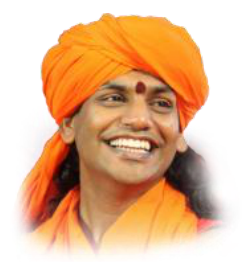
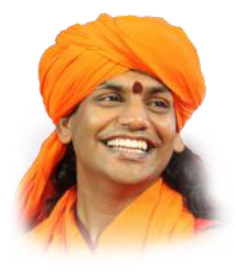
[Figure: Portrait of Paramahamsa Nithyananda]
MONKEYS IN THE MIND
O Kaunteya (son of Kuntī), the turbulent senses carry away the
mind of a wise man,
Though he is striving to be in control.
Having restrained them all, he should sit steadfast, intent on Me. Whose senses are
under control, his mind is steady in the present.
When a man thinks of objects, it gives rise to attachment for them. From attachment,
desire arises; from desire, anger is born.
From anger arises delusion, from delusion, loss of memory, from loss of memory, the loss of
discrimination, from loss of discrimination, he perishes.
The self-controlled man, moving among objects with his senses under control,
free from both attraction and repulsion, attains peace.
All pains are destroyed in that peace, for the intellect of the tranquil-minded soon
becomes steady.
A person not in self-awareness cannot be wise or happy or peaceful. How can there be happiness to
one without peace?
He loses his awareness of the present moment when his mind follows the wandering senses,
Just as the wind carries away a boat on the waters.
Kṛṣṇa says that our senses are turbulent, and however much we try to control them, they stay out of control. He says that the only way is to integrate and fix one's mind on Him once the senses are under control and the mind is steady. The mind cannot be stopped. Thoughts cannot be stopped as long as the body exists. You can bring integrity to your thinking by doing completion with your root patterns. Thus integrating your mind on something that transcends sensory pleasures, it will become quiet by itself. Once the mind discovers the bliss of this completion, it will never want to stray again.
Each one of us develops attachment, liking, hatred and dislike for many things through our experiences. These likes and dislikes stay in our unconscious memory as root thought patterns and even without any conscious awareness on our part, drive us into actions through desires or into inaction through fears. When the desires are fulfilled, there is temporary satisfaction; then the desires grow. When the desires do not get fulfilled we are disappointed, we get angry.
We should be angry with our own selves for having had the desires or for not having worked with authenticity, wholeheartedly at the peak of our capability towards fulfilling the desire, but we actually get angry with other people who we think are responsible for our failures. We do not realize that blaming others will make us feel more and more powerless!
Kṛṣṇa reveals two very important truths here in the last two verses. One is that you can never be peaceful unless you are complete, conscious. The other is that you cannot be complete if you are led by your senses. Therefore, as long as your senses lead you into what you think is a pleasurable journey; you cannot really be happy or peaceful. It is just another trick your mind is playing on you. Your happiness is not real happiness. It is just a gap between two periods of sorrow. What you hear, what you think you hear, what you see, what you think you see, and so on, all these sense inputs are unreliable, incomplete cognitions.
Understand, you can make whatever you can visualize as reality. With integrity and authenticity, visualize yourself in the space of non-falling, moving only from completion to completion, fulfillment to fulfillment. Your past is history. Your past record is the dumping ground of all your regrets and guilt. There is no greater sin that you can commit than carrying past records of these regrets and guilt.
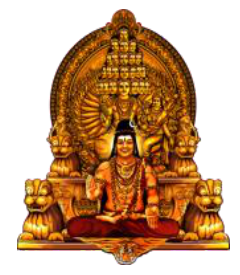
WAKE UP
O Mahābāho (mighty-armed one), his knowledge is therefore steady whose
senses are completely detached from sense objects.
The self-controlled man is awake in that which is night to all beings. Where all beings
are awake, it is night for the sage who sees.
Just as all waters enter the ocean, which, though always being filled from all
sides, remains unmoved; likewise, he, into whom all desires enter themselves, remains
unmoved, undisturbed, can alone attain peace; not the one who desires to fulfill desires.
The man who moves about abandoning all desires, without longing,
without the sense of ego—‘I’ and ‘mine’, attains peace.
O Pārtha, this is the state of Brahman, Brāhmī-sthiti; none is deluded after attaining
this.
Even at the end of life, one attains Brahmanirvāṇa, oneness with Brahman, when established in
this state.
We all think we are awake; are we really? We live in daydreams even if we are awake. The only occasion when we are truly awake is when we are in the space of completion. A person in such a space of completion is whom Kṛṣṇa calls a ‘Muni,’ a realized being living in the present. Such a person is always awake, having experienced his inner awakening, whether physically awake or asleep.
Kṛṣṇa says that such a person is in sleep when others are awake, yasyāṁ jāgrati bhūtāni sā niśā paśyato muneḥ (2.69). The realized person, although he may appear to be living and actively participating in the activities of the same world that we live in, is in reality, in a state of passive alertness or restful awareness.
This means that his senses are not immersed in worldliness and he is centered and complete in his Self. He is dead and asleep to this world because he has moved beyond his senses. A truly realized person is also awake when others are asleep, yā niśā sarva-bhūtānāṁ tasyāṁ jāgrati saṁyamī (2.69). Even in his sleep he is aware, in what is called the state of supta chittam.
A person who is in the space of completion is still as the waters in the bed of the ocean. Though there are waves in the surface, they do not disturb the bed of the ocean. Even when desires assail him, they are mere waves in the periphery of his consciousness, and do not disturb him at all. He has abandoned all attachment to ‘I’ and ‘mine.’ He is without thoughts and desires and when thoughts and desires come to him, they merge into him without disturbing him.
We are all enlightened because we are all a hologramic part of the reality of the Universe, Brahman. All that we lack is the awareness of the truth of our Enlightenment. What prevents you from realizing that you are enlightened is your root pattern, ego. This ego is not necessarily about any arrogance. It is the perception of who you think you are, your inner image; what you project yourself to be for others, your outer-image; and what others expect you to be for them, others’ image. It is the collection of thoughts, experiences and emotions that go to make up that ‘I’ and ‘mine.’ This identity is that of the body and mind, not of your spirit. Therefore, it perishes with your body and is transient.
People with a strong consciousness of ‘I’ live out of their blocked mūlādhāra cakra, the root energy center. They are at the very beginning of their spiritual evolution. Their main concerns will be about their own survival, and they are caught in lust, anger and greed. The person with a strong attachment to ‘mine,’ the possessions belonging to the ‘I,’ constantly lives in fear of losing these possessions. Such people live out of their blocked svādiṣṭhāna or spleen cakra—the energy center that gets locked due to fear. They live in insecurity of losing possessions, of losing identity, and finally, of death.
Energization of the mūlādhāra and svādiṣṭhāna cakra and moving the energy up through the anāhata or heart cakra to the ājña or thirdeye cakra (energy center between eyebrows) opens us to completion, the reality of looking at others, at Universe as our own self and finally dropping the root pattern—one’s identification with ‘I’ and ‘mine.’
Listen! Completion can make you experience Advaita (nonduality), the ultimate space of Consciousness, immediately. Then, true surrender to the Universe and identification with one’s true nature occurs, and Enlightenment happens. You then become God!
The science of completion is the essence of Sāṅkhya Yoga. Completion makes you experience the Sāṅkhya of life. In this second chapter of Gītā on Sāṅkhya Yogaḥ or Transcendental Knowledge of Completion, Śrī Kṛṣṇa who is the space of completion Himself, sets Arjuna on the path of completion. May all of you travel that path too!
Let us pray to the ultimate Existence, Parabrahma Kṛṣṇa, to give us all the experience of eternal bliss, Nityānanda. Thank you!
Thus ends the second chapter named Sāṅkhya Yogaḥ, 'The Yoga of Knowledge of Completion,' of the Bhagavad Gītā Upaniṣad, Brahmavidyā Yogaśāstra, the scripture of yoga dealing with the science of the Absolute in the form of Śrī Kṛṣṇārjuna-saṁvād, dialogue between Śrī Kṛṣṇa, Arjuna.