Rājavidyā Rājaguhya Yogaḥ
This text was machine-transcribed from the printed book and may contain errors. Select the words and choose “Report a mistake”.
Bhagavān Kṛṣṇa says:
Dear Arjuna, because you trust Me and you are not envious of Me;
I shall therefore impart to you this profound and secret wisdom and experience;
This will free you of all miseries of material existence.
This knowledge is king of all knowledge and the greatest secret of all
secrets.
It is the purest knowledge, sacred, and because it gives direct perception of
the Self by Self-realization, it is the perfection of religion, dharma. It is
eternal, easy, and it is very joyfully performed.
Those who have no faith in this knowledge cannot attain Me, O Parantapa, conqueror of foes;
They will return to the path of birth and death in this material world.
The Ultimate Secret
The very idea that Arjuna might be envious of Kṛṣṇa may surprise us. Understand, whenever the Masters were in the body, people never respected them. This problem always existed. Only after they left the body did people accept and worship them. Actually, it is easy to worship a photograph. There is no sacrifice or transformation required. However, it is never easy to worship a living being. The living person will always be questioned and envied.
Kṛṣṇa is giving the ultimate secret, guhyatamaṁ. Once we know this secret, then there is no difference between the Divine and us. Here He gives us the straight, ultimate secret.
Rājavidyā, King of All Knowledge
Yoga means achieving. Kṣema means protecting. Both are miseries. Whether we have or not, it is misery.
Kṛṣṇa says that the miseries of having wealth and not having wealth, both miseries that are caused by material existence disappear by knowing this secret. And I tell you honestly this is the ultimate secret that needs to be understood. Knowledge of this secret liberates you.
He says, ‘This knowledge is the king of all knowledge. The greatest secret of all secrets, it is the purest knowledge and because it gives direct perception of the Self by realization, it is the perfection of religion. It is everlasting and it is joyfully performed.’
Now He lets Arjuna know what kind of people can know the secret. He says people who do not have śraddha, faith in dharma or His teachings go back to the path of rebirth without Enlightenment, without attaining Him. He says the qualification required is to have faith in His teachings. Only those people can come out of the vicious cycle of birth and death.
You see, having authentic faith, śraddha is one of the most important things, especially in the spiritual
path. Whenever an Enlightened Master speaks, every word he utters is the Absolute Truth. That is why I always add the words, ‘Whether you believe it or not, accept it or not, understand it or not’, whenever I talk about some Truth. When I say we are part of the same Consciousness, when I say that we are all one, and each one is infinitely powerful, our mind cannot accept it because it tries to find a logical solution, an intellectual answer to everything. So you must have śraddha, faith in me to understand what I speak.
Śraddha, Authentic Faith In Master
There are three possible levels in which you can put faith in what a Master says.
With the first level or group, you can have doubt. That is obvious. You doubt what I say, what an enlightened Master says, because you can't comprehend what I say. See, you can have doubts. In fact, you should have doubts, only then you question what I say. However, you should look-in to find out if those doubts are genuine. If they arise out of ego, then it is your mind playing a game. Your mind creates a wall between you and Me.
The second group or level is when you believe whatever I say. This is dangerous. Believing whatever I say without intranalyzing, cognizing, and experiencing it for yourself is dangerous. When I say that ‘you are God’, if you just straightaway believe me it is dangerous, because you have not experienced it. If someone questions you on your belief, you will be unable to stand by it. You will stammer and stumble and do yourself harm.
The third approach is trust. When you trust me, you accept what I say. You still have doubts. However, you are willing to break that wall and try to see and experience what I am saying. You build your foundation and you make it strong because you trust me. This is the way authentic faith, śraddha should develop. Faith should arise from a strong foundation of integrity and authenticity. First you trust me, then you try exploring the truths I share and when you have a glimpse of the truth, you believe me with a stronger foundation. Now nobody can shake you because you have developed a strong base. You have done the work yourself.
So, Kṛṣṇa gives a technique. He says, ‘Have śraddha, faith in dharma and it will lead you to the Ultimate.’
By Me, the entire Universe is pervaded in My formless form. All beings are based in Me, but
I am not in them.
And yet everything that is created does not rest in Me. Look at My mystic powers! Although,
I am the Creator and Sustainer of all living entities, I do not depend the Cosmic
manifestation; for My Self is the very source of all creation.
As the mighty wind, blowing everywhere, always rests in eternal space, All beings rest in Me.
O Kaunteya (son of Kuntī), at the end of every age all beings merge into Me, At the beginning of
every new Age I create them again.
The whole Cosmic order is under Me and My material nature creates the beings again and again, and
it is controlled by My material nature.
The whole Universe is pure intelligence. The whole Universe is not dead matter. The Universe is not an accident. It can respond to our thoughts. Please understand, the whole Universe, planet Earth, air, oceans, rivers, earth, fire, or the space, sun, moon, this whole Universe, is intelligence. It can reciprocate. It can respond. It can react to our thoughts.
The moment we understand that we are this energy that is intelligence, the moment we are aware that we are inside the energy that is intelligence, at that moment, we immediately settle into a deep relaxation. The moment we experience, we understand: we are under the guidance of an intelligent energy. We are taken care of by an intelligent energy, we are part of the Cosmic intelligence and we don’t need to struggle or stress ourselves. We don’t need to torture ourselves with insecurity problems, unnecessary worries.
When we enjoy the process and trust the Universal intelligence, thoughts arising out of fear and greed will disappear. We will enjoy the process of doing and we will let the Universe take care of the results. Kṛṣṇa says elsewhere, ‘You do what you have to. Do it, but surrender the results to Me.’ When He says ‘Me’, He refers to the Universal consciousness or intelligence.
This is what Kṛṣṇa means in the next verse when He says that the beings do not depend on Him, nor does He depend on them. Of course, it is clear that the Universe does not depend upon us; yet how can He say that we, the beings created and sustained by the Universe, do not depend upon it? What He means is this: it is not a passive and lazy dependence of letting everything happen while we sit idle. It is an active understanding.
One does what one must do as part of his life process but without attachment and ownership.
Levels of Space, ākāśa
There are three levels of space.
The first level is when we are limited to what is inside this skin. This is Ghaṭākāśa, what is contained within our body. We limit our whole understanding of everything around us to this body. We become conscious of how this body should look, how it should be maintained. We think we are only this body and nothing else. This is the lowest level.
The next level is Cidākāśa. This space refers to what our mind perceives as the world. Let’s say we are sitting here but our mind is in Los Angeles. Then that (Los Angeles) becomes our cidākāśa, the space perceived by our mind. The next moment our mind shifts to Bangalore. Then that becomes our cidākāśa. The space that our mind operates in is cidākāśa.
The third and final level is Mahākāśa. The whole Cosmos, everything that is outside and that is inside forms mahākāśa. This is the ultimate level. This is the level where everything that we see as different becomes One.
Please clearly understand these three spaces. Our body, everything that is inside this skin is ghaṭākāśa. Next, the space governed by our mind, by our thoughts, is cidākāśa. Finally, the whole Universe, the whole cosmos, forms mahākāśa.
Now, if something happens inside our body, we immediately feel it. If we are hurt, we clearly see the blood flow. We see a rash or a cut. We clearly see and feel any disturbance or event in ghaṭākāśa at a gross level.
When we go to the next level, cidākāśa, events that disturb or change this space are subtle. Our thoughts affect cidākāśa. Listen! Whether we believe it or not, our thoughts have a huge effect on the external world. Whatever thought comes, don’t think that it simply comes and goes. Every thought is energy. It manifests as something in the external world. The problem is that we are unaware of the effect. The effect is subtle so our mind cannot see that what happens is because of those thoughts we entertained.
Our mind thinks something. It affects this cidākāśa, our inner space. These changes are projected into the external world, yet our mind is unable to recognize that all it sees is because of itself.
So, as we advance one level higher, the changes become more subtle but the effect is more powerful. In ghaṭākāśa, the effect is limited to our body. In cidākāśa, our thoughts affect the space around us. The effect is seen in a bigger space. The effect is more widespread.
Now the highest level is mahākāśa. This level is subtler than cidākāśa. Any change here affects the whole Universe. When something happens in this space, the whole Universe responds. When we enter this space, we realize the ultimate Truth. We merge with everything, with the whole Cosmos.
Kṛṣṇa says that only He can create and destroy this Universe at His will. This whole Universe is a manifestation or a projection of our own self. Please listen: We make our own world. We create the reality what we want. We create our world through our needs or desires. We don’t see what IS! We are only seeing what we want. Only an Enlightened being sees the real truth, as it IS. Once we understand everything is a mirror image of our own self, we become enlightened. Once we realize that we, along with everything else around us, are part of the same energy or Consciousness, we become enlightened.
In these two verses, Kṛṣṇa says this truth clearly. Every material manifestation is created by Him and goes back into Him. He says only He can create and destroy it at His will, which means the world that we see, the Universe that we perceive, is a projection of our own Self.
9.9 O Dhanañjaya, all this work does not bind Me. I am ever unattached from these activities, seated as though neutral.
9.10 The material nature or prakṛti works under My direction, O Kaunteya, and creates all moving and unmoving beings through My energies. By its cause, this manifestation
is created and annihilated again and again.
Fools deride Me when I descend in the human form.
They do not know My transcendental nature as
the Supreme Lord [maheśavara] of the entire creation.
Those who are thus deluded are demonic and atheistic. In their deluded condition, their
hopes for liberation, their result-oriented actions and their culture of knowledge become
false and useless.
Kṛṣṇa speaks of a divine play. He talks in terms of the Universe being created and destroyed from Universal consciousness. If we understand His words, we can apply them to day-to-day activities.
Drop your Attachments, Be Unclutched
Our material possessions create greed and fear in us. We are either in fear of losing them or we want to get more and more of them. We attach so much importance to them that getting more and more of them becomes our only goal. Naturally when we have so much, we create a fear of losing them. The problem is we associate ourselves with material possessions. Again and again, we run after them and forget who we are. So many people are in the rat race. They spend their lives accumulating money, bungalows and cars. And at the end of their life, they regret; they wonder what they have done in their lives. We are in a state of continuous fear.
This is one kind of attachment. There is another kind of attachment. We are attached to people. We create strong bonds in relationships. These are also attachments. We start possessing people. The possessiveness grows so strong that we suffer when someone leaves us or dies. We become so dependent on persons that our whole life seems to lose meaning when they die.
Actually, in this kind of bondage we define ourselves based on the opinions of other people. So we constantly hold on to that relationship because it gives us energy; that relationship helps us define ourselves. So when a person dies, we feel depressed because whatever we were holding to very tightly was the source of energy for us. That was defining us till now and now it is no longer there. It has disappeared. So our whole system is shaken.
Now there is the third kind of bondage or attachment. It is related to our thoughts and emotions. Whenever something happens, we start linking it with our past and start fantasizing about the future. Be very clear, a thought arises because our mind jumps from the past to the future. When a thought arises, we link up that thought with other thoughts and create thought patterns.
None of the thoughts are linked to each other. We create a shaft binding all these thoughts. Each thought is like a bubble in a fish tank. If you see bubbles rising in a fish tank, they are unrelated, unconnected and disjointed. However we create an illusory shaft and link them up. We attach ourselves with that shaft and start experiencing them. We let the thoughts control us.
In the same way, we deal with our emotions also. We create a shaft of all our pains and all our joys and associate with it. If we see that our pain shaft is longer than the joy shaft, we conclude that we had a painful life; we had a miserable life. Otherwise, we say we have a happy life. Yet if we look deeply, each of the pains is completely unconnected, disassociated, and disjointed.
For example, the headache that you experience today is not associated to the headache that you had one week ago. The headache that you had one week ago is not associated to the headache that you felt one month ago. But what do we do? We associate and connect all these and say we have always had headaches or migraines. We fail to see that all the events were independent events. We create a shaft through all these pains and come to a conclusion.
In the same way, if we have a joful experience, we want to hold onto it. We want to experience that joy again. We look for that source of joy and continuously run after it. This again leads us into the rat race.
Disowning incompletions is complete Completion! If you are convinced you have disowned these incompletions, you are complete!
Here Kṛṣṇa says He is neutral. Kṛṣṇa is in the space of complete completion, the eternal completion! How do we get ourselves unconnected from these attachments? Please understand that being unconnected
from material possessions does not mean you leave everything and go away. Being unconnected from relationships does not mean breaking your relationships, forgetting your children, parents and others.
Please understand this very deeply. Being neutral or unconnected has a deep meaning. Being neutral means being a spectator. It is like this: When you watch a movie, you watch something on the screen. Do you become an actor in that movie? No. You watch it and let it go.
In the same way, we need to watch attachments. When we watch them as a spectator, we get detached from them and complete with them. What do I mean by that? When we watch our materialistic wealth, we will not run after it. We do our job because we love it, not because we want to accumulate wealth.
In relationships also, we must be a spectator. When we stop seeing someone as a possession and when we become a spectator to the relationship, our dependency on that person and expectations from that person drop. When dependencies and expectations drop, there is no give and take in the relationship. There is only giving, only enriching. The relationship becomes stronger and completion with other happens.
When we become a spectator to our thoughts and emotions, we feel a great sense of liberation. All we have to do is break the shaft that we create between different unconnected thoughts and emotions. We have to ‘unclutch.’ When we see thoughts like passing clouds in the sky, we stop associating ourselves with them. We are no longer controlled by them.
Listen, being a spectator to thoughts does not mean that we suppress or destroy thoughts. We are not Brahma, the Creator, or Viṣṇu, the Sustainer, or Śiva, the Rejuvenator. When we become a spectator, we go beyond these three states. We transcend the trinity. By being a spectator, we remain unaffected and unattached to what happens in and around us. This is the truth. If we can internalize this completely, we will be enlightened this very minute!
Kṛṣṇa says that although He is a mere spectator, everything happens under His supervision. Here He shows His authority. He says the material world is created and annihilated according to His will through the power of prakṛti, Nature and the energy of māyā, Illusion.
Fools Deride an Incarnation
In the next verse Kṛṣṇa says, ‘Fools deride Me when I descend in the human form. They do not know My ultimate nature, eternal nature, as the supreme Lord of all that is.’
avajānanti māṁ mūḍhā mānuṣīṁ tanum āśritam |
paraṁ bhāvam ajānanto mama bhūta maheśvaram || 9.11
Here Kṛṣṇa uses a strong word: ‘Fools, mūḍhā’. Incarnations, Enlightened Masters don’t edit their words. They speak the truth as it is. Usually, normal people edit because they fear others’ opinions. See, normally in all your minds, three processes happen: first, words are created, then edited and then finally presented. In Masters, these three processes don’t happen. Straightaway what is created is presented. That is why, whatever words they utter become reality.
Listen. The world does not create words in them. Their words create the world around them. They express integrity, the power of words, vāk śakti. The words you utter towards you and towards others can do so much to your life. If you want to harness the power of words, the practice you need to do is integrity. Bring Integrity. Align all your words more and more towards completion.
Integrity means aligning your words, internal and external, more and more towards completion; that is integrity. Aligning the words you utter inside and outside you towards completion is integrity.
Only for an integrated person whose inner chatter has become pure, not only his words, his thinking becomes pure. That person can talk in a relaxed way for hours in public. To speak in public, that too in a relaxed and casual way, we need our inner being to be in pure integrity with our words and pure authenticity with our thinking. Only then can we talk whatever comes and be relaxed and complete.
When we practice integrity, we will experience the power of words. But the power of thinking is deeper than the power of words. The power of thinking will be available to us when we
practice authenticity. Masters don't edit; they express whatever they think. With authenticity, their thinking has become so pure, they simply harness the power of thinking and words, and so they don't need to edit. Even if they use sharp words, they are spoken to awaken you.
Why Masters Descend?
When an enlightened Master is in human form, we do not accept him as a Master. Only after the Master leaves the body do we pay our respects to the Master. Why do people again and again do this?
You see, when the Master is in his body, in human form, our mind sees him as another human being. Then our ego comes between him and us. It reasons, 'He is another human like me. Why should I listen to him?' All these questions come. We decide we don't have to follow another human being and go back.
A simple act of ego makes us miss a living enlightened Master. Our being wants it; however our mind and ego create a strong wall of questions between the Master and us. We miss the opportunity. And one more thing, some people know that a person is a Master and what he says is good for them, yet they escape. This is because they know that the Enlightened Master can see through them. They do not want anybody to know what a mess they have created in themselves.
O Pārtha (son of Prithā), the great souls, who are not deluded, are under the protection of My
Divine nature.
They are fully devoted to Me with a single-pointed mind
as they know Me as the origin of all creation, the unchangeable.
Always chanting My names and glories, fully striving with great determination, bowing down
onto Me, these great devotees of firm resolve, perpetually worship Me with devotion.
Some worship Me by acquiring and spreading wisdom of the Self [jñāna-yajña]. Others worship
Me in My non-dual form in oneness, in My infinite form as many, and in My Universal form.
Kṛṣṇa speaks about bhakti or devotion in these verses.
Prayer should express our devotion, gratitude, and love to God. All great devotees of Kṛṣṇa and Rāma showed complete gratitude and love. When devotion reaches that state, they reach the Ultimate Consciousness.
Kṛṣṇa continues to explain to Arjuna the ways in which people worship Him. Here he talks about the path of jñāna, knowledge: Those following the path of knowledge try to worship Me by acquiring and propagating knowledge.
Understand that mere accumulation of knowledge only increases ego. It does not give enlightenment. Internalize the knowledge by authentic listening, by meditation, and contemplation, and by enriching others and yourself with the experiential wisdom. Then the breeze of joy will flow into your life.
How can we internalize knowledge? Do meditation. When you are alone, think and contemplate upon great truths. Deeply immersing ourselves in contemplation is a meditation. Question those truths and try to find answers within yourself.
Meditation enriches us here, especially in the path of jñana or knowledge. You see, the path of knowledge is not an easy path. In the path of devotion, all we have to do is pray to some form: either Kṛṣṇa or Rāma or someone, have complete devotion to that chosen God. We must completely surrender. Actually, total surrender is difficult; however, in the path of devotion, at least we have someone to talk to, pray to and look up to.
However in the path of knowledge, there is no reference point. No one is in front of us. In this path, there is nothing called you and He. In the path of devotion, there is a clear separation between Kṛṣṇa and us. In the path of knowledge, Kṛṣṇa says that everything is Kṛṣṇa. There is no duality.
When we meditate, we experience the great truths. Through meditation we connect to our inner space and learn to create the space of completion. All the knowledge in the scriptures, the Upaniṣad, talks about microcosm and macrocosm.
I am the ritual, I am the sacrifice, I am the offering, I am the herb, I am the mantra, I am the
clarified butter, I am the fire,
and I am the oblation.
I am the supporter of the Universe, the father, the mother, and the grandfather.
I am the object of knowledge, the sacred syllable "OM", and also the Ṛg, the Yajur, and the Sāma Vedas.
I am the goal, the supporter, the Lord, the witness, the abode, the refuge, the friend, the origin, the dissolution, the foundation, the substratum, and the immutable seed. I give heat. I send, as well as withhold the rain. I am immortality as well as death. I am also both the Eternal and the temporal, O Arjuna.
We are all Brahman; we are all divine. God is everywhere. Divine energy fills and overflows in all the places. This is what Kṛṣṇa says in these verses.
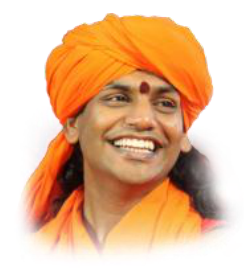
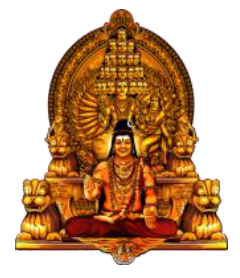
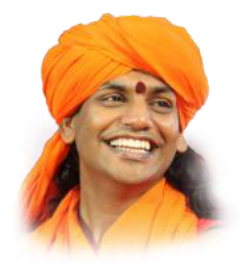
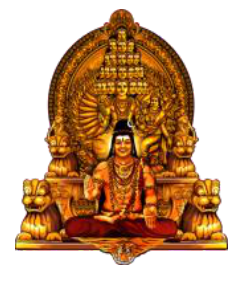
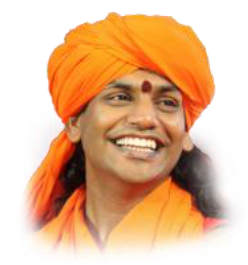
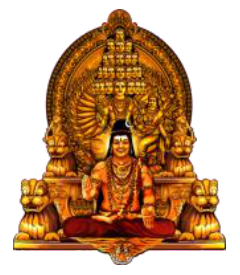
This is the basic truth. Whether we believe it or not, accept it or not, understand it or not, this is the truth. We can call 'It' God—Kṛṣṇa, Śiva, Universal Energy, Cosmic Energy, Parāśakti or Brahman. Whatever we may call It, It is present everywhere. When we worship some idol or form, we actually worship the formless energy behind that idol. People ask me, 'Why do we keep your photo in front of us and pray to it? Why can't we meditate on the formless?'
I tell them, 'First start meditating on the form, then you can go to the formless.' Our mind is continuously jumping everywhere. In such a state, we first need a form to bring our mind to the present. A form is necessary in the initial stages for the mind to calm down. Once we Master this, meditating on the formless becomes easier. We should understand that we are worshipping through that idol and not the idol itself.
Those who practice the vedic rituals and drink the soma juice, worship Me indirectly seeking
the heavenly pleasures.
They go to heaven and enjoy sensual delights.
Once they have thus enjoyed heavenly sense pleasures, they are reborn on this planet
again.
By practicing vedic rituals as result-oriented actions, they are bound by the cycle of
birth and death.
When you reside in My consciousness, always fixed in undivided
remembrance, whatever you lack I give [yoga].
And whatever you have, I preserve [kṣema].
Even those who worship other deities with faith, they actually worship Me, O Kaunteya, but
without the true understanding.
I am the only enjoyer [bhokta] and the only Lord [prabhu] of all sacrifices. Those who do not
recognize My true transcendental nature are born again and again.
Kṛṣṇa says that people who read scriptures, the Vedas, and who perform pious ritualistic activities based on scriptural injunctions with the aim of acquiring merits, enjoy heavenly pleasures; however they fall back into the cycle of life and death after they finish enjoying these pleasures.
Kṛṣṇa speaks about the attitude or the context from which we read Vedas and Upaniṣads or how we perform rituals. Scriptures have immense knowledge. Rituals have immense power. They are meditations; however they are useless if done with the wrong context of fear and greed.
When we perform certain rituals, be it pūjā or prayer or reading scriptures, it should become a meditation. It is the experience of you that you are having about you. Our ego, our fear and our greed should not come in the way. It is like this: when we perform rituals, do them with integrity and authenicity, out of the right context of completion.
What you Lack I give, What you have I Preserve
Now, please come to the space of listening.
The next verse is the main core that reveals the secret of secrets. Kṛṣṇa tells Arjuna and all of us:
‘Those who always worship Me, those who always reside in Me, those who have ananyāś cintayanto— means the non-dual mood, the space of Advaita, means those who have become Me, people who have experienced eternal consciousness, those who reside in eternal consciousness—to them, I carry what they lack and I preserve what they have. I personally take care of them.’
ananyāś cintayanto mām ye janāḥ paryupāsate |
teṣāṁ nityābhiyuktānāṁ yogakṣemaṁ vahāmyaham || 9.22
Please be very clear, no other Incarnation has revealed this truth so clearly. He says, ‘If you reside in eternal consciousness, divine energy, bliss consciousness, I take care of you in all ways.’
Yoga and kṣema: I give them whatever they want spiritually and materially and I take care that it stays with them. I take care that nobody takes it away from them. This is a beautiful statement and assurance.
Please understand, it is not only an assurance; it is a promise. Kṛṣṇa gives a promise, ‘If you reside in My consciousness, if you reside in eternal consciousness, whatever you lack will be given and whatever you have will be preserved.’
Again and again, Vedānta says, dṛṣṭi-sṛṣṭi, we create what we see. We create the Universe from the angle of our vision. When our dṛṣṭi (vision) changes, the sṛṣṭi (world around us) changes too. We project our world and see. It is the truth.
I tell you, this is a promise by the Divine. Nine years I lived in utter insecurity. I know Kṛṣṇa still proves His words. His words are guaranteed—yogakṣemaṁ vahāmyaham, He does!
I can quote thousands of incidents from devotees’ lives. From so many devotees’ lives, Tukarām, Tulsidās and so many masters’ lives I can quote to support these words. I can quote numerous incidents from my own life, from the life of people I have met.
Let me tell you a small incident that happened in my own life during my days of spiritual wandering before the happening of enlightenment.
I was staying in Hardiwar at a place called Kankhal. I was doing spiritual practice. Every day morning, I went for alms to places where they feed monks. In so many ashrams, they give alms to monks. I used to get my food, eat two or three rotis (Indian bread) and then start meditating.
Suddenly, one day, I fell sick. I had a high temperature and diarrhea. I was unable to walk. I thought, ‘What can be done? Alright! Let it be.’
Suddenly, a young Sannyāsi came from nowhere and gave me food. Not only for one day but continuously for three to four days, he came; he brought food for me. Not only food, he brought medicine also. I asked him, ‘Who are you? Where have you come from?’ He said, ‘Oh, my name is Śaṅkar. They call me Śaṅkar Mahārāj. I stay at a nearby ashram called Sādhana Sadan.’ He pointed towards a distant place and said that is where he stayed.
Everyday he brought me food and medicine till I recovered. He came for at least four days. Because he came everyday, I talked with him. We became acquainted.
I saw that he wore a beautiful pen with a diamond in it. I was surprised at how a monk got a diamond pen. I asked, ‘What is this, Swami?’
He said, ‘This is a diamond pen. Some devotee gave it to me. It looks nice, so I wear it.’ Anyhow, I did not bother about it.
After several days, when I returned to normal, he stopped coming. By then, I was okay. Then I thought, ‘I must go and see him. Now I can walk and move, so I should go and see him.’ I felt a little connected to him because he served me. I felt I must thank him. After a week, when I became completely alright, I started walking.
I went to this ashram and asked an elderly person sitting there, ‘Swamiji, I want to see Śaṅkar
Mahārāj.' The Swami said, ‘Śaṅkar? Who are you talking about?' I said, 'I want to see Śaṅkar, a young swami. I met him two to three days ago. He came everyday and brought me food. Is this Sādhana Sadan?'
This Swami replied, 'Yes, this is Sādhana Sadan. In our ashram, there is only one Śaṅkar. Go to the temple and see. He is the only Śaṅkar Mahāraj we have!' He pointed towards their temple.
I tell you, what I am telling is the truth. When I entered the temple, I saw a Śiva deity as a white marble statue with a cloth draped on His upper body, and wearing the same diamond pen on Him!
Of course, tears rolled down from my eyes. So much gratitude overflowed. Later, I asked the temple priest, 'How did this pen come to Śiva? Who put a pen on Śiva's statue?' He said, 'One week ago, a devotee came and offered the pen. It looked nice and he said it was a diamond pen. We just wanted to decorate Śiva with diamond jewelry. So we put the pen on Him.' It was the same pen! The very same diamond pen!
I asked, 'Who gave a pen to Śiva?' Other jewelry, we can understand, but a pen?
He replied, 'I don't know. A devotee came and offered this pen.
I asked, Why should a Sannyāsi have a diamond pen? I will give it to God instead. So I put it on Śiva. I just inserted it into Śiva's clothes.'
He then continued, 'For the last few days all the food of fering, prasād that we place in front of Him, disappears. I suspect that rats have been eating the food. So now I am careful. I sit for a while after placing the food for Śaṅkar Mahārāj.'
I did not want to tell him that I was the rat who ate Śaṅkar Mahārāj's food!
During the 2006 Himalayan trip I searched for this ashram and Śaṅkar Mahāraj's temple with my devotees. After many years, it was still the same, the same temple and the same Śaṅkar Mahāraj; but no diamond pen now!
Bliss Attracts Fortune
There is a beautiful mantra in tantra śāstras: 'ānanda kamaprāṇaḥ' that means 'bliss attracts fortune.' When we create a blissful inner space, automatically we attract external wealth. We need three things: clear integrated thinking, a creative authentic mind that aligns our thoughts and words, and the ability to make spontaneous decisions. The ability to respond spontaneously to any situation with the truth, that we are responsible for everything happening inside and outside us, is responsibility.
Just let your inner space be completely integrated with the words you utter. If we are able to respond spontaneously to any situation standing with the strength of integrity and authenticity, we take that responsibility. We need integrity, the power of words that brings the experience of completion with ourselves and with life. We need authenticity, the power of thinking that expresses as the peak of our creativity and the power of feeling to take responsibility.
All we need to do is transform our inner space to the space of completion, the space of eternal bliss. The first thing is to understand this secret. Whether we believe it or not, it is the truth: a basic secret. Once we enter spiritual life, once we decide we want to lead a spiritual life, all our worldly things are taken care of by the Divine. It responds to whatever we need and it takes care of whatever we have.
When we understand that we are a friend of the whole of Existence, even after death we will not disappear because we know we will be there in the Universe in some form; that there is nothing to worry about.
I tell you this from experience: It is practical. From experience I tell you, we never perish. We continue to exist, in some form, somewhere. Even if we become enlightened, we become a pure conscious energy. We will be there, everywhere. We never die when we understand that Existence is intelligence.
Those who worship the deities will take birth among the deities; those who worship ghosts and
spirits will take birth among such beings; those who worship ancestors go to the ancestors
Those who worship Me will live with Me.
9.26 Whoever offers Me with love and devotion a leaf, a flower, fruit or water, I will accept and consume what is offered by the pure-hearted.
9.27 O Kaunteya (son of Kuntī), all that you do, all that you eat, all that you offer and give away, as well as all austerities that you may perform, give them as an offering to Me.
9.28 You will be freed from the bondage of work and its auspicious and inauspicious results. With your mind fixed on Me in this state of renunciation, you will be liberated and come to Me.
Kṛṣṇa talks about the kind of life that we lead now. The last thought that we have at the time of death determines our next birth, next life. Please listen, our next life is completely dependent upon our last thought at the time of our death.
When we sleep at night, we actually change bodies. We are not aware that this happens. When we dream, we see ourselves doing various things in the dream. We run, talk, eat, and do everything in the dream. In our dream, we have created a world in which we live. If our body is on the bed, then who is this body in the dream? Our gross body is on the bed, while our subtle body is active in the dream. In the same way, the causal body is active during the deep sleep state.
This is the reason I tell anyone who think that they are following me or want to follow me: do completion for forty-two minutes before you sleep every night. Always sleep in the space of completion. If you have a dreamless sleep, I guarantee, you will have birthless life! If you have dream-free sleep, you will have birth-free, death-free life.
Every night do completion and every morning do heavy weight-lifting and yoga! I tell you, just these two will make you enlightened. Because, every night completion will lead to vedic mind and every morning heavy yoga will lead to yogic body. And these two will take care the whole day that you will have enlightened living. That's all! You don't need any other spiritual practice.
Exactly what happens everyday during sleep is exactly the same thing that happens during the time of death. Be very clear, the process of sleep and the process of death are not different. During the process of death, the soul passes through seven energy layers. The next body it enters depends on the vāsana, or the carried-over desires, the root patterns that it comes with, from the previous life. It takes up a body that can help shed that vāsana in the next life. Our soul always tries to merge with the colorless and formless universal consciousness. However, the vāsana creates a slight tinge on the soul and it cannot completely merge with the Universal consciousness. So the soul takes up another body that can help remove this tinge and help it merge.
Now it is up to us how we make use of this lifetime. We can either fulfill our unfulfilled desires of the previous life by completing with our root patterns or we can build new desires in this life and stay in the cycle of birth and death. The kind of life that the soul chooses in the next life depends entirely on the vāsana and the last thought at the time of death.
In Simplicity Lies Greatness
He says next: ‘If one offers Me with love and devotion, a leaf, flower, fruit or water, I will accept it,’ He says, ‘The Existence, the Divine is so alive that It responds to even simple things.’
Listen, He doesn’t say, I accept only big things. He says, even simple things, I accept.
patraṁ puṣpaṁ phalaṁ toyaṁ yo me bhaktyā prayacchati ।
tadahaṁ bhaktyupahṛtam aśnāmi prayatātmanaḥ ॥ 9.26
‘If one offers Me a leaf, flower, fruit or water with love and devotion, I will accept it.’ This is the greatness of the Divine. The greatness of the Lord is that He is simple. Simplicity is the greatness of the Lord. Listen, simplicity is the real greatness. To be big, you don’t need intelligence. Any one can show himself as big.
Simplicity is the great quality of the Divine. He says, ‘Just a leaf, a flower, a fruit, a little water... simple things are enough. I accept it. I am pleased. I respond to it.’
He says in the fourth verse of this chapter:
mayā tatam idaṁ sarvaṁ jagadavyaktamūrtinā
I am all-pervading, great, ultimate, divine.
Now, He says even though He is all-pervading, even though He is big, He accepts any small thing given with love and devotion. One major problem: Even if we know somebody is big or great, we can't relate with him unless he relates with us, unless he comes down to our level. Real greatness is not only being great. He must be able to relate with everybody.
Here, Kṛṣṇa creates a way, even for ordinary people to relate with Him. On the one side, He shows His greatness. He declares with authority His greatness. On the other side, He shows us how to relate with Him. He says, ‘Even if you offer a leaf, flower, fruit or water with love, I accept it. I relate with it.’
First thing Kṛṣṇa reveals is: He proves that the whole Cosmic energy, the whole Universe is intelligence. Next, the moment we understand it is intelligence, we relax from all tension, worry, fear and insecurity. He makes us understand that He is next to us and we can relate with Him easily.
See, as long as we think the world is material, matter, we feel like protecting ourselves from it. We feel that is the Whole and we are part. We fight with the Whole. That is why we feel deeply uprooted. We don't feel connected and relaxed. We don't feel homely because we fight with the Whole. The moment we understand we are part of the Whole, the Whole is the intelligence that responds to our thoughts, to our being, which responds to our consciousness, we relax into enlightenment!
Next, He says, ‘When you drop yourself into the Eternal Consciousness, I take care of your yoga and kṣema. I take care of whatever you lack. I will supply what you lack and preserve what you have.’
Next He says, ‘Even a simple leaf, water or a fruit or flower when you offer with love and devotion, I accept it.’ Please be very clear, He is not asking because He doesn't have these things.
He is the one who gives everything to us in the first place! But when we offer, we show to the Divine: I want to connect to you. We show the Master, ‘Oh Lord, I want to connect to you.’ And the Master feels, ‘When he wants to connect to Me, let Me connect to him.’ We show a green signal for the Divine to enter into our space.
Levels of Surrender
There are three levels in which we can surrender to the Existential energy.
The first level or basic level of surrender, is that of our actions. Whatever we do, whatever our actions are, surrender them to the Universal energy. All our actions, whether good or bad, when we surrender, will be taken care of. This is the basic level. Kṛṣṇa clearly says this in these verses, ‘All your reactions to good and evil will be taken care of, if you offer all your actions, all your austerities to me.’
When we surrender our actions, we are not bothered about what will happen in the future. We know that now the ball is in His court; He will take care of whatever is going to happen; He knows best. When we surrender our actions, we put our entire burden on His shoulders. Whatever good or bad happens, He is now responsible and we also know that He can never do anything wrong.
The second level of surrender is that of intellect and mind. The first level is easier compared to this. When I say surrender our actions, we can say, ‘Okay, I have done it.’ But surrendering our mind is more difficult because it is not in our hands.
The third and the most difficult level of surrender is that of the senses.
A history from Mahābhārat illustrates this:
Once, Kṛṣṇa and Arjuna were walking outdoors. While they walked, Kṛṣṇa suddenly pointed at a crow on the tree and told Arjuna, ‘Hey Arjuna, can you see that green crow?’ Arjuna replied, ‘Yes Kṛṣṇa, I see it. I see the green crow.’
After some time, Kṛṣṇa pointed to another crow and said, ‘Arjuna, can you see that black crow?’ Arjuna immediately replied, ‘Yes Kṛṣṇa, I see the black crow.’
Kṛṣṇa asked Arjuna, ‘Are you a fool? Earlier when I showed a green crow, you said you can see a green crow. Now when I showed a black crow, you say you can see a black crow. Are you a fool? How can a crow be green?’
Arjuna replied, ‘O Kṛṣṇa, I don’t know all that. When you asked me to see a green crow, I saw a green crow. Now when you asked me to see a black crow, I saw a black crow.’
This is surrender of the senses! Arjuna had surrendered completely to Kṛṣṇa. He had surrendered even his senses to Kṛṣṇa. If the Master says something, the disciple takes it as it is. That is the level of surrender. When we reach this level of surrender, we are one with the Divine. The Divine takes cares of us.
Kṛṣṇa says this clearly. Every Enlightened Master makes this promise. When we surrender ourselves to the Master, to the Divine, to the Universal energy, it takes care of us. When we offer all our actions to the Universal energy, It takes care of us. The entire burden on our shoulders is offloaded. This is the promise of every Enlightened Master.
I am equal to all beings. No one to Me is hateful or dear. But, whoever worships, offers
enriching service onto Me in devotion, is in Me and I am also indeed in him.
Even if the most sinful person engages himself
in devotional service, he is to be considered saintly because he is properly situated in
his determination.
He quickly becomes a righteous being [dharmātma] and attains lasting peace.
O Kaunteya (son of Kuntī), declare it boldly that My devotee never perishes.
O Pārtha, anyone who takes shelter in Me, women, traders, workers or even sinners can
approach the supreme destination.
How much easier then it is for the learned, the righteous, the devotees and saintly kings, who in this
temporary miserable world engage in loving service unto Me.
Fix your mind on Me, be devoted to Me, worship Me, and bow down to Me. Thus, uniting yourself with
Me by setting Me as the supreme goal and the sole refuge, you shall certainly come to Me.
Ramaṇa Maharṣi says beautifully, ‘The Universe has enough to satisfy each man’s needs; however it does not have enough to satisfy a single man’s wants.’ Our needs become wants when we look at others and accumulate their desires into our own list. If you notice in life, most of our actions are governed by comparing our lives with others. Buddha says, ‘Nothing exists but in relationship.’ See, all adjectives of good, bad, tall, thin, ugly or beautiful, come when you compare with others, right? Something is good because something else is bad in comparison to that. So, our lives are run by constant comparison with those around us. When we have a clear context about what we really want, then we will spend all our energies in fulfilling those needs, without worrying about what others want or think.
In this verse, Kṛṣṇa says that he does not dislike anybody. He also says that He is not partial to anyone. Normally, in our lives we are partial to those who are helpful to us. From childhood, we are taught to love those who are potentially useful in our lives, based on what we get back in return.
My Devotee Never Perishes
An Enlightened Master wants nothing. He gives constantly. He radiates love because that is his true nature. He does not care who receives it; he simply gives. He says in the verse:
kṣipraṁ bhavati dharmātmā śaśvac-chāntiṁ nigacchati ।
kaunteya pratijānīhi na me bhaktaḥ praṇaśyati ॥ 9.31
‘He who quickly becomes righteous and understands this truth, enters into eternal bliss, eternal consciousness, O Kaunteya; declare it boldly, pratijānīhi means ‘declare it boldly’, that my devotee never perishes, na me bhaktaḥ praṇaśyati.’
Let me tell you from my personal experience.
I can quote so many great devotees’ lives, where the Divine came down and served them, where the Divine took care of them. When Mīrābāi was poisoned, Sri Kṛṣṇa came and protected her. So many millions of stories I can narrate!
But let me tell you about my own life. Since I left home, when I was seventeen, I have lived without touching money. With one water pot, with this two-piece robe, walking the length and breadth of India, living under trees, begging and eating, I have lived. I tell you, whether you want it or not, accept it or not,
believe it or not, the Divine always protects. This is the solid truth.
When we understand this truth, not only in this world, wherever we go, we are protected. We relax into the consciousness that Existence continuously protects us, takes care of us.
When devotion matures, consciousness flowers. Devotion may seem different from knowledge when it is not ripe. Kṛṣṇa says that His devotee never perishes. Devotion is not simply offering worship daily to Kṛṣṇa's photo, lighting camphor, lamps and offering garlands. When one is a true devotee of Kṛṣṇa, he becomes Kṛṣṇa. He experiences Kṛṣṇa consciousness. The ultimate consciousness is where no good, bad, evil or virtue exists. Devotion, knowledge and wisdom appear to be different when they are not ripe. When they mature, they become the same. One experiences true wisdom at the peak of devotion or peak of knowledge.
The last two verses can be misunderstood if misinterpreted. Kṛṣṇa says, ‘Anyone can reach Me through devotion, whether they are women, traders or workers, or even sinners.’ He makes a point that there is no pre-qualification. Even in the age of Kṛṣṇa, there was a distinction between various trades as well as between men and women.
In the Vedic system, the caste system was a scientific practice to enable each one’s potential to radiate. The varṇa or caste system practiced by Hindus from time immemorial had its roots in the gurukul education. Actually varṇa meant vocation, which was determined by the Master for each child. It was not based upon birth as birthright, rather it was based upon aptitude. Unfortunately, over time this practice became a birthright. This corruption of such a scientific practice has led to many social inequalities and injustices. The son of a brāhmaṇa has no right to call himself a brāhmaṇa, unless he has the aptitude. In our ashram, we have brahmacāri priests, who are of faiths other than Hindu. In no way are these young priests inferior to any brāhmaṇa.
The point Kṛṣṇa makes here is that irrespective of caste, a person who has faith and devotion to Him can attain Him. Even if a person does not lead the life of a brāhmaṇa, he can reach and experience the ultimate consciousness. A person may follow any profession; however, if his inner space is cleansed, he can attain and experience Kṛṣṇa consciousness.
Always Think of Me
In the last verse of this chapter Kṛṣṇa says, ‘Engage your mind, always thinking of Me.’ Please understand that the whole Universe, the whole Cosmos is intelligence and it responds to our thoughts, it responds to our consciousness, to our very being.
man-manā bhava mad-bhakto mad-yājī māṁ namaskuru I
mām evaiṣyasi yuktvaivam ātmānaṁ mat-parāyaṇaḥ II 9.34
Let me narrate an incident from my life:
Some time after Enlightenment, I was sitting in a forest in Tamil Nadu. There was a big snake lying just next to me. I had my eyes open but was resting in the universal consciousness, in a meditative mood of restful awareness. Several hours must have passed before I came out of my meditative state and the first thought that came to my mind was, ‘Oh, it is a snake.’ As long as I was in the meditative state, I did not think of the snake. You will be surprised that as soon as the thought of the snake came to my mind, the snake began to realize that I was a man! It looked up, put down its hood and moved away. The fear in me triggered the fear in the snake.
The entire Universe responds to each and every thought that we have. It is pure intelligence. So we must be careful and integrated to what we think. When you start listening to you, integrity happens in you.
We are careful when we talk to others to make sure nobody is hurt. However when it comes to ourselves, we treat our inside worse than a garbage can. Almost all the time, you use very loose words inside you and outside you. A continuous stream of random thoughts, worries, fantasy, etc. goes on all the time. It is like a continuous television going on inside and we have misplaced the remote control to stop it!
Please listen! Integrity does not mean only fulfilling the word you utter in front of people. Integrity is honoring the words and thoughts that happen inside you, even when you are in your bedroom or bathroom. For example, suppose you utter a word, ‘I commit with me that I will do morning yoga properly.’ Then, you should give your life to fulfill it. Listen, the commitment you make to others is word, the commitment you make to yourself is thought.
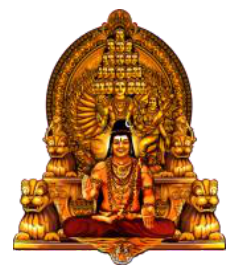
The moment we relax into eternal bliss, the Divine takes care of us. Whatever we lack is brought to us and whatever we have is preserved for us. Naturally, we will experience, enjoy and enrich both the inner space and the outer space. This is the ultimate secret that Kṛṣṇa reveals to Arjuna.
Let us pray to the Parabrahma Kṛṣṇa, the Divine consciousness, the Cosmic intelligence to make us understand this secret of all secrets and experience the outer space and the inner space with eternal bliss, Nityānanda.
Thus ends the ninth chapter named Rājavidyā Rājaguhya Yogaḥ, 'The Yoga of Supreme Knowledge and Supreme Secret,' of the Bhagavad Gītā Upaniṣad, Brahmavidyā Yogaśāstra, the scripture of yoga dealing with the science of the Absolute in the form of Śrī Kṛṣṇārjuna saṃvād, dialogue between Śrī Kṛṣṇa and Arjuna.