CHAPTER 8 - BANDHAS
This text was machine-transcribed from the printed book and may contain errors. Select the words and choose “Report a mistake”.
Introduction
1. Bandhas are important yogic techniques practiced separately and also with pranayama. Without bandhas, pranayama would be incomplete. Bandha means to hold, lock or tighten. Bandhas lock the flow of prana into certain areas and redirect it up the sushumna nadi. They also restrain the downward motion of prana. Bandhas have profound effects on the physical, mental and pranic levels.
2. Bandhas can unknot the granthis or psychic knots. These knots represent psychic and mental blocks that prevent one from moving on to higher states of consciousness, and prevent the kundalini from rising up the sushumna nadi.
3. The three granthis are: Brahma granthi, Vishnu granthi and Rudra granthi.
4. Brahma granthi is associated with the muladhara area. It is linked to deep survival instincts and fears, fantasies, imagination, sexual desires and procreation.
5. Vishnu granthi is associated with the anahata chakra and linked to emotions like constant worrying, sentiments, delusion, attention need, pseudo love, attachment to personal relationships.
6. Rudra granthi is associated with ajna chakra. It is linked to obstacles generated by comparison and jealousy, possessiveness, ego identification- social and intellectual, yearning for sidhis and intellectual psychic powers.
7. The four main bandhas are - jalandhara bandha, moola bandha, uddiyana bandha, and maha bandha (combination of the 3)
Jalandhara Bandha (throat lock)
When to do - Can be done with internal or external retention of breath
Contraindications – cervical spondylosis, high intracranial pressure, high blood pressure, vertigo, heart disease.
Benefits – This lock stimulates the carotid sinuses. The heart rate is lowered, and there is increased breath retention. This leads to mental relaxation, a meditative state and one pointedness. It also gives mental relaxation relieving anxiety and stress, balances thyroid function and regulates metabolism.
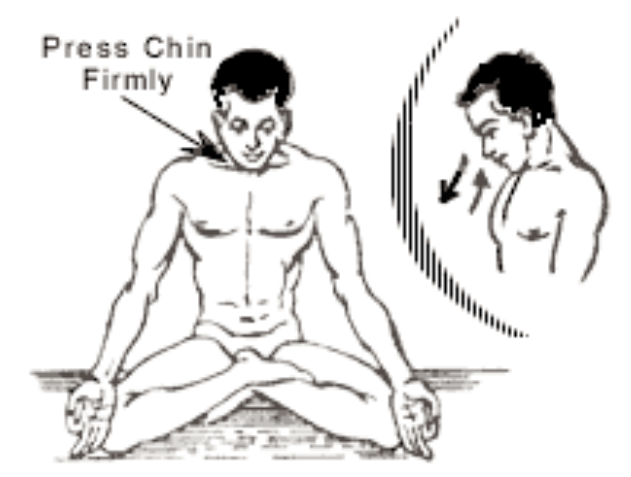
Jalandhara bandha (throat lock)
Awareness – on the throat and sensations related to the breath retention.
Technique 1. Sit in padmasana, close eyes, palms on knees. Relax the body.
2. Take a slow and deep breath.
3. Hold the breath inside, then bend the head forward, pressing chin to collarbone.
4. As chin presses down, straighten the arms, and press hands onto knees, raise the shoulders
5. Hold breath and position as long as you can without strain.
6. To come out of lock, relax shoulders, bend arms, then slowly raise the head and exhale. Breathe only when head is fully upright.
7. Repeat when breathing returns to baseline
8. A simpler variation of this lock – just bend head forward so that chin presses into neck.
9. Generally done in combination with specific breathing practices.
10. Powerful - it compresses the sinuses on the main arteries of the neck. This helps to regulate the circulatory and respiratory systems. The pressure on the throat helps to balance the thyroids.
Moola Bandha (root lock)
Beginners tend to contract both anal and perineum area. Moola bandha is only contraction of the perineum. This makes direct contact with the muladhara chakra. Controlled contraction of this lock awakens the kundalini.
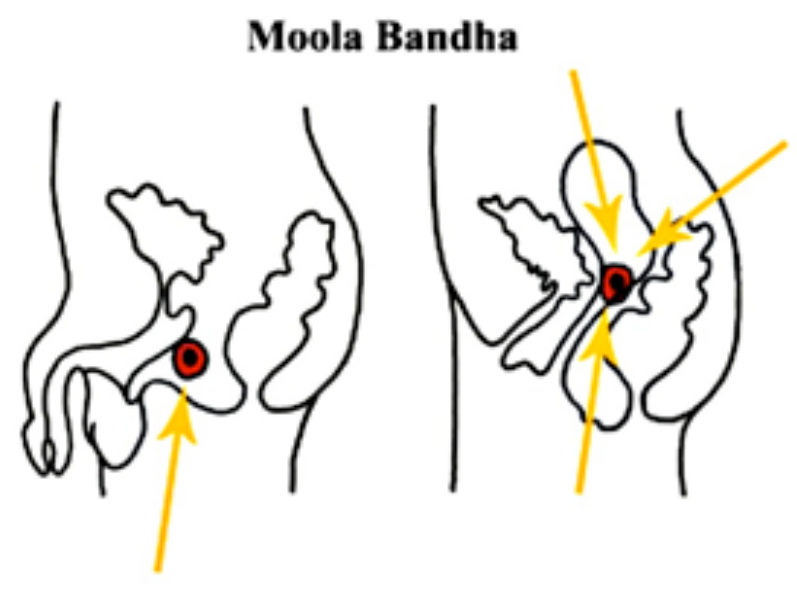
Breathing - May be done with internal or external breath retention and jalandhara bandha.
Contraindications – do not practice during menstruation. May cause hyperactivity.
Benefits – Stimulates pelvic nerves, strengthens uro-genital and excretory systems. Helps alleviate depression, psychosomatic and degenerative illnesses. Energizes and awakens muladhara chakra, seat of kundalini energy.
Technique
1. Sit in meditative asana with heels putting pressure on perineal/vaginal region.
2. Close the eyes, relax the body.
3. Hands in chin mudra.
4. Bring awareness to the perineal/vaginal region
5. Men bring awareness to, and contract area between anus and testes. Women bring awareness to, and contract area behind the cervix where uterus projects into vagina.
6. To start, contract only gently and hold, increasing time of hold slowly. Gradually increase the strength of contraction.
7. Do not hold breath while holding bandha
8. Release the bandha before.
9. It is contraction of only certain muscles in pelvic floor and not entire perineal area.
Uddiyana Bandha (abdominal lock)
1. Gheranda Samhita (chapter 3:11) says that among all the bandhas, this is the best. It makes emancipation easy.
2. Uddiyana means to fly upwards and bandha means lock. When this bandha is applied, the diaphragm is pushed upwards into the chest.
3. This technique directs prana into the sushumna nadi and is good for raising awareness. It can be practiced on its own but is usually combined with pranayama.
4. It is an advanced technique and to be practiced only after proficiency is achieved in external breath retention and the other two bandhas.
5. Perform with external breath retention only.
6. Can be done sitting or standing. Initially, it should be practiced in the standing position.
Contraindications – Avoid in pregnancy. Not for people with colitis, high blood pressure, stomach and intestinal ulcers, major abdominal problems, diaphragmatic hernia, heart disease, glaucoma and increased intracranial pressures.
Benefits – Helps to expand awareness, affects pranic flow in manipura chakra, revitalizes the whole body, stimulates function of abdominal organs through the massage action. Stimulates digestive fire, balances adrenal glands removing lethargy, anxiety and tension, removes or alleviates constipation, improves blood circulation throughout the torso.
Keep Awareness on throat or navel
When - must be done on empty stomach, and preferably with bowels emptied; before breakfast. Best done after asana and before meditation. Can be combined with pranayama and mudra.
Uddiyana Bandha – standing (for beginners)
Technique
1. Stand with legs apart. Do not lock knees. Bend forward with spine straight, arms extended, palms resting on lower thighs.
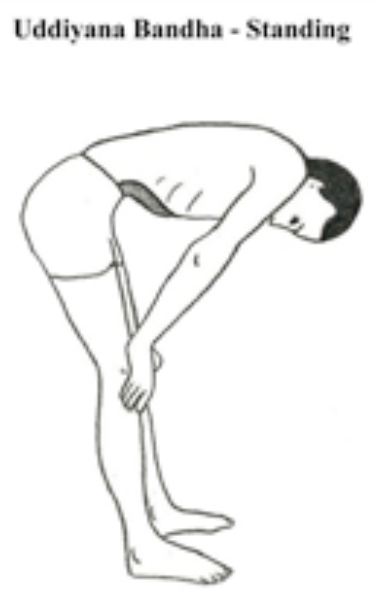
2. Exhale completely then bend head down but not in jalandhara bandha. Keep arms straight.
3. There will be an automatic abdominal contraction in this bent over position.
4. Make a false inhalation against a closed glottis (no air goes in) while straightening the knees a little. Keep arms and spine straight. Uddiyana bandha will happen when false inhalation is made and abdomen is spontaneously pulled in to spine and up into chest cavity. If bowels have been emptied, there will be greater sucking in power of the abdomen
5. Jalandhara bandha must always be done with uddiyana bandha.
6. Put your awareness on the throat or navel.
7. Hold as long as you can without straining. Release the abdominal lock, raise head, relax chest and straighten body. Breathe in through nose. When breathing returns to normal, start the hold again.
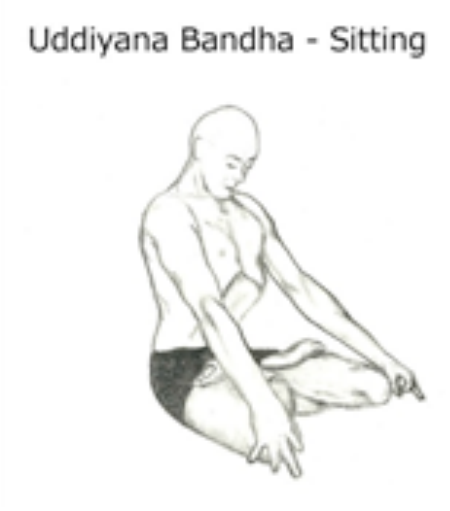
Uddiyana Bandha - sitting
Technique
- Sit in any meditation asana, padmasana (vajrasana OK), spine straight, knees in contact with floor, palms on knees.
- Contract the bowels equally above and below the navel. .
- Do the uddiyana bandha as described above.
- Remember to do jalandhara bandha – throat lock. Do a false inhalation (no air entering). It will automatically pull the stomach area in and up.
- Hold lock with breath out as long as you can comfortably without strain.
- Release the lock – relax arms, lower shoulders, raise head and breathe in slowly.
- Repeat bandha when breathing returns to baseline.
Maha Bandha (the great lock)
This is a combination of the above three locks. Do this only when in good health and proficient in the above three
Contraindications - pregnancy, high or low blood pressure, heart disease, stroke, hernia, stomach or intestinal ulcer
Benefits – has all the benefits of the 3 bandhas.
Technique
- Sit with back and head straight, padmasana or other meditative pose
- Close the eyes, relax body, hands on knees
- Breath slowly and deeply through the nose then exhale completely with force
- Hold the breath outside and do the locks in this sequence – jalandhara, uddiyana, moola.
- Hold as long as you can comfortably without strain.
- Release locks in this sequence – moola, uddiyana, jalandhara. Inhale slowly when head is up.
- Keep eyes closed, body relaxed, breathe naturally.
- Repeat when breath is back to normal.
- After practising for some time, spontaneous cessation of the breath occurs even after kumbhaka is released. Let this happen and just watch how long it lasts.
- Practice in combination with bhastrika as kumbhaka can be held for longer time this way.