Who was Patanjali?
This text was machine-transcribed from the printed book and may contain errors. Select the words and choose “Report a mistake”.
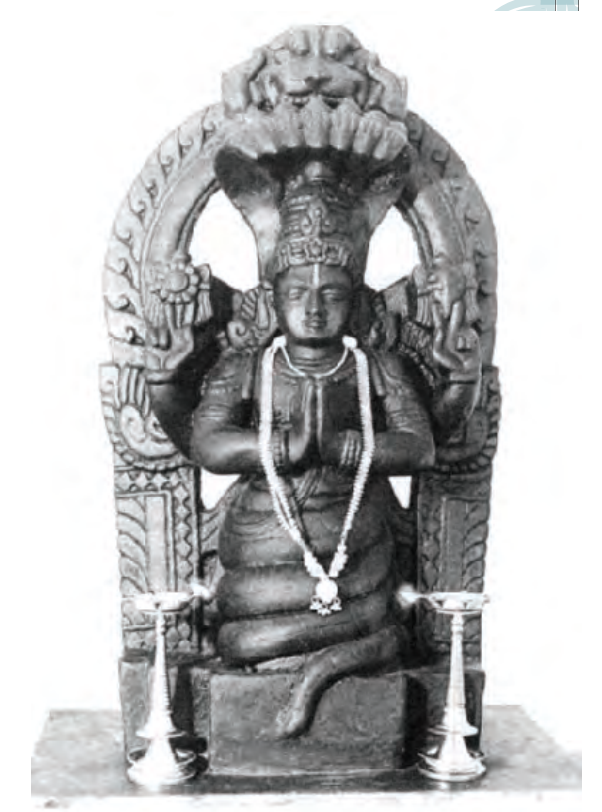
There is complete uncertainty as to who Patanjali was. Some think of him as the divine incarnation of the serpent Ananta, who supports the whole universe and is simultaneously the bed of Lord Vishnu. Factually, next to nothing is known about him. It is believed that he was born in Southern India, in the holy town of Chidambaram, a place very deeply associated with the dancing expression of Lord Shiva, as Nataraja. Hindu tradition identifies him with a famous grammarian of the same name who lived in the second century B.C.E.
The reason for this confusion is that India has known of several other Patanjali's. The name Patanjali is said to be given to Ananta because he wanted to teach yoga on earth and fell (pat) from heaven, onto the palm (anjali) of Gonika, his mother.
Notwithstanding his origin, Patanjali is credited with the compilation of the great book, the Yoga Sutra. It is an exceptionally open and profound work on the nature of consciousness. It is considered more universal than any other book because it focuses only on the mind, its qualities, influences and fluctuations and the resultant disturbances that are obstacles on the path of the discovery of the Self. It clearly outlines the means to transcend the mind and live in the heightened state of awareness called samadhi. Because the mind is common to all of human kind, these sutra, therefore, are of interest to all.
A sutra is a style of writing, which has very few words, is yet full of essence, is affirmative, universal in context and yet free from all ambiguity. These sutra, these aphorisms on yoga are scientific, straightforward and to the core. This is the greatest book ever presented to mankind. Millions of books and many styles of yoga have stemmed from this one book. The Yoga Sutra is so complete that not one single word more can be added to it.
Though Patanjali had his roots deeply in the Vedic tradition, he did not propogate any isms (religions). Patanjali was a saint and a scientist rolled into one. He declared universal truth for the benefit of all mankind. He left behind a strong energy, a strong understanding and a strong way for people to experience universal consciousness. Patanjali has either directly or indirectly influenced every spiritual teacher on planet earth.
One such great teacher was Raghupati
yogi, from the small temple town of
Tiruvannamalai, in Southern India.
Arrival of Raghupati yogi
When Paramahamsa Nithyananda was about three years old, a relative brought home a wandering mendicant, or sanyasi whose name was Raghupati yogi. Raghupati yogi lived on the same street as Paramahamsa and came to know the entire family. He was born and brought up in Burma (Myanmar) then a British Colony, where he had learnt yogic procedures from Buddhist lamas. He was an adept in yoga and related methods and could demonstrate many yogic powers, including the ability to levitate at will which he mastered through a combination of yogic postures (asana) and breath control techniques (pranayama). Paramahamsa fondly remembers the numerous occasions when Raghupati yogi would levitate and playfully ask the children to crawl under him; it was an entertaining game that everyone enjoyed thoroughly! Raghupati yogi was an expert in Patanjali's Ashtanga Yoga methods and taught it diligently to his most ardent student, Paramahamsa.
Raghupati yogi noticed that the young Paramahamsa, unlike boys of his age who played with toys and marbles, was engrossed in playing with little idols and statues of gods and goddesses. They seemed to be his companions and he was very comfortable playing with them. Being a man of such deep wisdom, Raghupati yogi realized that Paramahamsa was a highly evolved spiritual soul. He remarked that the boy was a light that had started shining in that household. Despite the huge age difference between them, Paramahamsa was totally at ease in the company of Raghupati yogi. They seemed to share a deep bond where the need for communication did not matter.
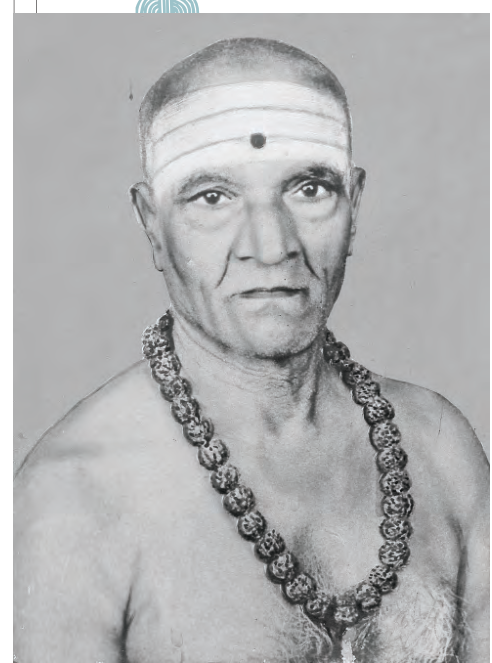
I bad the fortune to study yoga under a great master of yoga, Raghupati yogi. He was also conferred the title Yogiraj and was known as Yogiraj Yogananda Puri. When I spent time around him he was aged around one hundred and four or five. He was a very healthy man who bad mastered yoga and who had experienced all aspects of yoga; not just in the physical level, however in much deeper ways. He would express many different powers of yoga.
I remember very clearly be would take a stone and make the sound of a hammer bitting the stone; the stone would break into two pieces. Sometimes he would make the sound of a stone flying and to my astonishment I would see birds falling down as if they had been the targets! At other times he would create a particular vibration and snakes would come from the bushes! Similarly he would create the sound of a dog and from all over dogs would gather around him. Just through sound he was able to do anything he wanted to do.
He had amazing strength and unimaginable physical power, which he expressed so casually. He would tie an iron rope around his chest and exhale completely, then he would inhale deeply and the rope would break into pieces!
Usually a logical mind cannot accept or understand that all this is possible, but this great yogi made everything possible! I had the fortune to be around him and see him levitating, not once but at least twenty times. He would inhale deeply and hold the breath. The moment he did that the body would lift from the ground, like an inflated balloon!
From the age of three to thirteen I had the fortune to be under his feet, his guidance and care. Every day from morning till noon for at least 4 to 5 hours, he would make me do all of the traditional yogic techniques including asana (postures). He would instruct me to bend this way and that way, backwards and forwards. He would make me do all of the yogic cleansing techniques like neti, dhauti. I would have to swallow that long cloth to clean the intestine and the internal system.
To tell you honestly, it's only now that I feel happy about everything he used to make me do. Those days I used to hate him because from morning around 6 am he would start my training. It was practically like torture; any beginner in yoga can sympathize and understand what I am talking about.'
Raghupati yogi came into Paramahamsa's life for a purpose. Being a yogi of many great skills and powers, he helped prepare Paramahamsa's body to receive and hold the tremendous energy of enlightenment. Paramahamsa says retaining this tremendous energy is like squeezing four elephants into a small hut.
Paramahamsa says experiencing a satori (a glimpse of enlightenment or a no-mind state) is not a big thing; anybody can experience a satori. However, for somebody to stay in that level of consciousness and to actually express it, preparation of the body and mind is required. Raghupati yogi helped prepare Paramahamsa's body and mind through various yogic techniques. He enabled him to experience, remain and radiate the high energy of enlightenment.
Raghupati yogi
would without fail
come to
Paramahamsa's
house every
morning. The yogi
would take him to
the temple and for
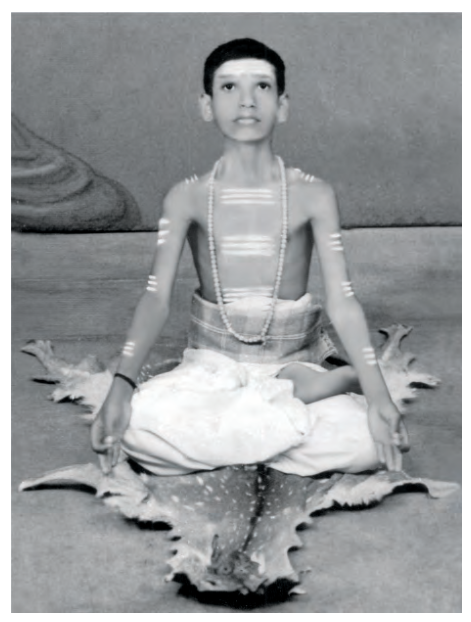
Paramahamsa age 10
Paramahamsa recalls affectionately: The temple where Raghupati yogi used to teach me yogic techniques had a beautiful stone pillared mandapam (hall). He would instruct me to climb all of the stone pillars; 20 to 30 pillars continuously! When climbing the pillars, he told me I was not allowed to use both hands to climb. I could use only one! The other hand was to be kept behind my back or tied with a rope. To this day, I am still not able to find any reference to support why he made me climb the pillars. I have not read any Yogic literature which identifies that climbing pillars is a yogic technique!
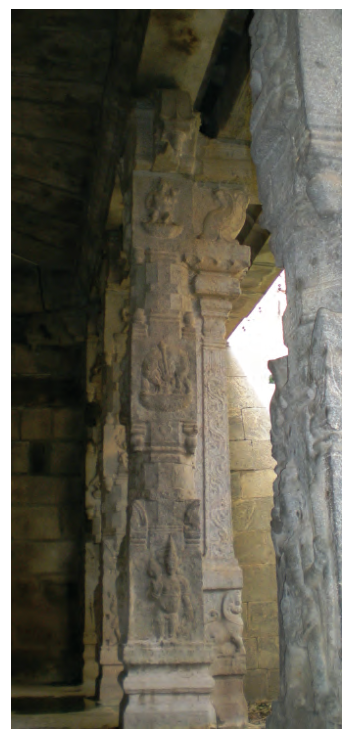
Pillars in the krithika mandapam where Paramahamsa received yogic training under Raghupati Yogi
The boy obeyed Raghupati yogi, partly out of respect and partly out of affection. The yogi insisted that Paramahamsa do this extended practice every day. He told the boy that he needed to keep his body fit, as he would need to do Herculean things in the future. After the yoga practice, he would take Paramahamsa to a nearby hotel to have breakfast. He was very loving and brought him candies and chocolates to keep the boy's interest alive.
Over time, Raghupati yogi taught all eight parts of Ashtanga Yoga, including pranayama (breath control techniques) and asana (postures) to Paramahamsa. Additionally, he taught mantra, dhyana (meditation) and various other yogic techniques. Paramahamsa was also given the invaluable knowledge of how to live without water and not feel thirsty, by twisting the tongue, sucking in air while sounding the mantra 'lam'. He also taught
Paramahamsa how to go without sleep, without feeling tired and how to live without food and not feel hunger, by using a herb to draw a diagram on the skin over the liver.
Paramahamsa was also taught how to play with light energy and how to create things through sound energy. These were of immense use to him during his wandering days and penance; but for these techniques and the strength built through yoga, his body-mind would have been unable to withstand the rigors of those years of tough ascetic life.
Raghupati yogi did a great service by preparing Paramahamsa's body and mind for his future endeavors. He also had fulfillment. As much as Paramahamsa learnt from him, the yogi said he learnt from the boy. He gave Paramahamsa the deerskin he used to sit on, which was
given to him by his Master. This was treated and tanned with herbs and even after 60 odd years it has the original hair still intact. Raghupati yogi arranged for taking pictures of Paramahamsa in various meditative postures during his years with him. Photography was very expensive those days in rural India. Raghupati yogi had borrowed money from a local hotel owner, Upadhyaya, for these photographs. When asked why he was doing it at such expense, he just smiled and never answered. When the photos were delivered, he wrote on them, 'The whole world will one day thank me for these photographs.' Raghupati yogi had photos taken of Paramahamsa alone as well as the two of them together, but none of himself alone. When questioned about this by Paramahamsa, Raghupati yogi just smiled and said, 'No one will want to have
Importance of early training
Raghupati yogi told Paramahamsa that the age to learn yoga is before 14 and that's why he started him at 3 years of age. He had in total a full ten years to train the young boy.
Paramahamsa says that the rigorous training he underwent in the first eleven years of his life helped in sustaining the tremendous energy of enlightenment. He remembers very clearly Raghupati yogi telling him that to bear fruit on the spiritual path you have to be trained from a very young age.
According to Vedic traditions any kind of spiritual practice must be undertaken before sexual maturity. If it is done so, it is easy to live with reality and not fall prey to impossible and unreal fantasies. Otherwise, the whole process can be difficult and disheartening. The reason is, once puberty is attained, the fantasies and imagination that are thrust on the individual through the outside world, (in the modern context the media, peer pressure and social conditioning), play havoc with the hormones and the vital energies. It then becomes very difficult to begin the practice of yoga for spiritual
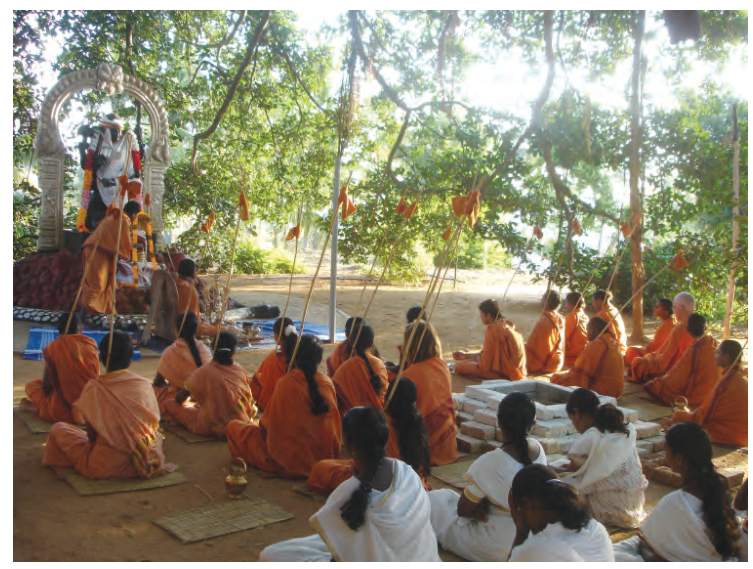
Sitting with the Guru, true learning happens The Vedic Renaissance - Brahmachari's of the Nithyananda Order elevation. At best it can be viewed as the practice for granting physical and mental well-being. During the Vedic times the practice of brahmacharya was all about learning to live with reality. Brahma means 'truth, reality' and charya means 'to walk with'. This understanding has more to do with learning about and accepting reality. In no way did it mean forced celibacy, as many people have erroneously understood it. This truth was very well known during the Vedic times. That is why in ancient India the gurukulam (the educational system) was highly regarded. When a child was about 3 years old, the parents handed the child over to the guru, who from then on became its father and mother.
Till the age of seven, children were allowed to roam freely, unclothed or wearing a single loose robe with no awareness of their gender. The energies were allowed to flow easily. Restrictions were not imposed on the children in this extremely natural atmosphere. Both boys and girls were taught the Gayatri mantra (sacred chant) so that the inner sun, their innate intelligence, would be awakened and expressed.
With such unique and caring guidance,
most children would have some kind of
spiritual experience by puberty. As the
Guru had trained their body and mind so
lovingly, they were capable of handling
the subtle high voltage energies that
coursed through their bodies.
Raghupati yogi's appearance in
Paramahamsa's childhood was indeed most propitious. He was very learned and would pass on as many teachings as possible to the young lad. It was as if he wanted to pour all his experience and knowledge in the little time that was available to him. Paramahamsa remembers that at all times Raghupati yogi would play with snakes, which for him, was initially quite frightening. He would playfully guide thin snakes through his nostrils and take them out through his mouth in imitation of some yogic cleansing techniques. When Raghupati yogi saw the boy's fear, he would laugh and say that they would not do any harm, as they were a part of him, his family. He always wore a gold girdle around his waist like a coiled snake
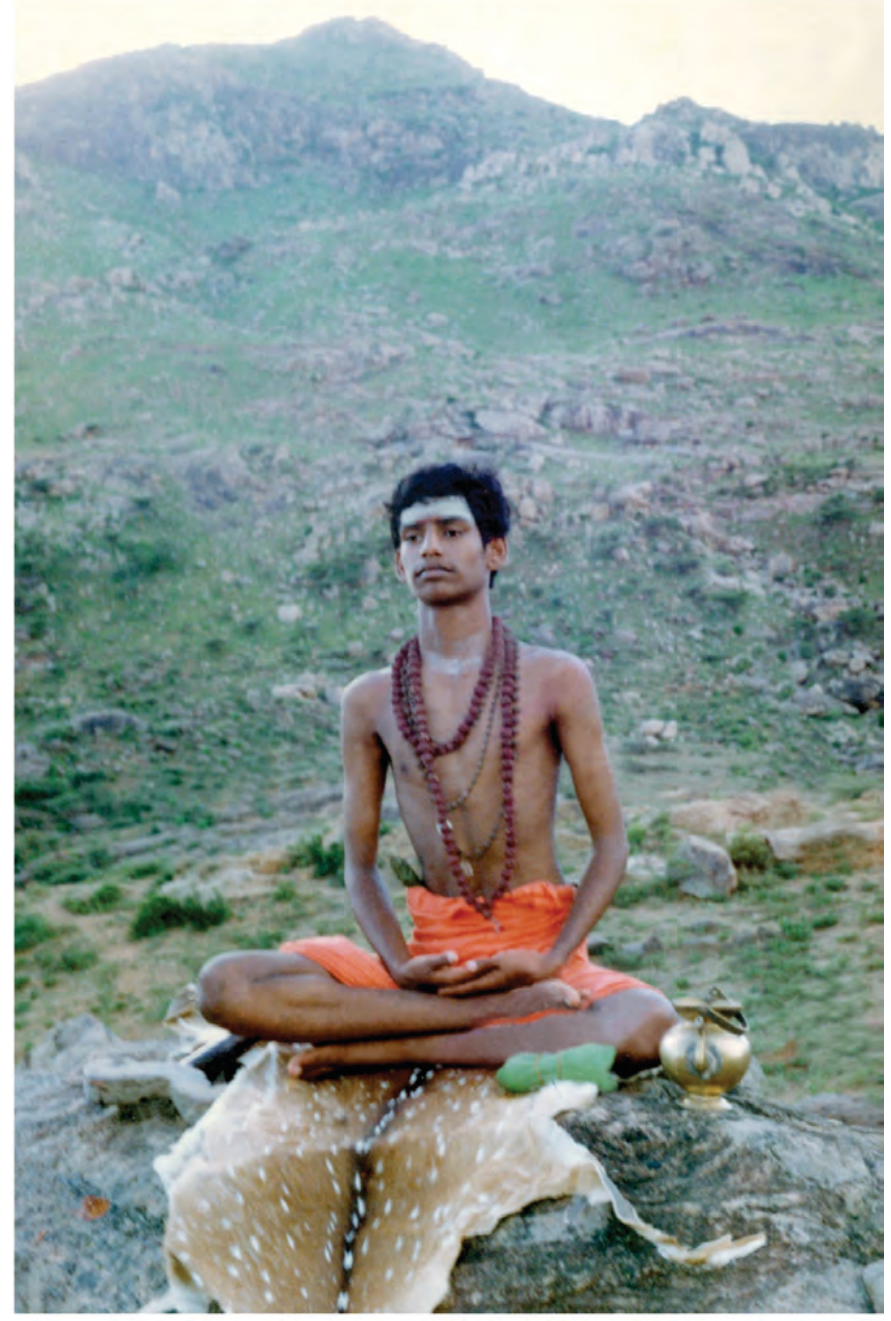
Paramahamsa meditating at the foot of Arunachala in his young age. He can be seen here seated on the deer skin given to him by Raghupati Yogi.
IN THE LINEAGE OF PATANJALI
Yoga
‘Before knowing what yoga is, it is important to know what yoga is not. Yoga is neither a physical exercise nor is it breath control. These are but a part of yoga.’
- Paramahamsa