The Prevalent View of Ashtanga Yoga
This text was machine-transcribed from the printed book and may contain errors. Select the words and choose “Report a mistake”.
Ashtanga Yoga is understood as 8 'steps' of yoga. We practice with the belief that the following practices have to be done one after the other.
- yama (restraints),
- niyama (personal conduct),
- asana (bodily postures),
- pranayama (breathing techniques),
- pratyahara (withdrawal of the senses),
- dharana (single pointed focus),
- dhyana (meditation) and
- samadhi (enlightenment)
The following diagram depicts this clearly:
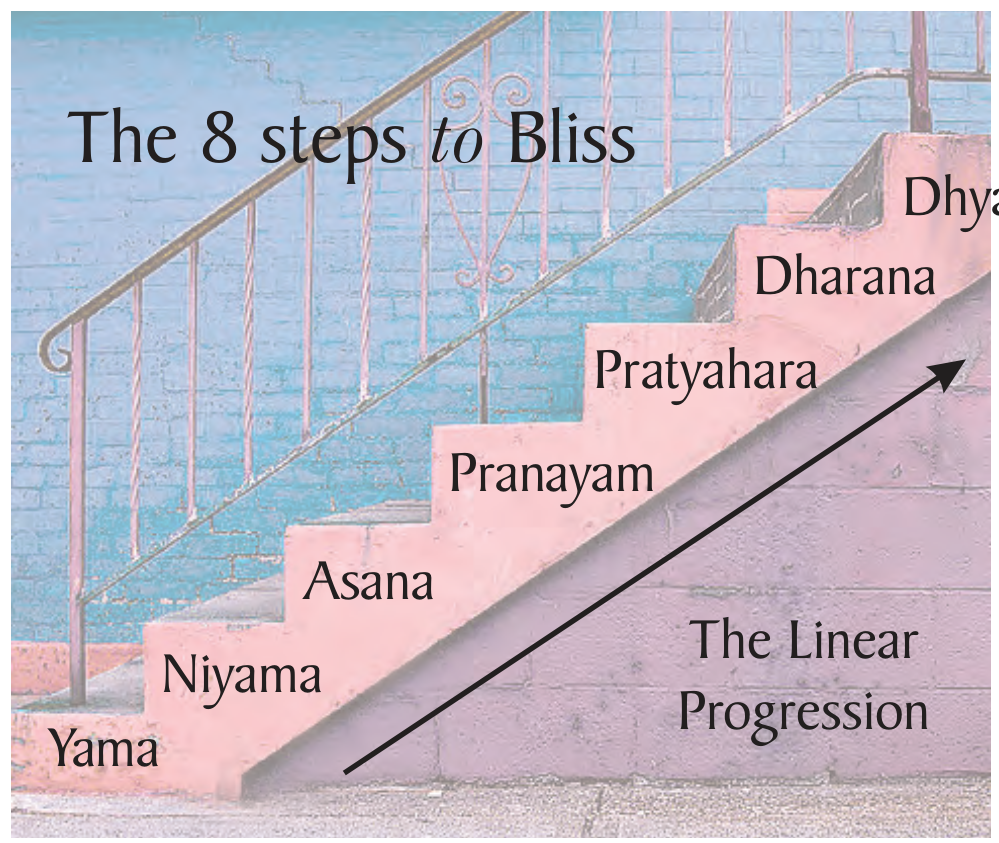
Paramahamsa says Patanjali never meant that each step has to be mastered before we go to the next step. If that were so we would need several lifetimes to reach the blissful state of samadhi. When we see Patanjali's Yoga as progressive steps to enlightenment our mind immediately perceives a goal, which can be reached through hard work over a period of time. So there is a feeling that we need to work
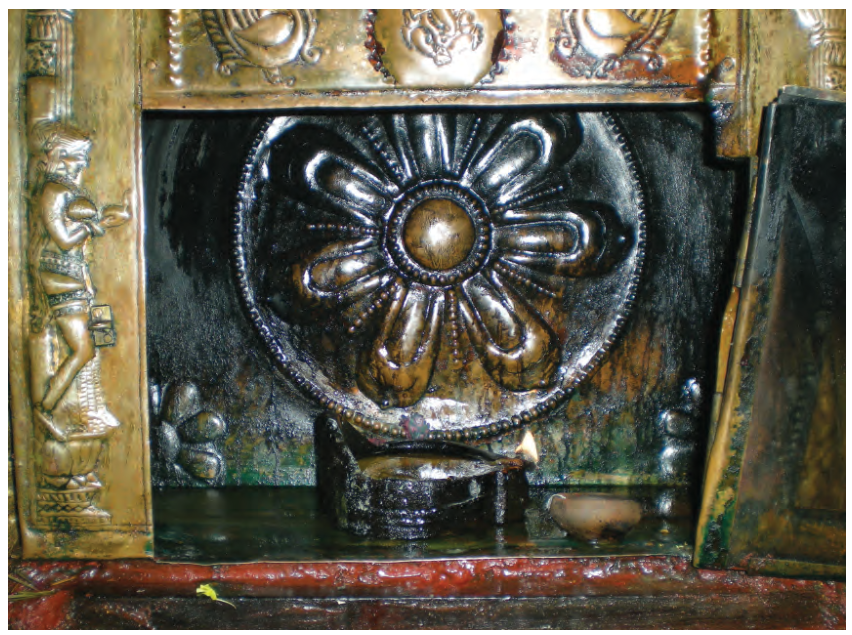
hard and that at some future date we will get rewarded for this. Paramahamsa declares that Patanjali never intended ashtanga yoga to be practiced this way. This copper flower (seen in photo above) is a part of Patanjali's samadhi (tomb) in Rameshwaram, South India. It symbolic of the spirit of Ashtanga Yoga.
There is a center with seven independent petals attached to it. Though the petals are independent, their very contact points connect them to one another. They share the same common core. The essence of the core or the center is established in each independent petal.
If we take this core to be the experience of samadhi, then every petal or anga (part) of the whole flower (yama, niyama, asana, pranayama, pratyahara, dharana, dhyana) is by default imbedded with the blissful energy of the state of samadhi or Oneness.
It is very clear that samadhi is not the eighth step to work t o w a r d s progressively. On the contrary, itis the state we are already in, the state of nithya ananda, Eternal Bliss. It just need to expressed.
When that expression happens, intensely, moment to moment, our consciousness flowers and we are in Nithya Yoga; Eternal Uniting.
Patanjali was the first Master who created a clear, scientific and logical system to reproduce the experience of enlightenment. Prior to Patanjali, enlightenment was an accident; it was a gamble, with no guarantee. Patanjali was the first master and spiritual navigator
responsible for the mapping of
consciousness and codifying complete
directions. He created an exact
formula to reproduce the experience
of enlightenment; just as how scientists
create formulae to reproduce
experiences of the outer world,
Patanjali created a beautiful formula
and technology to reproduce the
experience of the inner world.
Paramahamsa says, There are two
types of scientists. Scientists of the
outer world and scientists of the
inner world. Scientists of the outer
world are those who create
formulas to reproduce the outer
world experiences. Scientists of
the inner world are those who
create formulas to reproduce
experiences of the inner world - in
others. Patanjali was one such
inner scientist. He created a
formula, 8 yogic practices that
would reproduce in others the
inner space of Patanjali himself.'
Many masters and teachers of the yoga
tradition have added to the
understanding of yoga. They have
enriched the experiencing of yoga
with their unique insights into the
teaching and practice. All of them
agree that modern man is a complex
phenomenon reflecting the enormous
changes that have taken place in the
last century. This being so, old-
fashioned, incomplete methods of
integrating the body, mind and spirit
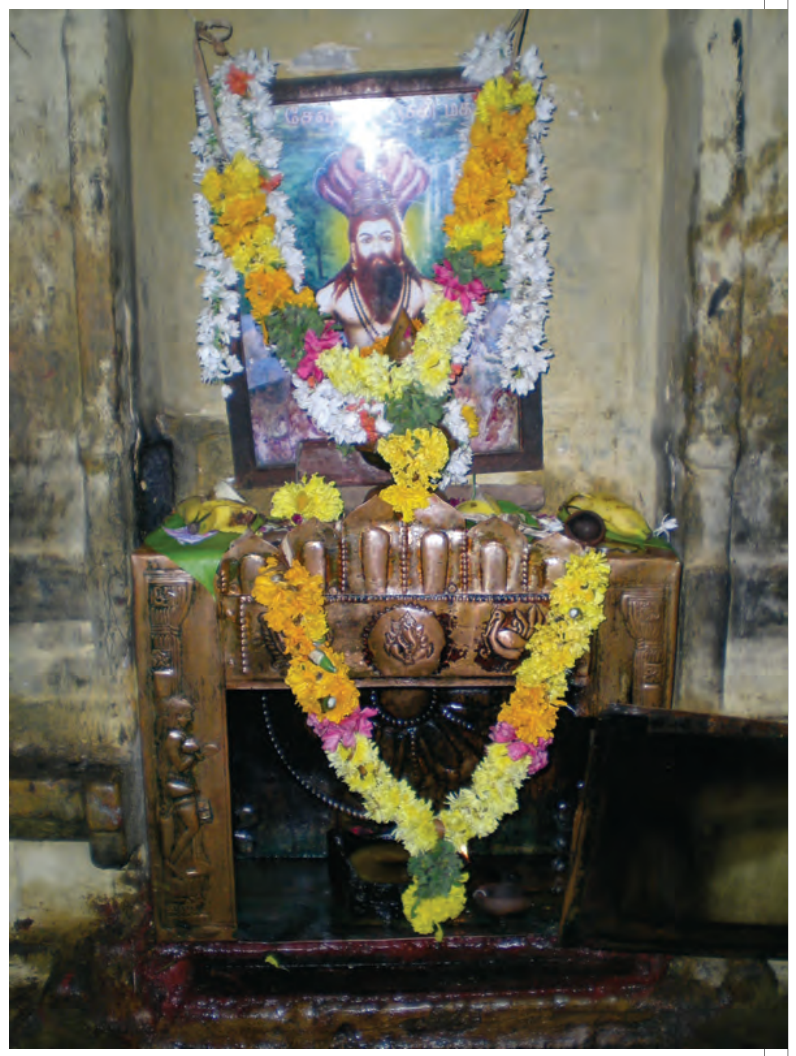
Patanjali's samadhi (tomb) at Ramanatha Swamy Temple, Rameshwaram, Southern India. The copper flower expresses the spirit of yoga, as expressed by Patanjali.