CURE FOR TINNITUS
This text was machine-transcribed from the printed book and may contain errors. Select the words and choose “Report a mistake”.
Disease Description
Tinnitus is the perception of sound within the human ear in the absence of corresponding external sound.
Tinnitus is not a disease, but a symptom that can result from a wide range of underlying causes: abnormally loud sounds in the ear canal for even the briefest period (but usually with some duration), ear infections, foreign objects in the ear, nasal allergies that prevent (or induce) fluid drain, or wax build-up. Withdrawal from a benzodiazepine addiction may cause tinnitus as well. In-ear headphones, whose sound enters directly into the ear canal without any opportunity to be deflected or absorbed elsewhere, are a common cause of tinnitus when volume is set beyond moderate levels. Tinnitus can also be caused by natural hearing impairment (as is often seen in aging), as a side effect of some medications, and as a side effect of genetic (congenital) hearing loss. However, the most common cause is noise-induced hearing loss.
As tinnitus is usually a subjective phenomenon, it is difficult to measure using objective tests, such as by comparison with noise of known frequency and intensity, as in an audiometric test. The condition is often rated clinically on a simple scale from "slight" to "catastrophic" according to the practical difficulties it imposes, such as interference with sleep, quiet activities, and normal daily activities.
STEPS TO BE FOLLOWED
- ANDHAASANA
- BHRAAMAREE KUMBHAKA
1. ANDHAASANA
JOGA PRADEEPIKAA, VERSES 193 TO 197
प्रथम पगथली सम ठहरावै कोर माहिली उभै मिलावै ।
फणापाण उकड कर बैठे दो उ एडी गुदा निवैसै ॥
जंघ ओर घोडा सम कर धरै पुन आगाको उभै पसारै ।
गोडामहिला नेत्र दोउ सम करि काठा दाबे सो उ ॥
पोहुचाकी संधिमाहिली ताको ऐसे ठानि ।
गोडा की ब्अझीझ दिसा तापार धरै जु आनि ॥
नेत्र मे जै पटब व्है पुनि रातींधो होय ।
गावा धृति अरू मिरचसो अंजन कीजै सोय ॥
मुख मारग रेचन करे मूलद्वारे दे बन्ध।
तो रतिंध्यो ना रहे नैननि देखे अंध ॥
Prathama Pagathalee Sama Taharaavai Kora Maahilee Ubhai Milaavai |
Phanaapaana Ukada Kara Baise Dovu Edee Gudaa Nivaise ||193||
Jangha Or Ghodaa Sama Kara Dharai Puna Aagaako Ubhai Pasaarai |
Godaamahilaa Netra Dovu Sama Kari Kaataa Dhaabe Sovu ||194||
Pohuchaakee Sandhimaahilee Thaako Aise Taani |
Godaa Kee Baahari Dhisaa Thaapari Dharai Ju Aani ||195||
Nethra Me Jai Pataba Vhai Puni Raatheendho Hoya |
Gaavaa Dhruthi Uroo Mirachaso Anjana Keejai Soy ||196||
Mukha Maaraga Rechana Kare Mooladvaara Dhe Bandha |
Tho Raathindho No Rahe Nainani Dhekhe Andha ||197||
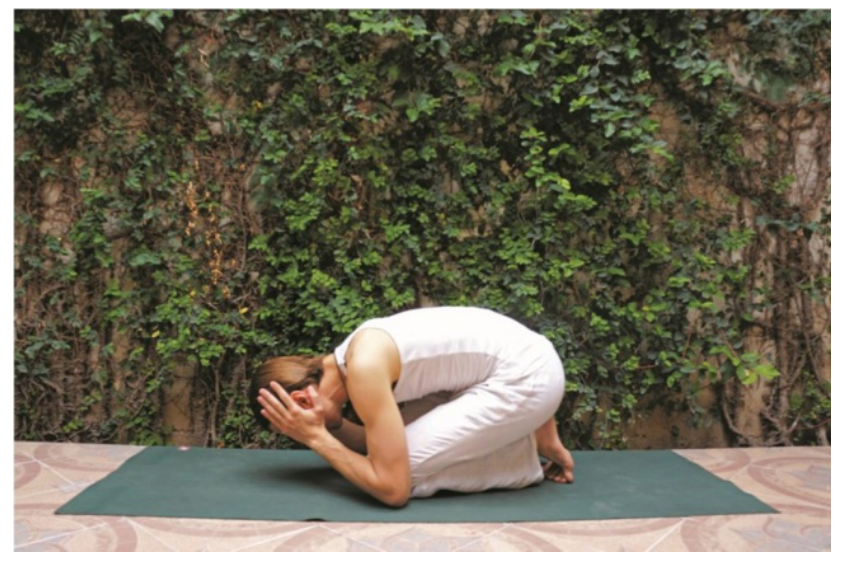
TRANSLATION-cum-TECHNIQUE
- Sit in a squatting position
- Direct the knees forward
- Bend forward
- Lower the head in between the knees
- Keep the elbows adjacent to the knees
- Hold the head with your hands
- Exhale completely through mouth
- Practice Mula Bandha– i.e., the practitioner should press with left heel between the anus and scrotum. And then contract the anus.
- Remain in this pose 30 seconds
- Release Mulabandha
-Joga PRADEEPIKAA, Verses 193 To 197
IN ANDHAASANA, NEXT-
2. BHRAAMAREE KUMBHAKA
KUMBHAKA PADDHATI, VERSE: 169
अलिशब्दयुतं वेगात् पूरयेत् कुम्भयेत्ततः ।
सालि शब्दाच्छनै रेकात् भ्रामरीकुम्भको मुनेः ॥ ॥
Alishabdhayutham Vegaath Poorayeth Kumbhayeth-Thathaha | SaalishabdhaathShanai Rekaath Bhraamareekumbhako Munehe ||169||
TRANSLATION
One should inhale rapidly producing the sound of male bee, then hold and then exhale slowly with the sound of female bee. This is called Bhraamaree Kumbhaka.
TECHNIQUE
- Inhale rapidly with the sound 'mmm' of a bee
- Hold
- Exhale steadily and slowly with the sound of a 'mmm' of a bee
- Do this 21 times
(you have to take something to eat within 10-15 minutes after doing this kumbhaka)
END OF KRIYA
Kriya Date 29-Dec-2011