CARE FOR TINNITUS
This text was machine-transcribed from the printed book and may contain errors. Select the words and choose “Report a mistake”.
Disease Description
Tinnitus is the perception of sound within the human ear in the absence of corresponding external sound.
Tinnitus is not a disease, but a symptom that can result from a wide range of underlying causes: abnormally loud sounds in the ear canal for even the briefest period (but usually with some duration), ear infections, foreign objects in the ear, nasal allergies that prevent (or induce) fluid drain, or wax build-up. Withdrawal from a benzodiazepine addiction may cause tinnitus as well. In-ear headphones, whose sound enters directly into the ear canal without any opportunity to be deflected or absorbed elsewhere, are a common cause of tinnitus when volume is set beyond moderate levels. Tinnitus can also be caused by natural hearing impairment (as is often seen in aging), as a side effect of some medications, and as a side effect of genetic (congenital) hearing loss. However, the most common cause is noise-induced hearing loss.
As tinnitus is usually a subjective phenomenon, it is difficult to measure using objective tests, such as by comparison with noise of known frequency and intensity, as in an audiometric test. The condition is often rated clinically on a simple scale from "slight" to "catastrophic" according to the practical difficulties it imposes, such as interference with sleep, quiet activities, and normal daily activities.
STEPS TO BE FOLLOWED
- ANASOOYA ASANA
- BHRAAMAREE KUMBHAKA
1. - ANASOOYA ASANA
YOGAASANA MAALAA SACITRA, VERSE 4
जीमणा गोडा की स्यंधि उपरि डावा गोडा की संधि मिलाइ राखै ।
गोडास्यौ ले पगथल्या लौ आडवाइ सूधा राखै ।
हाथा स्यौ पगाका अगूठा पकडे अथवा दोऊ हाथ पाछा नै करि काकसी करै ।
मूलद्वार पाछै काकसी राखै ।
हथेली पिष्टि मूलद्वार उर्द्ध लगा राखै ।
नासिका धरती लगावै दृष्टि नासा अग्र
आसन कौगुण यहु आसन मास दोई करी साधै तौ कंचनमई देह होई ॥
Jeemanaa Godaa Kee Syamdhi Upari Daavaa Godaa Kee Samdhi Milaayee RaaShai | Godaasyau Le Pagathalyaa Lau Aadavaayee Soodhaa Raashai | Haathaa Syau Pagaakaa Agoothaa Pakade Athavaa Dovoo Haatha Paachaa Nai Kari Kaakasee Karai | Mooladvaara Paachai Kaakasee Raashai | Hathelee Pishti Mooladvaara Urddha Lagaa Raashai | Naasikaa Dharatee Lagaavai Drishti Naasaa Agra Aasana Kauguna Yahu Aasana Maasa Doyee Karee Saadhai Tau Kamcanamayee Deha Hoyee ||
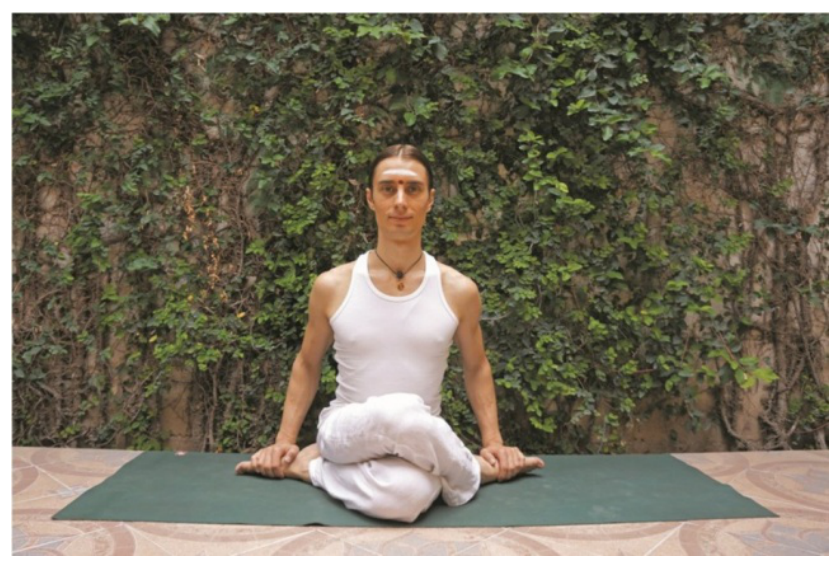
TRANSLATION-cum-TECHNIQUE
- Place one knee above the other
- Hold the hands from the back
- Bend down to touch the nose on the ground
- Gaze at the tip of the nose
- Remain in this pose 30 seconds
IN ANASOOYA ASANA, NEXT-
2. – BHRAAMAREE KUMBHAKA KUMBHAKA PADDHATI, VERSE: 169
अलिशब्दयुतं वेगात् पूरयेत् कुम्भयेत्ततः।
सालि शब्दाच्छनै रेकात् भ्रामरीकुम्भको मुनेः॥ ॥
Alishabdhayutham Vegaath Poorayeth Kumbhayeth-Thathaha | SaalishabdhaathShanai Rekaath Bhraamareekumbhako Munehe ||169||
TRANSLATION One should inhale rapidly producing the sound of male bee, then hold and then exhale slowly with the sound of female bee. This is called Bhraamaree Kumbhaka.
TECHNIQUE
- Inhale rapidly with the sound ‘mmm’ of a bee
- Hold
- Exhale steadily and slowly with the sound of a ‘mmm’ of a bee
- Do this 21 times
(you have to take something to eat within 10-15 minutes after doing this kumbhaka)
END OF KRIYA
Kriya Date 28-Dec-2011