CURE FOR SINUSITIS
This text was machine-transcribed from the printed book and may contain errors. Select the words and choose “Report a mistake”.
Disease Description
Sinusitis is inflammation of the paranasal sinuses, which may be due to infection, allergy, or autoimmune issues. Most cases are due to a viral infection and resolve over the course of 10 days.
Sinusitis (or rhinosinusitis) is defined as an inflammation of the mucous membrane that lines the paranasal sinuses and is classified chronologically into several categories:)
- acute rhinosinusitis – a new infection that may last up to four weeks and can be subdivided symptomatically into severe and non-severe
- recurrent acute rhinosinusitis – four or more separate episodes of acute sinusitis that occur within one year
- subacute rhinosinusitis – an infection that lasts between four and 12 weeks, and represents a transition between acute and chronic infection
- chronic rhinosinusitis – when the signs and symptoms last for more than 12 weeks
- acute exacerbation of chronic rhinosinusitis – when the signs and symptoms of chronic rhinosinusitis exacerbate, but return to baseline after treatment.
All these types of sinusitis have similar symptoms, and are thus often difficult to distinguish. Acute sinusitis is very common. Roughly ninety percent of adults have had sinusitis at some point in their life.
STEPS TO BE FOLLOWED
- VRISHCHIKASANA
- PRAKRITHI KUMBHAKA
- AGNEE SOMA KUMBHAKA
- UJJAYEE KUMBHAKA
- KUMBHA RAAJAA KUMBHAKA
- SEETHKAAREE KUMBHAKA
1. VRISHCHIKASANA HATHA SANKETHA CANDRIKA, VERSE 123
वृश्चीव पुच्छप्रतिमाङ्घ्रि पार्ष्णी
धृत्वा स्वशीर्षे चिबुकं विधार्य कौ ।
यन्नेति सन्दिष्ठत् साधकस्त्वविषावहम्
वृश्चिक संज्ञमासनम् ॥
Vrushcheeva-Puchcha Prathimaanghri-Paarshnim Dhruthvaa Svasheershe Chibukam Vidhaarya Kau | Yathreti Santhishtathi Saadhakas-Tvavishaavaham Vrishchika-Samjnamaasanam||123||
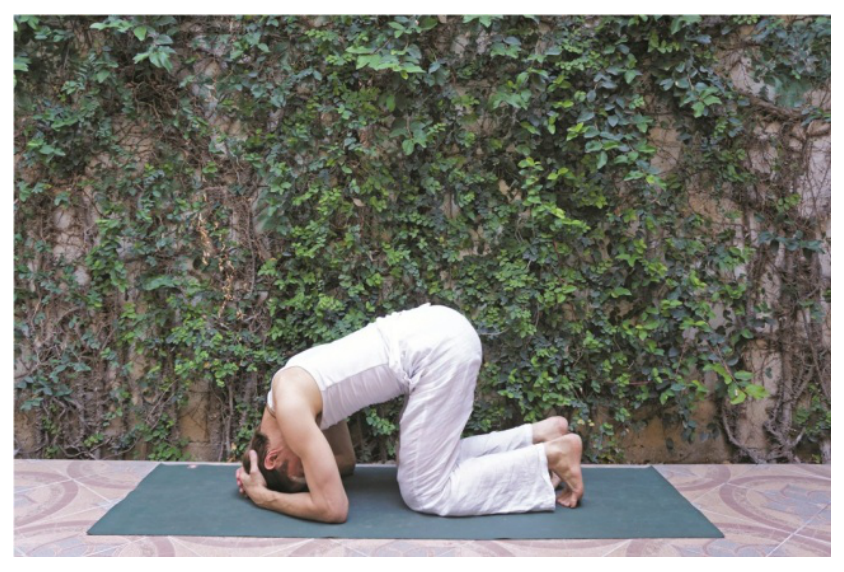
TRANSLATION-cum-TECHNIQUE
- Take a kneeling down position on the floor
- Lean forward and place elbows and hands on the ground
- Raise both legs up
- Bend them backwards
- Touch your head with your feet
- Raise the chin up
- Stay in this posture for 30 seconds
IN VRISHCHIKASANA, NEXT-
2. PRAKRITHI KUMBHAKA
KUMBHAKA PADDHATHI, VERSE: 70
वान्वितेनाशुगं कर्षन् कुर्वन्तूच्चतरं स्वनम्।
धारयेच्चेदुदानस्य प्रकृतिः कुम्भकः स्मृतः॥
Vaanvithena-Aashugam Karshan Kurvanthoochcha'tharam Svanam | DhaarayethCheth Udhaanasya Prakruthi: Kumbhaka: Smruthaha || 70 ||
TRANSLATION One should suck in air quickly with a loud sound of the bija mantra “VA” and retain the breath. this is called Prakrithi Kumbhaka.
TECHNIQUE
- As you chant the bija mantra “VA” loudly, suck in air quickly.
- After you are full, hold the breath 3. Then slowly exhale normally
4. Do this 21 times
P.S: If you have Hypertension, Hernia or if you are Pregnant do not hold the breath
IN VRISHCHIKASANA, NEXT-
3. AGNEESHOMA KUMBHAKA
KUMBHAKA PADDHATHI, 87TH VERSE
सूर्येण पूरयेत् प्राणं कुम्भयित्वा यथाविधिः ।
रेचयेदन्यमार्गेण पुनस्तेन प्रपूरयेत् ॥
येन त्यजेत्तेनापूर्य चाग्निशोमाख्यकुम्भकः ॥
Sooryena Poorayeth Praanam Kumbhayithvaa Yathaavidhihi |
Rechayeth Anya-Maargena Punas-Thena Prapoorayeth ||
Yena Thyajeth Thenaapoorya Chaagnishomaakhya-kumbhakaha ||87||
TRANSLATION Prana should be inhaled through Surya-naadi(right-nostril) and after retaining the same as prescribed, one should exhale through the other nostril, and again inhale by the same side through which one has exhaled. It is known as agni-shoma-Kumbhaka.
- Inhale through the right nostril
- Hold the breath
- Exhale through the left nostril
- Now inhale through left nostril
- Hold the breath
- Exhale through right nostril.
- Do this 21 times
IN VRISHCHIKASANA, NEXT
4. UJJAAYEE KUMBHAKA
KUMBHAKA PADDHATHI, VERSES 131 & 132
मुखं नियम्य नाडी याम् आकृष्यासुं नियोजयेत् ।
कुण्डलीपार्श्वयोः पश्चात् कुम्भयेदुदरस्थितम् ॥
रेचयेत् इडया वायुं गच्छन्तिष्ठन्यदा चरेत् ।
उज्जायीकुम्भकः प्रोक्तः शिवेनाखिलवेदिना ॥
Mukham Niyamya Naadeebhyaam Aakrushyaasum Niyojayeth |
Kundalee-Paarshvayoho Pashchaath Kumbhayeth Udharasthitham ||131||
Rechayeth Idayaa Vaayum Gachchan Thishthan Yadhaa Chareth |
Ujjaayee-Kumbhakaha Prokthaha Shivenaakhila-Vedhinaa ||132||
TRANSLATION One should inhale through both the nostrils and closing the mouth and retain the breath along the Kundalini and exhale through the left nostril. This is the Ujjaayee Kumbhaka explained by Shiva.
TECHNIQUE
- Close your Mouth
- Inhale through both the nostrils
- Hold as long as you can judiciously
- Exhale slowly through the left nostril
- Do this 21 times
IN VRISHCHIKASANA, NEXT
5. KUMBHA RAAJAA
KUMBHAKA PADDHATHI, VERSE 134
बलादाकर्षयेद्वायुं यावत् घ्राणसमुद्रणम्।
कुम्भयेच्च तथा वायुं कुम्भराजोऽयमीरितः॥
Balaadhaakarshayeth Vaayum Yaavath Ghraana-Sumudranam|
Kumbhayechcha Thathaa Vaayum Kumbharaajo’yameerithaha||134||
TRANSLATION One should forcefully inhale air till the lungs are full and hold the breath. This is called Kumbha raajaa.
TECHNIQUE
- Inhale forcefully
- Hold the breath to the maximum capacity by closing the nostrils
- Exhale when you feel you can not hold more.
- Do this 21 times
IN VRISHCHIKASANA, NEXT
6. SEETHKAAREE KUMBHAКА
KUMBHAKA PADDHATI, VERSES: 137&138
रसनामुन्मुखीकृत्य सीत्कारं कुर्वता मरुत् ।
पीयन्ते कुम्भके यस्मिन् नासिका यां विरेचनम् ॥ १३७ ॥
रसनां प्राणसंयुक्तां पीडद्यमानां विचिन्तयेत् ।
सीत्कारीकुम्भकः प्रोक्तः सर्वसिद्धिकरः सताम् ॥ १३८ ॥
Rasanaamunmukhee-Kruthya Seethkaaram Kurvathaa Maruth |
Peeyanthe Kumbhake Yasmin Naasikaabhyaam Virechanam ||137||
Rasaanaam Praana-Samyukthaam Peedyamaanaam Vichinthayeth |
Seethkaaree-Kumbhakaha Proktaha Sarva-Siddhikaraha Sathaam ||138||
TRANSLATION Having turned the tounge upwards, inhaling the air by producing the sound "seeth(hiss)" (because of inhalation), hold the breath and then exhale through both the nostrils. Concentrate on the tounge and the sound created by the air. This is called Seethkaaree Kumbhaka - the bestower of great Siddhis to the sadhus.
TECHNIQUE
- Turn and raise the tounge upwards
- Inhale the breath with a sound "seeth"(hiss) and be aware of the tounge and the hissing sound created by the air going in
- Hold the breath as long as you can judiciously
- Exhale through both the nostrils slowly
- Do this 21 times
END OF KRIYA
Kriya Date
30-Jan-2012