CARE FOR SKIN PROBLEMS
This text was machine-transcribed from the printed book and may contain errors. Select the words and choose “Report a mistake”.
Disease Description
Mycosis (plural: Mycoses) is a fungal infection of animals, including humans. Mycoses are common, and a variety of environmental and physiological conditions can contribute to the development of fungal diseases. Inhalation of fungal spores or localized colonization of the skin may initiate persistent infections; therefore, mycoses often start in the lungs or on the skin.
Causes: People are at risk of fungal infections when they are taking strong antibiotics for a long period of time because antibiotics kill not only damaging bacteria, but healthy bacteria as well. This alters the balance of microorganisms in the mouth, vagina, intestines and other places in the body, and results in an overgrowth of fungus. Individuals with weakened immune systems are also at risk of developing fungal infections. This is the case of people with HIV/AIDS, people under steroid treatments, and people taking chemotherapy. People with diabetes also tend to develop fungal infections. Very young and very old people, also, are groups at risk.
STEPS TO BE FOLLOWED
- MAAKADA ASANA
- SHANTHA KUMBHAKA
- SEETHKAAREE KUMBHAKA
- BHASTRIKAA KUMBHAKA
- TRINETRA KUMBHAKA
- TRISHOOLA KUMBHAKA
1. MAAKADA ASANA JOGA PRADEEPIKAA, VERSES 125 -127
दोऊ पगथली संपुट आने तिनकि पिष्टि भूमिपरि ठानै ।
मूलद्वार एडयांपरि ल्यावे मूड हाथ उचा ठहरावै ॥
दोउ करकी अंगुरी जोऊ वतखां आनि लगावै सोऊ ।
खाजि खुजावन की ज्यूं करै त्रिकुटी द्रिष्ट अनल करि धरै ॥
धरनसु कबहु ना चिगै अग्निवृद्धि अति होय ।
वेग थमै अरू उदरसुध माकड के गुन सोय ॥
Dovoo Pagathalee Samputa Aane Thinakee Pishti Bhoomipari Taanai | Mooladvaara Edayaampari Lyaave Mooda Haatha Uchaa Taharaavai ||125||
Dovu Karakee Anguree Jovoo Vathakhaam Aani Lagaavai Sovoo |
Khaaji Khujaavana Kee Jyoom Karai Thrikutee Drishti Achala Karai Dharai ||126||
Dharanasu Kabahu Naa Chigai Agnivriddhi Athi Hoya |
Vega Thamai Aroo Udharasudha Maakada Ke Guna Soya ||127||
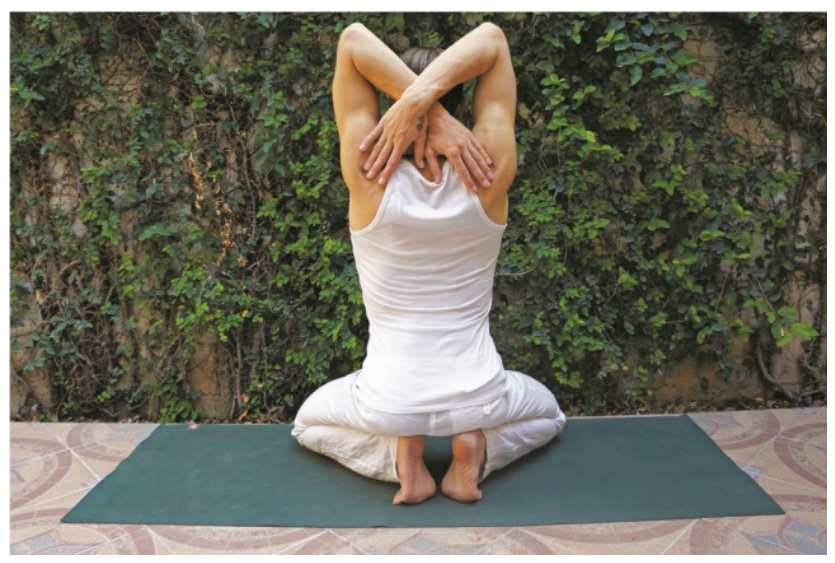
TRANSLATION-cum-TECHNIQUE
- Come to a full squat position
- Rest the knees on the floor and spread the knees a little apart
- Stay on the heels with the heels raised off the ground
- Keep the toes pointing downwards
- Raise the arms, cross them and place them behind the head
- Fix the gaze at the eyebrow center
- Settle in this posture for 30 seconds
IN MAAKADA ASANA, NEXT-
2. – SHANTHA KUMBHAKA KUMBHAKA PADDHATI, VERSE: 90
कायस्यान्तर्बहिर्व्याप्तिः शान्तकुम्भक उदाहृतः।
स्थानयोरन्तरे रुध्वा कुम्भयेद्यदि मारुतम् ॥
Kaayasyaanthar-Bahih-Vyaapthihi Shaantha-Kumbhaka Udhaahruthaha |
Sthaanayoranthare Rudhvaa Kumbhayeth Yadhi Maarutham ||90||
TRANSLATION If the breath is restrained inside and visualized to be inside and outside the body, it is called Shanta Kumbhaka.
TECHNIQUE
- Inhale deeply and hold the breath inside
- Visualize the breath inside and outside the body 3. Hold as long as possible
- Relax when you can not hold any more
- Do this 21 times
IN MAAKADA ASANA, NEXT
3. SEETHKAAREE PRAANAAYAAMA HATHA PRADEEPIKAA, UPADESHA 4, VERSE 43
सीत्कां दद्यात् सदा वक्त्रे घ्राणेनैव विसर्जयेत् ।
एवमभ्यास योगेन कामदेवो द्वितीयकः ॥
Seethkaam dadyaath sadaa Vaktre Ghraanenaiva Visarjayet |
Evam Abhyaasa-Yogena Kaamadevo Dviteeyakaha ||4.43||
TRANSLATION By drawing the breath in through the mouth, make a hissing sound, without opening the mouth, and exhale through the nose. By practicing this, one becomes a second Kaamadevatha (god of love).
TECHNIQUE
- Stay in same asana
- Press the lower and upper teeth together and separate the lips as much as comfortable
- Breath in slowly through the gaps of the teeth
- Listen to the sound of the breath as the air is being drawn in
- Close the mouth at the end of the inhalation
- Exhale slowly through the nose
- Do this 21 times
IN MAAKADA ASANA, NEXT-
4. BHASTRIKAA GHERANDA SAMHITA, UPADESHA-5, VERSES 75- 77
॥ अथ भस्त्रिकाकुम्भकः ॥
भस्त्रैव लोहकाराणां यथाक्रमेण संभ्रमेत्।
तथा वायुम् च लभभधभभपरभभटभद्भवभभपरभभत्र चालयेच्छनैः ॥
एवंविम्शतिवारं च कृत्वा कुर्याच्च कुम्भकम्।
तदन्ते चालयेद्वायुं पूर्वोक्तं च यथाविधि ॥
त्रिवारं साधयेदेनं भस्त्रिकाकुम्भकं सुधीः।
न च रोगो न च क्लेश आरोग्यं च दिने दिने ॥
Bhastraiva lohakaaraanaam Yathaa-kramena sambhramet |
Tathaa vaayum cha naasaabhyaam Ubhaabhyaam Chaalayet shanaihi || 5.75 ||
Vimshati-vaaram Cha Krutvaa Kuryaachcha Kumbhakam |
Tadante Chaalayet Vaayum Poorvoktam Cha Yathaa-vidhi || 5.76 ||
Trivaaram SaadhayetEnam Bhastrikaa-Kumbhakam Sudheehi |
Na Cha Rogo Na Cha Klesha Aarogyam Cha Dhine Dhine || 5.77 ||
TRANSLATION As the bellows of the ironsmith constantly dilate and contract, similarly let him slowly draw in the air by both the nostrils and expand the stomach; then throw it out quickly (the wind making sound like bellows).
Having thus inhaled and exhaled twenty times as stated above, then let him perform Kumbhaka and then let him expel it by the previous method (this completes one round of Bhastrikaa). Let the wise one perform this Bhastrikaa (Bellows-like) Kumbhaka thrice; he will never suffer any disease and will be always healthy.
TECHNIQUE
- Inhale slowly expanding the stomach
- Exhale slowly
- Do this 21 times
- After 21 times, Now inhale slowly
- Hold the breath as long as you can
- When you feel you cant hold quickly expel the air with the sound of bellows. At this moment the stomach should contract to touch the back (This is one Bhastrikaa)
- Do this complete sequence three times
IN MAAKADA ASANA, NEXT
5. TRINETRA KUMBHAKA KUMBHAKA PADDHATHI, VERSE: 192
सकृच्चन्द्रेण चापूर्य धार्यं सूर्येण पूरयेत् ।
नियम्य पूरयेन्नो यां धारयित्वा यथाविधि ॥
त्रिनेत्रकुम्भकः प्रोक्तः त्रिनेत्रेण त्रिसिद्धिदः ॥
SakruthChandrenaChaapoorya DhaaryaSooryenaPoorayeth |
NiyamyaPoorayennobhyaam DhaarayithvaaYathaa-Vidhi ||
Thrinethra-KumbhakahaProkthaha ThrinethrenaThrisiddhidhaha ||
TRANSLATION
Inhale through the left nostril and retain, inhale through the right nostril and retain and then inhale through both the nostrils, retain the breath (all these in one shot before exhalation). This is the Trinetra Kumbhaka – the giver of three siddhis – as explained by the three-eyed Shiva.
TECHNIQUE
- Inhale through the left nostril
- Hold the breath as long as you can judiciously
- Without exhalation, inhale through the right nostril
- Hold the breath as long as you can judiciously
- Again without exhaling, inhale through both the nostrils
- Hold the breath as long as you can judiciously
- Now exhale through both the nostrils slowly
- Do this 21 times
IN MAAKADA ASANA, NEXT-
6. – TRISHOOLA KUMBHAKA
KUMBHAKA PADDHATHI, VERSE: 193
घोणा यां च मुखेनापि युगपत् पूरयेत् सदा ।
त्रिशूलिना त्रिशूलाख्यः कुम्भ उक्तस्त्रिशूलनुत् ॥
Ghonaabhyaam Cha Mukhenaapi YugapathPoorayethSadhaa | ThrishoolinaaTrishoolaakhyaha KumbhaUkthas-Trishoolanuth ||193||
TRANSLATION
Always inhale through the nostrils and mouth together at a time. This is called the Trishoola Kumbhaka – the remover of triple sufferings – as explained by the Thrishooli Shiva.
TECHNIQUE
- Inhale through the nostrils and also through the mouth simultaneously
- Hold the breath as long as you can judiciously
- Now exhale through the nostrils slowly and relax
- Do this 21 times
END OF KRIYA
Kriya Date 05-Dec-2011