CLARITY AND EMOTIONAL STABILITY KRIYA
This text was machine-transcribed from the printed book and may contain errors. Select the words and choose “Report a mistake”.
STEPS TO BE FOLLOWED
- VAJRA ASANA
- NADI SHODANA
- TRISHOOLA KUMBHAKA
- TRINETRA KUMBHAKA
1. VAJRA ASANA GHERANDA SAMHITA, UPADESHA 2, VERSE 12
॥ अथ वज्रासनम् ॥
जङ्घा यां वज्रवत् कृत्वा गुदपार्श्वे पदावुभौ ।
वज्रासनं भवेदेतत्द्योगिनां सिद्धिदायकम् ॥
Janghaabhyaam Vajravath Kruthvaa Gudha-Paarshve Padhaavubhau | Vajraasanam Bhavedethad Yoginaam Siddhidaayakam ||2.12||
TRANSLATION Having hardened the thighs like steel, and placing both the legs on the sides of the anus is called Vajra asana, which gives great extraordinary powers.
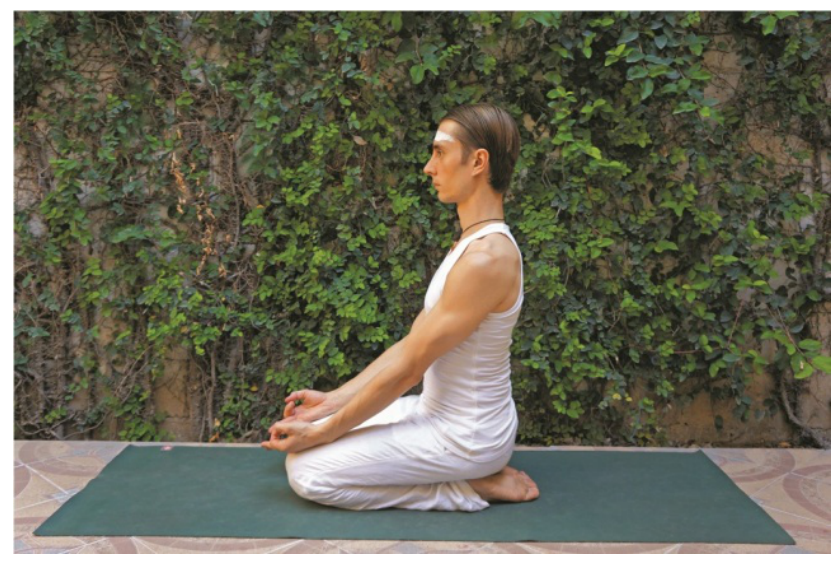
TECHNIQUE
- With knees, ankles and big toes touching the ground, stand on a kneeling position.
- Sit erect with the heels under your buttocks
- Erect in this asana 30 seconds
IN VAJRA ASANA, NEXT-
2. NAADEE SHUDDHI HATHA PRADEEPIKAA, UPADESHA 4, VERSES 11 & 13
बद्धपद्मासना योगी प्राणं चन्द्रेण पूरयेत्।
धारयित्वा यथाशक्ति भूयः सूर्येण रेचयेत्॥
येन त्यजेत्तेन पीत्वा धारयेदतिरोधतः।
रेचयेच्च ततोऽन्येन शनैरेव न वेगतः॥
Baddha-Padma asanaa Yogee Praanam Chandrena Poorayet |
Dhaarayitvaa Yathaa-Shakti Bhooyaha Sooryena Rechayet ||4.11||
Yena Tyajet Tena Peethva Dhaarayeth Athirodhitaha |
Rechayechcha Tatho'nyena Shanaireva Na Vegatha||4.13||
TRANSLATION The Yogi seated in Baddha Padma asana, should first inhale through the left nostril and retain the breath up to his capacity and exhale through the right nostril.(4.11)
Having drawn in the air through the same nostril through which it was exhaled, the breath should be retained to the maximum capacity. Then the exhalation should be done through the other nostril very slowly and not in haste. (4.13)
TECHNIQUE
- Sit in the same posture
- Inhale slowly through the left nostril
- Retain the breath inside as long as you can and exhale through the right nostril
- Inhale slowly through the right nostril
- Retain the breath inside as long as you can and exhale through the left nostril
- Do this for 3 minutes
IN VAJRA ASANA, NEXT-
3. TRISHOOLA KUMBHAKA
KUMBHAKA PADDHATHI, VERSE: 193
घोणा यां च मुखेनापि युगपत् पूरयेत् सदा।
त्रिशूलिना त्रिशूलाख्यः कुम्भ उक्तस्त्रिशूलनुत्॥
Ghonaabhyaam Cha Mukhenaapi YugapathPoorayethSadhaa |
ThrishoolinaaTrishoolaakhyaha KumbhaUkthas-Trishoolanuth ||193||
TRANSLATION
Always inhale through the nostrils and mouth together at a time. This is called the Trishoola Kumbhaka – the remover of triple sufferings – as explained by the Thrishooli Shiva.
TECHNIQUE
- Inhale through the nostrils and also through the mouth simultaneously
- Hold the breath as long as you can judiciously
- Now exhale through the nostrils slowly and relax
- Do this for 7 minutes
IN VAJRA ASANA, NEXT-
4. TRINETRA KUMBHAKA
KUMBHAKA PADDHATHI, VERSE: 192
सकृच्चन्द्रेण चापूर्य धार्यं सूर्येण पूरयेत्।
नियम्य पूरयेन्नो यां धारयित्वा यथाविधि ॥
त्रिनेत्रकुम्भकः प्रोक्तः त्रिनेत्रेण त्रिसिद्धिदः॥
SakruthChandrenaChaapoorya DhaaryaSooryenaPoorayeth |
NiyamyaPoorayennobhyaam DhaarayithvaaYathaa-Vidhi ||
Thrinethra-KumbhakahaProkthaha ThrinethrenaThrisiddhidhaha ||
TRANSLATION Inhale through the left nostril and retain, inhale through the right nostril and retain and then inhale through both the nostrils, retain the breath (all these in one shot before exhalation). This is the Trinetra Kumbhaka – the giver of three siddhis – as explained by the three-eyed Shiva.
TECHNIQUE
- Inhale through the left nostril
- Hold the breath as long as you can judiciously
- Without exhalation, inhale through the right nostril
- Hold the breath as long as you can judiciously
- Again without exhaling, inhale through both the nostrils
- Hold the breath as long as you can judiciously
- Now exhale through both the nostrils slowly
- Do this for 7 minutes
END OF KRIYA
Kriya Date
08-Apr-2012