CARE FOR VERTIGO
This text was machine-transcribed from the printed book and may contain errors. Select the words and choose “Report a mistake”.
Disease Description
Vertigo is a type of dizziness, where there is a sensation of spinning while stationary. The symptoms are due to a dysfunction of the vestibular system in the inner ear. It is often associated with nausea and vomiting, unsteadiness, and excessive perspiration, as well as difficulties standing or walking. Blurred vision, difficulty in speaking, a lowered level of consciousness, and hearing loss may also occur. Central nervous system disorders may lead to permanent symptoms.
There are three types of vertigo: objective − subjects are moving around the patient; subjective − patient feels as if moving himself; pseudo vertigo − intensive sensation of rotation inside the patient's head.
The most common causes are benign paroxysmal positional vertigo, concussion and vestibular migraine while less common causes include Ménière's disease and vestibular neuritis. Excessive consumption of alcoholic beverages can also cause notorious symptoms of vertigo.
Vertigo is a frequent symptom in the general population. Its prevalence rises with age and is about two to three times higher in women than in men. It accounts for about 2-3 % of emergency department visits.
STEPS TO BE FOLLOWED
- ANDHAASANA
- PRAKRITHI KUMBHAKA
- KOORMA KUMBHAKA
- AARAMBHAASANA
- GADAA KUMBHAKA
- VAAMAAVARTHA CHAKRA KUMBHAKA
- DAKSHINAAVARTA CHAKRA KUMBHAKA
1. - ANDHAASANA JOGA PRADEEPIKAA, VERSES 193 TO 197
प्रथम पगथली सम ठहरावै कोर माहिली उभै मिलावै ।
फणापाण उकड कर बैठे दो उ एडी गुदा निवैंसे ॥
जंघ ओर घोडा सम कर धरै पुन आगाको उभै पसारै ।
गोडामहिला नेत्र दोउ सम करि काठा दाबे सो उ ॥
पोहुचाकी संधिमाहिली ताको ऐसे ठानि ।
गोडा की ब्अझीझ दिसा तापार धरै जु आनि ॥
नेत्र मे जै पटब व्है पुनि रातींध्यो होय ।
गावा धृति अरू मिरचसो अंजन कीजै सोय ॥
मुख मारग रेचन करे मूलद्वारे दे बन्ध ।
तो रातिंध्यो ना रहे नैननि देखे अंध ॥
Prathama Pagathalee Sama Taharaavai Kora Maahilee Ubhai Milaavai |
Phanaapaana Ukada Kara Baise Dovu Edee Gudaa Nivaise ||193||
Jangha Or Ghodaa Sama Kara Dharai Puna Aagaako Ubhai Pasaarai |
Godaamahilaa Netra Dovu Sama Kari Kaataa Dhaabe Sovu ||194||
Pohuchaakee Sandhimaahilee Thaako Aise Taani |
Godaa Kee Baahari Dhisaa Thaapari Dharai Ju Aani ||195||
Nethra Me Jai Pataba Vhai Puni Raatheendho Hoya |
Gaavaa Dhruthi Uroo Mirachaso Anjana Keejai Soy ||196||
Mukha Maaraga Rechana Kare Mooladvaara Dhe Bandha |
Tho Raathindho No Rahe Nainani Dhekhe Andha ||197||
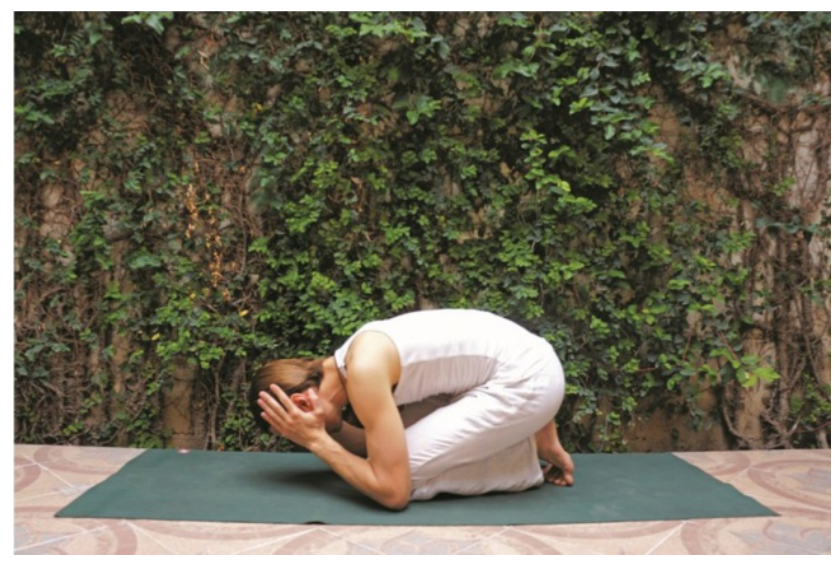
TRANSLATION-cum-TECHNIQUE
- Sit in a squatting position
- Direct the knees forward
- Bend forward
- Lower the head in between the knees
- Keep the elbows adjacent to the knees
- Hold the head with your hands
- Exhale completely through mouth 8. Practice Mula Bandha– i.e., The practitioner should press with left heel between the anus and scrotum. And then contract the anus.
- Remain in this pose 30 seconds
- Release Mulabandha
IN ANDHAASANA, NEXT –
2. PRAKRITHI KUMBHAКА
KUMBHAKA PADDHATHI, VERSE: 70
वान्वितेनाशुगं कर्षन् कुर्वन्तूच्चतरं स्वनम् ।
धारयेच्चेदुदानस्य प्रकृतिः कुम्भकः स्मृतः ॥
Vaanvithena-Aashugam Karshan Kurvanthoochcha'tharam Svanam | DhaarayethCheth Udhaanasya Prakruthi:Kumbhaka: Smruthaha || 70 ||
TRANSLATION
One should suck in air quickly with a loud sound of the bija mantra "VA" and retain the breath. this is called Prakrithi Kumbhaka.
TECHNIQUE
- As you chant the bija mantra "VA" loudly, suck in air quickly.
- After you are full, hold the breath
- Then slowly exhale normally
- Do this 21 times
P.S: If you have Hypertension, Hernia or if you are Pregnant do not hold the breath
IN ANDHAASANA, NEXT-
3. KOORMA KUMBHAКА
KUMBHAKA PADDHATHI, VERSE: 79
निमीलोन्मीलने त्यक्त्वा पीठे काष्ठमिव स्थितिः ।
नेत्रयोश्च शरीरस्य कूर्मकुम्भः स उच्यते ॥
Nimeelon'meelaneThyakthvaa PeeteKaashtam Iva Sthithihi | Nethrayoshcha Shareerasya Koormakumbhaha Sa Uchyathe ||79||
TRANSLATION
Having stopped the blinking of eyes, (the kumbhka that happens) when the eye balls and body are perfectly steady without any movements, like a log of wood, is called Koorma Kumbhaka.
TECHNIQUE
- Continue to be seated in the same asana
- Fix your sight at one point and stare
- Do not blink your eyes
- Do not allow your eye balls to move.
- Do not move your body.
- While you stare intensely, automatically the breathing will stop. Hold the breath as long as you can.
- When you can't hold anymore, relax
- Then again stare
- Do this 21 times.
4. AARAMBHAASANA YOGAASANA MAALAA SACITRA, VERSE: 30
दोउ पग मिलिवा पसारी पगाका अगुठा पकडि लिलाट गोडा लगावै ।
सरीर समीराषै आसन कौगुण आरभ की विधि उत्तर सनमुष बैसी आरम्भ करै ।
Dovu Paga Milivaa Pasaaree Pagaakaa Aguta Pakadi Lilaata Godaa Lagaavai |
Sareera Sameeraashai Aasana Kauguna Aarabha Kee
Vidhi Uththara Sanamusha Baisee Aarambha Karai ||30||
TRANSLATION-cum-TECHNIQUE
- Sit with the legs stretched.
- Bend your body and catch hold of the great toes with your hands
- Try to touch the knees with your head
- Remain in this pose 30 seconds
IN AARAMBHAASANA, NEXT-
5. -GADAA KUMBHAKA KUMBHAKA PADDHATHI, VERSE 112
उभा यां पूरणं यत्र रेचनं सूर्यवर्त्मना ।
गदाकुम्भः शिवेनोक्तो योगिनो बलकारकः ॥
Ubhaabhyaam Pooranam Yathra Rechanam Soorya-Vartmanaa|
Gadaakumbhaha-Shivenoktho Yogino Balakaarakaha||112||
TRANSLATION When the inhalation is performed through both the nostrils and exhalation through the right one, it is called Gadaakumbhaka explained by Shiva and strengthener of Yogis.
TECHNIQUE
- Inhale through both the nostrils
- Hold the breath
- Exhale through the right nostril
- Do this 21 times
.IN AARAMBHAASANA, NEXT
6. – VAAMAAVARTHA CHAKRA KUMBHAKA
KUMBHAKA PADDHATI, VERSE: 107, 108
सूर्येणापूर्य मरुतं कुम्भयेदुदरस्थितम् ।
रेचयेदिन्दुना भूयः तथा दक्षिेण पूरयेत् ॥
कुम्भयेदिडया रिच्याद्दक्षिणावर्त्तचक्रकः ।
विलोमोऽयं चक्रकुम्भो वामावर्त्तः शिवोदितः ॥
Sooryenaapoorya Marutham Kumbhayeth Udharasthitham |
Rechayeth Indhuna Bhooyaha Thathaa Dakshena Poorayeth ||107||
Kumbhayeth Idayaa Richyaath Dakshinaavarththa-Chakrakaha |
Vilomo’yam Chakra-Kumbho Vaamaavarththash-Shivodhithaha ||108||
TRANSLATION
One should inhale through the right nostril and fill the abdomen with breath, exhale through the left nostril, and again one should inhale through the right nostril and hold and exhale through the left nostril. This is Dakshinaavarta Chakra Kumbhaka. The reverse of this is called Vaamaavarta Chakra Kumbhaka by Lord Shiva.
TECHNIQUE
- Inhale through left nostril
- Hold the breath as long as you can judiciously
- Exhale through the right nostril
- Again inhale through left nostril
- Hold the breath as long as you can judiciously
- Exhale through the right nostril
- Do this 21 times
IN AARAMBHAASANA, NEXT
7. DAKSHINAAVARTA SHANKHA KUMBHAKA
KUMBHAKA PADDHATI, VERSE: 110
चक्रकुम्भकं द्विधा कुर्यादग्निशोमं तथैकधा ।
शङ्खकुम्भोऽयमीशेन पूर्ववद् द्विविधः स्मृतः ॥११०
chakrakumbhakam dvidhaa kuryaadagnishomam tathaikadhaa | shankakumbho (a)yameeshena poorvavad dvividhah smrutah ||
Translation Practising chakra kumbhaka twice and agnishoma kumbhaka once is called as shankakumbhaka. As said before Shanka kumbhaka is also of two types like chakra Kumbhaka
Technique
- Inhale deeply and fully through the right nostril
- Hold the breath inside as long as possible
- When you can’t hold anymore slowly release the breath through the left nostril
- Again inhale deeply and fully through the right nostril
- Hold the breath inside as long as possible
- When you can’t hold anymore slowly release the breath through the left nostril ( practise as described from points 1-6 once more. With this two rounds of Dakshinavartha chakrakumbhaka is completed. Then do one round of agnishoma kumbhaka as described below)
- inhale through the right nostril
- hold the breath
- exhale through the left nostril
- now inhale through the left nostril
- hold the breath
- exhale through the right nostril
- Do this 21 times
END OF KRIYA
Kriya Date
27-Nov-2011