Overview of the primary school education
This text was machine-transcribed from the printed book and may contain errors. Select the words and choose “Report a mistake”.
system immediately before Macaulay
- The Indian Education system, which was at least a few thousand years old, older than most Abrahamic religions, was completely wiped out, in about a century, during the British Rule.
- Based on the reports, the Governor, Sir Thomas Munro, was of the view that institutional education of the boys between the ages of 5 to 10 years appeared to be more than 1/4th, nearer to 1/3rd of the boys of that age in the Presidency as a whole[i], while the rest were educated at home. Madras Presidency represented nearly 1/3rd of India then.
- The survey carried out in Madras Presidency was done to a specific prescribed format. The numbers of schools, colleges were to be mentioned. The student population had to be described as per gender (male, female, transgender) and as Brahmin, Vaishya, Shudra and other castes.
- Sir Thomas Munro, the Governor, observed that the Indian education would certainly have been far superior during its glorious peak[ii], that is during the times of Takshila and Nalanda University. But right then, during the 1830s, Indian education system was already damaged and suffering due to a series of invasions and increasing impoverishment of the population.
- As per W. Adam’s report, there was at least one school in every village. He observed that there existed about 1,00,000 village schools in Bengal and Bihar around the 1830s.[iii]
[i] [ii] Thomas Munro in his review of 10 March 1826. The Beautiful Tree, ShriDharampal, Page 26. [iii] Report on the state of Education in Bengal, 1835. p.6.
How the Indian Education compared with the state of
education in Europe, particularly in England
- The content of studies was better than what was then studied in England, which was almost only the bible!
- The economy at which education was imparted impressed British collectors that they suggested it to be replicated in Britain [i], which indeed did inspire the British education later on.
- The duration of study was more prolonged. The collectors (apart from Nellore and Salem) stated that the duration of study varied from a minimum of 5 to about a maximum of 15 years [iii]. Average schooling year in Britain was 1 year in 1835, and 2 years in 1852.
- For Indian traditional schools typical age of enrolment was 5 years. The duration of schooling hours was also much longer. It started at 6 AM, had one or two short intervals for meals, finishing about at sunset [iii].
- The method of school teaching in India (which had prevailed in India for centuries) was considered superior and it is this very method that was introduced in England, which greatly helped the beginnings of popular (public) education in England.
- School attendance, especially in the districts of Madras Presidency, even in the decayed state of the period 1822-25, was proportionately far higher than the numbers in all variety of schools in England in 1800[iv].
- The conditions under which teaching took place in the Indian schools were less dingy and more natural; and, it was observed, the teachers in the Indian schools were generally more dedicated and sober than in the English versions. Education was imparted without violence[v].
[i] The economy with which children are taught to write in the native schools, and the system by which the more advanced scholars are caused to teach the less advanced and at the same time to confirm their own knowledge is certainly admirable, and well deserved the imitation it has received in England. – A.D. Campbell, Collector, Bellary, 17th August 1823. [ii] [iii] [iv] The Beautiful Tree, Shri Dharampal, Page 30, 31, 20 FRA PAOLINO DA BARTOLOMEO, ON EDUCATION OF CHILDREN IN INDIA, (Born at Hos, Austria, 1748, as John Phillip Wesdin; in India 1776 to 1789. From Voyages to the East Indies (Published, Rome, 1796, Berlin, 1798, England, 1880), Book II: Birth and Education of Children (pp.253-268)) [v] MALABAR BIBLIOGRAPHY, THEIR PROGRESS IN LITERATURE, EDUCATION—SYSTEM BORROWED FROM IT. ACCOUNT OF IT FROM PETER DELLA VALLE. CUSTOM IN MALABAR TO TRANSLATE WORKS FROM SANSCRIT, MANNER OF WRITING OR ENGRAVING ON LEAVES. QUOTATION FROM LUSIAD. LIST OF BOOKS. (National Library of Scotland Edinburgh: Walker of Bowland Papers 184 a 3, Chapter 31: pp.501-27)
A few unique aspects of the Indian primary education (as identified by the British themselves)
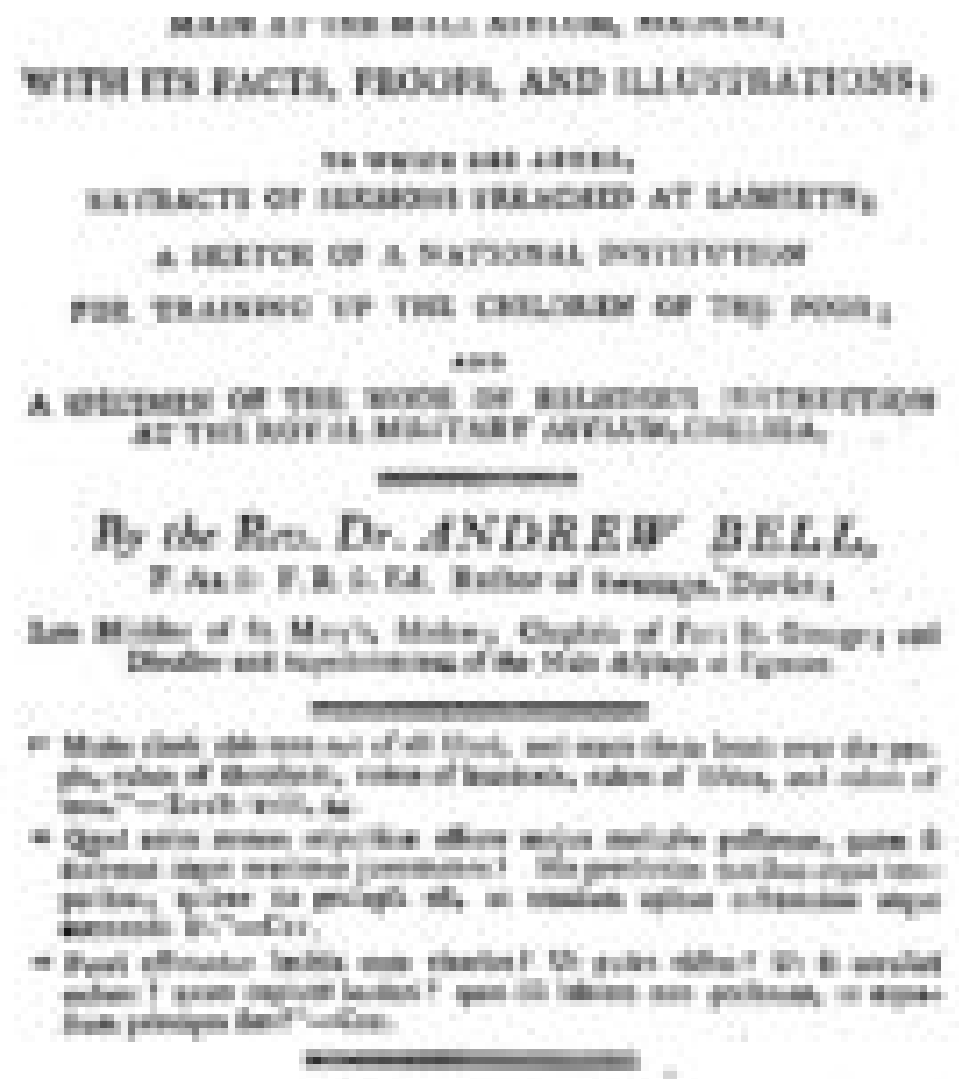
1. Monitorial System[i] [ii] – For the initial mode of learning a novel method of education existed where the pupils were monitors of each other. Example – The tutor would choose some 3–4 monitors and impart them a particular lesson. For example, the multiplication tables. The monitors would sit crossed legged on a sandy ground, and recite the multiplication table (sometimes like a song), “one by itself makes one.” Along with reciting, the monitor would also write the same on the sand with his finger. After this other students repeated the same task. The ground by now had to be planned for the next lesson. The monitors would then start with the multiplication table for two and so on. The process was unique as it involved the following: a. Low cost to benefit ratio. No need for paper and pen. b. Redundancy. There were 3–4 monitors and thus if even if one of them made a mistake, he/she was likely to be corrected by the other three. All the four were unlikely to make the exact same mistake. c. Scalability. The system allowed a single teacher to handle a large number of students. d. The stolen idea. The system was adopted by the British, repackaged as Bell’s “Madras System” with the idea to produce a “Christian Education” and “train children in the practice of such moral habits as are conducive to the welfare of society.” The system was introduced in several countries. With time however it was replaced with other systems particularly – the lecture model of direct instruction delivered to passive students grouped into classes by age. e. Teaching not confined to classroom and linked to nature. f. Close relationship between student and teacher.
g. Memorization: The children were known to memorize multiplication tables as far as 100[iii]. In current era, it is often limited to 16, 12 or worse 10, if at all.
[i] Peter Della Valle published an account of this mode of instruction in Malabar 22nd November 1623, mentioned in Walker of Bowland Papers 184 a 3, Chapter 31: pp.501-27) [ii]https://en.wikipedia.org/wiki/Monitorial_System#The_Madras_System [iii] The Beautiful Tree, ShriDharampal, Page 53