Imparted education to the commons
This text was machine-transcribed from the printed book and may contain errors. Select the words and choose “Report a mistake”.
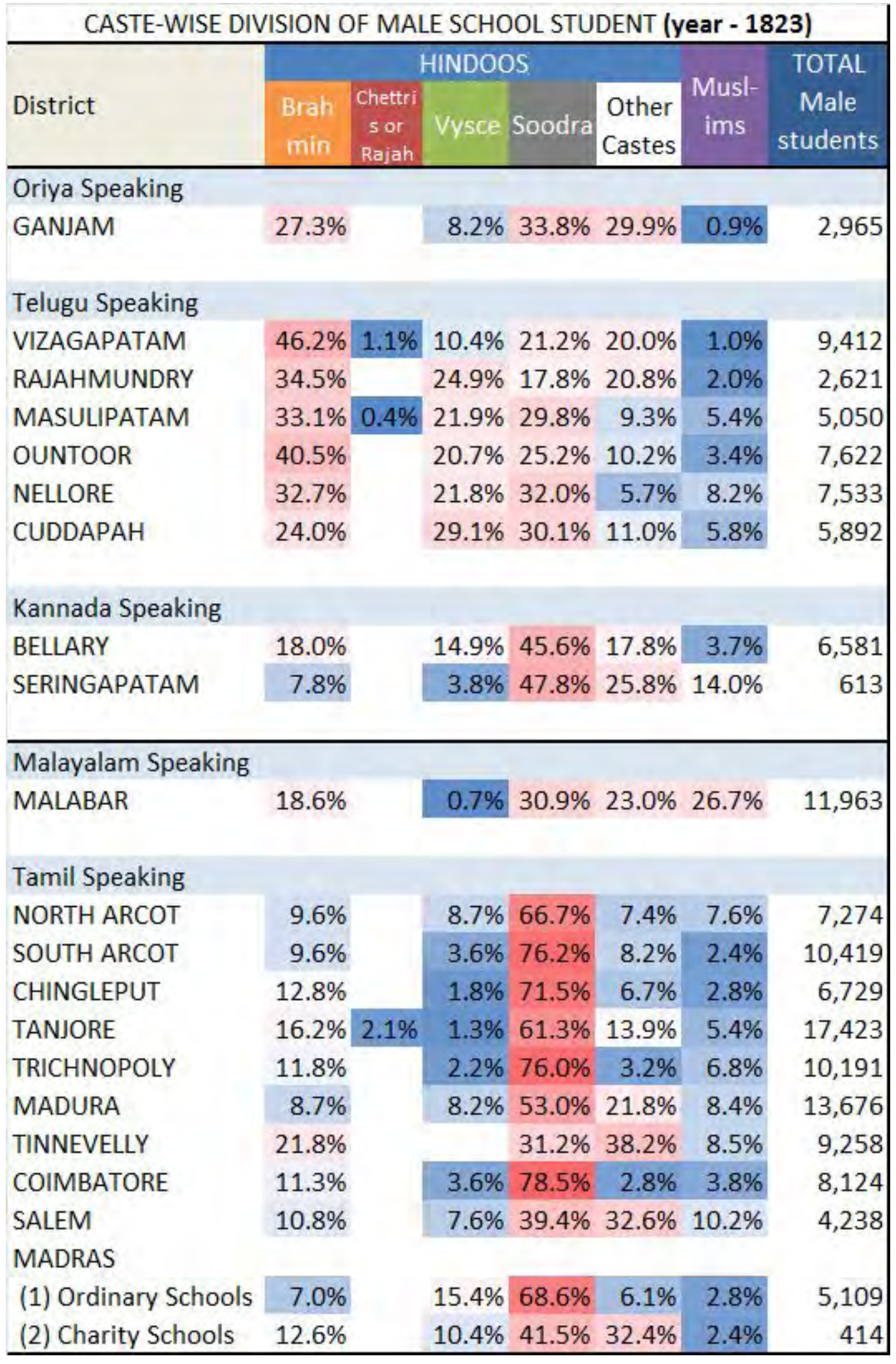
- The term Scheduled caste and Scheduled Tribes did not exists during that era, but were mentioned as ‘other castes’ (also known as ‘panchamas’) in the report[i].
- 70% of the students (70% in Salem and Tinnevelly to over 84% in South Arcot) were from the ‘Shudra’ community[i] and the ‘other castes’. This was the trend for most of country.
- Around 20% of the students were from the ‘Brahmin’ and the ‘Vaishya’ community[i].
- In some villages of Bihar, ‘Chandal’ and ‘Dom’ jati accounted for 50% of the students. In Bihar, the ‘Brahmin’ and ‘Kayastha’ jati accounted for more than 40% of the total students [ii].
5. All professions, traditions were respected. There was dignity of labour, farmer, priest, every limb of the society. For example, a book on agriculture, used in that era, the second verse of the book, declares, "that if a learned priest who has knowledge of 4 vedas, even after learning 4 vedas if looks down at farming considering it inferior, that person is surely to suffer from poverty". The context of this verse is that all professions, including farming should be respected.
| District | Brah | Chettri s or Rajah | Vysce | Soodra | Other Castes | Musl- ims | TOTAL Male students |
|---|---|---|---|---|---|---|---|
| Oriya Speaking | |||||||
| GANJAM | 27.3% | 8.2% | 33.8% | 29.9% | 0.9% | 2,965 | |
| Telugu Speaking | |||||||
| VIZAGAPATAM | 46.2% | 1.1% | 10.4% | 21.2% | 20.0% | 1.0% | 9,412 |
| RAJAHMUNDRY | 34.5% | 24.9% | 17.8% | 20.8% | 2.0% | 2,621 | |
| MASULIPATAM | 33.1% | 0.4% | 21.9% | 29.8% | 9.3% | 5.4% | 5,050 |
| OUNTOOR | 40.5% | 20.7% | 25.2% | 10.2% | 3.4% | 7,622 | |
| NELLORE | 32.7% | 21.8% | 32.0% | 5.7% | 8.2% | 7,533 | |
| CUDDAPAH | 24.0% | 29.1% | 30.1% | 11.0% | 5.8% | 5,892 | |
| Kannada Speaking | |||||||
| BELLARY | 18.0% | 14.9% | 45.6% | 17.8% | 3.7% | 6,581 | |
| SERINGAPATAM | 7.8% | 3.8% | 47.8% | 25.8% | 14.0% | 613 | |
| Malayalam Speaking | |||||||
| MALABAR | 18.6% | 0.7% | 30.9% | 23.0% | 26.7% | 11,963 | |
| Tamil Speaking | |||||||
| NORTH ARCOT | 9.6% | 8.7% | 66.7% | 7.4% | 7.6% | 7,274 | |
| SOUTH ARCOT | 9.6% | 3.6% | 76.2% | 8.2% | 2.4% | 10,419 | |
| CHINGLEPUT | 12.8% | 1.8% | 71.5% | 6.7% | 2.8% | 6,729 | |
| TANJORE | 16.2% | 2.1% | 1.3% | 61.3% | 13.9% | 5.4% | 17,423 |
| TRICHNOPOLY | 11.8% | 2.2% | 76.0% | 3.2% | 6.8% | 10,191 | |
| MADURA | 8.7% | 8.2% | 53.0% | 21.8% | 8.4% | 13,676 | |
| TINNEVELLY | 21.8% | 31.2% | 38.2% | 8.5% | 9,258 | ||
| COIMBATORE | 11.3% | 3.6% | 78.5% | 2.8% | 3.8% | 8,124 | |
| SALEM | 10.8% | 7.6% | 39.4% | 32.6% | 10.2% | 4,238 | |
| MADRAS | |||||||
| (1) Ordinary Schools | 7.0% | 15.4% | 68.6% | 6.1% | 2.8% | 5,109 | |
| (2) Charity Schools | 12.6% | 10.4% | 41.5% | 32.4% | 2.4% | 414 |
Superficial look at the numbers seems to suggest that the Brahmin community has the maximum population of the school going children. But if one looks at the Tamil Nadu region, he will see that it is actually the Sudra community (as labled by the British) which consists of the maximum school going children. If the average is taken of all regions put together, it is noticed the it is actually the Sudras which had the highest numbers of school going children. In such circumstances, the allegations made the Hindus deprived non-Brahmin community from education is untenable as per the official colonial era Christian British records themselves.
[i] [ii] The Beautiful Tree, Shri Dharampal, Page 88, Page 54