Bhagavad Gita Decoded
This text was machine-transcribed from the printed book and may contain errors. Select the words and choose “Report a mistake”.
SCIENTIFIC RESEARCH ON BHAGAVAD GĪTĀ
Several institutions have conducted experiments using scientific and statistically supported techniques to verify the truth behind Bhagavad Gītā. Notable amongst them is the work carried out by Mahṛṣi Mahesha yogi, whose findings are published through Maharṣi ved vijñāna viśva vidyāpīṭaṁ.
Studies conducted using meditation techniques related to truths ex-pressed in the verses of Bhagavad Gītā have shown that the quality of life is significantly improved through meditation. These studies have found that meditators experience a greater sense of peace resulting in a reduced tendency towards conflict.
Meditators gain greater respect for and appreciation of others. Their own inner fulfillment increases resulting in improved self-respect and self-reliance, leading to Self Realization.
One's ability to focus along with brain function integra-tion is enhanced. These have resulted in greater comprehension, creativity, faster response time in decision-making and superior psychomotor coordination.
Stress levels have been shown to decrease with enhanced sensory perception and overall health. The tendency towards depression has been clearly shown to decrease.
There is enough evidence to show that as a result of meditation, individuals gain a better ethical lifestyle that in turn improves their interaction with others in the community, resulting in less conflict and crime. Group meditation of 7000 people (square root of 1% of world population at the time of the study) was significantly correlated to a reduction in conflict worldwide.
Meditation leads to higher levels of consciousness. Through the research tools of Applied Kinesiology, Dr. David Hawkins (author of the book Power vs. Force) and others have shown that human consciousness has risen in the last few decades, crossing a critical milestone for the first time in human history. Dr. Hawkins' research also documents that Bhagavad Gītā is at the very highest level of Truth conveyed to humanity.
We acknowledge with gratitude the work done by the Mahṛṣi Mahesha yogi institutions and Dr. David Hawkins in establishing the truth of this great scripture.
KURU FAMILY TREE
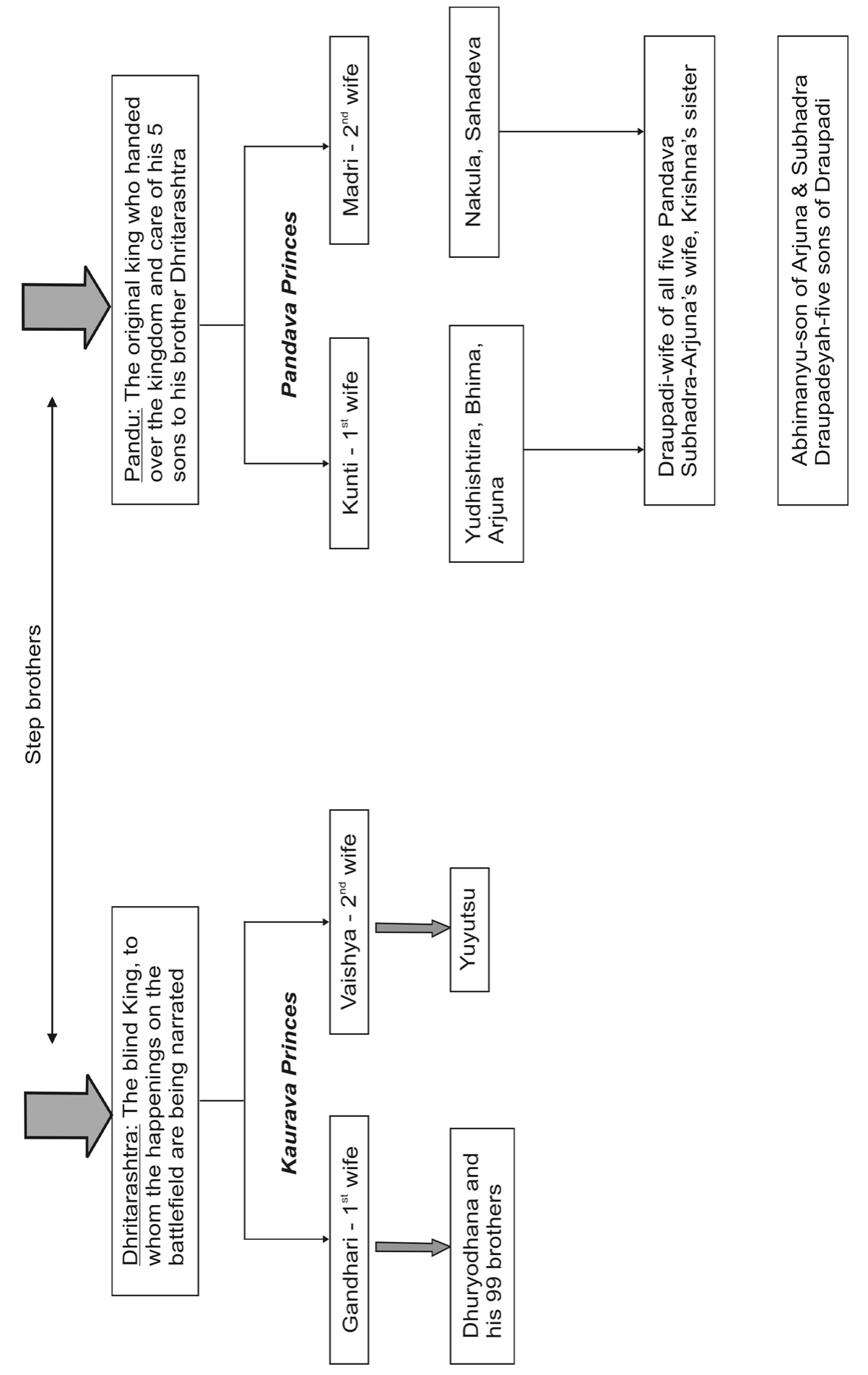
KEY CHARACTERS IN BHAGAVAD GĪTĀ
Kṛṣṇa : God Incarnate, Nārāyaṇa; eighth incarnation of Śrī Viṣṇu; complete Incarnation, Pūrnāvatar; Superconscious Divine, Parabrahma Kṛṣṇa; related to both Kauravas and Pāṇḍavas, Vāsudeva Kṛṣṇa; Arjuna's charioteer in the war; Master of the Universe, Jagadguru—revivor of the sacred, secret science of enlightenment through the Bhagavad Gītā to his disciple Arjuna; removes bhū bhāra, the weight of adharma, collective unconsciousness from the earth through the Mahābhārat war and re-establishes dharma.
Arjuna : the most illustrious of the Pāṇḍava brothers; divine son of Indra, the God of Devatas; expert wielder of the bow; the warrior leader amongst all warriors; human incarnate, Nara (reflection of Nārāyaṇa)
Veda Vyāsa : author of Mahābhārat, Brahma Sūtras; grandfather to the Pāṇḍavas; lord of Enlightened Masters; compiler of Vedas, the sacred texts of Truth.
Pañcha Pāṇḍavas : The 5 Pāṇḍava brothers, Yudhiṣṭra, Bhīma, Arjuna, Nakula, Sahadeva, who are immaculate conceptions of Exitence, born from Nature and Divine energies; embodiment of dharma; cousins of Vāsudeva Kṛṣṇa.
Yudhiṣṭra : eldest of Pāṇḍavas, divine on of Yama Dharma, the God of time and righteusness; renowned for his unflinching adherence to truth and righteousness which earned him the title ‘Dharmarāja—king of Dharma’
Bhīma : The 2nd of the Pāṇḍava brothers; divine son of Vāyu, the wind God; blessed by energy of Hānuman; distinguished from his brothers by his great stature and unimaginable strength.
Nakula, Sahadeva : twin sons of Mādri; divine sons of Aśvini Kumāras, the Divine physicians; expert swordsmen; high wis-dom and war skills; experts in Astrology and Ayurveda.
Draupadī : wife of all Pāṇḍavas; daughter of Drupad; emerged from the fire-sacrifice ener-gy also named ‘Yagñaseni’—born of fire’ and ‘Kṛṣṇa’; dear friend of Śrī Kṛṣṇa; perfectly faultless, chaste and virtous wife; embodied the energy of fighting injustice and adharma; incarnation of eight goddesses in one form.
Duryodhana : son of Dhṛtarāṣṭra, the Kaurava King
Karṇa : son of Kuntī from the Sun god; eldest of the Pāṇḍavas, renowned for his sacrifice and generosity; Duryodhana's close friend
Duśśāsana : brother of Duryodhana, is killed by Bhīma in the war; committed the infamous act of attempting to disrobe Draupadī (wife of Pāṇḍavas)
Bhīṣma : great grandfather of the Kaurava & Pāṇḍava; great warrior
Droṇa : a great archer and teacher of both Kauravas and Pāṇḍavas
Pāṇḍu : father of Pāṇḍavas, husband of Kuntī
Kuntī : wife of Pāṇḍu, mother of Pāṇḍavas (along with Karṇa); embodiment of patience and penance.
Mādrī : 2nd wife of Pāṇḍu; mother of Sahadeva and Nakula; died after her husband left his body.
Gāndhārī : mother of Kauravas; voluntarily blindfold-ed herself throughout her married life since her husband Dhṛtarāṣṭra was born blind.
Śakuni : brother of Gāndhārī; prince of Gāndhāra kingdom. Duryodhana's maternal uncle; mastermind of inciting enmity between Kauravas and Pāṇḍavas.; attempted evil strategies to destroy Kuru dynasty, such as the dice game against Pāṇḍavas.
Drupad : a great warrior and father of Draupadī
Dṛṣṭadyumna : son of king Drupada and brother of Draupadī
Dṛṣṭaketu : king of Chedis, an ally of the Pāṇḍavas.
Śikhaṇḍi : a mighty archer and a transsexual person; responsible for bringing down Grandsire Bhīṣma Pitāmaha from war. Was Ambā, princess of Kāshi, in previous birth.
Virāṭa : Abhimanyu’s father-in-law; king of a neighboring kingdom; ally and host of Pāṇḍavas during their secret stay.
Yuyudhāna : Kṛṣṇa’s charioteer and a great warrior
Kāśirāja : king of the neighboring kingdom of Kāśī
Cekitāna : an ally of the Pāṇḍavas, a great warrior
Kuntībhoja : adoptive father of Kuntī, the mother of the first three Pāṇḍava princes
Purujit : brother of Kuntibhoj
Śaibya : a ruler friendly to the Pāṇḍavas, leader of the Śibi tribe
Uttamouja : a great warrior
Sañjaya : minister and narrator of events to Dhṛtarāṣṭra
Vikarṇa : third of the Kaurava brothers
Aśvattāma : Droṇa’s son and Achilles heel; said to always speak the truth; ally of Duryodhana
Kṛpācārya : teacher of martial arts to both Kauravas and Pāṇḍavas.
Śalya : king of neighboring kingdom and
brother of Mādrī, Nakula and Sahadeva's
mother
Somadatta : king of Bahikas
Śāntanu : Arjuna's great grandfather
Subhadrā : Lord Kṛṣṇa's sister; wife of Arjuna; mother of Abhimanyu.
Abhimanyu : son of Arjuna and Subhadrā; neph-ew of Lord Kṛṣṇa and Lord Balarāma; most brave and illustrious warrior in entire Kuru and Pāṇḍava lineage; inherited the great courage, skills and valour from his father Arjuna and Uncle Kṛṣṇa; engaged in war at the age of 16 and defeated many Mahārathis, great warriors by himself; willingly fought and left his body in warfield proving his loyalty and love to his family; Abhimanyu's son, Parikśit became the sole survivor and heir to Pāṇḍava empire and throne.
Vicitravīrya : Śikhaṇḍī's step brother
Yudhāmanyu : an ally of Pāṇḍavas, prince of Pāñcāla
Yuyudhāna : another name for Sātyaki
S
AMSKRIT PRONUNCIATION
GUIDE
Samṣkṛit is Devabhāśa, meaning the language of the Gods. It is the sacred and sophisticated language or bhāśā, the source of all languages and vocal expressions from time eternal. Spoken by the Gods, it is the first langauge of the world, which flourished in the land of Bhāratavarśa (India).
Samṣkṛitaṃ is a perfect language of the perfect or enlightened ones, used by the learned sages and divine beings to express the inexpressible energy of the sacred Truths. The roots of vedic Samṣkṛit source directly to Lord Śiva, from His Cosmic sound creations (like aiun rilrik etc.), which were later concieved by Sage Pāṇani, who created the entire samṣkṛit grammar called Aṣtādhyāyī. No one in the world could create perfect grammar just from a few sounds, and this is pure evidence that Samṣkṛit is a Divine literal manifestation. The word Samṣkṛtaṃ means—‘that which is perfectly, well done or refined or elaborate speech.’
It is a phonetic language, for it is phonetically precise and natural, where every sound truly represents what it means by a unique symbol. For example, the sound ‘ga’ expresses motion or the samṣkṛit root ‘gam.’ The uniqueness of Samṣkṛit is that it is unchanged in every age in every Veda or in other Samṣkṛit literatures as it is Divinely created grammar. It uses 2200 verbal roots (dhātu) that combine to create an entire vocabulary of millions of words with precise and elaborate verbalization in short syllables. Its sophistication lies in its sacred meanings hidden in samṣkṛit texts, formed with its well-defined combinations (sandhi) of sounds.
In the Vedic tradition, the power of sound is used. Vedic chanting is nothing but 'becoming It' by creating the right space just by declarations. Each sound is a mantra, which invokes that specific energy when chanted with the right phonetic sound; perfect for| expressing the power of words, vāk śakti. To retain the original Vedic tradition, as it is spoken, and to experience the energy of sacred sounds or mantras, the right pronunciation or chanting has utmost value in Saṃskṛit.
Bhagavad Gītā is the direct speech of the Divine— Bhagavān, Parabrahma Śrī Kṛṣṇa sung in His own sound, in the most-refined and kingly Saṃskṛit poetry. Just by chanting the Gītā, we can experience the pure space and energy of Śrī Kṛṣṇa and His teachings; the most confidential, sacred Truths. Ādī Śankaracārya, the great Enlightened Master sings in Bhaja Govindaṁ, ‘Even a little chanting of the Bhagavad Gītā will liberate you from death.’
The chanda or the vedic meter for chanting the Gītā is ‘anuśtubh chandaḥ’—a meter of 32 syllables in a shloka (verse stanza) or 8 syllables in a 4 pada (metrical foot); and the only other meter is ‘trishubh chandaḥ’ of 4 padas of 11 syllables or 44 syllables in each shloka (e.g. most of chapter 11-Viśvarūpa Darśan Yoga). It is recommended to understand the chanda as the verse meter structure is directly related to the right listening and internalizing the meaning.
Saṃskṛit is now mostly written in Devanāgiri script, meaning ‘the city of Gods’, which is also the Hindi language script. Throughout this book, the diacritical marks have been rendered to indicate the right pronunciation of each Saṃskṛit sound in the English letter as per the accepted saṃskṛit transliteration system. In the Devanāgari script, there are fourty-nine characters—fourteen vowels and thirty-five consonants.
(स्वरा:) Vowels
| Simple Vowels | अ a | आ ā | इ i | ई ī | उ u | ऊ ū |
| ऋ ṛ | ॠ ṝ | ऌ l | ॡ l̄ | |||
| Diphthongs | ए e | ऐ ai | ओ o | औ au |
Numerals
० - 0 १ - 1 २ - 2 ३ - 3 ४ - 4 ५ - 5 ६ - 6 ७ - 7 ८ - 8 ९ - 9
(व्यञ्जनानि ) Consonants
| Hard | Hard Aspirate | Soft | Soft Aspirate | Soft Nasal | Soft Semi-vowels | Hard Sibilants | |
|---|---|---|---|---|---|---|---|
| Guttural | क ka | ख kha | ग ga | घ gha | ङ ṅa | ह ha | ः ḥ |
| Palatal | च ca | छ cha | ज ja | झ jha | ञ ña | य ya | श śa |
| Lingual | ट ṭa | ठ ṭha | ड ḍa | ढ ḍha | ण ṇa | र ra | ष ṣa |
| Dental | त ta | थ tha | द da | ध dha | न na | ल la | स sa |
| Labial | प pa | फ pha | ब ba | भ bha | म ma | व va | ः ṁ |
Consonant Pronuncations
- Gutteral: ka, kha, ga, gha, ṅa—pronounced from the throat.
- Palatal: ca, cha, ja, jha, ña—pronounced with the middle of the tougue against the palate
- Lingual or Cerebral: ṭa, ṭha, ḍa, ḍha, ṇa—pronounced from the tip of the tougue against the roof of the mouth
- Dental: ta, tha, da, dha, na—pronounced like the cerebrals but with the tongue against the teeth
- Labial: pa, pha, b, bh, m—pronounced with the lips
- Semivowel: ya, ra, la, va
- Anusvara: ṁ—a resonant nasal sound (mm)
- Visarga: ḥ—an outbreath h-sound like aḥ (aha), iḥ (ihi)
- Aspirate: h—a short h-sound (h)
| ॐ | oṁ | home | ॐ | oṁ | Rome |
|---|---|---|---|---|---|
| अ | a | fun | ट | ṭa | touch |
| आ | ā | car | ठ | ṭha | ant-hill |
| इ | i | pin | ड | ḍa | duck |
| ई | ī | feen | ढ | ḍha | godhook |
| उ | u | put | ण | ṇa | thunder |
| ऊ | ū | pool | त | ta | (close to) think |
| ऋ | ṛ | rig | थ | tha | (close to) pathetic |
| ॠ | ṝ | (long r) | द | da | (close to) father |
| ऌ | ḷ | * | ध | dha | (close to) breathe hard |
| ए | e | play | न | na | numb |
| ऐ | ai | high | प | pa | purse |
| ओ | o | over | फ | pha | sapphire |
| औ | au | cow | ब | ba | but |
| अं | aṁ | भ | bha | abhor | |
| अः | aḥ | म | ma | mother | |
| क | ka | kind | य | ya | young |
| ख | kha | blockhead | र | ra | run |
| ग | ga | gate | ल | la | luck |
| घ | gha | log-hut | व | va | virtue |
| ङ | ṅa | sing | श | śa | shove |
| च | ca | chunk | ष | ṣa | bushel |
| छ | cha | match | स | sa | sir |
| ज | ja | jug | ह | ha | house |
| झ | jha | hedgehog | ळ | (Note 1) | (close to) world |
| ञ | ña | bunch | क्ष | kṣa | worksheet |
| त्र | tra | three | ज्ञ | jña | * |
| ऽ | unpronounced (a) | ऽऽ | " | Unpronounced (a) |
note: * no English equivalent
nasalisation of the preceding word
aspiration of preceding vowel