Your Last Memory Follows You In Your Next Birth
This text was machine-transcribed from the printed book and may contain errors. Select the words and choose “Report a mistake”.
Bhagavān said:
The indestructible, transcendental living entity is called
Brahman and His eternal nature is called the Self.
Actions pertaining to the development of the material
bodies is called karma, or result based activities.
Physical nature is known to be endlessly changing.
The universe is the cosmic form of the supreme Lord, and I
am that Lord represented as the super soul, dwelling in
the heart of every being that dwells in a body.
Whoever, at the time of death, quits his body
remembering Me alone, attains My nature immediately.
Of this there is no doubt.
Whatever state of being one remembers when he quits his
body,
It is that state one will attain without fail.
Before going into what happens at the time of death, let us understand how we assume the body, how we live through it and how we leave it. Please understand that we create our whole body out of our fear, greed, guilt and our engraved memories (saṁskāras). The problem is that once we have created the body and live our life, we do not live out only the saṁskāras that created this body. We acquire more. For example, we take $10,000 and go downtown to buy things that we need. On the way, we meet a friend with whom we go Disneyland and blow up all the money. Finally, when we go downtown to buy what we need, we are broke. Now, with the credit card we buy what we want to buy, come back and live our life just to pay credit card bills. We then feel that we do not have sufficient things. We have fulfilled our friend's desires through our body using our time, money and energy.
In the same way, when we came down to planet earth, we came with enough energy to work out our saṁskāras. Karma refers to the unfulfilled desires that we create over many births, which pull us back again to take birth and fulfill them. We have three types of karma - sañcita, prārabdha and āgāmya. Sañcita karma is our complete bank of unfulfilled karmas like our safety deposit or the files archived in our office vault. Prārabdha karma are those karmas that we have brought in this life, like files in filing cabinets which we access and work on regularly. Āgāmya karma are like the new files on our table that we keep creating – new karma that we create in every life. We must exhaust all three types of karmas to experience enlightenment. Sañcita karma is all that we have accumulated over many births.
When we are born, we bring enough energy to exhaust this prārabdha karma. Then why do we feel that this life is not sufficient? The problem is that after coming down, we forget what we came for and accumulate more and more desires from family, friends and society. For example, if our neighbor wears a new sari, we think, 'I should also get one.' We try to work out her desire. Naturally we run short of money, energy and everything.
When we live out others' desires in our life, we feel deeply discontented, because the energy that we brought with us will become insufficient. After coming down to planet earth, we forget what saṁskāras we brought and we collect more and more desires from society.
So much social conditioning happens through advertisements. All advertisements make us poor. The advertisers become rich, no doubt, but we become poor. Ideas are continuously put into our head, especially advertisements that touch the mūlādhāra, the root cakra, the sex energy center. Anything related to sex appeal is recorded in our system.
That is why whether it is soap or shampoo, it is promoted with the undertones of sex appeal. We automatically ask for that product when we shop. Yet we forget one thing: when we pay $2, we get only the soap and not the model who posed for the soap in the advertisement! But when it was recorded, both the soap and the model are recorded together in our system.
Whatever is recorded in the mūlādhāra energy center is so deep that we unconsciously act in accordance with it. As long as we fulfill our own desires, it is fine. However, when we live out others' desires, the problem starts. In the next verse, Kṛṣṇa goes slightly deeper into this.
Kṛṣṇa says here, ‘O best of embodied beings! The physical nature that is constantly changing is called ādibhūta or the universal form of the Lord, which includes all the demi-gods. For example, the nature of the Sun and Moon is ādidaiva. As the supreme Lord represented as the super soul in the heart of every embodied being, I am called ādiyagna.’
We have seen how we are ruled by our desires at every step. This gives us a background against which to understand the secret of death. When we understand why we take birth, it is easier to understand what happens when we leave the body. Here Kṛṣṇa throws light on the physical matter in front of us. If we deeply understand this, our desire to ‘possess’ automatically drops.
Let us take this chair you are sitting on. To our knowledge, there is some solid object placed at this location. However, if we go one level deeper, this solid plastic can be broken down into many particles that make up this plastic. Now if we go one step further, we see that there are atoms and molecules. We can keep dividing into smaller and smaller particles and there is no end to it. And more than ninety percent of the volume within each particle is empty space.
Modern science has proven that matter and energy are mutually convertible. You see, this solid object that our eye sees is not solid. It is pure energy. This physical matter is energy and it constantly changes because of the fluid nature of energy. That is what Kṛṣṇa says:
adhibhūtaṁ kṣaro bhāvaḥ
This physical or material nature constantly changes. Understand, because of the fluid nature of energy, it constantly moves. Change is the only certain thing. That is why everything around is temporary. We think something is permanent and hence we try to possess it.
Everything that we call matter is energy and it constantly changes. This truth was given by inner scientists or ṛṣis thousands of years ago. This truth was declared not only in the Gītā but in the Upaniṣads also. All physical matter is energy and it keeps changing. In the last verse, we talked about our desires. Why do we run behind materialistic desires? Why do we constantly operate from the mūlādhāra cakra? It is because we do not have a good understanding about the physical world. If we understand this verse, we will understand the futility of running after the fulfillment of material desires.
When we look at something, we think of it as a physical object. We think we can possess it. This is where the problem lies. Our ego sees the material world as only matter, and it asks for more and more of it to keep under its control. We fail to see that it is all energy and energy cannot be kept in one place. Energy is universal. The physical object that we see is a manifestation of the universal energy.
There is a wonderful movie called What the Bleep Do We Know? If you get a chance, please watch this movie. It talks about Probability Theory. We see this chair here because our mind wants to see it here. There is every possibility that this chair may not be present here. Our mind creates a high probability for its presence here. There are energy waves and these waves manifest as physical matter. When we understand this, we can understand the futility of holding onto something or running after something.
One more thing, this is our pattern with people as well. We are continuously looking for someone to possess. When we have someone, we hold onto that person. If that person leaves, we feel terrible. When a close family member passes away, we feel depressed. Why? It is because we hold onto them as if they are physical matter like the television, refrigerator, car and air conditioner. If our car meets with an accident, we feel sad. We feel that we have lost something. In the same way, when someone passes away, we feel that part of us is lost. We feel depressed.
I do not say that we should be insensitive to relationships. I mean we should stop being possessive. Understand that everything and everyone is created out of the same underlying energy. Kṛṣṇa says clearly in this verse: Everything, whether living or non-living, is an embodiment of the supreme soul. When we understand this, we see the truth that we are a part of everything around us. There is no difference between you and me, this chair and me or that tree and me. We see ourselves in everything.
When we understand this great truth, a new dimension of ourselves is revealed to us. Our compassion towards everything grows a thousandfold. By being compassionate to others, we are being compassionate to ourselves because everything is one. Please understand this great truth. This completely changes the way we perceive our desires, our fantasies. Kṛṣṇa answers all the questions with a single technique.
The secret of death
Here, Kṛṣṇa reveals the secrets of death. He says, ‘Whoever dies remembering Me alone at the time of death will attain Me at once.’ What does He mean when He says, ‘remembering Me alone?’ He says, ‘Whoever, at the end of his life, quits his body remembering Me alone, at once attains My nature. Of this there is no doubt.’
Why should He say the words nāstyatra saṁśayaḥ? Why should He say, ‘there is no doubt?’ He emphasizes, ‘this is the truth.’ He takes an oath.
We have a meditation program lasting two days on this sūtra, called Nithyananda Spurana Program. In India we conduct it for four days. Here I do it as a two-day program because people are unable to take 4 days off. Here, in America, even if God comes, He must come on the weekend! Otherwise people will say, ‘Please give me your card or email me; I will get back to you.’ The whole program is based on this single verse. Before starting the discourse on death, I always take the oath, ‘I hereby state that whatever I say is the truth,’ because there are some truths that cannot be logically expressed. You need a little patience to listen.
The big problem with our mind is that we question, refute or straightaway don’t want to listen to anything not presented in a logical form. Otherwise, we hear it as one more story. It will not go into our being. We think, ‘Anyhow, I have come all the way, let me sit and hear what he has to say.’ We allow the speaker to speak; however, we do not listen.
That is why, before I talk about death, I say, ‘Hereby I promise that whatever I am going to say is pure truth. If you are interested, take it, digest it and transform your life. If you are not, it is ok; it is up to you; it is your choice.’
Kṛṣṇa says nāstyatra saṁśayaḥ, because He is going to speak something that is beyond logic. When we want to understand the outer world, we need logic. When we want to know about the inner world, we need a master who takes us beyond logic. Logic gives us the outer world; it cannot give us the inner world.
Here Kṛṣṇa says nāstyatra saṁśayaḥ: Have no doubt, what I am speaking is the truth. Please wait. Let Me finish the calculation, then you will understand. For now assume that ‘X equals 2.’ At the end of the calculation, you agree that X should be substituted with 2, but at the start, you need to believe the master’s word and patiently wait until he works it out and shows you.
Until it becomes an experience for you, for a few minutes you need to accept the master’s word as it is. When you finish the calculation, naturally it becomes your understanding. Then you naturally see the truth behind the words.
So Kṛṣṇa says: ‘Whoever, at the end of his life, quits his body remembering Me alone, at once attains My nature. Of this there is no doubt.’ Why? Why does He say, ‘remembering Me?’ and that too ‘alone?’
In Mahābhārata there are at least 100,000 stories. One story goes like this:
There was a king who lived for a hundred years. Then Yama, the god of death comes and tells him, ‘Your life is over, O King, come now, it is time, let us go.’ The king says, ‘What is this? You gave me such a beautiful kingdom, such a beautiful life, such wonderful wives, kids; you have given me everything. 100 years is too short to enjoy this life. Please bless me with 100 more years.’
Yama explains that no extension is possible. The king continues to plead, ‘No, please bless me with another 100 years.’ Yama says, ‘Alright, if one of your sons gives his life, I will extend yours as an exchange offer.’ Somehow one son agrees to give his life for his father and the king gets 100 more years.
After 100 years when Yama appears again, the king does not realize that his time is up and says, ‘What is this? I asked for 100 years and you have come so soon.’ Yama tells him that 100 years are over. The king pleads again, ‘Please help me somehow; I did not realize that 100 years are gone. Please give one more extension.’ Yama tells him it is too much and that a second extension is not possible. However the king begs Yama to let him live a few more years. Finally he gets one more extension.
The next time when Yama comes, again the king is in the same mood. Now Yama gives a beautiful teaching. He says, ‘By pouring oil on it, you can never put out the fire. Now it is time, you must come.’ The king understands and follows Yama.
In the same way, by chasing our desires, we can never feel fulfilled. Only more desires will come up. When we acquire more and more desires from the outer world, we naturally feel that life is not sufficient, that we had not been given time or resources to fulfill these desires.
Understand that if we have lived 70 years, at the end of our life, when we leave our body, the whole 70 years appear before us as a flash, as a fast-forward movement so that we can make the decision about our next birth. Now, we have karma that we brought with us but have not enjoyed or experienced, as well as karma that we accumulated from society in this birth, but have not exhausted. I want to give you one more understanding: karma or saṁskāra means any desire that is not completely experienced by you. By nature you are a fulfilled being. But whenever you do not fulfill any action completely, with totality, you create a hangover. You create a recorded memory of that action, a saṁskāra. A saṁskāra is not merely a dead memory stored in your unconscious mind; it has the power to make you repeat that action again and again till the desire is fulfilled.
Now you are going to decide a few important things: birth, type of parents and family, whether to choose a male body or female body. All these decisions are taken by your consciousness, under the influence of karma collected when you lived on planet earth.
One important thing you should understand is that even sense enjoyments look like enjoyment because from a young age you are taught that it is enjoyment. An important research report about the lifestyle of a group of African tribal people said that they do not know anything called joy or sense pleasures. They eat everything, they taste, they smell, they listen, they see, they have the sense of touch, everything. However, they do not have the idea that something is a pleasure and so they do not run after it. They are not conditioned to chase pleasures.
Before I continue telling you about these African people, let me share another example of how social conditioning works. During my days of wandering, I lived near Oṁkāreśvar in Madhya Pradesh with a small group of tribal people. I was really surprised about the way they lived. Not a single person there was depressed. This is the truth, the honest truth. Human beings can live on planet earth without getting depressed!
I lived with them for months. I was surprised that not a single person in that village was depressed, and nobody ran behind sense pleasures. I was surprised and thought to myself, 'How come these people lived without running behind sense pleasures?' It was because they had not been taught that there is something called sense pleasure. The basic corruption had not happened.
We read in the Bible that the relationship between Adam and Eve is the original sin. I tell you, whether the relationship is the original sin or not, I do not know. But when we are taught that something is a pleasure and therefore should not be done, it is then that sin starts.
One more thing - when I was with these tribal people in Madhya Pradesh, I lived in a small temple in the center of the village. While wandering about one day I came upon a small hut. A pregnant lady entered it. Half an hour later, she came out with a newborn baby! There was no pain, no attendant, no doctor, no medicine, no screaming. Within half an hour she walked out with a baby.
I was shocked! Of course, I could not ask her anything because I did not know their language. After one month, another pregnant lady did the same thing. Within half an hour she came out with a baby. Now it was too much! I asked the local priest who came to the temple, 'How does this happen? Don't they have pain?'
He asked in surprise, 'Pain? Why pain?'
I was surprised! They do not have pain at the time of delivery. The idea that women should have pain during delivery does not exist in their society. Not only that, nobody suffers from menopause problems. Nobody suffers from any gynecological disorders.
I enquired about their lifestyle. Then I understood that they respect women a lot in their culture. Women are never disrespected. They are never told that they become impure during their monthly periods. Women are never taught that they are lower than men. The moment a girl comes of age, she is honored and told, 'Now you are qualified to become a mother.' She is respected. People fall at her feet and she touches and heals them. They believe that if a woman touches and blesses them during her menstrual period, they will be healed. Because the conditioning is totally different, nobody suffers any pain there.
In the so-called civilized society today, women are disrespected. They are taught, ‘You are not pure now; don’t stand here, don’t sit there.’ Especially in India, it is real torture. Because of the wrong conditioning, women suffer pain. If they are not conditioned in this way, they will never feel pain.
Getting back to the research on the African tribal people, the research scholar says, ‘They don’t know anything called pleasure.’ Because of that, they do not run after pleasure. Social conditioning divides everything into pleasure and pain. Even this decision – ‘What kind of life will I choose in my next birth? What kind of body will I take?’ - is based upon your social conditioning.
You decide to achieve whatever you think is the highest thing in life. Whatever you consider the highest ideal of your whole life, only that comes to your mind when you leave the body. Kṛṣṇa says, ‘Whatever state of being one remembers when he quits his body, O son of Kuntī, that state he will attain without fail.’
Death is a mere passage
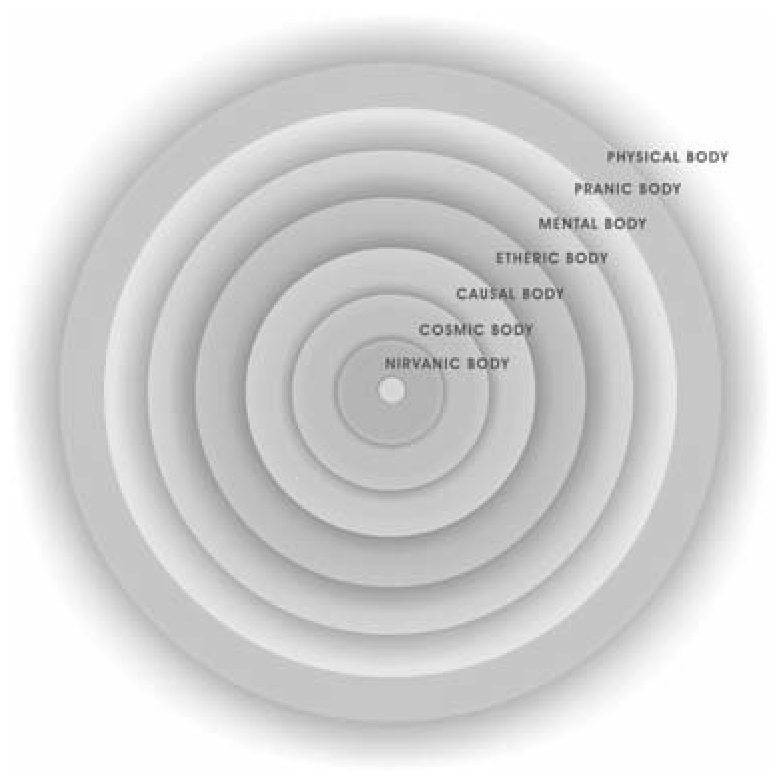
What exactly happens at the time of leaving the body? When a person leaves the body, he goes through seven layers of his being. The first and the outermost layer is the physical layer. When a person leaves the body, it creates tremendous pain in his whole system like ‘thousands of scorpions stinging at a time.’
I am frightening you. Even though it hurts, it is better to tell the facts now. At least we will be better prepared for the journey. Whether we will take it or it will be forced upon us we don’t know, but we must make this journey.
There will be tremendous pain at first. We may ask, ‘Why pain?’ It is because our being wants to stay in the body, but the body cannot host the being anymore. There is no need for our being to leave unless the body is completely tired or exhausted. If death starts happening, it means the body is completely exhausted, or damaged. In natural death, the body is exhausted while in an accident, the body is damaged.
Understand: You know the pain that we experience when we cut our finger. What would the pain be like if we extend the same thing to our six-foot body? Naturally there will be tremendous pain. But one thing: there is an automatic painkiller mechanism. The moment the pain becomes unbearable, we fall into coma to escape pain. But the problem is, we also die in unconsciousness when we are in coma. That is the worst thing, because we will remain unaware of why we took this birth, and we will not be able to make the decision about the next birth consciously. That is the reason Kṛṣṇa says: yaṁ yaṁ vā 'pi smaran bhāvaṁ; in whatever state you are at the time of leaving the body, you will achieve that state without fail. If we are unconscious at the time of leaving the body, then naturally, we come back as beings which do not have a high level of consciousness.
The moment we leave the physical body, we go to the next level, the pranic body. The pranic body refers to the layer responsible for the inhaling and exhaling of prāṇa, the life giving energy in our body. It is filled with all our desires. Our prāṇa and desires are closely related. If our desires change, immediately the circulation of our prāṇa changes.
Similarly, if we change the circulation of prāṇa, our whole mind changes. Our mind and prāṇa are closely connected. That is why people inhale and exhale, pull and push with their breath at the time of leaving. The body says, ‘I can’t host you anymore; go out.’ But the being says, ‘But I have so many desires. I must live in this body.’ The tug of war happens between body and being.
Next we move to the mental layer, mana śarīra. All the guilt that we harbored is in this layer. Guilt is regret about the past. Desire is expectation about the future. Guilt is regret about the past. Guilt is: I have not lived in this way - thoughts about the past. Desire is: I should live like this - a thought about the future. Understand, guilt is nothing but the emotion created in our being when we review our past decisions with updated intelligence.
Let me give you a small example. At the age of seven we are playing with our toys. Our mother comes and calls us for dinner, ‘Come and eat.’ We say, ‘No, I don’t want to eat; I want to play.’ By force our mother takes away the toys and pulls us to come and eat. Immediately we say, ‘You go and die; give me my toys, I want to play.’
At that moment, the toys look most important to us. We feel that toys are more important in life than our mother. But as we mature, we understand that this isn’t true. Once we mature, if we think, ‘O what a grave mistake I made. I shouldn’t have said those words to my mother. It is a big mistake. How important the mother is! But I never thought of it at that time!’... If we create guilt in this fashion, there is no point or utility in it. At that moment as a young child, we had only that much intelligence. Now, our intelligence has been updated. If we review our past decisions with updated intelligence, we create only one thing: guilt. When we review our past decisions with updated intelligence, we create guilt.
If God gives us one more life, we will make the same mistakes that we made at seven years of age because we will have only that much intelligence at that age. Now just because our intelligence has been updated now, we can’t review our actions and create guilt in ourselves about what we did earlier. We had such and such data and we had only that much intelligence to process the data at that time. Based on that, we made the decision. Now the intelligence to process the data has been updated; our software has been updated. Because our software has been updated, we now say, ‘Oh! I made the wrong decision at that time; I am suffering from guilt.’ This does not make sense.
Guilt is a wedge inserted in our being. It creates uneasiness between you and your being. It is the worst sin. Guilt is the only sin on planet earth, nothing else. We can never achieve morality through guilt. People ask, ‘Swamiji, how can I become a better person without guilt?’
Be very clear: We can never become a moral person through guilt. Instead, guilt becomes such a load on us that we repeatedly make the same mistake. If we have deep guilt about smoking, we can never quit smoking because the habit is strengthened when the guilty thoughts are continuously repeated in our system. Whatever is continuously repeated in our consciousness becomes strong; we never grow out of it.
In Rāmāyaṇa, there is a character called Vāli. He obtained a boon from Lord Śiva that whomsoever stands in front of him to fight him, half of that person’s power would go to Vāli. If we stand in front of Vāli, half of our power goes to Vāli! Naturally Vāli will win. Understand, our guilt is like Vāli. The moment we fight the smoking habit, we empower the habit and struggle with it. Then how can we come out of it?
Bernard Shaw says beautifully, ‘Quitting smoking is easy, I have done it many times!’ We can continue to quit many times. But we never get out of the habit. We are caught in the rut that guilt creates. If we remove guilt, at least our personality will be integrated and we will naturally become pure and energetic. All immoral behavior is because we don’t have enough energy. The person with plenty of energy is always pure. In society we have a wrong idea that people who are full of energy do nonsensical things. No!
Doing immoral things means a person wants energy through that action. Understand, even our sense enjoyments are in the same league. We feel that we will get energy or feel blissful through that action. If we create guilt, the whole thing sits in the mental body and when we leave the body it becomes a big obstruction.
The next layer we cross is the etheric body where all the painful experiences of our life are stored.
These four layers are hell. When the energy crosses these four layers: physical body, pranic body, mental body and etheric body, the being undergoes hell. Understand hell is not situated in a place above our heads. It is in these four layers, comprising all our desires, guilt and painful experiences.
During our life in the body, if we have kept these four layers clean, we will never enter hell. If we clean these layers through meditation, we will not have problems at the time of leaving the body. We will have a clear highway. That is what Kṛṣṇa says: This is the path on which a man can easily leave and liberate himself, and also the path on which he can suffer and destroy himself. Both ways are now shown by Kṛṣṇa. These are the major obstructions when we leave the body.
After these first four layers, the three inner layers where all our blissful memories are stored are called heaven. Even if we are stuck there, we need to move on. Even our puṇya, merits, are karma. Even that will not allow us to become enlightened. We may feel good, ecstatic, for a few days. After that our mind takes that also for granted. In the case of heaven also, we will take it for granted after a few days. When we take it for granted, the trouble starts and you have to come back to take another body, another birth.