The Art of Leaving
This text was machine-transcribed from the printed book and may contain errors. Select the words and choose “Report a mistake”.
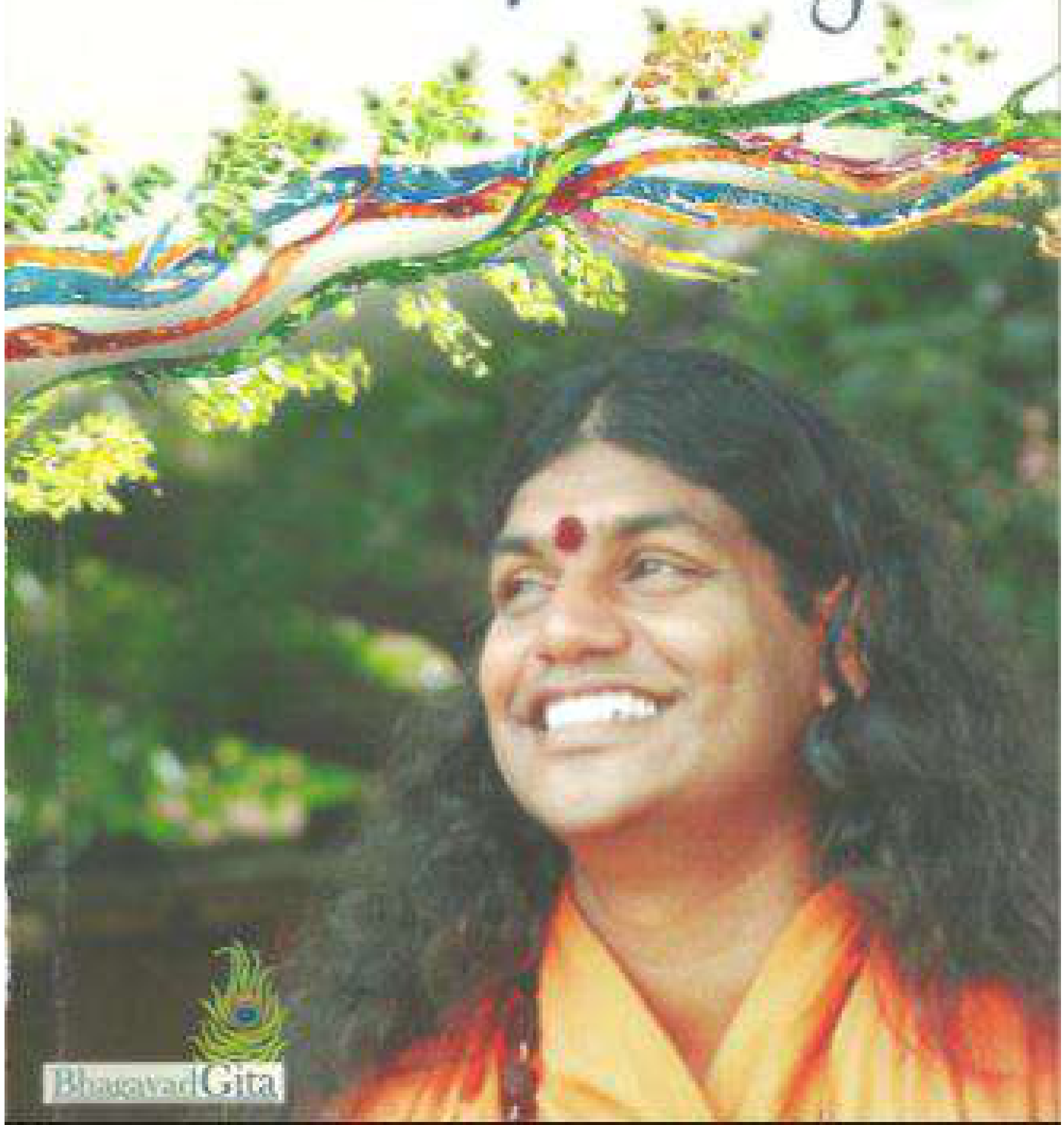
Bhagavad Gita
BhagavadGītā
The Art Of Leaving
Akṣarabrahma Yogaḥ
Chapter 8
Death is our ultimate fear.
Anyone who claims not to be disturbed
by the thought of death is only lying.
Nithyananda answers all the questions
you have been afraid to even ask!
Ebook ISBN: 979-8-88572-037-3
Copyright: Apr 2011

The Art Of Leaving
In this chapter, Kṛṣṇa speaks about death. He gives us an insight into how death can become liberation and celebration. Death is the end of life as we understand it or don’t understand it! The moment we understand it, it becomes a liberation and celebration.
Death is a celebration!
Death is not the end of life. It is the climax of life. End is different from climax. The moment we think that death is the end, we try to figure out what happens next. We start worrying about death. The shadow of death happens even when we live.
A person who does not understand death dies even when he is alive. A person who understands death lives even when he dies. Death or life depend on our intelligence. When we have clear intelligence, we live our death. When we don’t know, we die even when we live.
The fear of death haunts everyone from birth. All religions sprang up from this one fear, this one question: Why do we die? What happens after we die? Most religions answer in such a way that they can control us through the fear of death and the greed of escaping death. They talk about sins and merits and threaten us with hell and entice us with the promise of heaven. None of these really exists. Heaven and hell are not physical or metaphysical locations; they are merely states of our mind.
Death is a passage. It is a passage in a journey that continues. We do not live and die once; we live again and again. As Kṛṣṇa says, the undying spirit casts off bodies as one casts off garments and puts on new ones. The spirit within is immortal. The spirit within us is part of the cosmic energy and lives on, whereas the bodies that it assumes perish.
Enlightened masters of the vedic tradition experienced the state beyond life and death and have provided us with guidelines about how to achieve the same state. However, they expressed this to a select audience of disciples in a language coded for the understanding of those mature enough to work with that knowledge.
Here Kṛṣṇa, the greatest of all enlightened masters, out of His infinite compassion, provides this knowledge in a form that anyone can understand. All one requires to imbibe this knowledge, is an open mind and the willingness to work sincerely and with dedication.
When we understand the art of living, the process of leaving becomes a celebration. When we understand that this life and the departure from this life is a single journey in a continuous cycle of birth and death, there is no urgency in living this life and there is no fear in leaving this life also. When we understand that what we do in this life and how we do it determines how we are reborn, we will have a far greater understanding of how to lead this life.
Arjuna starts here with questions:
Arjuna said:
O my Lord, O supreme person, what is Brahman? What
is the Self? What are result-based actions?
What is this material manifestation? And what are the
demigods? Please explain all this to me.
How does this Lord of sacrifice live in the body, and in
which part does He live, O Madhusūdana?
How can those engaged in devotional service know You at
the time of their death?
These are two beautiful questions! Of course, when I translate them into English, much of the taste is lost! We do not have the right words in English for many beautiful words expressed by Arjuna. A single word has many meanings in Sanskrit. The moment I translate, I give only one dimension, a single dimension of the verse.
An important thing we should understand about the Sanskrit language is that it is not only linguistic, but also has importance at the phonetic level. Just the vibration of the words can transform our whole inner space. The sound changes the energy of the place and the inner space of those who hear it or are chanting it.
We should understand the concepts called padā and padārtha. For example, when I say the word ‘cow,’ immediately a figure appears in our mind – an animal with four legs, a tail, head and two horns. The word is called padā, the figure is padārtha. What happens in our mind when we hear the word is padārtha. In all languages the distance or gap between padā and padārtha is significant.
In Sanskrit the connection is immediate; the result is instantaneous. That is why I tell people to listen to Sanskrit devotional verses for at least 10 minutes a day. It does not matter whether you understand it or not. Just listen to any Sanskrit verse for at least 10 minutes every day. The very energy of the vibrations will purify your body.
There is something called śabda tattva, the principle of sound. When air travels from our navel area to the throat, the śabda tattva changes the air into words. If this element is not there, only air comes out; no words come out. In other languages the more we use śabda tattva, the more tired we become. However in Sanskrit, the śabda tattva strengthens us. The more we chant, the more energetic we become! It is like the generator automatically re-charging the battery and the battery running the generator. It is completely interconnected.
The Sanskrit language strengthens the śabda tattva that converts air into sound or words. This is why it does not matter whether or not we understand it. Modern day research proves that the vibrations of the verses have the effect of removing impurities. This is why masters ask us to offer different types of worship which are the means to chant verses in Sanskrit. When we chant, we simply heal ourselves.
Here, Arjuna asks beautifully, ‘O Lord! What is Brahman? What is Self? What are result-based actions? What is this material manifestation? What are demi-gods? O Madhusūdana! How do You live in the body, and how can those engaged in devotion, those who are practicing the eternal consciousness, know You at the time of death?’ He continuously poses these questions.
I had seriously wondered how Arjuna, a kṣatriya (warrior) who ruled a kingdom, could ask the same questions again and again in different ways! Yesterday I read a version of Mahābhārata. That version says that Arjuna is also an embodiment of Kṛṣṇa: the incarnation of Narā and Nārāyaṇa. These are two different energies of Lord Viṣṇu; one manifested as Arjuna and the other as Kṛṣṇa. The whole drama happened so that the Gītā took shape for humanity! Otherwise, even the disciple with the least consciousness would not have asked so many questions, again and again.
One thing we should understand is that when we have so many questions, we are not ready to wait for answers. We are simply expressing our confusion. It is almost a catharsis. Here Arjuna asks so many questions. However, the main question is: How does a person who is engaged in practicing Your teachings know You at the time of death?
Here starts the whole teaching of Kṛṣṇa. He reveals the secrets of death.
One thing I want to tell you: The West has spent all its energy to understand life. The East has spent all its energy to understand death. Nobody has gone so deeply into, or achieved such deep experiences of death, as our ṛṣis, sages have. These masters have done a great service by bringing the knowledge of death to the people who are living.
People ask me, ‘Swamiji, why should I know about death? Knowing about life is enough; after all I am still young.’ The word ‘death’ creates fear in people. They are ready to listen to any other subject. However, when it comes to death, they think, ‘Why should we know about death? If we know about life, it is enough.’
Our understanding about death impacts our understanding about life. Life and death are two sides of the same coin. In the East, all religions talk about many births. Most Western religions talk about a single birth. This concept of reincarnation has influenced Indian society so deeply that nobody bothers about time! They are so relaxed. Till 10 o’clock in the morning, people sit in teashops! If we ask for anything, they say, ‘Not today, tomorrow; if not tomorrow, next birth!’ They have eternity in front of them because somewhere they know they will come again. They are in no hurry and therefore do not run behind anything.
In the West, whatever they desire to achieve, they must finish achieving within 75 to 80 years. They do not have time. They either live now or never because there is only birth according to them. That is the reason why people run and run!
Our understanding about death influences our whole social structure. Our whole thinking system, our whole mentality can be transformed with the right understanding about death. I gave a single example about how the idea of reincarnation influences Eastern society and how the idea of one birth influences Western society. Thousands of such examples can be given.
The idea and understanding of death is much more important than the understanding of life. Whether we understand life or not, it remains the same. But the moment we understand death, the whole quality of life changes.
If we experience even an intellectual understanding of death, it is enough to transform our whole way of thinking. That is why the moment we think of Yama, god of death, our whole life has yama, or discipline. The Sanskrit word yama means both ‘death’ and ‘discipline’. For your convenience, I pronounce it a little differently; yet the spelling is the same.
Understanding of death, instills discipline
The first technique of sage Patañjali in his work - Yoga Sūtra, is yama. And death is also yama. If we understand death, a strange but honest discipline will happen in our life. Why do I say ‘strange but honest?’ It is because discipline as we know it is hypocrisy. But the discipline that is yama is a new kind of discipline, which is strange yet totally honest.
Yesterday a person asked me a question. He was well read in Bhāgavatam, the Hindu epic that describes the incarnations of Viṣṇu. He asked, ‘Swamiji, Kṛṣṇa is enlightened and He was a brahmacāri, celibate; but He made love to Kubja. How is that possible?’
The name Kubja can be found if we read Bhāgavatam very deeply. She is supposed to have been the maidservant of Kṛṣṇa. Somebody who had read Bhāgavatam very deeply asked this question. What he said was true. There is a record in Bhāgavatam that Kṛṣṇa lived with Kubja. Brahmacarya does not mean celibacy. I have not said that Kṛṣṇa is celibate. I said Kṛṣṇa is in the consciousness of Brahman. Here we translate the word ‘brahmacarya’ to mean celibate. The moment we translate it, the meaning is lost. Kṛṣṇa’s inner space was totally pure, untouched.
Let me tell you a small story:
Once Vyāsa, the ancient sage of India attended a function. After having a feast at the function, on his way back, he came to a river which he had to cross in order to reach his monastery. He stood before the river and said, ‘If I am sincere in my ekādaśi fasting, let this river give way so that I may cross over.’ Ekādaśi refers to the eleventh day of the moon’s cycle when normally people fast.
The moment Vyāsa uttered those words, the river gave way. Vyāsa crossed it followed by his devotees and they reached the ashram.
The devotees were astonished and asked, ‘What is this? You enjoyed a feast just a few hours back. Yet, when you asked the river to give way on the condition that you have been sincere in your ekādaśi fast, the river gave way! How can this be?’ Vyāsa replied, 'When you eat with the consciousness that you are not the body, you never feel that you are touched by food. You never feel that you are eating, digesting, living. The body ate; I do not know anything about it.'
Of course, it is difficult to understand this concept. We can easily cheat ourselves with this idea. The problem with all great truths is, there is the danger of our misusing and abusing them. Take atomic energy; we can use it to serve the whole of humanity. Or we can destroy humanity with that same energy. This truth is like atomic energy; we can use it or abuse it.
People ask me, 'How can I find out whether I am living in the out-of-body-consciousness or not; how can I live like Vyāsa?' Understand, when we reach the state of Vyāsa, we will not have this question. Vyāsa says he is fasting after having eaten a feast because he does not feel connected to his body. He is untouched. His inner space is so pure and filled with bliss.
If we read Rāmakṛṣṇa Paramahamsa's life, we will know that he did different kinds of spiritual practices. As far as I know, Rāmakṛṣṇa is the only master who has performed so much penance. He also practiced tantra sādhana, which aims at harnessing and transforming our powerful sensual energies as a means to enlightenment. An ordinary person straightaway falls if he does tantra sādhana.
The greatness of Rāmakṛṣṇa was that his inner space was never touched. His inner space was so pure and filled with bliss that he completed tantra sādhana successfully. Tantra sādhana is supposed to be done with many conditions, yet he achieved and successfully completed it because his inner space was pure.
Going back to the question, 'How can you say that Kṛṣṇa is a brahmacārī?' Please understand that His inner space was so pure that He was never touched by body consciousness. Let me tell you one more thing: It is not easy to live with so many women as he did, and yet survive! When a single man or woman enters our life, we understand how difficult it is to adjust and live. The other person seems to naturally create hell for us. Here we see somebody living with many persons, and yet remaining blissful. This shows that His inner space was pure and radiating bliss.
The person whose inner space is filled with bliss will never be touched by any impurity. The moment we understand the depth of it, we will understand this concept.
A small story:
A sanyāsi (monk) goes to the Indian king Janaka who is supposed to be an enlightened king and one who enjoyed both the material world and spiritual enlightenment. The sanyāsi questions him, ‘How can you say you are enlightened when you enjoy the benefits of worldly life?’
Sanyāsis are jealous of people who enjoy life! If you experience bliss within you and consciously leave the world to enter monastic life, you will never feel jealous. If you have escaped from the outer world thinking that you will find something worthwhile in the inner world, and there too the experience has not been solid, you start wondering what to do. You have neither the inner space of bliss nor the outer possessions. You are stuck.
Such people console themselves by abusing householders. They say to them, ‘You are too attached to everything. You are not doing this, you are not doing that….’ That is why from time immemorial, people who took the sanyāsi life condemn the householder’s life. Have you seen a householder jealous of a swami? You will never find one. Yet I have seen hundreds of people who took sanyāsi who are jealous of householders because they feel something is missing in their own lives.
So this sanyāsi asked Janaka, ‘How can you say you are enlightened and have both material and spiritual enjoyments?’ Janaka said, ‘Please stay in my palace for a few days. I will talk to you after that. Right now I am busy, a party is going on, so I cannot talk about philosophical things now!’
Accordingly, arrangements were made for the sanyāsī's food and stay. However, above his bed a sharp knife hung, suspended on a thin thread. The sanyāsī asked, ‘Why do you hang this knife exactly over my head?’ The palace workers said, ‘We do not know, but these are our king’s orders. You must sleep here.’
Throughout the night the sanyāsī sat up, awake, thinking when the knife might fall on him.
The next morning Janaka asked, ‘O swami! How are you today? Did you sleep well?’
The sanyāsī said, ‘You know what you have done! Why do you then ask? How can I sleep when a knife hangs over my head? How can I think of sleeping?’
Janaka laughs and says, ‘When death is in front of you, your whole life changes. However, although I know death is in front of me, I am unaffected. That is the difference. Just because of one knife you are unable to enjoy the beautiful bed and all these luxuries. Yet even though all these things are there externally, my inner Self is not touched. It is pure because I know clearly that at any moment death can happen. Because I live with this moment-to-moment awareness of death, I enjoy the material world fully without getting caught in it.’
That is why I said, ‘Yama can make a strange, yet honest yama in your life. Death can instill a strange but honest discipline in your life.’
Understand death, intellectually. Your whole thinking will change. You will not leave this place as the same person. Your being will be transformed.
Kṛṣṇa starts with the secrets. He explains the secrets of death.