BHAGAVAD GITA
This text was machine-transcribed from the printed book and may contain errors. Select the words and choose “Report a mistake”.
BOOK XVIII, VOLUME I
The Act And The Actor
Authored by
THE SPH NITHYANANDA PARAMASHIVAM

अर्जुन उवाच । संन्यासस्य महाबाहो तत्त्वमिच्छामि वेदितुम् ।वेदितुम् त्यागस्य च हृषीकेश पृथक्केशिनिषूदन ॥ १८-१ ॥
arjuna uvāca saṁnyāsasya
mahābāho tattvamicchāmi
veditum tyāgasya ca hṛṣīkeśa
pṛthak keśiniṣūdana
O mighty armed Kṛṣṇa, I wish
to understand what is the
essence, tattva of renunciation,
tyāga and the renounced order
of life, sannyāsa, and the
difference between the two, O
Hrīśikeṣa, O Killer of the
demon Keśī.’
POWERFUL COGNITION
The words of a Master are energy.
ARJUNA SPEAKS NOW AFTER BEING SILENT FOR A LONG TIME.
Arjuna will stop speaking soon. He has just a few words. He is not questioning. He just expresses a few doubts. The arrogance or violence in Arjuna's being has disappeared. He has become like a flower due to the experience of the cosmic vision that Kṛṣṇa showered on him. I cannot even call these words doubts. He just wants to hear the truth from Kṛṣṇa again and again.
Sometimes after listening to the whole discourse, disciples ask me to repeat a joke or a story once more! They have heard it once but want to hear it again. Especially from the master, listening to certain things again and again gives great joy. The words of a Master are energy. These words drill deep into you and transform you. At the time of listening, you may not realize their impact. But they never fail to impact and enrich you. Arjuna asks some of these questions to listen to Kṛṣṇa again.
sannyāsasyā mahā-bāho tattvam
icchāmi veditum I tyāgasya ca
hrṣīkeśa pṛthak keśi-niṣūdana II
18.1
Arjuna says, ‘O Mighty One, I
wish to understand the purpose
of renunciation and of the
monastic life of Sannyāsa. O
Hriśikesa (another name of
Kṛṣṇa, one who is in complete
control of His senses), please tell
me the truth.
As I told you, it is not that Arjuna does not know. He has just heard the whole thing. Still, he wants to listen to it once more. Sometimes we enjoy listening to the same thing over and over. It is not that we do not understand, but it gives us great joy to listen to the same thing again and again! Like that, Arjuna wants to listen to the same truth again and again.
Arjuna wants to know why a person would want to sacrifice everything and what is the process of renunciation.
In India it is often difficult to
distinguish a renunciate, a
Sannyāsi, from a common
beggar. Both seek alms. Both
possess very little. And both
are homeless. Many people
take the easy path and treat
the Sannyāsi like a beggar
and shoo him off.
IN THE SPH's OWN WORDS:
"I tell my disciples, 'When in
doubt treat the beggar as if
he were a monk. If you have
money to give, what harm is
there if you give it to enrich
another person?' Some
people tell me, 'But Swamiji,
they are cheating us!' So
what?"
So, giving alms to a Sannyāsi is like taking out insurance. You expect that your merits are getting noted down in a Cosmic record to decide whether you go to hell or heaven. . Make it simple. Give out of your completion. Give unconditionally if you can afford it. Give even if you cannot afford it. that is when giving becomes truly enriching. When you sacrifice what you cannot afford to sacrifice, by the mere act of giving, you become a renunciate, a Sannyāsi. How noble it is!
Arjuna is confused about the act and the actor. What is important is the act. Anyone can be the actor.
GOALS:
Helping children
understand that giving
should always come from
a space of completion.
Helping children
differentiate between
"act" and "actor".
Helping children
understand the space a
Sannyasi carries.
ASSESSMENTS

❖ Why is Arjuna asking Krishna a few questions here? ❖ What makes the words of the Master so powerful? ❖ What does Arjuna want to know at the beginning of this chapter? ❖ What is the advice Swamiji gives to anyone who has a doubt as to whether the person asking for alms is a beggar or a sannyasi? ❖ What is the space we should carry when we give to others? ❖ When does giving become truly enriching? Who becomes a Sannyasi?
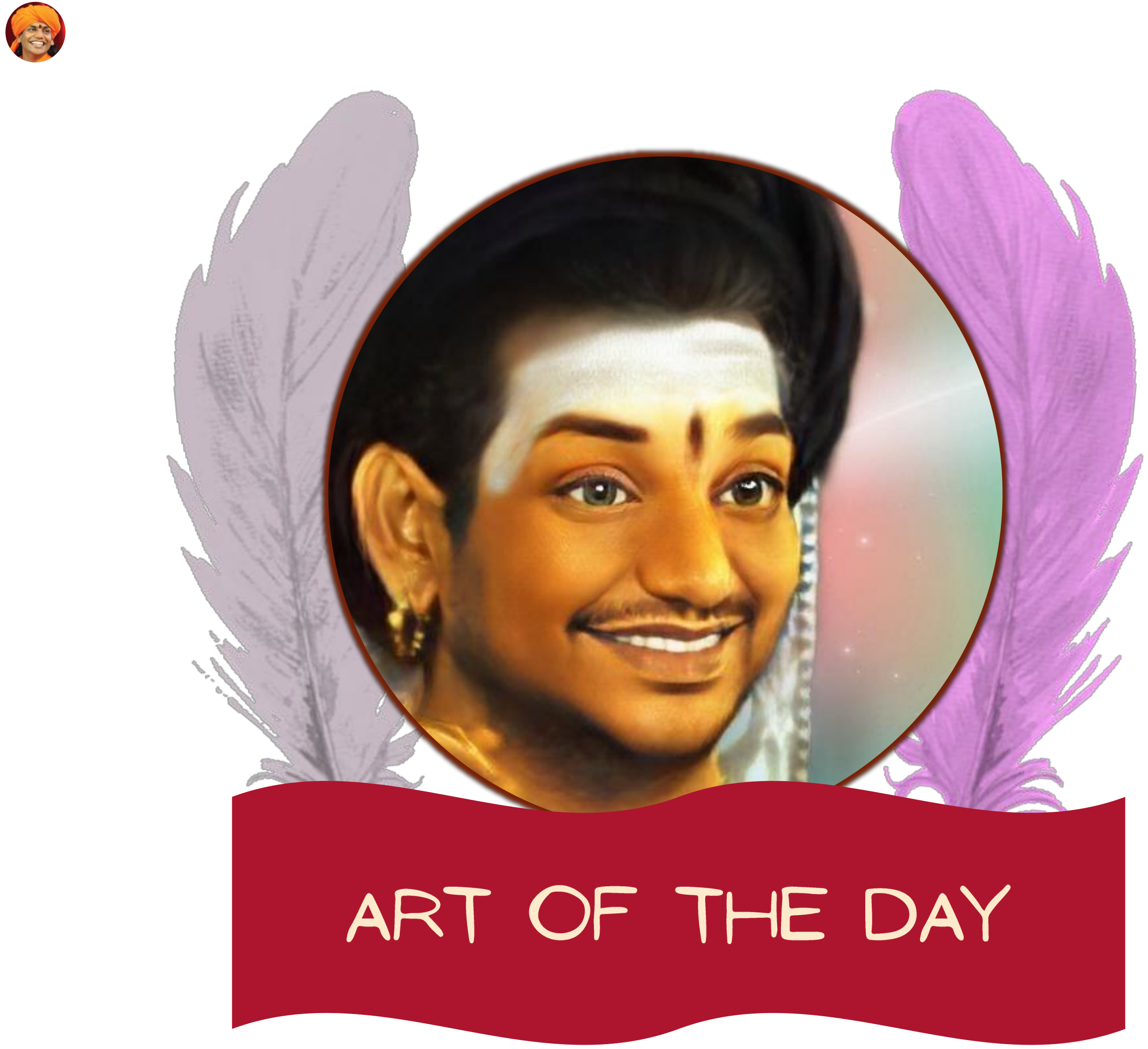
ART OF THE DAY
ART OF THE DAY:
SANNYASi
MATERIALS NEEDED:
- Coloured Papers,
- Markers,
- Scissors,
- Glue,
- Pencil,
- Eraser,
- Sparkles
PROCEDURE
Ask the children to close their eyes and to visualize a true Sannyasi. Then, ask them to give life to their visualization through art.
INFERENCE
The act and the space from which the act is performed determines who is Sannyasi.
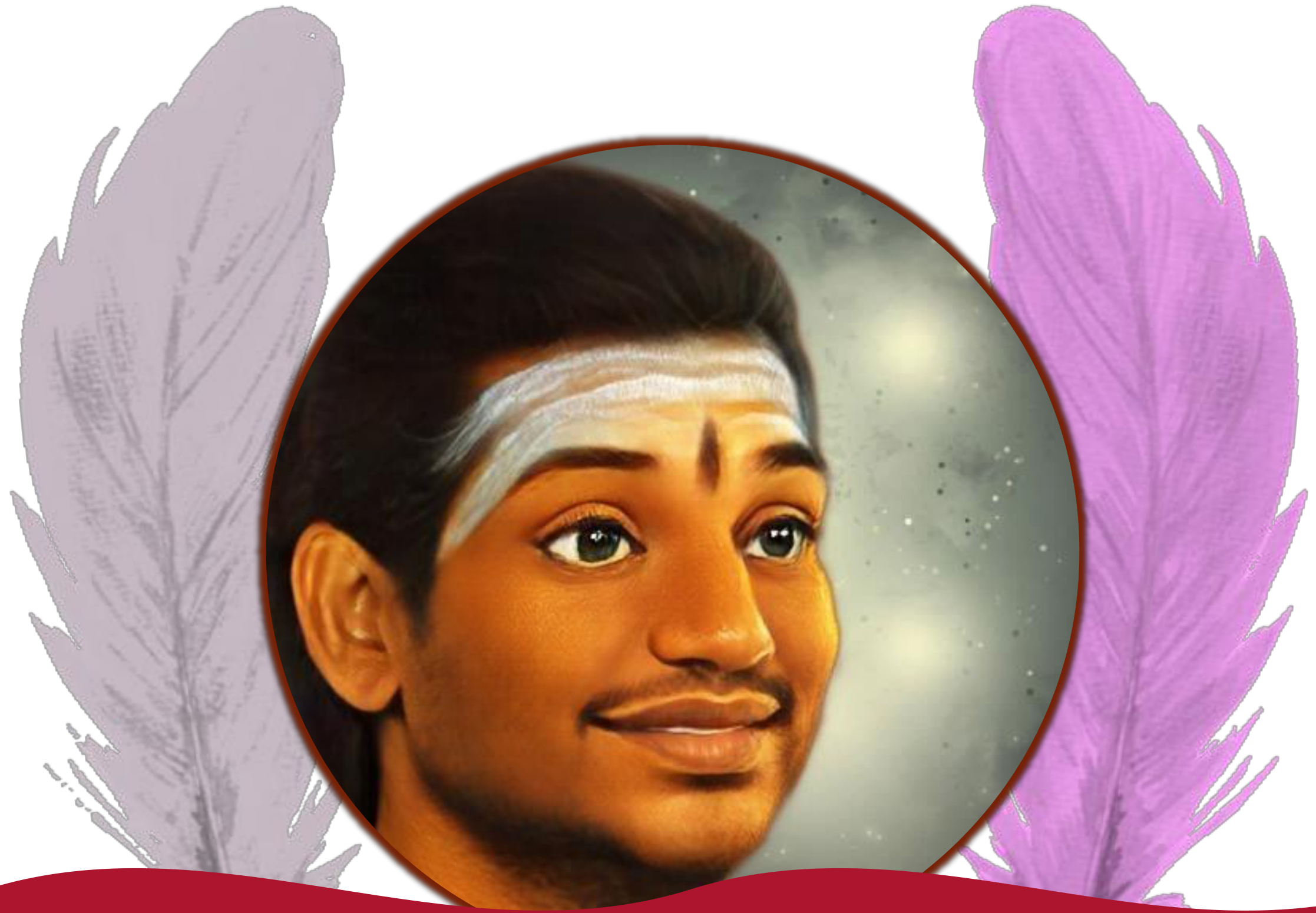
ACTIVITY OF THE DAY
ACTIVITY OF THE DAY:
THE ACT AND THE ACTOR
MATERIALS REQUIRED:
One food item for each child/teenager (except for the two who will be designated as "beggar" and "sannyasi").
PROCEDURE:
-Choose two children or two acharyas and tell one that he/she is a beggar and the other one that he/she is a sannyasi but do not tell the rest of the class who is who.
-Give the rest of the children one food item to offer.
-Then tell the beggar and the sannyasi to go around asking other children for alms in any way that they want.
-The children get to decide who they want to offer to/what they want to offer. Give them the freedom to act in any way they want.
-At the end, ask everyone to sit in a circle and ask each child about the decision they made and what giving felt like. Also ask the beggar and the sannyasi what their experience of asking for alms felt like..
ACTIVITY OF THE DAY:
THE ACT AND THE ACTOR
INFERENCE:
What is important is the act. Anyone can be the actor. When you give out of completion, not expecting anything in return, whether you give to a monk or a beggar makes no difference.

WORKSHOP OF THE DAY
WORKSHOP OF THE DAY:
VAAKYARTHA SADHAS - INNER TRANSFORMATION
PROCEDURE
Ask the children/teenagers to describe the state that Arjuna is in at the beginning of this chapter and have them engage in a discussion of how Arjuna's state has transformed from the beginning of the war until this point. Then, ask them to write a short essay to explain the transformation that they have seen occurring in their own inner space / mental set-up / cognitions since the beginning of the course.
WORKSHOP OF THE DAY:
VAAKYARTHA SADHAS - INNER TRANSFORMATION
CONCLUSION
When you give, give out of completion, give unconditionally or don't give at all.
BHAGAVAD GITA
BOOK XVIII, VOLUME II
Never Give
Up Selfless Enriching
Authored by THE SPH NITHYANANDA PARAMASHIVAM

श्रीभगवानुवाच ।
काम्यानां कर्मणां न्यासं संन्यासं कवयो विदुः ।
सर्वकर्मफलत्यागं प्राहुस्त्यागं विचक्षणाः ॥ १८-२ ॥
karmaṇāṁ nyāsaṁ sannyāsaṁ kavayo
viduḥ sarvakarmaphalatyāgaṁ prāhus
tyāgaṁ vicakṣaṇāḥ
Bhagavān Kṛṣṇa says, the renouncing
of all selfish work based on desire, is
what the learned ones call as
sannyāsa, the renounced order of life.
And renunciating the attachment to
fruit or result of one's actions is what
the wise ones call as tyāga,
renunciation.
POWERFUL COGNITION
When you stop choosing, you will choose everything.
त्याज्यं दोषवदित्येके कर्म प्राहुर्मनीषिणः ।
यज्ञदानतपःकर्म न त्याज्यमिति चापरे
॥ १८=३ ॥
tyājyaṁ doṣavadity eke karma
prāhurmanīṣiṇaḥ yajña-dāna-tapaḥ-
karma na tyājyamiticāpare
Some learned men say that all kinds of result-based activities are faulty and should be given up, but there are yet other sages who maintain that acts of enriching sacrifice [yajña], charity [dāna] and austerity [tapaḥ] should never be given up.
POWERFUL COGNITION
Enriching Sacrifice is the Path of Completion
निश्चयं शृणु मे तत्र त्यागे भरतसत्तम ।
त्यागो हि पुरुषव्याघ्र त्रिविधः सम्प्रकीर्चितः ॥ १८-४ ॥
niścayaṁ śṛṇu me tatra tyāge
bharatasattama tyāgo hi
puruṣavyāghra trividhaḥ
samprakīrtitaḥ
Arjuna, best of Bhāratas, now listen from Me certainly about renunciation or tyāga; O tiger among men, renunciation or tyāga is declared to be of three kinds.
POWERFUL COGNITION
Surrender Both Inner and Outer Space.

यज्ञदानतपःकर्म न त्याज्यं कार्यमेव तत् ।
यज्ञो दानं तपश्चैव पावनानि मनीषिणाम्
॥ १८-५ ॥
yajñadānatapaḥ karma na tyājyaṁ kāryameva tat I yajño dānaṁ tapaścaiva pāvanāni manīṣiṇām
Acts of enriching sacrifice [tyāga], charity [dāna] and austerity [tapaḥ] are not to be given up; they should be performed. Indeed, even the Sages are purified by enriching sacrifice, charity and penance.
POWERFUL COGNITION
Enriching and completion, both should be practiced simultaneously
एतान्यपि तु कर्माणि सङ्गं त्यक्त्वा फलानि च ।
कर्तव्यानीति मे पार्थ निश्चितं मतमुत्तमम्
॥१८-६॥
etānyapi tu karmāṇi saṅgaṁ
tyaktvā phalāni ca kartavyānīti
me pārtha niścitaṁ
matamuttamam O Pārtha
(Arjuna), all these acts of
responsibility must also be
performed without any
expectation of result. That is
My final and ultimate opinion.
POWERFUL COGNITION
Only by enriching others does your life get enriched.
NO OTHER MASTER iS AS COMPASSiONATE AS KṛṣṇA.
Krishna is the ultimate Master.
He does not merely teach.
He knows it is difficult for people
to believe. It takes time to believe.
So He gives logic to support His
teachings. Again and again, He
tries His best to convince Arjuna.
Considering the level that He is at,
there is no need for Him to come
down to the level of Arjuna. He
can say, ‘This is the truth. If you
want you can follow it, otherwise
get out!’ But He does not do that.
He is compassionate. Again and
again, He comes down and
explains the truths step-by- step.

ENRICHING SACRIFICE IS THE PATH OF COMPLETION
After all, it is Śrī Kṛṣṇa in the form of the Ultimate who originally created the scriptures and laws. Therefore any explanation from Him should be considered the last word. He says that any process of renunciation should be considered within the context in which it is performed. Renunciation can be of three types: enriching sacrifice, charity and penance; yajña, dāna, tapaḥ. These purify even those who are already evolved and pure.
It must be understood that the
purpose of performing yajña,
enriching sacrifices is the
purification or upliftment or
completion of the human being
on the spiritual path. They link
cosmic energy with individual
energy.
In our times, sacrifice refers to
any selfless enriching service
that enriches others and
enriches you. Whatever
enriching we do for others out
of completion, without
expecting anything in return is
a sacrifice, an enriching
sacrifice or yajña.
Unfortunately, many people
engaged in sacrifice are more
interested in seeing their
pictures on the television or in
newspapers than in the service.
Charitable enriching, dāna is
giving out of overflowing
completion with no
expectation in return.
Charity is not giving while
posing for a picture that will
be published in tomorrow's
newspaper. That is business.
Those who are truly charitable never allow others to know what they are doing. That is why it is said that your left hand should not know what your right hand is giving. Only then charity achieves its authentic purpose of enriching others. Charity should also involve pain. You can call it charity when you cannot afford to give something away and yet you give it away. Charity must become a penance, tapaḥ and lead to austerity if it is to be real.
Penance, tapaḥ is denying oneself sense pleasures and being complete with the senses. Ultimately, the purpose of all spiritual exercise is to be complete with the mind, body and senses and thereby controlling the mind and senses. Penance, tapaḥ is turning inwards whereas sacrifice, yajña and charity, dāna are focused outwards.
All these enriching activities
should be performed without
attachment or expectation of
results. They should be
performed as a matter of
responsibility, and this is My
final opinion,' says the Master.
Only by enriching others does your life get enriched. Don’t be selfish. Understand, responsibility is the fruit. Enriching is sowing the seed for the fruit to happen. Enriching is sharing the fruit to create more fruits. Every person who eats the fruit is responsible for sowing the seed for more fruits to happen.
Kṛṣṇa gives His ultimate opinion. Earlier He explained what others said about renunciation, as either giving up the activity itself or the results of the activity. Now He says that His opinion on renunciation is living without attachment, etāny api tu karmāṇi saṅgaṁ tyaktvā phalāni ca (18.6).
Kṛṣṇa gives His ultimate opinion. Earlier He explained what others said about renunciation, as either giving up the activity itself or the results of the activity. Now He says that His opinion on renunciation is living without attachment, etāny api tu karmāṇi saṅgaṁ tyaktvā phalāni ca (18.6).
The person who surrenders to the flow of life, experiences the inner space and outer space at the same time. He enjoys the inner and the outer space at the same time. Whatever Kṛṣṇa has spoken in these seventeen chapters, He is now giving its gist.
As long as you struggle in material life, you avoid spiritual life.
As long as you are struggling, you can struggle either in this direction or that direction. As long as you struggle in material life, you avoid spiritual life. As long as you struggle in spiritual life, you avoid material life. Listen! As long as you struggle with completion, you don't enrich. As long as you struggle with enriching, you are not complete! Both are a struggle.
Kṛṣṇa says, ‘Relax from both.’ You
may think, ‘What is this funny
instruction He is giving!’ You
think that if you relax in both you
will lose both.
However, the truth is that when
you relax in both, you fall into
your inner consciousness, your
being or your inner space. When
you experience this inner space,
this inner consciousness, you will
suddenly realize that you can
explode in all directions. You do
not need to choose between
horizontal and vertical lines. You
can travel on both lines at the same
time!
For the first time, Kṛṣṇa gives the ultimate technique for Quantum Spirituality. He is the first quantum scientist of the inner world. He says relax and surrender and you will experience the completion of your inner consciousness.
You will understand that you do not need to choose between the horizontal and vertical lines. You can explode in all 360 degrees. You need not make a choice. You experience choicelessness. Choicelessness does not mean that you do not choose anything. When you stop choosing, you will choose everything.
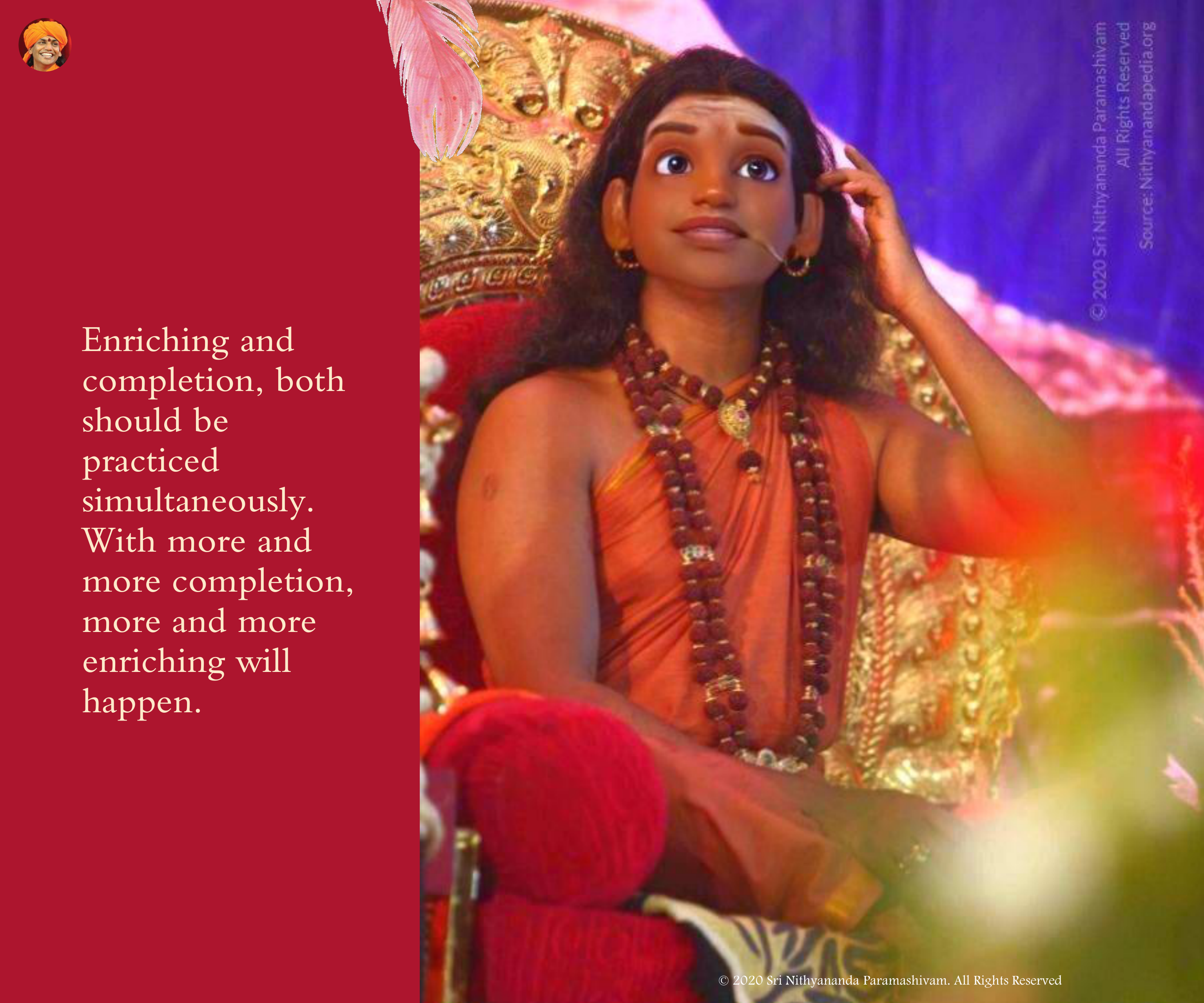
Enriching and
completion, both
should be
practiced
simultaneously.
With more and
more completion,
more and more
enriching will
happen.
With real surrender you do
not exclude anything. You
include everything. You
experience everything at
once.
IN THE SPH's OWN
WORDS:
“Again, when I say surrender,
you do not need to surrender
to any God or Guru. God or
Guru are symbols or
representations. Just
surrender to your own being,
to your own consciousness,
to your own inner space. The
problem is you do not
respect your inner space.
That is why in the initial level
you need an entity called
God or Guru.”
GOALS:
- Help students discover and respect their inner space.
- Help students understand choicelessness.
ASSESSMENTS
1. What are the three types of renunciations?
2. What does "sacrifice" refer to in our times?
3. What is the instruction given by Krishna regarding struggles?
4. How should enriching and completion be practiced?
5. What happens when we truly surrender?
ART OF THE DAY
ART OF THE DAY:
WHAT HAPPENS TO THE ONE WHO EATS THE FRUIT?
MATERIALS NEEDED:
- Pens, Pencils and Eraser
- Crayons and Markers,
- Seeds,
- Glue,
- Paper
PROCEDURE
“Understand, responsibility is the fruit. Enriching is sowing the seed for the fruit to happen. Enriching is sharing the fruit to create more fruits. Every person who eats the fruit is responsible for sowing the seed for more fruits to happen.” Read the following to the students and ask them to draw the life of a seed and how it creates more and more fruits. Then ask the students to share their thoughts on how they can plant more and more seeds in their own life / how they can enrich others and how enriching others enriches them.
INFERENCE
Only by enriching others does your life get enriched.
ACTIVITY OF THE DAY
ACTIVITY OF THE DAY:
WHAT SURRENDERING LOOKS LIKE!
PROCEDURE:
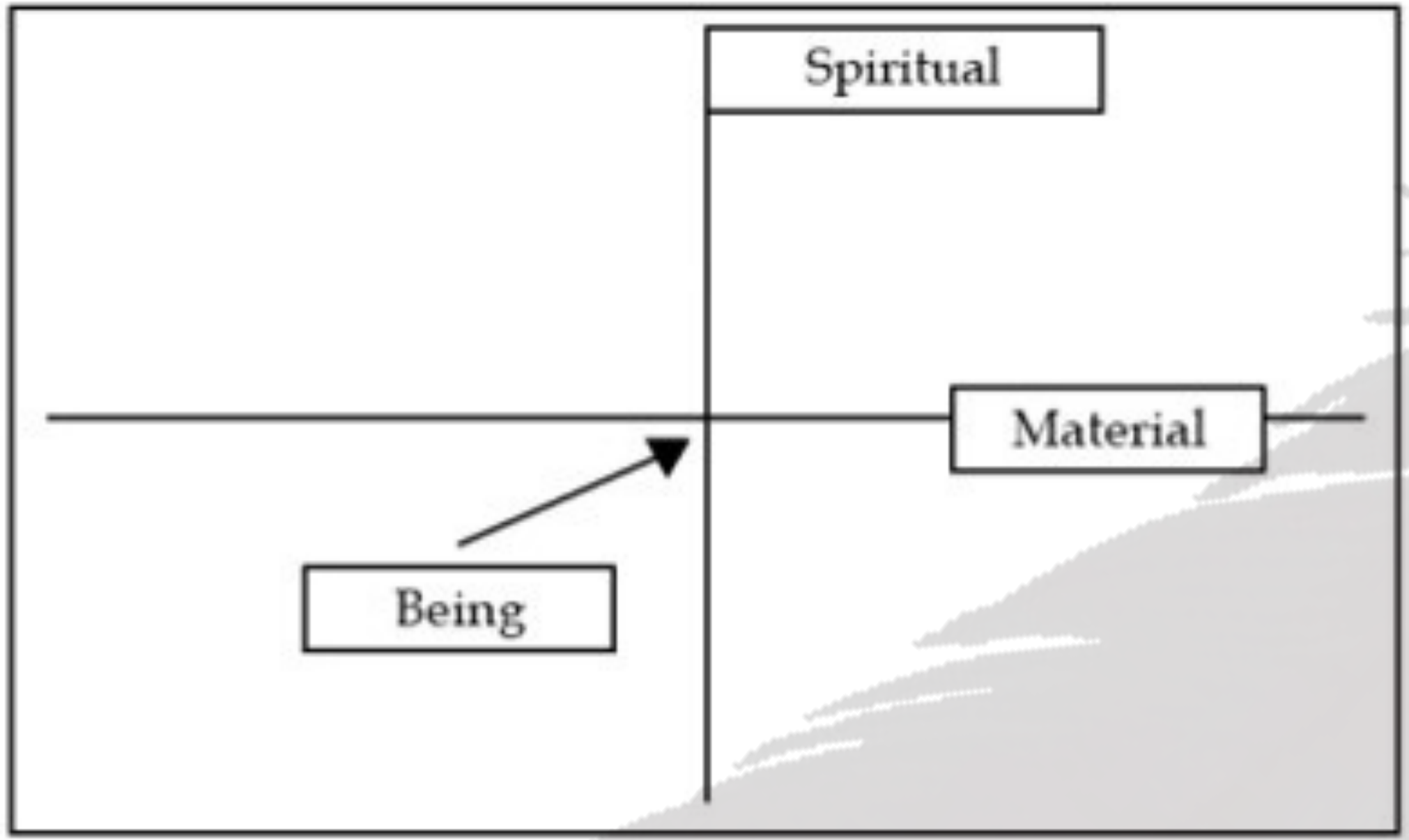
Without showing the drawing shown on the next page, ask the students to draw a horizontal line that represents the material goals and a vertical line that represents the spiritual goals that they have in their life. Then ask them to write down a few goals on each axis and ask them to point to where their "Being" would be in that drawing. Then ask them to share why they placed their "Being" at that point. After everyone has shared, draw the diagram and explain to them why the Being is placed exactly in the center by using the explanation given in the "inference" section.
ACTIVITY OF THE DAY:
WHAT SURRENDERING LOOKS LIKE!
INFERENCE
IN THE SPH'S OWN WORDS:
“Let me explain what I mean by the word surrender. Then you can understand better. Think of two intersecting lines, axes. The vertical axis is spiritual life. The horizontal axis is material life. The point of intersection is your being. This is the goal you have. You have some goal in your material life and also in your spiritual life. To achieve your goal in your material life, you are continuously struggling and working. You are somewhere on the horizontal axis. To achieve your spiritual goal, you are again working intensely doing yoga, prāṇāyāma, pratyāhāra, etc. You practice spiritual techniques. You are somewhere on the vertical axis. So when you struggle with material goals, you are on the horizontal line whereas when you struggle with spiritual goals, you are on the vertical line.
ACTIVITY OF THE DAY:
WHAT SURRENDERING LOOKS LIKE!
INTERFERENCE
As long as you are struggling, you can struggle either in this direction or that direction. As long as you struggle in material life, you avoid spiritual life. As long as you struggle in spiritual life, you avoid material life. Listen! As long as you struggle with completion, you don't enrich. As long as you struggle with enriching, you are not complete! Both are a struggle.
Kṛṣṇa says, 'Relax from both.' You may think, 'What is this funny instruction He is giving!' You think that if you relax in both you will lose both. However, the truth is that when you relax in both, you fall into your inner consciousness, your being or your inner space. When you experience this inner space, this inner consciousness, you will suddenly realize that you can explode in all directions. You do not need to choose between horizontal and vertical lines. You can travel on both lines at the same time!"
WORKSHOP OF THE DAY
WORKSHOP OF THE DAY:
VAAKYARTHA SADHAS | CHOOSING CHOICELESSNESS
PROCEDURE
Ask the students to contemplate and discuss the topic of choicelessness: "Choicelessness does not mean that you do not choose anything. When you stop choosing, you will choose everything". How is it possible to choose everything when we stop choosing?
CONCLUSION
Surrender to your own being, to your own consciousness, to your own inner space.
- BHAGAVAD GITA -
BOOK XVIII, VOLUME III