Introduction To Bhagavad Gītā Decoded
This text was machine-transcribed from the printed book and may contain errors. Select the words and choose “Report a mistake”.
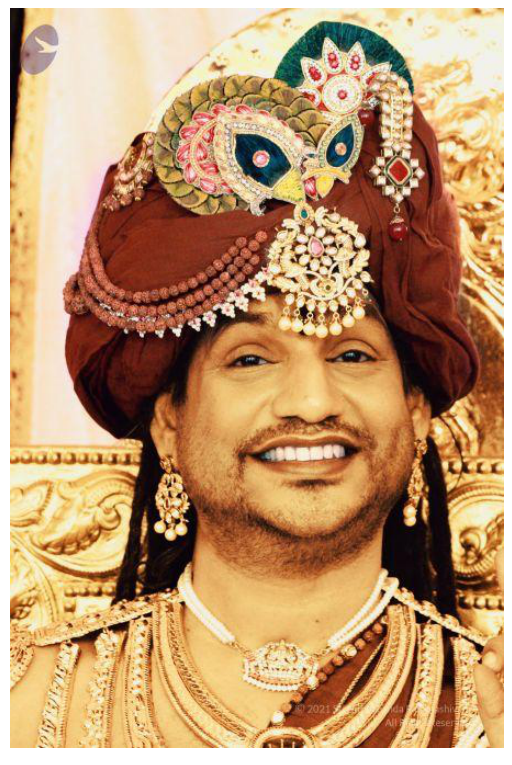
Bhagavad Gītā Decoded book is not a commentary or a modern interpretation on the Bhagavad Gītā. It is the re-speaking, the revival of the supreme secret of the Gītā from the consciousness of the rare living incarnation, Paramahamsa Nithyananda, who embodies the very science and experience of the Gītā. A pure, absolute revelation of the happening of Gītā presented in its original spirit and body language that only an Enlightened being can radiate through the inexpressible energy veiled within His expressed words. To read this book is to obtain an insight that is rare. It is not mere reading; it is an experience; it is meditation.
He takes the reader through an inner world tour while talking on each verse. It is believed that each verse of Gītā has seven levels of meaning. What is commonly rendered is the first-level meaning. Here, an Enlightened Master, an Incarnation takes us beyond the common into the uncommon, with equal ease and simplicity.
The power of the Living Master’s words, the confidence and energy of Enlightenment, the space of Advaita that He radiates, can directly become the experience in us, when we authentically study this book. The absolute truths of life are to be listened and internalised from the direct source, the living presence of those truths, who can also transmit the experience unto us.
His Holiness Paramahamsa Nithyananda explains the inner metaphorical meaning and the deep spiritual insights of the Mahābhārāt and the Bhagavad Gītā:
Understand, this whole history is such a beautiful happening. Mahābhārāt is actually your life!
Every character in the Mahābhārāt teaches so much! We don’t need to go anywhere for our life success or fulfilment or for anything else that we may desire. We don’t need to study any other book to learn the human psychology or the science of living and leaving. Whether we seek righteous living—dharma; or we want to learn business or administration, economy of abundance—artha; or we want to create the best rich lifestyle—kāma; or we want to be a leader and want the enriching life of being enlightened—mokṣa, for all these purposes, we don’t need anything other than the Mahābhārāt!
Study each character. We will not find any more characters in our life than the characters described in the Mahābhārāt! Any character we see in our life is mapped to Mahābhārāt’s one character. They are either half or full representation of some character. To know how to handle them and even handle yourself, just see how Śrī Kṛṣṇa handles them and handle them the same way.
The Mahābhārāt war is a representation of life as it was lived in that age. Vyāsa, its author is an unbiased historian who recorded the whole history as it happened without trying to apply any makeup. People ask whether the Mahābhārāt war happened at all!
Let me tell you this: If the Mahābhārāt was a story and not history, Vyāsa should receive multiple Pulitzer prizes for his highly creative work!
The Mahābhārāt is the longest literary work in the whole world with hundred thousand Saṃskṛit verses—the longest poem ever written with such delicate harmony of unmatched poetic perfection. It is larger than the Greek epics. Vyāsa had no computer, no tape recorder with speech-to-text capabilities. He dictated and Lord Gaṇeṣa wrote it down!
The Mahābhārāt is like an ocean. It has at least 10,000 stories woven into it. All of these are seamlessly woven into the main text even though each is an independent event. Just imagine the effort required to create hundreds of thousands of characters and maintain the integrity of these characters throughout the epic without the help of editors. Do you think anyone could do it today?
Because it is impossible to create such a work of fiction, one needs to accept this as a compilation of true incidents that reflect the lifestyle in what is referred to as Tretā yuga, third quarter of Time, in our scriptures.
This is how people behaved then and how people behave now. What happened then repeats itself now, again and again!
The Great War of Mahābhārāt is the fight between the positive and negative thought patterns of the mind called the saṃskāras or the root thought patterns—meaning the deep identity or the earliest memory you carry and create about you and others. Please understand, don't think you carry only the identity about you, you also carry an identity of the world inside you and look at the world only through that. That is what I call the root thought pattern—the identity through which you see yourself and the world.
The positive thought patterns are the Pāṇḍava princes and the neg-ative thought patterns are the Kaurava princes. Kurukṣetra or the battlefield is the body. Arjuna is the individual consciousness and Śrī Kṛṣṇa is the enlightened Master, the supreme consciousness driving and guiding the individual consciousness.
The various commanders who led the Kaurava army represent the major incompletions of root patterns and conflicting patterns that the individual consciousness faces in its journey to Enlightenment or liber-ation, mokṣa. Bhīṣma, the grand patriarch of the Kuru clan who embodies dharma, represents the pattern of parental and societal conditioning. Droṇa, the teacher of both the Kauravas and the Pāṇḍavas, represents the conditioning from teachers who provide knowledge including spiritual guidance.
Śakuni, the maternal uncle of Duryodhana embodies the pattern of self-hatred, which is cunningness personified. Karṇa represents the restrictive influence of good deeds such as charity and compassion done out of incompletion from the pattern of feeling deprived. Finally Duryodhana represents the ego or the self-denial pattern, which is root of the root patterns and is the last to fall.
Parental and societal conditioning has to be overcome by rebelling against conventions. This is why, traditionally, those seeking the path of enlightenment are required to renounce the world as Sannyāsi and move away from civilization. This conditioning does not die as long as the body lives, but its influence drops.
Droṇa represents all the best knowledge one imbibes and the teachers one encounters, who guide us but are unable to take us through to the ultimate flowering of enlightenment. It is difficult to give them up since one feels grateful to them. This is where the Enlightened Master, the incarnation steps in and guides us.
Karṇa is the repository of all good deeds and it is his good deeds that stand in the way of his own Enlightenment. Śrī Kṛṣṇa has to take the load of Karṇa's puṇya, his meritorious deeds, before he could be liberated. The Enlightened Master guides one to drop one's attachment to good deeds arising out of what are perceived to be charitable and compassionate intentions. He also shows us that the quest for and the experience of enlightenment is the ultimate act of compassion that one can offer to the world.
Finally one reaches Duryodhana, one's ego or root-pattern, the most difficult to conquer as it leads one to self-destruction. One needs the full help from the Master here. It is subtle work and even the Master's help may not be obvious, since at this point, sometimes the ego makes us deny and disconnect from the Master as well.
The Great War was between 180 million (18 crore) people—110 million on the Kaurava side representing our negative root patterns and conflicting patterns (saṁskāras) and 70 million on the Pāṇḍava side representing our positive patterns. The War lasted 18 days and nights.
The number eighteen (18) has a great mystical significance. It essentially signifies our ten (10) senses that are made up of five jñānendriya—the senses of perception like taste, sight, smell, hearing and touch, and five karmendriya—the senses initiating action like speech, bodily movements, etc., added to our eight (8) kinds of thoughts like lust, greed, etc. All eighteen need to be dropped for self-realisation, completion or liberation, mokṣa!
Mahābhārat is not just an epic history. It is not merely the fight between good and evil. It is the dissolution of both positive and negative saṁskāras (root patterns) that reside in our bio-memory or body-mind system, which must happen for the ultimate liberation. It is a tale of the path of living advaita, the process of powerfully living, radiating enlightenment and causing enlightenment for humanity.