2. The nature of the mind
This text was machine-transcribed from the printed book and may contain errors. Select the words and choose “Report a mistake”.
Let me give you a simple diagram to understand how thoughts flow in the mind and how you connect them. Each thought in your mind is shown here as a rectangle. Each is a different shape, size, and color. Different thoughts are continuously flowing in you. One may be related to pain or a painful experience.
Another may be related to joy or a joyful experience. The next one may be related to joy, but you think of it as pain. It is referred to as JP on the chart – joyful experience, painful impression. Similarly you may have a thought that is related to a painful experience, but you think of it as joy. It is referred to as PJ – painful experience, joyful impression.
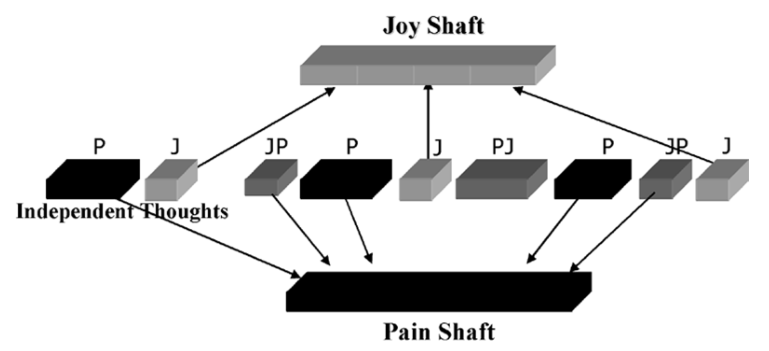
Generally, all your thoughts are related to something about the past or the future. You cannot have thoughts about the present. In the present moment you can have only consciousness, no thoughts.
Thoughts are either related to some joyful experiences that you had in the past and want to have in the future, or painful experiences that you had in the past and don't want to have again. Even at the time of some serious problem, you will suddenly have a positive thought. Even in the peak of joy, you will have some unconnected negative thought. Each thought is completely independent, completely unconnected to the previous thought. That is why you are able to have a happy thought amidst sad thoughts and vice versa.
Understand that no two thoughts are logically connected. No thought is responsible for the creation of another thought. They all appear randomly, independently, and illogically. How do you ‘unclutch’ from this random stream of thoughts? We will be using the word ‘unclutch’ again and again. Let’s clearly define what is meant by ‘unclutch’.
When we change gears while driving a car, whether we change from first to second, or second to third, or any gear for that matter, we have to pass through neutral every time. We have to completely depress the clutch, or ‘unclutch’, move through neutral, and only then we can go to the next gear, right? In the same way, we experience a neutral space between any two thoughts in our mind.
That neutral space, that silence that exists between two thoughts, is peace and bliss. When we no longer grab onto thoughts and connect them to the past or future, we remain ‘unclutched’. As we remain ‘unclutched’ from our thoughts we become more aware of the neutral spaces between thoughts.
The gap between the thoughts will automatically extend when we remain ‘unclutched’ from the stream of thoughts. We will dwell in the neutral space longer and experience more and more peace and bliss.