Why Meditate?
This text was machine-transcribed from the printed book and may contain errors. Select the words and choose “Report a mistake”.
In the following four chapters as well as those on meditation techniques that follow in a later section, I give you the pathways to experience the truths we talked about. By now, you have the intellectual understanding about what needs to be done and why.
We now come to the part of how. All the understanding will remain only theoretical if it is not converted into experience.
What is the real aim of life?
What is your ultimate aim in life?
To earn more... ? To stay forever young, healthy, beautiful...? To have better, longer- lasting relationships...? To improve your personality. . .?
Each of us is actually searching for bliss, but we search in many different ways. But ninety-nine percent of us are not even aware that bliss is our true goal! We search everywhere in the outside world for something which is there within us, just waiting to be discovered.
A small story:
One evening, a man was searching hard for something in the courtyard in his house. His wife asked him what it was. He replied that he had dropped a gold coin. His wife also joined in the search. Soon, others gathered and practically the whole neighborhood was searching for the lost coin.
Suddenly one neighbor asked the man, "Where exactly did you drop the coin? How come we still haven't found it?". The man replied, "Oh, I lost the coin inside the house." Everybody searching became angry and asked him, "Then why are we searching here?" The man replied, "The problem is I have no lights inside my house. So, I started searching by the light of this streetlamp here!"
This is exactly what we do in our own lives. We are all experts in searching for answers in the wrong laces. We search for bliss everywhere, be 1t in money, power, relationships or ideologies. But we don't move in the one obvious direction which is inwards.
What is bliss?
In life everyone has experienced some moments of great happiness. But it has always been for a reason. The state of that happiness does not seem to remain forever. It is there temporarily, and when it changes or goes away, once again you feel pain. Only the happiness you experience for no reason at
all, which does not die for any reason, is real and permanent happiness. This is what is called bliss. Such happiness doesn't depend on anything outside of you.
The word ananda itself means, 'that which cannot be reduced, which cannot be lost'. Ananda does not translate into 'happiness'. You will be surprised to know, it simply means 'that which cannot be reduced or lost'. And bliss is that thing which does not reduce for any reason.
What is meditation?
Technique to raise consciousness
Any technique, any method which raises your consciousness is meditation.
Meditation can even be a simple breathing technique. It can be a simple repetition of a word or simply sitting. In the Zen tradition, just sitting is meditation. You may think this is the easiest thing to do but in fact, just sitting is the most difficult meditation. Anything can become meditation if it raises your consciousness.
Intensely blissful in the present
Meditation is just being blissful in the moment. When you are at complete peace in the present moment, you are already in a state of meditation.
Recall any moment in your life when you have experienced extreme beauty. Maybe it was the sun rising suddenly from behind a mountain, or the first time you heard a lovely piece of music. Suddenly you became totally still, wordless. In the presence of that beauty you couldn't think any more. You were just silent, relaxed, in thoughtless awareness. You were completely dissolved in that beauty. That moment was meditation!
After a few moments your inner chatter started again. Your mind said, 'What a beautiful sunrise!' The moment the words appeared; you were out of meditation! You can either think or meditate. You can never do both. Meditation is just being. It is experiencing the present moment without resistance.
What is the right way to approach meditation?
The first thing is, be sincere. Keep an open mind. Have the openness to experiment. Be enthusiastic.
There is a beautiful term in the Zen tradition to describe the attitude — the beginner's mind. It means looking at every single thing in life as new, so everything in life excites you.
The second thing is, be optimistic. Bliss is a perfectly realizable goal for you, even if you are completely unfamiliar with meditation.
Once a man approached the great enlightened master Ramana Maharishi and asked him, "Bhagavan, am I qualified for spiritual life?" Bhagavan answered him with a question, "Are you alive?" The man was startled. He said, "Yes, of course!" Bhagavan replied, "That is enough. You already have the necessary qualification for spirituality!"
The very aim of human life is enlightenment. The possibility of becoming enlightened lies in the Kundalini shakti, an extraordinary potential energy which is hidden inside every human body. If it can be awakened, it will take you to a different plane of consciousness, a different plane of Existence. The possibility to become a different conscious being is present only in human beings. Animals don't have this potentiality to become enlightened, to become different conscious beings.
The third thing is, be playful! Meditation is a big adventure. To become serious about meditation is to miss the whole point. Celebrate meditation. Simply enjoy it! The fourth thing is, have patience. Don't start worrying about results the moment you start meditating.
The possibility to become a different conscious being is present only in human beings.
A small story:
Three monkeys once found a ripe, juicy mango. Like all monkeys, they fought over the mango for a while. Then somehow, they had a moment of clarity, a moment of intelligence. Instead of eating the mango right away, they decided to sow the mango. They knew that once the mango seeds sprouted and grew into a tree, there would be more than enough mangoes for all three of them.
Each of them decided to take up one part of the task of caring for the mango plant. The first monkey said, "I will water the plant every day!" The second monkey said, "I will keep the soil healthy and rich, add fertilizers and ensure that the plant grows well." The third monkey said, "I will guard the plant carefully and protect it from harsh weather and other animals."
One month passed, then two, then three. There was no sign of any plant growing out of the soil. The three monkeys called for an urgent meeting to discuss the issue. The first monkey declared, "As promised, I have been watering the seed every single day." The second monkey cried, "As promised, I have been adding fertilizer and making the soil rich."
The third monkey said, "As promised, I have been guarding the seed very carefully. Not only that, I have been taking the seed out every single day to check whether it has sprouted or not!"
If you are greedy for instant results, you actually prevent the process from settling down in your system. You yourself block the whole process.
The fifth thing is, enjoy solitude. Give yourself a chance to experience your inner environment. When meditation becomes a part of you, bliss will flower naturally.
Why Meditation?
There are three states that we constantly experience in our lives – the waking state, dream state and deep sleep state. But there is a fourth state that we have not experienced. It is called turiya. In this state the ‘I’ consciousness exists but without thoughts. It is called thoughtless awareness. Very few
people experience this in their lives. Some people experience this for a few seconds and then go back to their regular waking state.
If you get a sudden shock or if you are sitting with nature in a completely relaxed state and in deep silence, it is possible that for a few moments you experience this thoughtless awareness. The identity is alive, the 'I' consciousness is alive, but there are no thoughts. This is the fourth state of turiya.
All our physical and mental illnesses take root in the dream state. The dream state starts penetrating and overlapping the deep sleep and waking states.
If our waking state is penetrated by the dream state, it is called daydreaming. We fantasize or imagine endless things that we wish to do. If our deep sleep is penetrated by dreaming, it is called disturbed sleep.
Continuously during the day or night, our dream state disturbs us. When our deep sleep state is disturbed by dreams, it results in problems like chronic fatigue and insomnia. When our waking state is disturbed by dreams, we will be daydreaming with much less awareness of the world around us.
The more the dream state penetrates the waking state, the more the frequency of our consciousness decreases. We may be living in the human body, but we will not be living a truly human life. When the frequency of consciousness comes down, we will not be fully aware about the decisions we make. We will not be aware of the kind of words we are thinking. We will not be aware of what is going on inside of us. It will be as if we are living in a house, but we do not know everything that is happening inside that house. You ask, 'Why should I meditate?' Meditation is needed to infuse deep awareness into both your waking state and the deep sleep state. Instead of the dream state penetrating the waking and deep sleep states, with meditation the turiya or blissful state will start penetrating the waking and deep sleep states!
The purpose of meditation is to experience this fourth state at least once. Once we experience this fourth state, we can bring the influence of it more and more into our waking and deep sleep states. If our waking and deep sleep states are completely influenced by the fourth state, turiya, that is what we call jeevan mukti or living enlightenment.
Benefits of meditation
Physical health
Meditation has the power to transform you physically, mentally, emotionally, and spiritually.
See, physical health means digesting whatever you eat and having that food become part of your body. Mental health means digesting all the ideas and problems that you encounter and forming a clear solution. In other words, it is living without conflict. Spiritual health means receiving all the great teachings and energy, digesting them and living a liberated life. Having all three is total health.
Meditation is also a complement to medication. Through meditation, you can regulate your blood pressure and blood sugar and you can increase your body's resistance to disease. Through meditation, it is possible to heal even chronic problems like skin allergies, asthma and arthritis. No disease can escape the power of meditation.
Mental health - awakening of intelligence and flowering of intuition
On the mental level, meditation enhances clarity of thought. Meditation is also a proven way to improve concentration and memory power. Above all, meditation leads you from intellect to intelligence to intuition.
With meditation, you go beyond the mind, into the being. In the being no rules exist. You become free to explore your full potential. That's why with meditation you will suddenly find yourself at ease with your surroundings, easily able to cope with new situations. You rediscover your spontaneity.
Self-healing thoughts
You may have a medically fit body. That does not mean you are completely healthy. Of course, I can say from my experience of having seen millions of people, ninety-nine per cent of those who do not have the 'self-healing clarity' in their system are never able to maintain even physical health.
When I say 'self-healing clarity', I mean the clarity and understanding to bring yourself out of depression whenever it tries to grip your consciousness.
Knowledge-weapons to combat depression
The knowledge of the Truth is what I call 'knowledge-weapons' or shaastra-shastra. Shaastra means Truth, knowledge. Shastra means weapons. Knowledge-weapons are the weapons of Truth that can destroy the depression of your being. The more knowledge-weapons you have, the more depression will be afraid of you! If you have a huge army, naturally the enemy country will be afraid of attacking you. Just by seeing your pile of weapons, the other country will think twice before attacking you. In the same way, the more you accumulate the self-healing thoughts, the knowledge-weapons, inside your being, the more depression will fear to come near you.
Freedom
With meditation, you can live your life in a much better way with greater clarity and greater intensity. You will be more aware, more creative. Yet internally, you will experience a deep and undisturbed silence.
You will no longer be doing, you will only be watching the doer. This is the whole secret of meditation — to become the watcher, to become the witness of your own actions and emotions.
Once you become aware that the real you is not the one who acts, that the real you is not the one who feels angry or hurt or depressed, then you experience a tremendous sense of freedom. This will happen through meditation. And this is real freedom.
All our life we are searching for freedom. Whether we realize it or not, every single one of us is searching for freedom. We think our freedom is dependent on others. This will happen through meditation. And this is real freedom.
All our life we are searching for freedom. Whether we realize it or not, every single one of us is searching for freedom. We think our freedom is dependent on others. Now you know that the other person is in no way connected to your freedom.
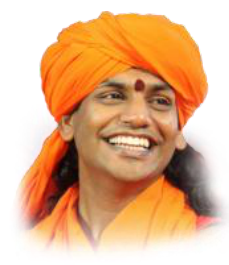
[Figure: Swami]
Love and joy for no reason
With meditation, for the first time, you will understand what it means to love for no reason. For the first time you will not be giving something in order to receive. You will give love simply because you have so much to give! You will shower love upon the world in the same way that a rain cloud showers upon the earth or a flower spontaneously spreads its fragrance all around. You will love because you are so full and overflowing!
Work as play
Just try this: whatever you do, act with awareness. If you are eating, eat with awareness. No extra time is needed to do this. In fact, it will take less time to eat because when you eat with awareness, you will eat just the amount your body needs rather than stuffing food down your throat thoughtlessly.
Awareness has tremendous knowledge. Awareness can do better miracles than all your planning. Awareness doesn't contradict, it complements the plans. It will add to the potentiality.
With meditation, for the first time, you will understand what it means to love for no reason.
When you are aware, you are absent. When awareness is present, your ego can't exist. When your ego exists, awareness can't be present. 'Your absence' will make you live enlightenment.
When you are aware, you will work optimally and use your energy efficiently. So at the end of the day you are just as fresh as in the morning. You see, it is not the work that exhausts you; it is your mind, your attitude. The whole game of meditation is to get out of the work-oriented mind and look at every moment of life as a beautiful Divine play.
When to do meditation?
The next question is when to meditate. This is always a controversial question! All the youngsters think, 'I can do this in my old age after I have lived my life fully and I don't have anything else to do.' All the elderly people think, 'I should have done this in my young age when I was fresh and energetic.'
So the question is not just how long to meditate everyday, but also when to make the decision to enter into meditation. Please understand, meditation is the basic need for every person. It is not an option. It is a very basic need.
Benefits of Meditation
Health
Meditation results in holistic health. It gives good health on the physical, mental and emotional levels. Specific health benefits reported by some who meditate are:
- The stabilization of high or low blood pressure, blood sugar, body heat and heartbeat.
- The balancing of mind/body rhythms.
- Reduction of muscle tension, stronger bones, immunity from disease.
- Cleansing - quicker elimination of toxins and body waste.
- Overcoming insomnia and improved quality of sleep.
- Enhanced energy, increased work capacity.
- Longer life span - improved body metabolism and body cells with a longer life span.
- Secretion of healthy body chemicals - increased secretion of natural anti- depressants, enhanced secretion of endorphins, the body's 'happy chemical's'.
- Relationships - Meditation inherently puts you in tune with yourself and others. The direct result of this is deeper, more meaningful interpersonal relationships with family, friends and with everyone you encounter in your daily life.
- Intelligence - To work efficiently, one needs intelligence. Meditation ignites your innate intelligence making you more aware and sharp. The natural result of this is improved, efficient and effortless performance in whatever you do.
- Creativity - Each of us holds within us an undiscovered treasure of talent and potential. Meditation reveals and helps you realize your inner talents and latent creativity. 12. Authenticity - Meditation allows you to touch base with the real you, and makes you realize your uniqueness. Self-confidence then becomes a natural by-product.
- Balance - Most of us live life as a roller-coaster ride, held in the sway of emotions like worry, jealousy, discontentment, fear, anger, guilt, etc. over which we have no control. Meditation enables you to be centered in yourself, have a solid inner balance and thus, be the master of your own self.
- Relaxation, peace, bliss - A natural byproduct of meditation is something we spend almost a lifetime trying to attain inner relaxation and peace. With meditation, you automatically drop out of the vicious cycle of fear, greed and stress, and enter the virtuous cycle of bliss.
- Holistic spiritual growth - To measure intellect, we have IQ or Intelligence Quotient, which is measured by many standardized tests. Of late, another measure is gaining importance, especially in the corporate world, namely EQ or Emotional Quotient. However, the most important factor of our lives which is inner satisfaction and fulfillment, is what matters at the end of the day. Meditation enhances this very important factor of life, SQ or Spiritual Quotient, besides also increasing IQ and EQ.
- Life - As of now, our mental setup is rigid and reflects our personality. Because of this self-image we carry in our minds, we face a lot of troubles in life and are not able to enjoy life completely. Meditation simply reprograms the software of the mind so that we can live life completely.
- Ultimate potential - You are like an airplane with the potential to fly, but you think you are an ox-cart because you have not actualized your potential. Meditation simply makes you realize and experience who you really are and the enormous capabilities you have been born with.
- Ultimate potential - You are like an airplane with the potential to fly, but you think you are an ox-cart because you have not actualized your potential. Meditation simply makes you realize and experience who you really are and the enormous capabilities you have been born with.
Kinds of meditation
There are three kinds of meditation.
The first is bringing the truth or awareness into your life.
This meditation is supposed to be done all twenty-four hours a day. Breath-related techniques like vipassana or techniques where you bring your awareness to the present moment all the time belong to
this category of meditation. It is not a part of your routine. It should become the very quality of your routine. You may be doing anything like writing, reading, cooking, discussing, but this thread of meditation should be happening simultaneously like an undercurrent.
With the second kind of meditation techniques, you need to spend a particular time, like one hour in the morning or one hour in the evening, or any other convenient time.
The Mahamantra' meditation technique, where you hum for a few minutes and then remain a witness for a few minutes, can be given as an example for this category of meditation. Nithya Dhyaan is another example of this type of meditation, since it is practiced for a specified time each day.
Then there is the third kind of meditation techniques, where just the very remembrance of the technique is enough.
Examples of this are the statements of the great timeless truths. When you are in a highly mature state, you don’t need any separate technique. You don’t need to practice the whole day or at any particular time. Just the very remembrance of these truths will put you in the elevated state. This is the third type of meditation. Examples of this are the beautiful Zen koans They are profound truths written in a concise way. Just the very remembrance of them will transport you to the zone of truth!
There is a very beautiful story in the Upanishad" where a disciple comes to the master and asks for a technique or a method for enlightenment. The master just says, "'Tat tvam asi, Tat tvam asi, Tat tvam asi - 'Thou art that, Thou art that, Thou art that', and the story says, the disciple became enlightened!
It seems like a very strange story. The master just repeats a few words and the disciple is suddenly enlightened. How is it possible? It seems unbelievable! Actually it is not so. If we have done the first two types of techniques, the technique that needs to be done the whole day and the technique that needs to be done at a particular time, then the very maturity that happens out of that practice will cause you to experience the Truth the moment you hear it from the master!
Reality as dream
You may wonder, 'How is it that every day when I come back to the waking state, I see the same world but every night when I go back to the dream state, I don’t see the same world? So, can this be used as a scale? With this can we say that this waking-state world is real?'' Let us analyze one night’s dream. For example, let us say that you go to sleep on the night of the fourteenth, and on the morning of the fifteenth, you wake up. You sleep for around ten hours. I am sure many of you have had experiences of having lived around ten to twenty years of your life in one night’s dream, in just ten hours’ time.
Perhaps the dream starts in your college days and moves slowly, step by step, up to your marriage, your having a son, your son’s marriage, etc. In this way, you live even twenty years of your life in just one night’s dream, am I right? If you have experienced this at least once, you can follow very closely what I am going to present now.
You see, while sleeping, we go through the dream state and the deep sleep state. Maybe for half an hour, you fall into the deep sleep state. Then you go to the dream state and have some dreams. Again you fall back into the deep sleep state for perhaps twenty minutes, and then once again, you come back to the dream state. In this way you keep moving from the dream state to the deep sleep state and back.
Understand: in one night, you dream that you have lived twenty years of your life. In the first episode of your dream, you are in college. In the second episode, when you come back to the dream state after a gap of deep sleep, you are getting married. In the third dream episode, you have a son. Maybe in the fourth episode, you see your son getting married.
An important thing you need to understand: when you fall into the deep sleep state and then come back to the dream state, and then repeat this process, in these different episodes, you do see the same world even in your dream state. Am I right? Sometimes you do see the same world even in the dream state.
Understand, it is a very subtle point, a very subtle understanding. If you can catch this, it will lead to very great clarity, which can really revolutionize the way in which you think about your life, the way in which you try to solve the problems of your life.
Imagine a man is dreaming. In the dream he sees a tiger chasing him and he starts shouting, 'Oh, a tiger is chasing me! Save me, save me!' His wife is sleeping next to him. He wakes up and sees the husband shouting! The wife is confused, 'What am I supposed to do?' She just needs to tell him, 'Hey, wake up!' Instead of that, if she tries to supply some weapon to kill the tiger in the dream, what will happen? He may kill himself or he may kill her! Any other solution she may try to find will only lead to more problems, more difficulties. All the husband needs to do is wake up.
If you understand these basic things, suddenly you will see that your very decision- making is revolutionized. The cognitive shift happens in you. The way in which you think and the way in which you make decisions, the way in which you find solutions for your problems, will be entirely different. You will start working towards the right solutions.
When you are dreaming, in a span of ten hours, you can easily live twenty years. You fall into deep sleep and come back to the dream state many times. Whenever you come back to the dream state from deep sleep, even though there was a break from the last dream, you see the same world. So, you have to understand clearly that just seeing the same world after the break in the dream state cannot be the quality to define it as reality. Only when you wake up from sleep, do you realize you have 'lived' twenty years of your life in a mere ten hours.
In the same way, only when you wake up from this 'waking dream' in which you are living now, suddenly you will realize you have dreamt maybe ninety years of your life in a few hours! This life in the waking state may be another long dream!
When you are in a dream, you think the dream is reality. Where you are, that is reality for that moment. There is no other scale. In the dream you can never imagine, 'It is a dream.' In the reality, you can never think, 'It is one more dream.' When you come out of the dream, the dream looks like a dream. But when you are in the dream itself, it will not look like a dream.
In the dream,even if you remember about your real life, you think it is a dream. In the reality, even if you remember about the dream, you think it is a dream. So it just depends on the frequency in which you are. There is no other scale to explain which is reality or dream.
Realizing and understanding there is a possibility that this very waking state could be one more long dream will turn much of your attention and awareness to the center, to the consciousness, to the ultimate reality. When you go beyond the frequency of this waking state, it will also look like one more dream.
This is the first step in spirituality. This is the first step in psychological revolution.
Again and again, your suffering gives you a clear statement that you are not living in reality.
Many times I am asked another question along the same lines, ‘Not only am I seeing this world, even the people who are living around me are seeing the same world. How can you say it is a dream?’
Understand, in a dream if you are seeing a particular city, and if in that dream you are going to that city with your whole family, then not only you, but the family with you inside your dream, will also see the same city, because they are also projections of your mind! So, just because the people around you see the same scene as you do, it does not mean that the scene is reality. Those people around you might be a projection of the same scene!
The ultimate truth is that the stuff out of which your dream world is made is the same as the stuff out of which this waking world is also made.
If your attention is centered on the stuff, naturally the inner healing cannot happen. If your attention is equally distributed on the consciousness and the stuff, that is what I call healthy life or balanced life. You will have physical health, mental health and a vibrant life. If your attention is totally centered on the consciousness, not on the stuff with which these worlds are made, that is what I call ‘living enlightenment’ or jeevan mukti.
Whether you want jeevan Mukti or not, whether you want enlightenment or not, is secondary. But if you can turn a little bit of your attention towards the ‘I’ consciousness, towards the Truth, towards the center, suddenly you will see that a tremendous inner healing happens.
For example, if you are facing some big difficulty or depression, if you realize very clearly and consciously that this whole thing is a dream, you will experience such a relaxed feeling or the inner healing happening in you. That inner healing is what I call meditation. That restful awareness that happens in you is what I call satori, the first glimpse of samadhi.
A basic cognitive shift or a basic psychological revolution, with the simple understanding that what you are seeing may not be reality as you think, can bring tremendous inner healing inside you, can bring a great restful awareness inside you.
Glimpse of scientific research on meditation
Science is just now getting glimpses of the tremendous power of meditation to completely change the entire body-mind structure itself. The benefits of meditation are countless and across all planes, be it physical, mental, emotional or spiritual. Meditation can simply change the very quality of life.
Increased brain power
Until recently, it was believed that in the brain, the connections among the brain nerve cells were fixed in childhood and did not change, so the brain growth stopped early in life. Now scientists are finding that the brain actually grows and forms new connections all throughout life, they call this neuroplasticity.
The other day I was reading in the papers Washington Post, January 3, 2005), about research done by the University of Wisconsin to study the effects of meditation on the brain. The study was done on a
group of Tibetan monks who had been meditating for years, and also on a group of students who were new to meditation but had been taught how to meditate.
They found that the awareness was more and the brain activity was faster and much better organized and coordinated in the meditating monks than in the students who were new to meditation. Not only that, the brain region associated with happiness, positive thoughts and emotions, was also much more active in the monks than in the students.
One more important thing, the researchers found that the brain activity of the meditator monks was more intense and organized (than that of the students), even before the monks started meditating. So the benefits of meditation are actually permanent. Meditation can simply change the very circuitry and the inner workings of the brain.
Many top universities in the USA like Yale, Harvard and MIT (Massachusetts Institute of Technology), have also studied the effects of meditation.
Studies using MRI (Magnetic Resonance Imaging) showed that meditation actually increased the very thickness of the brain in areas related to awareness and attention, as well as cognitive processing and emotional wellbeing.
The researchers found that the blood vessels become wider, the support structures also increase in number and they have more branches and connections.
Meditation Vs Sleep
There was another research done at the University of Kentucky where they studied the effects of sleepiness on a person's awareness. A group of people was made to look at a screen and they were supposed to press a button as soon as an image came on the screen. Normally a person who has had less sleep takes much longer to respond to the image than a person who has had normal sleep. Sometimes they even completely miss seeing the image coming up.
The researchers tested the participants before and after forty minutes of sleep, meditation, reading or some light activity.
They found that with meditation, the response was the fastest for every single participant, even though the participants were not experienced in meditation. In fact, their response was even better after keeping awake the whole night!
Improved concentration and speed of response
There have been many studies to learn the effect of meditation on the speed and correctness of perception and response
A couple of studies were done at Liverpool John Moores University in Liverpool, England. In one study, the participants were given lines of letters with different numbers of dashes marked above the letters. They had to cross out the letters with multiple dashes, as quickly as possible.
In another study, the participants were shown the words like ‘RED’, ‘BLUE’ or ‘GREEN’ printed in different colored inks. They had to quickly name the color of the ink the word was written in. Normally, this is difficult because your brain tends to read the word rather than look and identify the color of the ink that the word is written in!
They found that the meditators were much faster and made about half the number of errors as the non-meditators.
Meditation directly and significantly improves awareness, attention, memory, concentration, response time, visualization, emotional wellbeing, and general health.
Science has just started exploring the vast dimensions of the effects and benefits of meditation. But for thousands of years, right from the vedic times, man has been enjoying the benefits of meditation which is the ultimate way to the Ultimate! It is a foolproof, time- proven technique to realize oneself.