4: Jñānakarmasannyāsa Yogaḥ
This text was machine-transcribed from the printed book and may contain errors. Select the words and choose “Report a mistake”.
THE PATH OF KNOWLEDGE
I TAUGHT THIS SCIENCE TO SUN
4.1 Bhagavān says: I taught the Sun god, Vivasvān, the imperishable science of yoga and Vivasvān taught Manu, the father of mankind and Manu in turn taught Ikṣvāku.
4.2 The supreme science was thus received through the chain of master-disciple succession and the saintly kings understood it in that way.
In the course of time, the succession was broken and therefore the science as it was appears to have been lost.
4.3 That ancient science of Enlightenment, is today taught by Me to you because you are My devotee as well as My friend. You will certainly understand the supreme mystery of this science.
You need to understand that Kṛṣṇa is just thirty-two years old when He makes this statement! Physically His body is only thirty-two years old. But He says, ‘I gave this imperishable knowledge to Sūrya, the Sun god—imaṁ vivasvate yogaṁ proktavān aham avyayam (4.1).’
With logic, you cannot understand this statement. With ordinary logic, which you use in your daily life, you cannot make any meaning out of this statement. In the next statement He says: The supreme science, this yoga as it was, appears to have been lost in course of time.
These two verses should be understood clearly. The first thing is that the truth is not new. It is eternal; neither new nor old. Eternal means it is there forever. It never becomes old. It was never new. When you are in completion, anything you create stands for eternity. It is immortal and eternal.
See, for a religion or any civilization to be alive, three things are important. First, the knowledge and the science of lifestyle, Upaniṣad— what is birth, what is death, why life, what is the purpose of life—the answer to all questions of living and leaving. Second, the buildings— architecture and arts. And third, the language. All these three are made out of the magnetic field of completion in sanātana-dharma. That is why these three things can never be destroyed, no matter how much anyone tries.
The architectural wonders and monuments created out of completion, and the linguistic monument and wonder, Saṁskṛitaṁ born out of completion—these can never be destroyed. Just like the wonders of the world, if you analyse the linguistic wonders of the world, Saṁskṛitaṁ, the devabhāśā—language of Divine, will be the first and only linguistic wonder of the world. Understand, the word Saṁskrit means well done, refined, perfect.
And the great science of lifestyle is the Upaniṣads. All three are created out of the magnetic field of completion. That is why nothing could destroy or kill it.
This yoga is imperishable as Kṛṣṇa declares, avyayam. Anything created out of the space of completion stands forever, stands eternally. Completion is eternal, Nitya.
‘In course of time, the science was lost.’ Kṛṣṇa uses a beautiful phrase, ‘the supreme science was taught by Me, imaṁ vivasvate yogaṁ and the supreme science was received through lineage, evaṁ paramparā prāptam.’ You don’t lose that supreme science in just one generation. In course of time, even a single unenlightened disciple is enough to destroy the whole science.
The problem is, your Master creates a big movement and you succeed him without the necessary qualifications. People who simply ascend the throne only because they are the successor are the most dangerous people. They have everything except Enlightenment. One who creates a spiritual movement, creates it only out of the energy of Enriching with Enlightenment, from his love and compassion. For the person who succeeds the founder, the whole movement is a gift.
When you get somebody’s throne as a successor without the energy of responsibility, you will be filled with ego. You will create damage. You carry just the book and not the knowledge. Responsibility is the energy in which your life flowers and blooms. First learn to think with these four tattvas as reality. That is why our Vedic Masters always transmitted and mirrored the truths through the oral tradition of disciple succession from the enlightened Master to the disciple. The disciple sits in Upaniṣad at the feet of the Master.
Upaniṣad means sitting with the Master.
One cannot tell this ultimate truth to a person who is not ready. I repeat, this truth cannot be delivered to a person who is not ready to listen. And truth told to a person who is not ready creates danger for everyone.
The ultimate truth is beyond logic. Initially when you start to teach the truth, it always starts with logic. Words go logically. But after some time, you have to leave logic behind. Otherwise, you can’t reach the Divine. You can’t talk to God through logic.
If you want the divine relationship to happen, you need love. You need the language of poetry. Here, only a person who understands, who has become a part of the Master can receive the Master’s experiences. Unless you become part of the Master, it is very difficult to understand his message. When you speak the ultimate truth to a person who is not ready, it leads to many troubles.
A wrong person can never understand the truth told by Kṛṣṇa. For example, Kṛṣṇa says, ‘I am God. I am everything. Surrender unto me.’ If the person is not completely devoted to Kṛṣṇa, if he has not understood Kṛṣṇa, what will he think? ‘What an egoistic person he is! How dare he tell me to surrender to him?’
Beyond Logic Lies Devotion
Here, the qualification to receive the truth is devotion. If you have heard all the things I have said in the other three chapters of the Gītā, it is expressed logically. Until this point, I am able to bring both logic and spirituality together. Now, the time has come when I have to give you the pure truth as Truth. Understand, great truths can never be expressed by logic, because logic is not sharp enough!
Here, Kṛṣṇa is going to talk about something that is beyond logic. This is where you leave your logic behind, become completely open, sit in a totally passive mood, and be ready to receive. With logic, either you will understand everything or you will not understand anything. There is no other danger. When it comes to the deeper level teachings, either you understand, or you misunderstand. The teachings which Kṛṣṇa is going to deliver now are much deeper, much subtler than the teachings delivered earlier.
That is why He says, 'Now I am telling you these secrets just because you are my devotee and friend, just because you are near and dear to me.
4.4 Arjuna says: 'O Kṛṣṇa, you are younger to the Sun god Vivasvān by birth. How am I to understand that in the beginning You instructed this science to him?'
4.5 Bhagavān says: Very many births both you and I have passed. I can remember all of them, but you cannot, O Parantapa!
4.6 Although I am unborn, imperishable and the Lord of all living entities,
By ruling My nature I reappear by My own māyā.
4.7 Whenever positive consciousness declines, when collective negativity rises, O Bhārat, again and again, at these times, I appear Myself.
4.8 To protect the pious and to annihilate the wicked, to re-establish dharma (righteousness), I Myself appear, age after age.
Arjuna and Kṛṣṇa are almost of the same age. Suddenly, Kṛṣṇa says He gave this science to the Sun god thousands of years ago! Moreover, Arjuna lived with Kṛṣṇa for a long time. He knows and has seen the human side of Kṛṣṇa, all of Kṛṣṇa's līlā (plays), all of Kṛṣṇa's moods. So, now, it is very difficult for Arjuna to believe Kṛṣṇa's words.
Bhagavān says, 'O Arjuna, many, many births both you and I have passed. I can remember all of them but you can't.' Then He says, 'Although I am unborn, imperishable and the Lord of all living entities, I reappear by my original māyā, by controlling my nature.'
He says, although I am unborn and my transcendental body never deteriorates and although I am the Lord of all living entities, I still appear in every millennium in my original transcendental form.
Three things we need to understand here. First He says, 'I am unborn, ajopi. I never take birth. I am the ultimate Parabrahma. I am the ultimate energy.' I don't think anyone else has declared it so clearly. Here, Kṛṣṇa straightaway declares the truth. 'I am God, bhūtānām īsvaro'pi san,' He says.
KṚṢṆA Promises to Happen Again and Again
The next two verses, if they are understood, then not only the whole Gītā but all the spiritual scriptures can be realized. Here He declares:
yadā yadā hi dharmasya glānir bhavati bhārata |
abhyutthānam adharmasya tadātmānaṁ sṛjāmyaham || 4.7
paritrāṇāya sadhūnāṁ vināśāya ca duṣkṛtām |
dharma saṁsthāpanārthāya sambhavāmi yuge yuge || 4.8
Whenever there is a decline in individual consciousness, whenever the collective unconsciousness increases, to establish the righteousness of the eternal consciousness, the science of eternal bliss, dharma saṁsthāpanārthāya, I Myself appear, millennium after millennium—sambhavāmi yuge yuge.
Only a Master like Kṛṣṇa can declare the truth so clearly. Here Kṛṣṇa declares, 'I come down again and again, to set right the wrong.'
4.9 One who knows or experiences the reality of My Divine appearance and activities does not, upon leaving the body,
take birth again in this material world, but attains Me, O Arjuna.
4.10 Being freed from attachment, fear and anger, being fully absorbed in Me and taking refuge in Me, many beings in the past have become purified by the knowledge of Me, and thus they have realized My being.
4.11 I reward everyone, I show Myself to all people, according to the manner in which they surrender unto Me, in the manner that they are devoted to Me, O Pārtha!
4.12 Men in this world desire success through activities and therefore they worship the gods. Men get instant results from active work in this world.
Here, when He says, ‘I am God, I am the Ultimate,’ He says there is a possibility, ‘When I can achieve, why can’t you?’ He shows the space of possibility, He gives us the courage of authenticity, He encourages us. Here He says, ‘When I can achieve, why can’t you?’
It is like a seed is always afraid of rupturing to become a tree. The seed always feels, ‘If I break and the tree doesn’t happen, then what will happen? I will die.’ But the tree tells the seed, ‘Unless you open, I cannot happen.’ The seed says, ‘No, let the tree happen, then I will open.’ But the tree says, ‘No, no, first you have to open, only then I can happen.’ The problem between the tree and the seed continues endlessly.
It is necessary for somebody to give a little courage to the seed. A tree that was a seed once can say, ‘Be courageous. Be authentic to your highest possibility. Don’t worry. You will never perish. Open. Just like me you will become a tree.’ In the same way, Kṛṣṇa gives courage of authenticity to us, ‘You can also become God, like Me. You can also experience the truth like Me.’
Here, when Kṛṣṇa says, ‘I,’ there is just the Divine that is speaking. There is nobody inside. It is pure emptiness. Just the Divine, the pure Existence speaks through Him. He has become a hollow bamboo. That is why He can courageously declare in a battlefield, bhūtānām īsvaro’pi—I am the Lord of all beings. Sitting comfortably at home where you have all the security and protection and declaring ‘I am God’ is very easy, because there is nothing to risk. You don’t need to prove anything. But Kṛṣṇa is making this statement in a place where He needs to prove it. He is making this statement in a battlefield, where His life itself is at risk. One arrow is enough to finish His body. Yet He boldly declares, ‘I am God.’ What courage and energy behind His words! It can come only from a solid experience, a deep conscious experience.
See, when you leave the body, the moment the physical body dies and relaxes, that very moment the soul leaves the body. At that time, what you perceived as the highest pleasure in your life surfaces. If you thought eating was the highest pleasure in your life, naturally while leaving the body, you will think, ‘I should take a body which will continuously help me to eat. You go through all the choices and you decide to take a pig’s body. Whatever you think is the greatest experience in your life, whichever experience occupies your maximum inner space, you decide your next birth based on that desire. Please listen, nobody else decides your birth. It is simply you who chooses. It is clearly the conscious decision of your soul.
Here Kṛṣṇa says beautifully, ‘I am telling you the secret of things.’ Kṛṣṇa says, ‘rahasyaṁ hy etad uttamam.’ ‘I am telling you the mysterious ultimate science, Oh, my dear devotee and friend, bhakto‘si me sakhā ceti.’
I made a few statements: ‘You take birth based on your desires, based on how you lived in the previous birth. Birth and death are your conscious decisions.’ We will now analyze these statements. Only then will we be able to intranalyze and powerfully live them.
The moment this truth is understood, you will immediately see that Life is a blessing. This life is your decision, please be very clear about it. Including poverty, everything is your decision. Don’t think poverty has been forced upon you. Even that is your decision. When we take birth, we take birth based on our fear and greed. On one side, greed pushes us, ‘Let me become the son of a king, let me become the son of a rich man.’ On the other side, our own fears say, ‘No no, I can’t take on so much responsibility.’
Yoo too can Happen as Divine
Here I am giving you the straight technique to become Kṛṣṇa, how to enter Kṛṣṇa consciousness, how to become an Incarnation. The man who assumes the body out of love and compassion is an Incarnation. If you assume the body out of greed or fear, you are a man. If you assume the body out of love and compassion, you are an Incarnation and you are divine. Your whole life will become pure eternal bliss. Your whole life will be a happening with a different consciousness.
Here Kṛṣṇa gives us a technique to attain Him, to experience janma karma ca me divyam. If we are able to live in such a way as to be free from the attachments born out of anger and fear, then we can be absorbed in Him, we can attain Him. All actions create their own reactions. When we sow a seed, the action, though it may appear to be complete, is in reality not so. We have set into motion a cycle, a chain of events. The seed sprouts and becomes a plant or tree. Thus it is in the order of Existence that every action or cause has its own reaction or effect.
Here Kṛṣṇa gives a technique to cut these kārmic bonds, to be complete and realize the reality. Actions that are complete and free from fear and anger do not create bonds, vītā-rāga bhaya krodhā. They lead us towards elevated consciousness. Fear and anger that arise out of greed pattern are two of the most provocative emotions, the root patterns that create incomplete action, and lead to bondage.
Attachments are our bondage to the future based on experiences of the past. We have unfulfilled desires that we hope to fulfill. We look for results. When the results happen the way we wish them to, there is temporary satisfaction. More wishes arise. More attachments are formed. When things do not happen the way we want them to, we feel sorrow, we are depressed. We strive again. Either way it is a never-ending cycle that brings sorrow in the end. When we let go of attachments and perform complete actions with no expectations, we enjoy the path of action. There is no stress regarding what must happen, since there is no attachment.
Kṛṣṇa offers a way to be in His space of completion. He says, 'Be drowned in Me, man-mayā mām upāśritaḥ; you will have no anger, no fear. All actions will thus be without bondage. In this manner, you can be purified and realize Me, pūtā mad-bhavām āgatāḥ (4.10).' He gives the assurance that having followed this path, many people in the past have achieved Realization.
All your actions, Kṛṣṇa says, are based on material success, and He says such activities bear instant results in this world, kṣipraṁ hi mānuṣe loke (4.12). Whether you understand it or not, all these prayers and actions do produce instant results. This does not mean whatever you pray for is instantly granted by the God you prayed to. God, fortunately, has far more wisdom than we have. God uses His buddhi, wisdom, to grant what He deems appropriate. However, the result of your actions is instant. The karmaphala is immediate.
4.13 Depending upon the distribution of the three attributes or guṇas and actions, I have created the four castes. Yet, I am to be known as the non-doer, the unchangeable.
4.14 I am not affected by any work; nor do I long for the outcome of such work. One who understands this truth about Me also does not get caught in the bondage of work.
4.15 All the wise and liberated souls of ancient times have acted with this understanding and thus attained liberation. Just as the ancients did, perform your duty with this understanding.
4.16 What is action and what is inaction, even the wise are confused. Let Me explain to you what action is, knowing which you shall be liberated from all ills.
There are three basic guṇas: satva or purity, rajas or activity and tamas or inactivity. People quote this verse whenever they want the support of religion for making the caste system more solid.
They say, 'Kṛṣṇa Himself has sanctioned it' or, 'This system has been given by the Incarnation Himself.' Listen, Kṛṣṇa uses the words, 'depending upon the distribution of the three guṇas.' He
does not say, 'depending upon birth.'
Every person is unique and possesses a unique ratio of the three guṇas. There are basically four kinds of people; based on the more dominant guṇa in them. He says, 'Based on the guṇa one is born with, I decide his varṇa, his caste.' The varṇa system was four-fold. Brāhmaṇas were the scholars and priests, intellectually inclined. Kṣatriyas were the soldiers and kings, ambitious and physically strong. Vaiṣyas were the business community with strong commercial acumen. Śudras were the workers, physically able and skillful. Based on their guṇas, their skill sets and not birth, the children in ancient Gurukul were trained into their vocations, their varṇa or caste.
Kṛṣṇa, the ultimate Master, is always conscious and complete. He has no karma, no unfulfilled desires, no incompletion, and no attachment. So it is with every enlightened Master. His so-called desires get fulfilled as they arise. When I desire food, it appears. When I feel the need to sleep, I rest. There is no gap between my desire and its fulfillment. There is no trace of that desire after it is fulfilled. The fulfillment is complete. The attachment is zero. Therefore, there is no karma. This is the lesson every Master teaches his disciples. Work from your needs, not from your wants. Act without attachment. You shall attract no karma and you will be liberated.
4.17 The complexities of action are very difficult to understand. Understand fully the nature of proper action by understanding the nature of wrong action and inaction.
4.18 He who sees inaction in action and action in inaction is wise and a yogi, even if engaged in all activities.
4.19 He who is determined and devoid of all desires for sense gratification, he is of perfect knowledge. The sages declare such a person wise whose actions are burnt by the fire of knowledge.
4.20 Having given up all attachment to the results of his action, always satisfied and independent, the wise man does not act, though he is engaged in all kinds of action.
When you see that it is not the 'I' in you that is doing the activities, but it is the senses following their nature; when you see that it is the mind that is creating the false sense of identification of you with the action, then you have realized; you have attained completion because you are now no longer in the clutches of the mind.
For example, the eyes see, the ears hear, and the nose smells. Yet, you are free from the bondage of action because you do not have any identification or any emotional attachment to anything. So naturally, you are liberated and you can do actions most beautifully without expecting any particular result. This is what it means to be 'Unclutched.'
By your very Nature, You are Inclutched
Being 'Unclutched' is the state where you are free and liberated. Let me expand on the word 'Unclutching.' If you observe your mind keenly, you will see that you are constantly connecting all your thoughts and creating links in your mind.
For example, the headache that happened ten years ago, five years ago and yesterday are all independent experiences. For easy reference, you categorize all these into 'headache,' just like you file documents in your office. By and by, you start believing all these experiences are connected. When you start believing they are connected you create a shaft.
You connect all painful memories, create a pain shaft and conclude, 'My life is suffering, my life is pain.' Now when you start believing your whole life is suffering, you have created a pain shaft and you are waiting only for painful incidents in your life so that you can elongate that shaft. First understand, whatever you believe is what you create within you and outside you. You will see that manifesting in your life over and over again. That is why vedic ṛṣis, sages, say that you create what you want. By seeing, you create. You will wait unconsciously for painful incidents to strengthen that belief, that life judgment.
Second thing, whenever you add the painful incidents unconsciously, you will be elongating that shaft, even though you may want to consciously end the pain by breaking it. If you believe your whole life is a shaft of joyful experiences, which we do very rarely, constantly you are in fear about whether the joy will continue. If you believe life is a shaft of painful incidents, you do two things: Unconsciously you gather more and more
incidents and strengthen your faith about how your life is painful, and consciously you try to break the pain shaft! If you believe life is a chain of joyful incidents, unconsciously you will be in fear that it will end, and consciously you will try to prolong it. Understand these are two big dramas we are continuously enacting with ourselves.
You forget that you can neither break the shaft nor elongate it because the shaft itself does not exist! The shaft itself is your own imagination. Just try this experiment:
Sit down for ten minutes with a pen and paper. Now, just start jotting down whatever thoughts come to your mind. Please do not edit your thoughts; write them down as they are. Do not judge yourself and do not try to control what comes to your mind. If you try to judge, you are playing a hypocritical game with yourself. Now, read whatever you have written. You can see for yourself how unconnected and illogical your thoughts are! One moment you would think, ‘I think I should go to my office tomorrow,’ then the next minute, ‘No I should just wake up and decide then,’ then, ‘What should I do about dinner tonight?’
Have you seen how the bubbles rise up in a fish tank? There is a gap between one bubble and the next. But the gap is so small that it looks like a continuous stream. Similarly, there is a gap between one thought and the next thought in your mind. Your thoughts are independent like the bubbles. By their very nature, your thoughts are independent.
For example, if you see a dog in the street, suddenly you remember the pet you used to play with as a child. Then you will remember the teacher, then the place where your teacher used to stay, and so on! The dog and the teacher are not connected in any way, but your mind simply flows. Look a little deeply, you will understand that your thoughts are illogical, independent and unconnected.
When you believe that your mind is logical, you have created the first ‘original sin’ for yourself. Understand, by your very nature you are unclutched. Every moment you are renouncing the thoughts by your very nature. A new thought can appear only when the old thought has been renounced. But even after renouncing them you try to pick up the thoughts from the dustbin and try to create a shaft with them.
Listen, first understand consciously that you are creating a shaft of pain or a shaft of joy and trying to fight with it, by either trying to elongate it or break it. Second, you don’t even have to unclutch yourself from the shaft because the shaft is imaginary. By your very nature, if you stop creating a shaft, you are Unclutched.
That is what Kṛṣṇa means by action, karmaṇi and inaction, akarmaṇi. You cannot be inactive by nature. You will daydream, clinging on to fantasies. You will try to escape from reality by deluding yourself, because your mind is clutching onto a soft and easy dream shaft.
When you truly Unclutch, without any attachment to the past and future, you will realize that you are full of energy. You will have to do something. That ‘something’ will be dictated by your present moment completion, not by fantasies. What you think of as ‘you’ is not necessary to run your day-to-day life. This is the basic truth.
In the process of Unclutching, you transcend both action and inaction, karmaṇi and akarmaṇi. You successfully destroy the false cognition of the connection between the thoughts and rest in the present moment, the space of completion, the state of no-mind, the state of dropping thoughts. In this unclutched space, you are active and yet not attached to any activity. You are truly in Kṛṣṇa consciousness.
That is what Kṛṣṇa says here: Be involved completely in the action yet be detached, independent and satisfied within. Then you can function spontaneously, flowing in tune with Existence. Life then becomes a celebration. Every single thing you do is an act of joy and an expression of the loving energy in you.
The person who acts without desire for the result; with his consciousness
controlling the mind,
giving up all sense of ownership over his possessions and body and only working, incurs
no sin.
He who is satisfied with profit which comes of its own accord and who has gone beyond duality,
who is free from envy,
Who is in equanimity both in success and failure, such a person though doing action, is never
affected.
The work of a liberated man who is unattached
to the modes of material nature and who is fully centered in the ultimate knowledge, who
works totally for the sake of sacrifice, merges entirely into the knowledge.
4.24 The offering, the butter offered to the Supreme in the fire of the Supreme is offered by the Supreme.
Certainly, the Supreme can be reached by him who is absorbed completely in action.
4.25 Some yogis worship the gods by offering various sacrifices to them,
While others worship by offering sacrifices in the fire of the Supreme.
This very prāṇa, the life breath going inside your body is not your property. It is the property of Existence. Your very life is a sheer gift to you from Existence. When you realize this, you will immediately see that all your fears and worries and greed are so baseless.
The space you carry, the attitude, the intention, and the thoughts behind the action actually decide the energy behind the action. The power of space and thought is immense. In fact, some of the latest research shows how our DNA can be influenced and reprogrammed by words and frequencies.
If you can complete with your greed and fear patterns, which is what we have normally, and create the space of bliss or Ānanda, then your energy flow will start brimming and your thoughts will be authentic, your words will be integrated and you will be more in the space of completion. When you do this, you have every power to control outer world incidents because you and Existence have a very deep connection at the energy level. When you are blissful, when the space you carry is not one of worry, fear and greed but one that is in the present, always complete and joyful, you will automatically attract all good things to yourself.
When you practice Integrity with integrity, Authenticity with authenticity, Responsibility with responsibility, and Enriching with enriching, you will simply have the four great powers—the power of words—vāk siddhi, the power of thinking—mano siddhi, the power of feeling—prema siddhi, and the power of living—ātma siddhi.
When you unlock the power of words, you will have the spontaneous intelligence to use the right and most effective words towards yourself and others. Next, what is Authenticity? The decision of authenticity has to come from your very soul. Your soul has to awaken. Till then, you may be practicing a little authenticity in your yoga, or in your waking hours. But that is not completely authentic. When your soul wakes up, only then do you become a completely authentic soul. When you start practicing authenticity, your soul wakes up. Your being wakes up. When you discover the power of thinking, you will be able to focus on your thoughts to achieve success in your job, relationships, education, finances and life itself!
Authenticity is nothing but remembering that all powers are at your disposal. You can just possess and express any power you want. With responsibility, the power of feeling, you will learn to express these powers. The power of feeling teaches how to launch yourself to the next level of life through empowered responsibility. And with enriching, you will truly be enjoying the power of living when you realize that the greatest rewards come when you live your life for others.
Kṛṣṇa says here, ‘One who works for the sake of enriching sacrifice, merges into the knowledge— yajñāyācarataḥ karma samagraṁ pravilīyate (4.23).’ Enrich just for the sake of enriching. All these parasite patterns of jealousy and envy come when you think life has a goal and somebody else has been given something more than you to reach the goal. When you understand that you are unique and Existence has equipped you with all that you need to fulfill all your desires, you will actually be able to live life in completion and work sincerely for the sake of enriching. Otherwise, you will only be running behind some goal or the other. You will envy others who you think are closer to that goal towards which you are running. You will be caught in this roller coaster of success and failure.
4.26 Some sacrifice the hearing process and other senses in the fire of equanimity. And others offer as sacrifice the objects of the senses, such as sound, in the fire of the sacrifice.
4.27 One who is interested in knowledge offers all the actions due to the senses, including the action of taking in the life breath into the fire of Yoga, and is engaged in the yoga of equanimity of the mind.
4.28 There is the sacrifice of material wealth, sacrifice through penance, sacrifice through yoga and other sacrifices, while there is sacrifice through self-study and through strict vows.
4.29 There are others who sacrifice the life energy in the form of incoming breath and outgoing breath,
thus checking the movement of the incoming and outgoing breaths and controlling the breath.
There are others who sacrifice through controlled eating and offering the outgoing breath, life
energy. All these people know the meaning of sacrifice and are purified of sin or karma.
Having tasted the nectar of the results of such sacrifices, they go to the supreme eternal
consciousness.
This world is not for those who have not sacrificed. How can the other be, Arjuna?
Thus, there are many kinds of sacrifices born of work mentioned in the Vedas.
Knowing these, one will be liberated.
‘Sacrifice’, it is not just the act of giving, but the attitude of giving. Otherwise, you may do everything, following all rituals according to the scriptures, but you will miss out on the real intent for which the act had to be done.
Kṛṣṇa mentions many forms of sacrifice here. He talks of sacrifices of material wealth, yoga and penance—a combination of material, physical, mental and spiritual sacrifices. When a person does these at some cost and pain to himself, they would be genuine sacrifices. Otherwise they would merely be meaningless rituals. However, even that which is given away by someone who can afford what he is giving, if done with good intentions of enriching, would result in gains to that person. His very intention to enrich will alter his mindset and liberate him. A person who does not believe in sharing his wealth will not only suffer in future births as a result of his mental makeup, but he will also be unable to enjoy his own wealth in his present birth.
O Parantapa (conqueror of foes), the sacrifice of wisdom is superior to the sacrifice of
material wealth.
After all, all activities totally end in wisdom.
Understand these truths by approaching a spiritual Master, by asking him your questions,
by offering service.
The enlightened person can initiate you into wisdom because he has seen the truth.
O Pāṇḍava, knowing this you will never suffer from desire or illusion,
You will know that all living beings are in the Supreme, in Me.
Even if you are the most sinful of all sinners,
You will certainly cross completely the ocean of miseries with the boat of knowledge.
Kṛṣṇa advises the seeker to sacrifice one’s knowledge and one’s intellect at His feet, at the feet of the Master, to experience the ultimate Truth. Beautifully He says, ‘tad viddhi praṇipātena paripraśnena sevayā (4.34).’ A Master is one who has experienced the truth and who can simply transfer his experience of truth to you. He communes with you.
In Saṃskṛit, there are three beautiful words to describe this. You are born in the bhū garbha, the womb of the mother; this signifies your physical birth. The teacher with his love and teachings gives birth to you in the hrid garbha, the womb of the heart. The master gives birth to a completely new you, a transformed being in the jñāna garbha, the womb of knowledge. You then become re-born, dvijā!
Surrender Transforms
Understand, Masters have no vested interest for themselves; they have no karma to exhaust. They descend on this planet Earth out of sheer love and compassion for humanity. Just like a low-pressure region attracts winds, a depression created in the world attracts the formless energy of Existence. This energy is what is known in different forms like Kṛṣṇa, Rāma, Buddha etc.
Actually, the Master lives in three dimensions of energies: the body, His teachings and His mission. Masters come to dispel the ignorance of seekers, to show them the path. Only one third of the Master’s energy
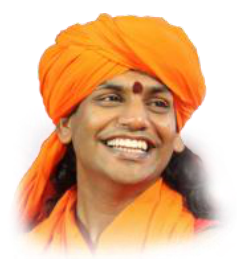
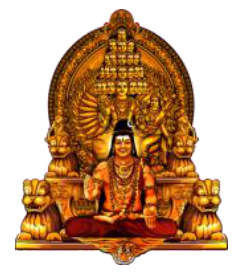
is in the physical body. The other third is in the teachings and another third is in the mission.
Nithyananda is nitya-dhyāna-ānanda, all in one. Nithya, the Master in the body as Nithyananda, dhyāna, my teaching and message of meditation and ānanda, my mission of bringing forth the fountain of bliss that is lying latent in you, all the three together constitute the energy called Nithyananda.
The moment you surrender to the Master and his mission and you stand up taking responsibility, you will find that the divine energy simply flows through you and you just flow effortlessly and express yourself most gracefully and powerfully.
All you need to do is to be stable and available, and the divine energy will make you able! On the mental level, you surrender your intellect, your mental pursuits, your incompletions to serve the Master and the mission. You become like a liquid, flowing into the shapes and moulds created by the Master. The Master knows the best way in which you can grow. He creates the moulds for each of you according to your needs and abilities. Trust him, drop your solid ego and become fluid so you can fill in the spaces he creates for you.
At the being level, when your very being surrenders to the Master, your being clearly recognizes the call of the Master. You become a part of the Master. You no longer carry any separate identity. This process of transformation automatically happens when you surrender to the Master, his teachings and his mission. The water is converted into formless steam. Like steam, you now explode in all directions. There are no limitations because all limitations exist only in the mind. You now transcend the mind and express your peak potential. The Master tirelessly and compassionately pushes you in different ways so you can also experience and be in the same state of eternal bliss as he is. The only emotion that a Master knows is love.
Here, Kṛṣṇa says beautifully, ‘Even if you are the most sinful of all sinners—sarvebhyaḥ pāpa-kṛt-tamaḥ, you will certainly completely cross the ocean of miseries with the boat of knowledge—sarvam jñāna- plavenaiva vṛjinam santariṣyasi (4.36).’
At the spiritual level, the concept of sin does not exist. It is a creation of man-made institutions, of societal and political organizations to control others through fear. When you have the true knowledge, the intelligence of why you are doing what you are doing, the very knowledge will make the action divine, the act will no longer be just a ritual but a means to reach the Ultimate. Automatically, you will cross the ocean of miseries because misery itself is a result of ignorance of your true self. When ‘spirit’ is added to a ‘ritual’, it becomes ‘spi-rituality’.
Just as a blazing fire turns firewood to ashes, O Arjuna,
So does the fire of wisdom burn to ashes all actions, all your karma.
Truly, in this world, there is nothing as pure as wisdom.
One who has matured to know this enjoys in himself in due course of time.
A person with śraddha (courageous authenticity) achieves wisdom and has control over the senses.
Achieving wisdom, without delay, he attains supreme peace.
Those who have no wisdom and authenticity, who always have doubts, are
destroyed.
There is no happiness for the ones who doubt the self, either in this world or the next.
O Dhanañjaya (winner of riches), he who has renounced the fruits of his actions, whose doubts are
destroyed, who is well established in the Self, is not bound by his actions.
O descendant of Bhārata, therefore, stand up, be established in yoga. Armed with the sword of
knowledge, cut the doubt born of ignorance that exists in your heart.
Śraddha Enriches You with Knowledge
In the next verse, Kṛṣṇa uses the word ‘śraddha’ again. What a beautiful verse, ‘śraddhāvān labhate jñānam— the one established in authenticity is enriched with knowledge.’
Actually, śraddha means faith plus the courage of authenticity to live to your highest possibility; the courage to be established in the peak of your capability. Understand, continuously committing
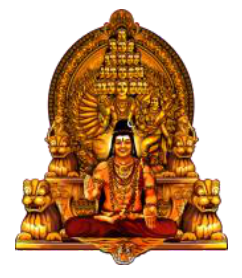
with words that express your maximum peak capacity, as per your understanding and as per others' understanding is what is referred to as śraddha, authenticity.
Kṛṣṇa declares the power of authenticity here, 'śraddhāvān labhate jñānaṁ (4.39).' Only the authentic one is enriched with knowledge. When you have the knowledge and the courage of authenticity to follow and live the teachings, then you can achieve the ultimate knowledge, the knowledge of enlightenment.
Of all religious and spiritual doctrines, it is only the scriptures of the sanātana-dharma, the eternal path of righteousness, as the Hindu philosophy is called, that allow themselves to be updated. The Vedas and the Upaniṣads, which we believe are the voices of Nature, are not rules and regulations. They are truths to be understood and followed only in awareness. There are no punishments if one does not follow them, nor is one condemned as a sinner if one doesn't follow them.
This is the greatness and pristine beauty of sanātana-dharma, the eternal path of living. We are the most powerful, most sophisticated, most intelligent, most cutting-edge presentation of the Truth left with the possibility to evolve more and more, open for the possibility of being updated! Nothing was sacred just because it was uttered.
CoMpLetIng SeLf-doubt In any fIeLd Is EducatIon
In the next few verses, Kṛṣṇa says that there is no happiness for those who always have self-doubts and who have no knowledge and authenticity. He uses the word 'always.' He does not say that from the beginning itself you should not have any doubts. Having doubts is natural; as long as you have the mind, you will have doubts. But you can go beyond it by completing with your self-doubts.
Kṛṣṇa warns, 'The one without the wisdom and without authenticity, who always has doubts, is destroyed. There is no happiness for the one who doubts the self, either in this world or the next.' Self-doubt destroys you—saṁśayātmā vinaśyati and the one who has the self-doubt is never happy anywhere—na sukhaṁ śaṁsayātmanaḥ (4.40).
First, we need to understand what self-doubt is! What is the root of this self-doubt? In your life, when the first root incident happens, you make your inner image, you project the outer image, and you create the life image to protect yourself for survival reason. For example, at the age of three or four, you run around and play in the rain. Your mother sees you and strongly pulls you into the house and gives you a slap saying, 'Don't go out in the rain! You will catch a cold! Your health will be spoiled!' She screams at you. For a child, getting slapped, being pulled inside the house and locked up is too much. The child will not understand that it is only a slap. The child will literally feel he is going to die!
At that moment, the child will create the inner mage, mamakāra: 'I am helpless.' He will create the outer image, ahaṁkāra: 'I am powerful,' because he cannot survive with the idea, 'I am helpless in the society. I am helpless in life.' So, naturally, he will create a compensating outer image, 'I am powerful,' and he will create the life's image or svānyakāra, the image about his mother and life, that life is cruel.
So, when this root pattern is formed, you start living and you naturally project your pseudo outer image: 'I am powerful.' If you are not able to convince others with the pseudo outer image, it is good for you. But if you convince them with the pseudo outer image, when you come back to your private space like your bedroom, you will start thinking, 'Oh God! I made every one believe my outer image as the truth, but my inner image is different from my outer image!' So, this clash is self-doubt. This clash is what Kṛṣṇa calls as saṁśayātmā.
If root pattern is the root of a tree, lust patterns are the parasites of the tree, every day suffering and powerlessness are the leaves of the tree, self-doubt is the fragrance of the tree.
So, please understand, when you convince others with your strong outer image, and your inner image starts questioning you; your inner image questioning you is self-doubt. That is where the self-doubt starts. This is where your root of unhappiness grows—na sukhaṁ śaṁsayātmanaḥ (4.40).
Completing with your self-doubt in any field is education. In any field, whether it is self-transformation, cooking, medicine, law, or construction, in any field, complete with your self-doubt. Your kuṇḍalini energy, your innate potential energy will flow in that direction and you will excel in that field.
Here, Kṛṣṇa refers to the stages in the Master-disciple relationship.
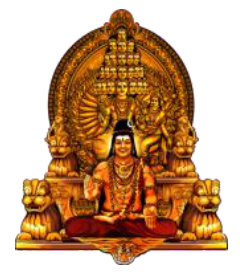
There are many levels. The first level is purely intellectual, doubt-based. ‘Doubt based’ refers to the negative self-doubts, which are purely intellectual. It is like you are telling yourself on seeing the Master, ‘What is he going to do? Let us see. How is he able to mobilize such a big crowd at such a young age? He seems hardly thirty. What is going on here?’
The next step is intelligence; from intellect to intelligence. You tell yourself, ‘Why not attend this program and see what he is really doing?’ By this time, it has changed from, ‘What is he doing!’ to ‘Oh, I think He means something. But I neither believe nor disbelieve Him. Ok, let us check it out.’ The intellect is becoming intelligence. You are giving a little space for the Master.
Then, if you continue to start looking in, first from intellect to intelligence, then from intelligence to intelligence with emotion, like 60% intelligence, 40% emotion, that is the time you will feel like a friend towards the Master. After that, it becomes 60% emotion and 40% intelligence. That is the time you will feel like the Master is like an elder, like a father or mother or lord or teacher. You feel respectful towards him. And then, the relationship becomes pure emotion. You will feel a deep connection like a mother and son.
Then, after that, it is neither emotion nor intellect nor intelligence. It is a being-level relationship. It is the deep connection of a beloved, the madhura bhāva.
And suddenly, you will see, he is not even the beloved, he is beyond the beloved. You start experiencing the mahā bhāva, what I call the Guru-disciple experience, experiencing yourself as the Master. That is what I call— ‘Tat Tvam Asi.’ Tat Tvam Asi means That art thou. It means you are the Master.
Thus ends the fourth chapter named Jñānakarmasannyāsa Yogaḥ, ‘The Yoga of Action In Knowledge And Renunciation,’ of the Bhagavad Gītā Upaniṣad, Brahmavidyā Yogaśāstra, the scripture of yoga dealing with the science of the Absolute in the form of Śrī Kṛṣṇārjuna saṃvād, dialogue between Śrī Kṛṣṇa and Arjuna.