18: Mokṣa Sannyāsa Yogaḥ
This text was machine-transcribed from the printed book and may contain errors. Select the words and choose “Report a mistake”.
Arjuna says,
‘O mighty armed Kṛṣṇa, I wish to understand
what is the essence, tattva of renunciation, tyāga and the
renounced order of life, sannyāsa, and the difference
between the two, O Hriśīkeṣa, O Killer of the demon Keśī.’
Bhagavān Kṛṣṇa says,
the renouncing of all selfish work based on desire, is what the learned ones call as sannyāsa,
the renounced order of life.
And renunciatig the attachment to fruit or result of one’s actions is what the wise ones call as
tyāga, renunciation.
Some learned men say that all kinds of result-based activities are faulty and should be given up,
but there are yet other sages who maintain that acts of enriching sacrifice [yajña],charity
[dāna] and austerity [tapaḥ] should never be given up.
Arjuna, best of Bhāratas, now listen from Me certainly about renunciation or tyāga; O
tiger among men, renunciation or tyāga is declared to be of three kinds.
Acts of enriching sacrifice [tyāga], charity [dāna] and austerity [tapaḥ] are not
to be given up; they should be performed. Indeed, even the Sages are purified by
enriching sacrifice, charity and penance.
O Pārtha (Arjuna), all these activities must also be performed without any attachment or any
expectation of fruit or result. They should be done as an act of responsibility.
That is My final and ultimate opinion.
Renunciation can be of three types: enriching sacrifice, charity and penance; yajña, dāna, tapaḥ. These purify even those who are already evolved and pure.
Kṛṣṇa says that any sacrifice done for the welfare or enrichment of humanity is not to be given up. As enriching sacrifices, yajñas are meant to achieve the supreme, performing charity, dāna is recommended to purify one’s heart and put one on the path of spiritual progress. Sacrifice is normally understood to be rituals such as yajña and homa, etc. These are the fire rituals prescribed in Vedic literatures to propitiate the deities. When carried out with integrity and authenticity, these powerful techniques link us to the Cosmic energy.
Understand, responsibility is the fruit. Enriching is sowing the seed for the fruit to happen. Enriching is sharing the fruit to create more fruits. Every person who eats the fruit is responsible for sowing the seed for more fruits to happen.
Surrender both Inner and Outer Space
Let me explain what I mean by the word surrender. Then you can understand better. Think of two intersecting lines, axes.
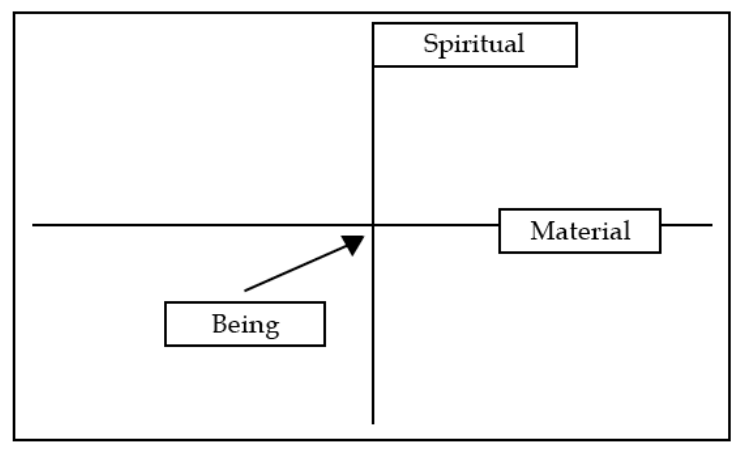
The vertical axis is spiritual life. The horizontal axis is material life. The point of intersection is your being. This is the goal you have. You have some goal in your material life and also in your spiritual life. To achieve your goal in your material life, you are continuously struggling and working. You are somewhere on the horizontal axis. To achieve your spiritual goal, you are again working intensely doing yoga, prāṇāyāma, pratyāhāra, etc. You practice spiritual techniques. You are somewhere on the vertical axis. So when you struggle with material goals, you are on the horizontal line whereas when you struggle with spiritual goals, you are on the vertical line.
Kṛṣṇa says, ‘Relax from both.’ You may think, ‘What is this funny instruction He is giving!’ You think that if you relax in both you will lose both. However, the truth is that when you relax in both, you fall into your inner consciousness, your being or your inner space. When you experience this inner space, this inner consciousness, you will suddenly realize that you can explode in all directions. You do not need to choose between horizontal and vertical lines. You can travel on both lines at the same time!
Not only that, you can explode in all directions. The only difficulty is that you must surrender at least to your own being. You do not need to surrender to somebody else. To whom you surrender is unimportant. Just relax into your own being. Just relax into your inner space, into your inner consciousness. Just surrender to your own inner space. Stop your struggle in the material world and the spiritual world.
For the first time, Kṛṣṇa gives the ultimate technique for Quantum Spirituality. He is the first quantum scientist of the inner world. He says relax and surrender and you will experience the completion of your inner consciousness. You will understand that you do not need to choose between the horizontal and vertical lines. You can explode in all 360 degrees. You need not make a choice. You experience choicelessness. Choicelessness does not mean that you do not choose anything. When you stop choosing, you will choose everything.
Prescribed duties should never be renounced. If one gives up
his prescribed duties through the illusion of renunciation [tyāga], this is said to be in the state of
ignorance or tamas.
Anyone who gives up prescribed duties as troublesome,
or out of fear of bodily discomfort, his renunciation [tyāga] is said to be in state of
aggression [rajas],
Such action never leads to gaining the fruit of renunciation.
But he who performs what is prescribed, as a matter of responsibility, without expectation or
attachment to the results, his renunciation [tyāga] is said to be in the nature of satva, goodness, O
Arjuna.
One who neither hate disagreeable work nor is attached to pleasant work, is in a state of
intelligence, goodness and renunciation, having cut-off all doubts.
Embodied beings cannot give up all activities.
Therefore, the one who has renounced the fruits of action is called the tyāgī, one who has
truly renounced.
18.12 For one who has not renounced, the three kinds of fruits of action, desirable, undesirable and mixed, accrue after death, but those who are in renounced order of life, sannyāsa, have no such result to suffer or to enjoy.
Many times the idea of dropping our responsibilities and taking up a different role is more attractive than growing in completion so that we can perform our own responsibilities well and without attachment. Be very clear, without the right cognition of completion, no role that we take up will work out for us.
When you don't take responsibility for anything, you live as slave, śūdra. When you take the responsibility for the money of the society, you become vaiśya. When you take the responsibility for weapon of the society, you become kṣatriya. When you take the responsibility for knowledge of the society, you become brāhmaṇa. When you take responsibility for everything, you become Sannyāsi.
One of the biggest problem we have is—'let me have the power first, let me have the status first, let me have the position first, then I will take the responsibility.' No! That does not happen in life. Take the responsibility to build the state inside you. Then, after you are tested by the Cosmos, it gives you the status. That status can never be taken away.
Kṛṣṇa says that doing what needs to be done because that is what is our responsibility, without attachment to the action and without desire is the ideal condition of satva.
Kṛṣṇa has said this many times in the Gītā. He repeats it again so that the message sinks in our muscle-memory and bio-memory. Do what must be done. Do what your responsibility is, based on your societal or religious beliefs and codes. However, do it with integrity and authenticity without attachment and expectation of results.
The consciousness of 'I' and 'mine', in terms of the performance of the activity should be absent. The consciousness of 'feeling responsible in your being' should be present. Restricting your being in feeling responsible is what I call conditioning. Responsibility in your being means the space from which you cognize, from where you make decisions, carrying responsibility in that zone.
Kṛṣṇa says that a person in the sātvic space of completion, calmness and awareness is undisturbed by external conditions. He is not bothered whether someone appreciates or condemns what he does. He just feels responsibility in his being. He is clear what he should do and he carries on with excitement.
Renunciation is in the true spirit of completion and is done out of goodness, only when a person renounces the expectation of result.
Karma is nothing but unfulfilled, incomplete desires. As long as we have attachment to the action as 'doer', which in turns creates an expectation of reward or punishment, we are caught in the cycle of karma and saṃsāra. Our concern about whether an action or the result is good, bad or a mix of both, follows us as our mental patterns or vāsanā after death.
18.13 , 14 Learn from Me Arjuna, there are five causes that bring about the accomplishment of all action, as described in Sāṅkhya philosophy. These are: physical body that is the seat of action, the attributes of nature or guṇa that are the Doer, the eleven organs of perceptions and action by the life forces and
finally the Divine.
18.15 These five factors are responsible for whatever right or wrong actions a man performs by deed, word and thought.
18.16 Therefore, one who thinks himself, his body and spirit, as the only doer [kartā], is certainly ignorant and foolishly does not see things as they are.
These two verses can be called techniques. Kṛṣṇa lists five factors from Sāṅkhya philosophy responsible for our activities. These are the body-mind system, the operator of the bodymind system (that is the individual), the senses, different efforts causing the activities and finally the ultimate power of God. All activities, right or wrong, good or bad, are caused by these five factors. If however, the individual considers himself to be the doer, his body and mind, he is not aware.
Kṛṣṇa uses the word ātman while saying that one who perceives one's spirit or Self as the agent, the doer, or
the performer, does not see and is not aware. Kṛṣṇa draws a distinction between the individual Self and the cosmic energy. He differentiates between ātman and Brahman, mānava and Deva, nara and Nārāyaṇa, self and Parāśakti.
Final Surrender itself Is Enlightenment
In the inner world, the first and last tool you need is complete surrender. Only then can you wake up to the Truth. If Arjuna had trusted only his senses, he would have been at best a good warrior and king. Instead he trusted Kṛṣṇa more than his senses and became enlightened. He experienced the truth of Kṛṣṇa.
You can experience Kṛṣṇa consciousness not just by surrendering the intellect and emotions but also by surrendering the root of the intellect and emotions, that is the senses. The senses supply the data. When you surrender them, the source of the data is surrendered.
When I say surrender, I mean wake up to the truth that you are in the ocean. When you are born, when you think you are an individual or when you become enlightened, you are always in the ocean. Just wake up! Waking up to this ultimate Truth is surrender. Surrender these small ideas about yourself and wake up to reality. As a result, surrender automatically happens in your inner space, your inner Consciousness.
One who is egoless, whose intelligence is not of attachment, though he may kill, is not the
slayer and is never bound by his actions.
No master except Kṛṣṇa can make such a courageous statement. Kṛṣṇa makes a bold statement here. One who is not motivated by ego, whose intelligence is not based on attachment, though he may kill many men in this world, he does not kill, nor is he bound by his actions.
Of course, one who has reached that level of completion does not think of killing. As long as we have the idea of ‘I’ and ‘mine’, we attack or kill. When we exclude, we kill. On the other hand, when we surrender, we learn to include everything.
Kṛṣṇa emphasizes here: May you be liberated from entanglement. May you liberate yourself from ego, yasya nāhaṅkṛto bhāvo. He does not ask Arjuna to kill.
Kṛṣṇa makes this statement to drive the point home to Arjuna that it is his responsibility to stand up and fight instead of running away from the battlefield.
Knowledge, the object of the knowledge and the subject of the knowledge, the knower, are the three
factors that stimulate action; the senses, the action and the performer comprise the three
components of action.
According to the science of guṇa or attributes in Sāṅkhya, there are three types in knowledge,
action, and performers of action. Now Listen as I describe them.
That knowledge by which the one imperishable reality is seen in all Existence, undivided in the
divided, you should undrestand to be the knowledge in the state of goodness.
The knowledge by which one sees different realities of various types among all beings as
separate from one another,
such knowledge is in the mode of aggression.
The irrational, baseless, and worthless knowledge by which one clings to one single effect as if it
is everything;such knowledge is in the mode of darkness or ignorance.
Obligatory duty performed without likes and dislikes and without selfish motives and
attachment to the fruit,is in the mode of goodness.
Action performed with ego, with selfish motives, and with too much effort, is in the mode of
aggression.
Action that is undertaken because of delusion, disregarding consequences, loss,
injury to others, as well as one's own ability, is in the mode of ignorance.
18.26 The performer who is free from attachment, non-egoistic, endowed with resolve and enthusiasm, and unperturbed in success or failure is called good.
18.27 The performer who is impassioned, who desires the fruits of work, who is greedy, violent, impure, and affected by joy and sorrow, is called aggressive.
18.28 The performer who is indisciplined, vulgar, stubborn, wicked, malicious, lazy, depressed, and procrastinating is called ignorant.
In these verses Kṛṣṇa explains the nature of man, the human.
Kṛṣṇa has already said that the final performer is not man, nara, but the Divine, Nārāyaṇa. Even so the human is still the subject, the medium that we are dealing with. All the frailties that we have are inherent in our nature. These are the guṇas or attributes that define our behavior.
The guṇas are of three kinds: satva, rajas and tamas. Satva is defined as calm, peaceful, spiritual and good, etc. This is generally the attribute of spiritually inclined persons. Rajas is translated as aggressive, passionate and active, etc. This is the primary attribute of kings, warriors and business people. Tamas is lazy, ignorant and passive, etc.
I want you to know a very important fact. Never, ever will you be free by your efforts to be free. Freedom will happen to you only by the right knowledge about freedom, never by your efforts towards freedom.
18.29 Now hear Me explain, fully and separately, the threefold division of intellect and resolve, based on modes of material nature,
O Dhanañjaya.
18.30 O Arjuna, that intellect is in the mode of goodness that understands the path of work and the path of renunciation, right and wrong action, fear and fearlessness, bondage and liberation.
18.31 That intellect is in the mode of passion that cannot distinguish between principles of right conduct and wrongdoing, and right and wrong action, O Pārtha (Arjuna).
18.32 That intellect is in the mode of ignorance that accepts unrighteousness as righteousness and thinks everything to be that which it is not, O Arjuna.
18.33 Consistent and continuous determination in controlling mind, breath and senses for uniting with the Divine is goodness, Pārtha
18.34 Craving for results of action while clinging to goals of proper conduct, pleasure and wealth is the state of passion., Arjuna.
18.35 Ignorant resolve that cannot go beyond dreaming, fear, grief, despair and delusion—such is in darkness, Pārtha.
Dharma, artha, kāma and mokṣa are the four puruṣārtha. These can be translated as righteousness, wealth, desire or lust and liberation.
Puruṣārtha provides four meanings to life:
Dharma is right conduct or virtue. Dharma means the natural law of the cosmos. The very DNA structure with which human consciousness is built, the natural law of human life, the dharma are these four principles.
Constantly give life to the four dharmas of authenticity, integrity, responsibility and enriching. When you protect dharma, it protects you. When you are integrated to it, it is integrated to you. When you are authentic with it, it is authentic with you. When you take responsibility for it, it takes responsibility for you. When you enrich dharma, it enriches you. Only then it is possible that your energy is awakened. Only then is your energy awakened.
Artha is the stuff that we pick up on our path and journey, the material things that we need to sustain ourselves.
Kāma is the pleasure of the senses we experience and enjoy on this journey. These are rightful acquisitions and pleasurable experiences. Do not feel disturbed by the need for these. But do not become caught up in them and forget to move on the path with completion and enjoy the journey to the fullest.
Mokṣa or liberation is the ultimate meaning to life. The meaning of human life is you experiencing completion, and working, radiating, showering others also with the same space of completion. This is the culmination of the liberation from expectation, desires, greed and fear, and liberation from attachment to desires. This understanding that experiencing completion with non-attachment and absence of expectation leads to liberation can fill us with bliss.
18.36 ,37 And now hear from Me, O Arjuna, about three kinds of pleasure. The pleasure that one enjoys from spiritual practice results in cessation of all sorrows.
The pleasure that appears as poison in the beginning, but is like nectar in the end, comes by the grace of Self-knowledge and is in the mode of goodness.
18.38 Sensual pleasures that appear as nectar in the beginning, but become poison in the end, are in the mode of passion.
18.39 Pleasure that is delusion from beginning to end and born out of sleep, laziness and illusion is said to be of the nature of ignorance.
18.40 No one, either here or among the celestials in the higher planetary systems, is free from these three states [triguṇa] of material nature.
Kṛṣṇa says that spiritual practice, that is the state of satva, is difficult in the beginning, and it is like poison; however, it becomes life-giving nectar in the end.
Sensual pleasures born out of rajas, on the other hand, seem like nectar in the beginning but become poisonous. In the tamasic state, Kṛṣṇa says, one is deluded as if in sleep, laziness and illusion.
18.41 Brāhmaṇas, kṣatriyas, vaiśyas and sūdras are divided in the work they do based on their nature, Parantapa (Arjuna).
18.42 The nature of Brāhmaṇa is characterized by calmness, discipline, austerity, tolerance, honesty, knowledge, wisdom and belief in God.
18.43 Kṣatriya are characterized by their qualities of heroism, vigor, firmness, dexterity, and steadfastness in battle, leadership and generosity.
18.44 Those who are good at cultivation, cattle rearing and trade are known as Vaiśya. Those who are very good in service are classified as Sūdra.
18.45 One can attain the highest perfection [saṁsiddhi] by devotion to one’s natural work. Listen to Me how one attains perfection while engaged in one’s natural work.
18.46 One attains perfection by worshipping the Supreme Being, from whom all beings originate and by whom this entire Universe is pervaded, through performance of one’s natural duty for Him.
18.47 It is better to engage in one’s rightful conduct [svadharma], even though one may not perform it to perfection, than to accept another’s conduct and perform it perfectly. Responsibility prescribed according to one’s nature is never affected by sinful reactions.
18.48 Every work has some defect, just as fire is covered by smoke. One should not give up the work that is born of his own nature, even if such work is full of fault, O Kaunteya (Arjuna).
Kṛṣṇa says it is better to do one’s assigned work imperfectly rather than do another’s work perfectly. It is possible that one can perform elements of another’s work well. A brāhmaṇa, being a schoar, may excel as a vaiśya in commercial calculations; however, he will have neither the heart nor the head to be a businessman. In this Gurukul system, along with the Master, the child also was allowed to select his vocation. The child could express its passion and decide.
18.49 One whose intelligence is always free from selfish attachment, who has controlled the mind
and who is free from desires,
by practicing renunciation [sannyāsa], attains the ultimate state of perfection of selfless work or actionlessness [naiṣkarma siddhi].
Understand from Me, how one who has achieved this perfection, can attain the Supreme state of
Truth, Brahman, by acting in the way I shall now summarize, Kaunteya.
,52,53 Endowed with purified intellect; subduing the mind with firm resolve; turning away from
objects of the senses; giving up likes and dislikes; living in solitude; eating lightly;
controlling the mind, speech, and organs of action;
being ever absorbed in meditation; taking refuge in detachment, and relinquishing egotism,
violence, pride, lust, anger, and proprietorship, one becomes peaceful, free from the notion of ‘I’
and ‘mine’, and fit for attaining oneness with the Supreme Being.
Kṛṣṇa says, ‘Settle the mind and control the senses.’ Can you do that while sitting in the middle of a traffic junction? No. That is why He says go into solitude and cut yourself off from disturbances. Go into meditation and shut your senses to external objects. These are the clearest instructions on how to meditate. Prepare yourself to be away from potential sensory disturbances. There is no point in meditating when you are sure the phone will ring or a guest will be arriving. Fix a time and place when you will be alone, undisturbed. Closing the eyes is insufficient. Your eyeballs will still move and inner television will still play. Mentally freeze your eyeballs, think they are made of stone and still them. At the same time place your tongue on your upper palate and lock it. If there is movement of the tongue, that creates verbalization, then visualization is difficult. These two tools of mentally freezing your eyeball movement and locking your tongue, substantially reduce the wandering of the mind due to sensory disturbances.
Meditate on an empty stomach or eat little. A full stomach makes us sleepy. Ideally one should meditate in the same location regularly to preserve the energy raised in meditation. These are the physical requirements. Next Kṛṣṇa repeats what He has been emphasizing all along.
Complete and drop your personality, He says, drop your ego or root patterns, your attachments, your ideas of ‘I’ and ‘mine’ as well as the emotions that bind you to survival and possession. Then you will be liberated, you will be in the space of completion and ready to reach the Supreme Being.
Absorbed in the Supreme Brahman, the serene one neither grieves nor desires.
Becoming equally disposed to all living beings, one obtains My highest pure
devotional love [madbhakti].
Only by devotion one truly understands Me as I am and My tattva, essence. Having
known Me in Truth in full consciousness of Me, one immediately merges with Me.
My pure devotee, though occupied in all kinds of activities of everyday life, under My
protection, still reaches the eternal, imperishable ultimate abode through My Grace [mad-
prasād].
While being engaged in activities, just depend upon Me, and being fully conscious of Me,
work always under My protection [matparaḥ].
When your mind and inner-space becomes fixed on Me, you shall overcome and cross all
difficulties by My Grace. But if due to ego, you do not listen to Me, you shall perish.
Developing the state of non-attachment, being equally disposed to all beings, being unconcerned by success and failure, fully absorbed in Godhood, one becomes His devotee. In that state alone does one understand the essence of Kṛṣṇa. Once one understands this, one merges into Kṛṣṇa consciousness. When one is in Kṛṣṇa consciousness, the devotee, even if he is engaged in worldly activities, is protected by the grace and compassion of Kṛṣṇa.
Devotion and Knowledge are not Separate
Kṛṣṇa says that ‘having known Me in essence, one merges in Me’ and refers to this as devotion.
bhaktyā mām abhijānāti yāvān yaś c'āsmi tattvataḥ ।
tato māṁ tattvato jñātvā viśate tad-anantaram ॥ 18.55
Please understand that bhakti (devotion) and jñāna (knowledge) are not separate. Where there is devotion, there is knowledge and where there is true knowledge, there is devotion.
The entire purpose of Gītā is to enrich you to complete with your root patterns and drop the ego! All you need to do is understand one verse of Gītā, one statement of Kṛṣṇa, in its entirety. That is enough to enlighten you.
Every word of Gītā, every word of Kṛṣṇa, is energy. That is the knowledge that you need to imbibe and experience. This is what the 'knowing, tattvato jñātva' that Kṛṣṇa refers to. Once you 'know' this energy, you reach this energy. You become Kṛṣṇa. You are not only devoted to Kṛṣṇa, you become Kṛṣṇa.
There are two paths. One way is to 'know' the truth so clearly and completely that there is absolutely no doubt about your trust in the Master. There is no doubt that you are the same consciousness as the Master. Once you know this, there is no duality, there is the space of advaita, non-duality. You and the Master are the same. This is the height of devotion.
The other way is the deep surrender that happens within, the unbridled love that arises within you and through which you merge with the Master. Along with the merger, comes the knowledge that you are no different. Seemingly, knowledge comes from devotion; jñāna comes from bhakti. The truth is that both happen simultaneously.
18.59 If, due to ego you thus think: 'I shall not fight,' your resolve is useless, and your own nature
will compel you.
18.60 O Kaunteya, you are controlled by your own natural conditioning. Therefore you shall do, even
against your will,
what you do not wish to do out of delusion.
18.61 The Supreme Lord resides in everyone's heart, O Arjuna, and is directing the activities of
all living entities,
who are placed on a machine under His illusive material power.
'Whether you like it or not, Arjuna,' He says, 'you will fight. In seeming intelligence, your ego tells you that you should not fight.
You are under the illusion of your superficial knowledge that it is not right to wage war against friends, relatives and teachers. But you forget that your nature and your conditioning as a warrior drive you. You are a puppet in the hands of Existence, prakṛtis tvāṁ niyokṣyati. You will fight.'
These are extraordinary words. Whether we like it or not, whatever our intelligence may be, and whatever our will may be, Kṛṣṇa says we will be driven by our root patterns, saṁskāras. The Divine power drives the machine that is the kārmic cycle. There is no escape.
18.62 Surrender unto Him completely with all your being, O Bhārata. By His Grace you will attain supreme
peace and the eternal abode.
Throughout Bhagavad Gītā, Śrī Kṛṣṇa has been saying, surrender to Me. He has been saying 'I' and 'Me', meaning that He represents the Divine. Now, suddenly, He changes that and says surrender unto Him (tam) as a third person. For the first time He refers to the Divine in this way. This means that He has expanded beyond the body. He now speaks as Parabrahma Kṛṣṇa, the universal Kṛṣṇa. He speaks from the eternal consciousness. That is the reason He says surrender unto Him and not surrender unto Me. Earlier He used the word 'I' or 'Me'. This change means that He is in an expanded state to put Arjuna into the experience. In order to give a disciple the experience, the Master must be in the same state, too. That is why Śrī Kṛṣṇa went into that expanded state. He has expanded into that consciousness and is about to give energy darśan. He is ready to shower His energy on Arjuna.
18.63 Thus, I have explained to you, the knowledge that is the most secret of secrets. After
fully reflecting on this, do as you wish.
18.64 Because you are My dear friend, I am speaking My Ultimate words with you. This is the most confidential of all knowledge. Hear this from Me. It is for your benefit.
18.65 Always think of Me and become My devotee. Worship Me and offer your homage unto Me. Thus you will certainly attain Me.
This I promise you because you are My very dear friend.
18.66 Abandon all principles and concepts of right conduct and simply surrender unto Me. I shall liberate you from all sinful reactions. Have no worry.
Now He comes to the ultimate teaching. This is the essence of all His teachings, the quintessence of Bhagavad Gītā. He wakes up Arjuna with this verse and puts him into Kṛṣṇa consciousness.
Kṛṣṇa showers Himself on Arjuna, waking him up to the experience of the Whole.
sarvadharmān parityajya mām ekaṁ śaraṇaṁ vraja ।
ahaṁ tvāṁ sarvapāpebhyo mokṣayiṣyāmi mā śucaḥ ॥ 18.66
He says, ‘Give up everything, whatever you know as dharma, the rules and regulations of the outer life and of the inner life. Drop everything that you know and surrender unto Me. I shall liberate you from everything. Do not fear.’ Kṛṣṇa gives him abhaya, complete protection.
He liberates Arjuna with these words. He gives the ultimate experience to Arjuna. With this verse, Kṛṣṇa makes Arjuna drop everything and liberates him. He gives him a conscious experience of the ocean. He asks Arjuna to drop his ideas about being a separate bubble, relax and realize the truth. Even the idea of the ocean or of God are simply our ideas. Kṛṣṇa makes Arjuna drop those ideas and makes him explode into Kṛṣṇa consciousness, the eternal consciousness.
Śrī Kṛṣṇa is triguṇa rahita: beyond the attributes of nature and kārmic influence. Merging with Him, surrendering to Him takes you beyond all kārmic bondages.
If you understand this verse and act accordingly, you will be liberated. That is Kṛṣṇa’s promise.
Take a few moments now to pray to Parabrahma Kṛṣṇa, the universal Kṛṣṇa, who showered enlightenment on Arjuna and gave him the ultimate experience. Pray that He may shower the same experience on us or give us a glimpse of the ultimate Truth. Take a few moments to pray. Please close your eyes and pray intensely to Him. Do not think that He is unavailable now. He is always available to everybody on planet Earth. He may not have the body, but He is available in the form of energy. The deities in the temples are called arcāvatār. That means ‘incarnation of the Divine’. He is available to us all the time, whenever we call Him. Close your eyes and pray intensely to Him to shower us with the same experience He showered on Arjuna.
18.67 This knowledge should never be spoken by you to one who is devoid of austerity, who is without devotion, who does not desire to listen, or who speaks ill of Me.
18.68 One who communicates the supreme secret to the devotees performs the highest devotional service to Me, and, at the end he will without doubt, come back to Me.
18.69 No other person shall do a more pleasing service to Me, and no one on the earth shall be more dear to Me.
18.70 I declare that one who studies this sacred dialogue of ours, worships Me with the sacrifice of his intelligence [jñāna-yajña].
18.71 One who listens with faith and without envy becomes free from sinful reactions and attains to the planets where those of merit dwell.
18.72 O Pārtha, did you listen to this with single-minded attention? Has your delusion born of ignorance been completely destroyed, Dhanañjaya?
Only one who is in deep devotion to Me should read this. I have conveyed here that which is most beneficial, the secret of how to live and how to reach Me. One who understands this and drops his mind with his focus entirely upon Me, shall reach Me without a doubt. This is Kṛṣṇa's promise. He blesses the whole Universe with His grace and compassion. He showered His blessing on Arjuna and made him merge with Him. The same consciousness is being showered on the whole Universe.
Until the end He is the teacher. He is full of compassion. His concern is only for Arjuna and the rest of humanity. 'Have you understood?' He asks. 'Have your doubts disappeared? Do you need anything more?'
This is the greatness of Masters. Nothing concerns them except the deliverance of their disciples. That is why they have come here. Otherwise why should they waste their time on planet Earth? They can be immersed in the blissful energy that they are part of without disturbance.
My disciples understand when I tell them that the only time I feel anything like sadness is when a disciple leaves me. It saddens me because he is losing a great opportunity. His spirit brought him to me for completion. If the body-mind does not cooperate, the spirit must live again and again until it gets the opportunity to be liberated. Each cycle of birth that the spirit undertakes, it suffers and regrets not having taken that final step.
No one who has crossed my ashram gates can ever leave me. Even if they leave, I shall not leave them. I shall be with them. That one moment of intelligence that brought them in is enough for me to care for them. Those who have understood the formless form that resides in Me know that I am part of them. Wherever they are, I am part of them.
This is Śrī Kṛṣṇa's promise: Listen to Me, understand Me and come to Me; then you are a part of Me.
18.73 Arjuna says: O dear Acyuta (infallible lord), my illusion is now gone. I have regained my memory by Your Grace,
and I am now firm and free from doubt, and ready to act as per your instructions.
18.74 Sañjaya said: Thus have I heard the conversation of two great souls, Kṛṣṇa and Arjuna. And so wonderful is that message that my hair stands on end.
18.75 By the mercy of Vyāsa, I have heard these most confidential words directly from Yogeśvara Kṛṣṇa, the Master of all mysticism,
who was speaking personally to Arjuna.
18.76 O King, as I repeatedly recall this wondrous and holy dialogue between Kṛṣṇa and Arjuna, I take pleasure,
being thrilled at every moment.
18.77 O King, when I remember the wonderful form of Lord Kṛṣṇa, I am struck with even greater wonder,
and I rejoice again and again.
18.78 Wherever there is Yogeśvara Kṛṣṇa, the Master of all mystics, and wherever there is Pārtha, the supreme carrier of bow and arrow, there will certainly be opulence, victory, extraordinary power, and morality. That is my opinion.
Now Sañjaya comes back into the picture. Neither Kṛṣṇa nor Arjuna can speak since both of them are in a different mood. Arjuna has disappeared and Kṛṣṇa is in ecstasy. Both are in no mood to speak. Sañjaya started speaking when Arjuna was in depression and Kṛṣṇa had nothing to say at that time. Then when Kṛṣṇa was giving the first experience to Arjuna, Kṛṣṇa was in the higher consciousness and Arjuna was in ecstasy. Sañjaya came in to speak at that time because both were not in a mood to speak. Now Sañjaya comes back again. Not only are Kṛṣṇa and Arjuna not in a mood to speak, they are both no longer there. Arjuna has disappeared into the pure consciousness of Parabrahma Kṛṣṇa.
'Wherever there is Kṛṣṇa, the Master of all mystics, and wherever there is Arjuna, the supreme archer, there will certainly be opulence, victory, extraordinary power and morality. This is my opinion.'
yatra yogeśvaraḥ kṛṣṇo yatra pārtho dhanurdharaḥ ।
tatra śrīrvijayo bhūtir dhrūvānītir matir mama ॥ 18.78
He ends the whole thing with a beautiful auspicious blessing. Wherever the name of Kṛṣṇa, the divine energy of Kṛṣṇa is present and wherever Arjuna dwells, there will also be victory, prosperity, wealth and morality. All the divine positive energy will shower there. He concludes with this beautiful blessing, this beautiful verse.
Let us give our gratitude to the entire Guru Paramparā, the lineage of Gurus.
Please close your eyes and remain in silence for a while.
I bless you all. Let you all radiate with completion. And, let you all radiate with integrity, authenticity, responsibility and enriching with Eternal bliss, Nitya ānanda.
Thank you.
Thus ends the eighteenth chapter named Mokṣa-Sannyāsa Yogaḥ, ‘The Yoga of Liberation by Renunciation,’ of the Bhagavad Gītā Upaniṣad, Brahmavidyā Yogaśāstra, the scripture of yoga dealing with the science of the Absolute in the form of Śrī Kṛṣṇārjuna saṃvād, dialogue between Śrī Kṛṣṇa and Arjuna.