14: Guṇatraya Vibhāga Yogaḥ
This text was machine-transcribed from the printed book and may contain errors. Select the words and choose “Report a mistake”.
Bhagavān Kṛṣṇa says,
I will declare to you again the Supreme wisdom,
The knowledge of which has helped all Sages attain Supreme perfection.
By becoming fixed in this knowledge,
one can attain the transcendental nature, like My own,
And establish in his Eternal Consciousness, that one is not born at the time of creation, or
destroyed at the time of dissolution.
The total material substance, called Brahman, is the source of birth,
It is that Brahman that I impregnate, making possible the births of all living beings, O son of
Bhārata.
Arjuna, understand that all species of life are made possible by birth in this material nature,
and I am the seed-giving father.
Right inner space means where all the root thought patterns of suffering are destroyed. All the root thought patterns are destroyed where your inner space is fertile for experiencing the higher ideal and ideas.
Listen! Inner space means when you close your eyes and look inside, how you feel and what you feel as you, that is your inner space. In that inner space, if you suddenly feel as if you have taken bath in the cold water and the whole thing inside is in eternal peace, and there is no agitation; it is all completely in peace, in restful awareness, in completion, that is what I call inner silence or the right inner space. It means the space where all your root patterns of suffering are destroyed.
For the first time, Kṛṣṇa says that we will reach His state. So far He said, ‘Worship Me. Surrender unto Me.’ Now He says, ‘You will achieve the same state in which I am. Anyone can attain the transcendental nature like My own, mama sādharmyam āgatāḥ.’
Kṛṣṇa is the first Master who showed how to achieve Enlightenment. He showed the exact Science of Enlightenment. We can experience it through our conscious decision to create the space of completion.
There are very few concepts Kṛṣṇa repeats in Bhagavad Gīta. One concept is, ‘understand me, you will become God’. It may look very arrogant for an onlooker. Kṛṣṇa says, ‘understand my Divinity, you will become God’; ‘understand Me you will become Me!’; ‘understand My inner space, you will achieve that space’.
Personality of the enlightened being is not a person, it is personification. When you grasp the personality of an enlightened being, suddenly you know why you are the way you are, why you behave the way you behave. You know all the possible confusions and incompletions. And you will see, you will simply know the methodology to experience completion, pūrnatva.
You can be complete now! By declaring that you are complete, just once in the present, you can finish off all your millions of declarations in the past. Because when time and space cross, the declarations you make are alive and powerful! Time and space always cross in the present moment. In any legal system, the latest order will be the order that will be executed. Even in your life, only your latest declaration will be executed.
Material nature consists of the three modes: goodness, passion and
ignorance.
When the living entity comes in contact with nature, it becomes conditioned by these modes.
O Sinless One, the mode of goodness, satva, being purer than the others, is illuminating, and it
frees one from all sinful reactions. Those situated in that mode develop knowledge, but they
become conditioned by the concept of happiness.
Kaunteya, know that the mode of passion, rajas, is characterized by intense craving and is the
source of desire and attachment. Rajas binds the living entity by attachment to work.
Know, O Arjuna, that the mode of ignorance, tamas, the deluder of the living entity, is born of
inertia. Tamas binds the living entity by carelessness, laziness, and excessive sleep.
Material nature consists of three modes or attributes: goodness, passion and ignorance. These are called Guṇas in Saṃskṛit. Kṛṣṇa explains how we operate through three different types of root thought patterns. One is satva, the other is rajas and the third is tamas. These are translated as goodness, passion and ignorance; however, these are not exact translations. Let me explain these concepts: Satva refers to the root patterns that lead us to bliss, the space of completion. These root patterns lead us to joy and ecstasy. Rajas refers to the root patterns that lead us to restlessness, excitement and to work intensely. They make us active and materially productive. The third attribute, tamas, refers to the root patterns that lead us to depression, laziness and to dullness. Root patterns that lead to ecstasy and bliss form satva. Root patterns that lead to restlessness, anger and emotional imbalance form rajas. Root patterns that lead to depression, dullness and low moods form tamas. Those root thought patterns that automatically arise and imbalance our cognition, and lead to depression are called tamas. When we entertain and associate ourselves with powerlessness, powerlessness is so powerful that it can destroy us. Powerlessness is worst than alcohol and poison. Poison destroys our physiology. Alcohol destroys our psychology. Powerlessness destroys both our physiology and psychology. Once the cognitive shift takes place, we receive data, process it and go inside instead of outside. We respond from the complete cognition we carry inside and create more and more completion outside also. As long as we operate from the incomplete cognition, we react externally and we work towards depression, powerlessness. However, once we go in and complete with our root patterns, and associate ourselves with powerfulness, we move into bliss.
How the Mind and Senses Work
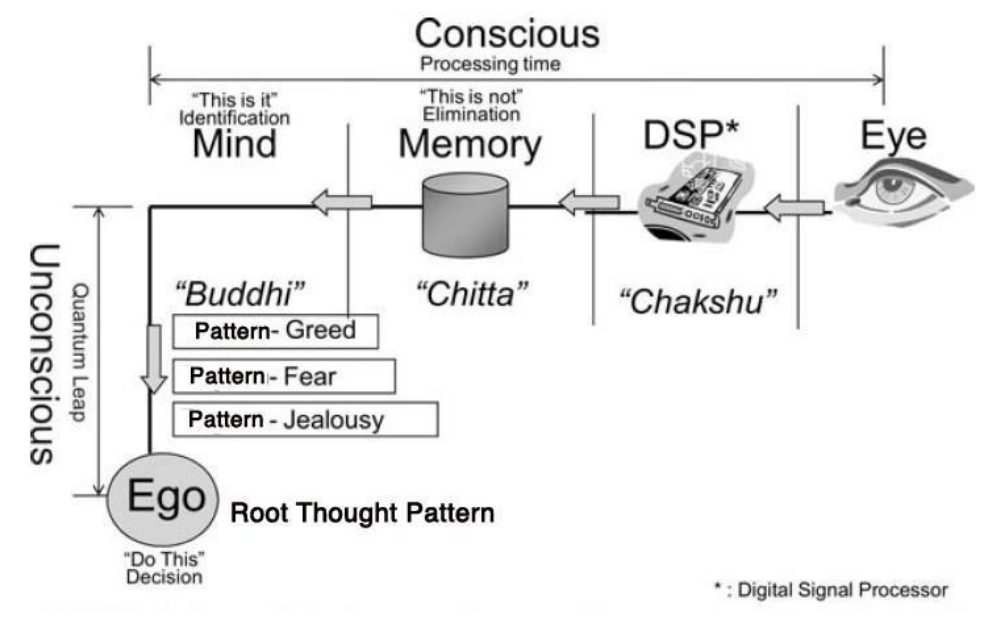
Kṛṣṇa explains how root thought patterns disturb our inner space and through this understanding, we can transform our being.
Cognition is the process of receiving information through our five senses, processing that information internally, relating with it based on our root patterns, and responding to life based on our patterns. This is known as cognition.
First, we see something through the eyes. I have taken the example of sight but we can replace it with any other sense: like hearing, smelling, tasting or touching.
There are five jñānendriya and five karmendriya (senses of action) that are the means of communication between the external world and us. Jñānendriya are the senses of perception, the five senses of smell, taste, sight, touch and hearing. The karmendriya are five actions of elimination, procreation, locomotion, grasping and speaking. Each sense is related to one of the energy centers (cakras) in our body-mind system.
First your eye captures this whole scene like a picture and this picture goes to the cakṣu (the energy behind the eyes). Understand, we don’t see with the eye, we see through the eye. There is an energy that is inside or behind the eye that actually sees.
The whole scene is converted into a file like in a digital signal processor in a computer so that our mind can process the data.
The cakṣu is almost like the digital signal processor or DSP in electronics. In a computer, whether it is an audio or visual file, it must be converted into a digital file. In the same way in our inner space whatever we see or hear is converted into a bio-signal file like a digital file.
The file goes to citta, the place where past bio-memories are collected. Citta means mind, inner space. This area is where the work of excluding happens as—‘Na iti, Na iti’—this is not, this is not. The process of neti neti (this is not, this is not) takes place in this area. Upon seeing this file, our citta starts eliminating whatever the object is not.
Take the example of this scene: First you see me, the whole scene is photographed. It goes to cakṣu and becomes a bio-signal file. The file is then taken to citta, bio-memory. Citta says, ‘This is not a tree. This is not an animal. This is not a plant. This is not this. This is not that.’ The excluding process happens in citta.
Next, the file goes to manas, another part of the mind. The manas tries to positively identify, ‘This is a human being. He is wearing a saffron robe. He is standing on a stage.’ The identification process, ‘iti, iti’ (this is it, this is it) identification process happens in manas. In citta, ‘neti, neti’ or the ‘not this, not this’ elimination happens.
Once this positive identification happens, the file goes to a third part of the mind called buddhi or intelligence. Buddhi is where the trouble starts. Here the analysis starts, ‘How am I related to this file? How am I connected to this scene? How is it relevant to me? How should I respond to this scene?’ If past bio-memories about me have been good or pleasant according to your intelligence, you cognize and respond in a positive way. You immediately refer to those past memories and review, ‘It was so good at yesterday’s discourse.’
Your intelligence refers to the past bio-memory and muscle-memory and makes a decision based upon your cognition of these experiences. If your cognition about the past experiences with me has been positive, your intelligence tells you to stay and listen. If your cognition of the past experiences has been inadequate, unpleasant and you felt bored, your intelligence tells you that this is not the place for you and that you should leave. These are logical decisions based on conscious memories retained by your mind.
Up to this point, your cognition, the transmission of what is perceived by the senses and what is the response based on that pattern is relatively straightforward. It is a conscious process.
From the conscious mind, the information is passed to the unconscious space of the mind, the ego. I call this unconscious space of the mind as the ego, not because it is arrogant, but because it provides you the identity of who you are.
All the major decisions that shape your life are consigned to this unconscious space. This is the repository of all those emotionally-filled memories, the root thought patterns and beliefs about yourself; which constitute what you believe as you, what you project as you, what others expect you to be, and what you expect others or life to be for you and therefore, create your identity. This is what I call the ego.
Root pattern means the first time in your life when your cognitions were imbalanced, disturbed by some external force; and your terrorized being started defining yourself with a disempowering word and started defining the world in that disempowering powerless state; and to compensate from this death, the disempowering inner identity—the inner image, you create a pseudo alternative compensating cognition—the outer image. This is what I call root pattern.
When your root pattern starts, that is moment you feel yourself as an individual identity. If it starts in an accidental moment, your life will be an accident forever. It is an eternal accident. Till you complete with that
root pattern, you will continue to have accidents in your life.
Completion takes away the agitated confusion and the alternative compensating image we create in our life. Because we have a very disempowering cognition about ourselves, we go on creating an alternative compensating cognition to compensate with our inadequate cognition. It is like you first declare you are a beggar, forgetting the billions of dollars you have in your bank balance, and then you yourself try to project the rich image to cover your belief that you are a beggar.
To compensate the inadequate cognition which got created unconsciously inside you, which is your inner image, mamakāra, you create an alternative compensating cognition which is your outer image, ahaṁkāra.
Till the end you never feel satisfied, because you feel the guilt you showed, which is not true, without realizing your true identity is much more than what you can imagine and show. So, your whole life ends in deep incompletion and the trial and error methods you do with these incompletions.
If you complete now, the first thing you will realize is that the alternative compensating cognition is a lie and it will melt down. Second thing, your disempowering cognition about yourself will melt down. Third, you will realize that your original self is much more than what you projected as your outer image, the alternative compensating cognition. And you will have complete easeness between what you feel as you, what you show as you, and what you are as you.
The conscious mind does not make important decisions. It makes a few decisions that can be reached by its limited intellect. Anything important moves to the unconscious ego or root patterns. Our unconscious handles all life-threatening situations with the disempowering cognitions, the so-called fight-or-flight decisions. Our conscious mind is too slow to handle them.
The effects of your root pattern are your conflicting patterns. Conflicting patterns are the branches which sprout from the root pattern.
When the file reaches the ego, the ego comes to a conclusion based on all the 'yes' responses and all the 'no' responses based out of your conflicting patterns. Yes or no is not a problem; however, we have wasted so much time and energy on this small decision. Not only that, any decision you take out of powerlessness, restlessness, will lead you to more and more powerless space.
Kṛṣṇa speaks of satva guṇa saṁskāras that lead us to bliss and peace, rājasic guṇa that lead to restlessness and violence, and tamasic saṁskāras that lead to depression. He further explains how these saṁskāras influence our decision-making process.
When we try to work with different types of conflicting patterns, satva, rajas and tamas and all three cross each other, they create hell in our lives. We need intelligence to even look into our lives to find our root pattern, and see how many times we have carried the same pattern. We usually react out of arrogance or guilt. We say, 'So what if I made a mistake?' We brush it under the carpet leaving it incomplete. This is one kind of attitude, the attitude of might is right. The other attitude is that of suffering from guilt.
Understand, the first lesson you need to learn is the ability to trust the power of integrity.
If you say, 'I am free,' then, you are free! If you say, 'I am a liar,' then, you are a liar! If you say, 'I am powerful,' then, you are powerful! It is just you! The words you utter to yourself and others is life. What a big relief! It can be great news for you if you start living it. It can be good news for you if you start believing it. It can be bad news for you, if you start worrying about it. But the words you utter towards yourself and to others is you, you, you!
One word can make us do whatever we want. Words that appear in our inner space are mantra (sacred sounds). When put together, all the words that appear in our inner space form our life, especially the words that we repeat unconsciously.
Thoughts that we repeat unconsciously are more powerful than words we use consciously. Your inner space is nothing but the words you repeat, again and again within you. So, now decide consciously that you will repeat the right words within you. Whatever mantra or word we use in our inner space, that dhyāna or meditation automatically happens in our unconscious. If we use the word 'headache' again and again, we will be meditating on the headache. If we use the word 'health', again and again, we will be meditating on health.
Completion with Rajas pattern
Next, let us see how two desires conflict one another. We want to lead a peaceful life and we want wealth. With wealth comes responsibility as well. If you actually analyze your attitude towards wealth with integrity,
you will understand that you are actually afraid of wealth. You hate wealth!
The fear of responsibility and the greed for wealth always go hand in hand. If you look in, you have greed for wealth, but you are not ready to take responsibility that comes with wealth. This is the self-conflicting desire. Either decide to take responsibility or decide to relax from that desire and restore your integrity by completing with it and accept whatever happens.
Only one thought should be strengthened when two desires conflict. When we have both, we have a self-conflicting mental setup. In the satva space, when we create self-conflicting patterns, we are automatically thrown into rajas.
Let me describe what Kṛṣṇa says about rajas. The mode of passion is born of unlimited desires and longings. This is a beautiful verse.
Kṛṣṇa says, because of this rajas, mode of passion, born of unlimited desires and longings, the embodied living entity is bound to doing result-oriented actions.
rajo rāgātmakaṁ viddhi tṛṣṇā saṅga samudhavam ।
tan nibadhnāti kaunteya karma saṅgena dehinam ॥ 14.7
He talks about desires and longings. What is the difference? Desires and longings—rāga means desire; tṛṣṇā means craving, longing. Some memories have our emotional support whereas some memories have been inserted into our being by advertisements.
How to complete with the rajas patterns? The first truth you need to know about completion—do completion just to be in the space of completion. All other reasons lead to more and more incompletions. Completion done in the space of completion transforms your personality, transforms your being; the intense, constant agitated violence you carry towards you and others due to rajas patterns.
See, there are only three ways to handle your incompletions.
One, by pushing them under the carpet.
Second, by trying to forget them either by alcohol or by other entertainments.
Third, by completing them and liberating yourself.
I tell you, all vengeance is rooted in incompletion. Complete it. Trust the Cosmos and complete it. Once we do completion with the rajas patterns, we can make one thousand decisions without any stress, violence or suffering. That is why Kṛṣṇa says that when we don't expect the result, when we don't think of karma phala (result of the work done), we can do the work intensely.
Consciousness can never Be Tired
In the next verse Kṛṣṇa talks about tamas.
He addresses Arjuna, 'Oh son of Bhārata, know that the mode of darkness, tamas, is born out of ignorance . It is the delusion of all embodied living entities. The result of this mode is madness, indolence and sleep, which bind the conditioned soul.'
This is a beautiful explanation of tamas.
tamas tv ajñānajaṁ viddhi mohanaṁ sarva dehinām ।
pramādālasya nidrābhis tan nibadhnāti bharāta ॥ 14.8
If there are more vāšanas or patterns, the file does not reach the ego easily or even fully. A powerful pattern may make the decision on the way. Why does this happen? Why do you decide unconsciously and regret later?
This unconscious space is filled with negative bio-memories, and powerlessness, restlessness. All our past bio-memory or root thought patterns are stored in your inner space as files without any logical connection between them.
Sometimes, people start enjoying even the self-sympathy, the victim mood, the depression! Even for that reason they start drinking alcohol! How do you think I liberate so many people from alcohol and smoking just through meditation, through the Inner Awakening program? Because, first I attack that mood pattern. I make sure neither they feel that elated pattern nor they feel that depressed pattern. When you break the pattern, they don't feel inspired to drink. Then addiction disappears.
Listen. When there are no patterns, there will be no need for the file to drop into the unconscious inner space for a decision. It straightaway meets the buddhi and ego after the mind. There are no blocks. The time taken for the unconscious process will be less than the conscious process. We will be intuitive or at the level of God.
The level of an animal is the level of instinct; the level of man is the level of intellect; the level of God is the level of intuition. The level of instinct is the level of tamas; the level of intellect is the level of rajas; the level of intuition is the level of satva.
The mode of goodness, satva conditions one to happiness, passion, rajas conditions him to
fruits of action, and veiling of knowledge , tamas binds one to madness.
Sometimes the mode of passion becomes prominent, defeating the mode of goodness,
O son of Bhārata.
And sometimes the mode of goodness defeats passion, and at other times the mode of
ignorance defeats goodness and passion. In this way there is always competition for
supremacy.
When the light of Self-knowledge illuminates all the senses (or gates) in the body,
Then it should be known that goodness is predominant.
O Bharatarsabha, chief of Bhārata, when there is an increase in the mode of passion, the
symptoms of great attachment, uncontrollable desire, hankering, and intense endeavor
develop.
Desire and Guilt Patterns
Desire and guilt are two forms of the same energy. One is related to the future. The other is related to the past. Desire is related to the future. Guilt is related to the past. ‘I should have done that’ plays a major role in our ‘I should do this.’ ‘I should do this’ is determined by ‘I should have done that.’
Guilt that is created by rules handed down to us by our elders creates hell in our life and leads us to tamas. Kṛṣṇa says we are led to antaḥ (the end). We fall into ignorance or into the end.
Kṛṣṇa says the manifestations of the modes of goodness can be experienced when all the gates of the body are illuminated by knowledge.
Kṛṣṇa gives one technique, one suggestion: Protect the five senses from negative ideas of powerlessness, the incompletions and infuse positive ideas of completion through the five senses. Whatever we feed upon becomes our being and we radiate that energy.
O son of Kuru, when there is an increase in the mode of ignorance, madness, illusion, inertia and
darkness are manifested.
When one dies in the mode of goodness [satva], He goes where the realized
souls are.
When one dies in the mode of passion [rajas], he takes birth among those
engaged in activities. When he dies in the mode of ignorance [tamas], he takes
birth in the space of the ignorant.
By acting in the mode of goodness, one becomes purified.
Work done in the mode of passion result in distress, and actions performed in the mode of
ignorance result in foolishness.
From the mode of goodness, real knowledge develops; from the mode of passion, greed
develops; From the mode of ignorance develops foolishness, madness and illusion.
Here Kṛṣṇa explains how that last thought is not an accident. It is based on one’s guṇa, nature, his patterns. The mental setup, the conditioning, the mūla vāsanā with which we led life and with which we leave our life as well. When we are reborn, our spirit finds another body to occupy.
Kṛṣṇa says that a person living in satva goes to higher spaces, the abodes of the realized sages. He becomes divine, tadottama vidāṁ lokān amalān pratipadyate (14.14). When we are steeped in satva, we live in restful awareness, the space of enlightenment. We live in the present moment. We are no longer attached to the results of our action and we are no longer controlled by fear and greed root patterns. We stop thinking about ourselves and we start living for others.
When one is in tamas, in deep ignorance and darkness, one sinks lower in rebirth. Kṛṣṇa says such a person is reborn as an animal. The lowest energy center of a human being is the mūlādhāra cakra, the root center.
We are not human beings striving for a spiritual experience. We are spiritual beings enjoying a human experience. That is the truth. We can be in this state only when we are in satva. When we are in tamas, we forget our spiritual nature. When we are in rajas, we have a vague idea; however, even that spiritual experience becomes an attachment, another pattern, goal and desire. We become attached to something that is beyond attachment. Kṛṣṇa says that we are reborn into this human form, back into this cycle of life and death, this cycle of saṁsāra, with all its suffering.
It is our choice to be instinctive and unconscious, in deep tamas, like an animal, or to be logical and chasing objects out of rajas. The third choice is to be beyond attachments, in a super conscious state of completion, in an intuitive state, in tune with our sublime satva nature. This choice determines our next birth. In fact, it determines whether we will even be born again.
The movement towards our core, our true self, ātma is driven by satva. The movement outwards is driven by rajas. When we are fully settled in the periphery, we are caught in tamas. We are no longer human. When we settle into the center which is the space of completion, we go beyond the three guṇas. We become the triguṇa rahita, the Divine one who is beyond the three attributes, who is pūrṇa—complete.
14.18 Those situated in the mode of goodness, gradually go upward to the higher planes; those in the mode of passion live on the earthly planets; and those in the mode of ignorance go down to the worlds below.
14.19 When you see that there is nothing beyond these modes of nature in all activities and that the Supreme Lord is transcendental to all these modes, then you can know, attain My spiritual nature.
14.20 When the embodied being is able to transcend these three modes, he can become free from birth, death, old age and their distresses and can enjoy nectar even in this life.
Step one is when we realize that each of our thoughts, words, and activities arises from one of the three root patterns, guṇas—satva, rajas and tamas.
Step two is the understanding about which guṇa, root pattern it is and exactly what that guṇa is doing to us; what disempowering cognition that guṇa is building about our inner image (mamakāra), our outer-image (ahaṁkāra), others' image (anyakāra), others' expectation about us, and life's image (svānyakāra).
Step three is to do the completion and the creation process; do completion with that guṇa or root pattern and do creation of the satva guṇa, the right inner space to create the reality that we want. Finally we transcend satva guṇa and enter into nirguṇa or 'no guṇa state'.
Every one of you has a fantasy deep down about you becoming all-powerful, all-knowing, sarvajña, that's all. I tell you, living as per the expectations of you, behaving as you expected about you, is the greatest joy you can experience in life. Completion does that to you! I tell you, nothing else can do that to you.
14.21 Arjuna inquires: O my Lord, by what symptoms is one known who is transcendental to those modes? What is his behavior? And how does he transcend the modes of nature?
14.22 ,23,24,25 Śrī Bhagavān says: He who does not hate illumination, attachment and delusion when they are present, nor longs for them when they disappear; who is seated like one unconcerned, being situated beyond these material reactions of the modes of nature, who remains firm, knowing that the modes alone are active;
He who regards alike pleasure and pain, and looks on a lump of earth, a stone and a piece of
gold with an equal eye; who is wise and holds praise and blame to be the same; who is unchanged in honor and dishonor, who treats friend and foe alike, who has abandoned all result-based undertakings, such a man is said to have transcended the modes of nature.
We create pain and pleasure through association with powerlessness, through conditioning. We create greed and fear through association. Our root patterns, our conditioned muscle-memories and bio-memories, create pain and pleasure.
Light and darkness, good and bad, right and wrong are based on root patterns. Our inadequate cognitions, the civilized education and refinement tells us that a person dressed in a particular manner is acceptable in society and another dressed differently is not.
No scripture ever said that one person is inferior to another. All scriptures affirm that every human being is a spiritual being; all of us carry the seed of Divinity in us.
When you complete with everything, animate or inanimate, you will experience the space of non-duality, Advaita. Relationships are nothing but your own extensions. Relationships are not outside; they are just your own extensions.
One who engages in full devotional service, who does not fall down in any circumstance, at
once transcends the mode of material nature and thus comes to the level of Brahman.
And I am the basis of Brahman, which is the rightful state of ultimate happiness, and which is
immortal, imperishable and eternal.
The faith and the surrender help us transcend the nature of all activities. We surrender the result of our actions to that Master, whomsoever He may be, whomsoever It may be. We do everything meditating on that Master and surrender it all at His feet. That space of completion alone liberates us.
This is what Kṛṣṇa means by devotion, bhakti-yogena sevate (14.26), which is unfailing in all circumstances. Nothing more is needed. Kṛṣṇa is not talking about the flute-playing, yellow-robed Kṛṣṇa. Anyone that we surrender to totally, is Kṛṣṇa and we then fall into Kṛṣṇa consciousness, the Consciousness of Completion.
Let us pray to Parabrahma Kṛṣṇa, the Universal Consciousness, the Ultimate Energy, to give us all this understanding in our life, to make us experience the truth that He teaches and to establish us in Completion, make us radiate Eternal Bliss, Nityānanda.
Thus ends the fourteenth chapter named Guṇatraya Vibhāga Yogaḥ, The Yoga of Division of the three Guṇas,’ of the Bhagavad Gītā Upaniṣad, Brahmavidyā Yogaśāstra, the scripture of yoga dealing with the science of the Absolute in the form of Śrī Kṛṣṇārjuna saṃvād, dialogue between Śrī Kṛṣṇa and Arjuna.