CHAPTER 12: Bhakti Yogaḥ
This text was machine-transcribed from the printed book and may contain errors. Select the words and choose “Report a mistake”.
Arjuna asks, 'Who are considered perfect, those who are always engaged sincerely in Your
worship in form, or those who worship the imperishable, the unmanifest formless You?'
Experience or Expression? Completion or Enriching?
Arjuna asks, 'Is it good to be established in the experience of the Divine consciousness, just to stay in it and enjoy the eternal bliss that flows from that experience? Or is it better to express that love and gratitude created by the conscious experience towards the whole world and every living being? Which is correct? Which one is preferred?'
Kṛṣṇa’s answer is that both paths are the same. The paths are intertwined. The first one leads to the second one and the second one leads back to first one. We have heard the term vicious circle. First one leads to the second and the second one leads back to the first one.
Now, I want to introduce another word, ‘virtuous circle.’ Vicious circle leads to low energy or lower level of consciousness. Virtuous circle leads to high energy, a higher level of consciousness! Bliss leading to devotion and gratitude, devotion and gratitude leading to bliss: these two form the virtuous circle that lead us to higher consciousness.
Bliss means the experience of completion that leads us to the expression of gratitude and enriching. Again, the expression, the gratitude of enriching, leads us to bliss, and bliss leads us to deeper completion. One leads to the other and therefore it is a virtuous circle.
Bhagavān Kṛṣṇa says,
Those who fix their mind on Me eternally and those who are steadfast in worshipping Me
with supreme faith, I consider them to be perfect in yoga, ready to be united with Me.
Real Completion Expresses as Enriching with Love
You need to know that relationships are not something external. It is an expression of yourself, how you feel about you. The relationship you carry with you is projected as the relationship with the world! I tell you, when you bring integrity in your relationship with others, honoring the words you gave or completing the words you gave, the way others look at you will be transformed immediately. Being established in that consciousness of completion or expressing it towards enriching the Universe is the same. When a person is merged, when a person is established, he automatically radiates. If the love is not happening, if the expression is not happening, the person has not experienced. When the real experience of completion happens, it automatically expresses as enriching. Kṛṣṇa says that a person established in the consciousness of completion is great; however, the person who expresses, who shares, who automatically radiates the power of living by enriching is as great as the one who is established. The truth is that if a man is established in consciousness, he will radiate, he will enrich, and he will sing.
– 12.4 But those who worship the imperishable, the unmanifest, that which lies beyond the perception
of senses, the all pervading, inconceivable, unchanging, the non-moving and permanent; those who
worship by restraining their senses, and are working with even mind for the enrichment of mankind,
they too attain Me.
The Divine is imperishable. It is akṣaram. Everything else in this material Universe may come and go, appear and disappear, while the Divine remains forever. It is unique and incomparable and cannot be benchmarked against anything, as it is supreme. It is avyaktam, unmanifest and acintyam, inconceivable, and therefore cannot be comprehended by the senses. It cannot be grasped by thoughts and mind, which is why one’s mind-body needs to be transcended to glimpse the Divine. The Divine resides everywhere and is omnipresent.
For those whose minds are set on the unmanifest, the formless, it is more difficult to advance;
attaining the formless unmanifest is difficult for the embodied.
In one’s search for the truth, the Divine, the unmanifest, avyakta, which is what the intellectual seeker is focusing on, the intellect, the mind or ego will be the block that makes the path difficult to traverse. The individual carries not only the body but the mind as well. And with the mind, it carries the ego. As Kṛṣṇa points out—avyaktā hi gatir duḥkham (12.5). Unless the mind-body is transcended by the process of completion and surrender, spiritual advancement is difficult.
12.6 – 12.7 But those who worship me with single-minded devotion, renouncing all activities unto Me, regarding Me as their Supreme goal, whose minds are set in Me, O Pārtha, I shall deliver them soon from the ocean of the birth and death cycle.
Kṛṣṇa says, ‘If you surrender to Me, surrender all your actions and the fruits of those actions to Me, do my service, meditate upon Me, remain single-minded upon My consciousness, I shall then liberate you. I shall make sure you never need to be born again.’ It is the roar of a lion. It is the roar of the King of this Universe. ‘Surrender to Me and I shall liberate you. Serve Me and I shall liberate you.’
Surrendering to the Divine is not conditional. It must be total. There can be no ‘ifs’, ‘ands’, or ‘buts’. It cannot be, ‘If you grant my prayers, I shall be devoted to you.’ That is business. Most of our relationship with God is business.
There are three kinds of surrender. First, there is surrender of one’s intellect. For many, this is possible. Once we understand that there is a Universal energy far greater than us, most of us can accept and surrender intellectually to that supreme power. At least we can say, ‘I surrender.’ That’s how many of us prostrate in a temple or before a master. The entire body touches the ground signifying our surrender. For that moment, our ego takes a vacation.
Surrender at the next level is emotional. One can melt at the thought of God or master. There is love, there is gratitude pouring out of our hearts and we feel tears streaming down. We become bhaktas, devotees. Rāmakṛṣṇa said, ‘If you have tears in your eyes when you think of God or your Master, be very clear, this is your last birth! You are ready for liberation.’ We are ready but not liberated until we reach the last and third step. This step of surrender is the surrender of one’s senses. Our surrender is total at this stage: complete, spontaneous, instant and natural.
Kṛṣṇa says, ‘When you surrender to Me, I shall liberate you.’ To reach Him, we must surrender totally without deviation. Our senses must be surrendered to Him. Our entire consciousness, our complete awareness must only be of Him and nothing else. Nothing else needs to be done. The technique is so simple. ‘Surrender and I shall save you,’ says the Master. ‘I shall save you without delay, immediately—bhavāmi na cirāt pārtha mayy āveśita cetasām (12.7).’ The Lord has made it so simple. Yet, we find it so difficult to believe Him.
12.8 You fix your mind on Me alone, establish your mind in Me. You will live in Me always. There is no doubt in it.
There are two kinds of love, horizontal love and vertical love. Let me explain. Horizontal love is like a horizontal line, flat. It is related to time: it starts and ends. Anything that starts must end. If it takes more time to end, don’t think it is permanent. Anything that starts must end. It may take a few years or a few months, but it ends. It is impermanent and time bound. This is horizontal love. Horizontal love is related to time.
Vertical love is related to consciousness. Vertical love neither starts nor ends. It does not discriminate. It is our very quality. It flows. If we discriminate and love, it cannot be love. It is an infatuation. As long as the other person fits into our frame, our love grows. The moment the other person doesn’t fit into our frame, our love disappears.
Real Renunciation Is Completion With the Whole
When we experience ecstasy and bliss within, we don’t feel we are missing anything from the outside world. Real renunciation is not about our renouncing the world. It is about the world renouncing us. When we have that completion, joy, ecstasy and bliss, we automatically radiate that bliss. We never feel that we miss anything or that we have lost something.
I tell people not to renounce the world unless they feel completion and ecstasy inside. Never renounce. Work towards completion and ecstasy. When that happens, renunciation automatically happens. If you renounce the outer world without having established the inner world with completion, you will fall into depression.
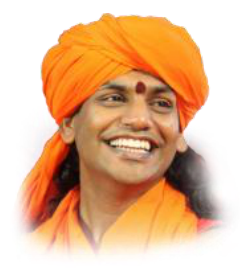
[Figure: Portrait of Paramahamsa Nithyananda]
When you are complete with you, the world will be complete with you. When you are incomplete with you, the world will be incomplete with you! Completion with you is Inner Awakening. Completion with the whole Universe is Sannyāsa. Sannyāsa means completion with the Whole. You are clear with your accounts and there is no incompletion!
I tell you: dharmo rakśati rakśitāḥ
When you protect dharma, it protects you. When you excite dharma, it excites you. When you enrich dharma, it enriches you. When you are integrated to it, it is integrated into you. When you are authentic with it, it is authentic with you. When you take responsibility for it, it takes responsibility for you. Only when you enrich it, will it enrich you. Dharma means the natural law of the Cosmos. It is an independent intelligence.
. I tell you, in every situation take the responsibility. You will have leadership consciousness happening in you, īśvaratva. Our brains are hardwired to experience higher possibilities and higher consciousness. It is this part that I call as non-mechanical parts of your brain.
Just take in this one truth that Kṛṣṇa speaks of, ‘Establishing your intelligence in Me.’ Please understand that whatever you take in as your inputs, you establish your mind only on that. So let your inputs be purified. Let purification of your sensory inputs, happen to you. Your consciousness will automatically be established in the Divine.
12.9 – 12.10 If you are not able to fix your mind upon Me, then O Dhanañjaya (Arjuna), with the constant practice of yoga you try to attain Me. If you are not able to practice even this yoga, then performing your duties and surrendering all your actions to Me, you will attain perfection.
Here Kṛṣṇa talks about Abhyāsa Yoga. What is Abhyāsa Yoga? Abhyāsa Yoga is the practice or method of yoga of holding the mind constantly in a state of union with Divinity. It is the state of complete immersion in the consciousness of Kṛṣṇa.
Why does Kṛṣṇa speak about Abhyāsa Yoga? In the last chapter, Kṛṣṇa gives Arjuna a glimpse of the universal consciousness, Viśvarūpa darśan. However, Arjuna is unable to stay in that state permanently. Arjuna comes out of the experience because of fear or old saṁskāras, root thought patterns of past desires. He slips from that state of consciousness. Therefore, Kṛṣṇa speaks about Abhyāsa Yoga, how to establish oneself in that consciousness. That’s why He speaks about abhyāsa, which means practice.
Since He knows that we may not be able to lose ourselves in devotion to Him, He offers this as an alternative. ‘If the mind cannot be focused on Me,’ says the Lord, ‘try this. Practice again and again uniting with Me through meditation.’ When neither seems possible, Kṛṣṇa offers one more way. ‘Do whatever you must. Do your duty as you need to and are able to. But then, surrender what you do to Me. Do what you do for My sake, mat-karma-paramo bhava.’ By performing whatever we do with total faith in Him, and with a deep feeling of surrender to Him, we reach Him.
12.11 If you are not able to work even this way, surrendering unto Me, give up all the results of your actions to Me without ego.
Kṛṣṇa brings in the core concept of the Gītā, that of ‘renunciation’. He says, ‘Do what you must do with an attitude of surrender to Me and sacrifice the results of your actions to Me, with complete control over yourself, your ego.’
We feel responsible for the results of our actions. Whether we succeed or fail in what we do, either proud and happy, or guilty and sad, our ego makes us feel responsible. We identify ourselves with what we do and the results of what we do.
Kṛṣṇa says, ‘If you cannot do whatever else I have told you to do, do this. Drop your ego. Drop the fruits of your actions and renounce them to Me.’
The freedom that results from what Kṛṣṇa advises is true liberation. Once we realize that we no longer are the masters of our destiny, decision makers of the results of our actions, we feel a weight lifting off our shoulders. It is He who is now responsible for the results of our action. We still are the ‘doers’, but no longer the ‘owners.’ We just need to let the Universe, Kṛṣṇa, the Divine, decide what is best for the rest of humanity and us.
Knowledge is better than mere practice. Meditation is superior to knowledge. Renouncing the
fruit of actions is better than meditation. After renunciation of fruits of actions, one immediately
attains peace.
Here Kṛṣṇa gives four different instructions. Either you can establish yourself in Bhakti Yoga – Path of Devotion, or live a regular life of spiritual routine, or sacrifice all the fruits of action to God, or live in consciousness and act. You can do whatever you want.
Here, with these four options, Kṛṣṇa is expressing spiritual freedom for us. He says that there are so many paths, and tells us to choose whichever one suits our mentality, and to practice at least one option. It is not so important which option that we choose. It is essential only that we choose something!
Eastern traditions offer many choices. If you are an intellectual person, then Śiva could be your choice and you can continuously sit and meditate. If you are inclined towards devotion, then Viṣṇu could be your choice. The path includes singing and dancing like the great masters Caitanya. Just sing the glory of the Lord like the Alwars, devotional saints of Tamil Nadu, related with Viṣṇu. If you are inclined towards yoga, if you are a yogi, then Devi is the one for you. Meditate on Her, offer worship and tantric practices.
There are many different kinds of techniques, and the options are many. You have customized ways, customized paths for your personal growth. Thus, naturally wherever one is, one can grow and reach the level one is supposed to reach. You are continuously given choices, given options. Naturally, one tends to take up something or the other.
Surrender is liberation. Surrender is the expression of choicelessness, of leaving the decision to the Divine after doing what one can do. Unless we let go of our expectations and our attachment to the results of our actions, we will continue to build unproductive stress and incompletions within us that will not raise us to our peak possibility.
When we learn to focus totally on what we need to do and work on the process, without worrying about the destination, whatever we do is done better, faster and more effectively. Kṛṣṇa’s teaching is not merely spiritual. It is highly practical. It is not only after-life enhancing, but it is present-life enabling.
One who has no dislike or envy for any being, who is friendly and compassionate to
everyone, free from the sense of I and mine, the ego, maintains equanimity of mind both
in joy and sorrow, forgiving, ever satisfied, united with Yoga, has a strong commitment to Me
and has fixed his mind and intellect upon Me, such a devotee of Mine is very dear to Me.
Important Qualities of Enriching
Understand here, He says, ‘Who is not envious and a kind friend to every living entity.’ These are important qualities. Let us analyze our minds. When we honestly analyze our mind, we realize that if somebody came to you and told you he loved you, you wouldn’t believe it. The first thing you would do is figure out what he wants from you. You don’t believe you are worthy of being loved. Next, you don’t believe that somebody can honestly love you, because you don’t love anybody honestly. Because you are calculative, you expect the other person also to be calculating. All our love is skin deep and you know how deep skin is!
Meditation for Devotion
I give people a simple meditation technique to experience Bhakti Yoga–the Path of Devotion. Just practice the technique of radiating pleasantness and friendliness. How does one do it? From morning till night whenever you remember, inhale, inhale, and inhale only the pleasant qualities of bliss. Visualize you are inhaling bliss and exhaling bliss. Your whole being will be filled with joy. In the beginning you will be visualizing, imagining. But in a few days you will realize it is your quality.
One more thing you should know is that imagination and visualization are two different things. Imagination translates into kalpanā in Saṃskṛit, while visualization translates into bhāvanā. Bhāvanā is different from kalpanā. Kalpanā means imagining things that are not there. For example, if you think of an elephant with ten trunks, that is imagination, kalpanā, that which is not there. But bhāvanā means visualizing that which is present but maybe eluding you.
If you sit during the day and visualize stars in the sky, that is not imagination. It is visualization. Because stars are in the sky even though you are unable to see them. So visualizing stars is not imagination. Perceiving what is there but what you are unable to see at this moment is visualization. Trying to perceive what can never exist is imagination.
So understand that meditating on gods and goddesses is not imagination. It is visualization. They are there. You cannot see them; that is all. You are supposed to fall in tune with them, like tuning your television. Similarly, visualization is tuning yourself. Just continuously visualize inhaling and exhaling bliss. Visualise prāṇa – the life giving energy—going inside and coming out. Prāṇa is energy and bliss. Prāṇa is not merely air. Prāṇa is the energy that goes through air. For example, a truck comes up to your house and unloads luggage and leaves. The truck is air and the luggage is prāṇa. Using air as a medium, prāṇa enters. Prāṇa- śakti is the subtle part of air. Prāṇa-śakti is bliss energy, ānanda-śakti.
So whenever you inhale, visualize yourself inhaling bliss. When you exhale, visualize yourself exhaling bliss. Inhale light and exhale light. Think that your whole body is a beanbag filled with light. Imagine your body is a beanbag filled with bliss and light. You will automatically start radiating bliss instead of irritation. Instead of vomiting the poison of anger and jealousy on others, you will radiate love and bliss.
‘Such a devotee of mine is very dear to Me, yo mad-bhaktaḥ sa me priyaḥ.’ Kṛṣṇa says that if somebody lives in this manner, that devotee is close to Him.
12.15 He, by whom the world is not affected adversely, and who in turn does not affect the world adversely, and he, who is free from joy, anger and anxiety, he is dear to Me.
froM IncoMpLetIons to Core of CoMpLetIon
Here Kṛṣṇa is saying that the persons who are expressing from their core, unaffected by the happenings around them, are dear to Him because they are centered on Him—mukto yaḥ sa ca me priyaḥ.
Anxiety lives and breeds in thoughts about the future. Its source is our ego. Ego creates expectations. Expectations related to ‘I’ and ‘mine’, ‘identity’ and ‘possession’ create the fear that what is expected may not happen. To move out of anxiety, we must move into the present moment of completion. That is the only point at which our inner chatter stops and anxiety disappears.
When Kṛṣṇa says, ‘He who is without anxiety will reach Me,’ He says that he who is in the present moment will reach Me. In the present moment our thoughts cease and we are in the space of completion, and we can see with clarity the truth of our Existence, Kṛṣṇa consciousness, and then we are one with Him.
Anger is often the product of guilt. We move into a defensive position. We feel guilty when we realize we did wrong. But instead of completing with that action, we become angry. In a sense, this anger is also directed at ourselves. The guilt we feel is the result of the internal rage against our own weakness. Guilt is the biggest sin we commit. Whatever we do at a point in time, we do with the knowledge and awareness we possess at that time. Once we have done what we have done, there is nothing within our power to change it.
Anger breeds anger. It is a vicious cycle. If however, we express anger and express it fully against the incident, event, or issue, without personalizing it, we can let go of that anger without harm to others and us. It is possible. You need to practice, that’s all.
12.15 He, by whom the world is not affected adversely, and who in turn does not affect the world adversely, and he, who is free from joy, anger and anxiety, he is dear to Me.
12.16 He who is free from wants, who is pure and skilled, unconcerned, untroubled, who is selfless in whatever he does, he who is devoted to Me, he is dear to Me.
Once you let go of joy, anxiety and anger, once you transcend these emotions, you reach a state of calmness that takes you close to Him. Now, He moves from ‘nissaṅgatvaṁ’ to ‘nirmohatvaṁ,’ from emotional non-attachment to non-attachment to desires.
We need to understand the difference between ‘wants’ and ‘needs’. Needs are necessary for us to survive on planet Earth, like the basic needs of food, shelter, etc. The great Jain master Māhāvīra says, ‘The moment you are born on this planet, the Universe sends everything with you that you need.’ We just need to trust the Universe and we shall get what we need to live. We shall not want anything else.
However, we end up seeking more. Basic needs are no longer enough. Everything we have is a match for what others have. It is a constant cycle of ‘What next? What next?’ Even before we start enjoying what we have got, we make a plan to get more. There is no joy in having, the joy is in chasing. There is no end point to this chase.
He who does not rejoice or hate or who does not grieve or desire, and who renounces both good
and evil and who is full of devotion, he is dear to Me.
To transcend love and hatred which are two different expressions of the same perceived reality, we need to drop expectations. We need to develop a sense of non-attachment. We need to be complete in our love.
We all go through several stages of relationships in our lifetime. As children, we are totally dependent upon parents. Our parents influence us and our love for our parents is conditional. We love them only because there is no option. To survive, a child must depend upon its parents. As we grow into adolescence, we question many things we took for granted as an infant or a child; therefore, teenagers rebel. They wish to be independent. They break rules.
In adulthood, we learn that to survive and coexist, we need to follow societal rules and regulations. The single most important lesson that people learn in adulthood is that it is important to relate with people meaningfully.
As we grow and mature, and the spirit and its development become important, we seek guidance. We look for a Master. With the Master, the relationship that we need with the Master is one of absolute dependence once again, but with a difference.
The only relationship that will work with the Master is total and unconditional love out of completion. It is absolute surrender. Surrender transcends love and hate. When one is in a mood of total surrender to the Master or the Divine, both being one and the same, the concept of good and evil, sin and merit disappear.
-12.19 One who treats friends and enemies the same, who faces in the same manner honor
and dishonor, heat and cold, happiness and sorrow, fame and infamy;
One who is always free from attachment, always silent and satisfied with anything,
without a fixed home, who is fixed in mind and who is devoted to Me,
such a person is very dear to Me.
Those who truly follow this imperishable path of righteousness with great faith, making Me the
supreme goal, are very dear to Me.
Let us pray to the ultimate energy, Parabrahma Kṛṣṇa, to make us all experience the truths of Bhakti Yoga, that love is our very life. Let us pray to Him to give us the conscious experience of bhakti, devotional love, and make us experience and radiate eternal bliss, Nityānanda.
Thus ends the twelfth chapter named Bhakti Yogaḥ, ‘Union through Devotional Love,’ of the Bhagavad Gītā Upaniṣad, Brahmavidyā Yogaśāstra, the scripture of yoga dealing with the science of the Absolute in the form of Śrī Kṛṣṇārjuna saṃvād, dialogue between Śrī Kṛṣṇa and Arjuna.