CHAPTER 4: Relation of Rituals with Karma – An Astounding Revelation
This text was machine-transcribed from the printed book and may contain errors. Select the words and choose “Report a mistake”.
(Based on talks given by Paramahamsa Nithyananda in Himalayas 2007 Spiritual Tour)
INTRODUCTION
Most of us would have heard about the word 'karma'. Each of us has some understanding of what karma is, based on what we have read from books or heard from others. The principle of karma needs to be understood by every individual because it is the basis of the cycle of our birth and death. We have to realize the understandings about life are very important; they are the bedrock upon which our ideals, principles and hence, actions are based.
For example, suppose you went for an adventure trip to a jungle with a group of friends. Let’s say the group gets lost and you are all trying to find a way out. It is getting dark, everybody is scared and you need to find your way back before nightfall. In this situation of panic, suppose one person takes responsibility and says that he will lead everyone out. Now, this person does not have the required knowledge about the jungle but he is a little more courageous than the rest of the people. What are the chances that you will get out of the jungle?
Only a person who has seen the goal and knows the way can clearly and safely guide the group. A person in the group who climbs a tall tree, studies the landscape and then maps the way out is the true leader.
In the same way, the great Truths about life should only be learnt from reliable sources! An enlightened master is one who has experienced and is living the Truth. He can simply transmit the experience to you if you are sincerely seeking and open to receiving it.
What follows is the unveiling of the deep mysteries about life and a logical understanding of the secrets about the inner workings of the cosmos, straight from an enlightened master - a rare happening on planet earth.
SEEING THE DIVINE IN THE DEITIES
An important difference you should understand between normal human beings and enlightened masters. A normal person doesn't have the ability to make his body alive out of his will. Either a normal person's body is alive or it is dead, that's all. It is not under his control. But for an enlightened person, it is under his control. He can either make his body alive, or relax. Because of this ability, he can make another body also alive! When he chooses to make a stone or metal alive, it becomes a representation of his very self.
All the deities in our major traditional temples are those energized by enlightened masters. Masters like Arunagiri Yogeeshwar from Tiruvannamalai, Patanjali from Chidambaram, Karurar from Thanjavur, Konganavar from Tirupati and Meenakshi from Madurai have energized the deities in these temples. So deities are considered to be the very bodies of the enlightened masters, and disciples start serving the deities even after the master leaves his physical body. The body of the deity is considered to be the body of the master himself. That is the reason why the deities receive the same respect offered to an enlightened master.
For example, all the disciples initiated by Arunagiri Yogeeshwar will worship the Arunachala temple for generations together. You will see that whatever is done to the master, the same thing will be done to the deity also.
The deities possess independent intelligence. Energizing the deities is a big process. It is like giving birth. So understand, these energised deities directly will respond to your prayers. They will directly relate with you if you are open in relating to them.
If you see our puja (offering), and our ashram routine, you will see that in the morning they will play the appropriate song to wake the Lord up. Then they will give oil and tooth powder: a small cup of oil for His hair and a small cup of tooth powder for Him to brush His teeth! Then they will give Him a bath and offer fresh, ironed clothes, just like how they offer to the master. Whether it is in Bidadi or Ohio or LA or Hyderabad, in all our temples, you will see the same routine. Then they also offer food and perform the evening arati (ceremoniously waving lit lamps and other items in front of the deities). Five times a day, they will offer puja. In the night, they will put the Lord to bed in a ceremonious way again. Understand: all this does not add anything to the deity or to the master; it adds to us! This is what is living with God! This is what is practicing the presence of God. Practicing the presence of the master is puja. Puja is done everyday because it is a technique to remember everyday the presence of God.
If you decide to remind yourself of all the clicks that happened in you, all the Truths and ideas that you could feel connected to when they were uttered, that is what becomes your ritual then. It is a ritual because when you are dabbling in it, you raise yourself to the higher consciousness.
Whenever you are in a low mood or depression happens in you, if you remind yourself with the right click, you are doing a great service to yourself. The moment you remember the click, what will happen? You will come out of the low mood. You will simply come out of it.
SIGNIFICANCE OF RITUALS
I will now explain about how karma and rituals are directly connected, how our prarabdha, agamya and sanchita karmas and rituals are connected. I will tell you about these three karmas, and how performing rituals can directly eliminate the negative influence of these karmas, these samskaras or engraved memories. You can come out of them with this understanding.
Rituals are very powerful tools, powerful techniques. Many people ask me, ‘You are enlightened; why you should perform rituals?’ I tell them, ‘Because I am enlightened, I am teaching people exactly how and why to perform rituals!’ No ritual is needed for enlightened beings.
Let me tell you a small story:
One man went to a hotel and started eating idlis (Indian dish made of rice flour).
He ate eight idlis, and after the ninth idli his hunger settled.
The waiter came and gave the bill for nine idlis.
This man said, ‘What is this? I will pay only for one idli - the ninth idli which put my hunger off! The first eight idlis did not do the job; only the ninth one did the job of satisfying my hunger. So, I will pay only for that idli!’
Doesn’t it sound strange? In the same way, people who reject rituals are actually rejecting the first eight idlis. People who think that rituls are a waste and that they will go straightaway to meditation and spiritual experience are doing nothing but rejecting the first eight idlis. Understand that the ninth idli worked because of the first eight idlis. So, your meditation will work because of you having gone through ritual worship sincerely! If you reject all these preliminary things and think that you can directly eat the ninth idli, will it ever happen? Will your hunger ever get satisfied? Whoever thinks that they can directly eat the ninth idli will be just sitting and starving. Not only that, because they did not do things in a proper way, they will not experience what they should experience, and instead they will think, ‘Maybe this is all that the experience is.’ Such people are called Vedantis - the so called meditators. If you see them, there will be no sign of joy on their face. They will perpetually appear depressed and be missing something.
Ramakrishna beautifully says, ‘As long as you think you have a body, you will be able to relate to the cosmic energy only through another body.' Only when you lose your body consciousness, you can see the Divine also as formless. Until that happens, you need some form, some reminding rituals, some deities to worship.
You see, in my first three years of the mission, from 2003 to 2006, I never gave any ritual along with meditation. Only in 2006, I added the GuruPuja to the everyday meditation - Nithya Dhyaan.
From 2003 to 2005, only 20% to 30% of the people who were initiated into meditation continued the meditation for at least three months. After three months, that also stopped.
But now, after I added the Guru Puja to Nithya Dhyaan, after it became more or less a ritual, more than 80% who take initiation follow it! I did a statistical study and discovered this. So I think it is good to have a ritual along with meditation, so that the regular habit of doing some sadhana – penance - will get cultivated.
Otherwise you won't do it regularly. The first day, you will think, ‘Today my mother-in-law is here,’ or ‘I have too much work’ and you will skip it. After two days, when your mother-in-law has gone, or the work is done, you will think, ‘Let me enjoy my vacation after saying goodbye to my mother-in-law. I don’t want to do it today.’ Or, if you are happy, you will think, ‘Today I am happy, then why meditate?’ Or if you are depressed, you will think, ‘Oh, today I am depressed. How can I focus on meditation?’ Your mind tries to find some logic to skip it! But if it is made into a ritual, you will not find any logic to skip it. You will simply do it.
Now we will see how we go through the janma marana chakra, (cycle of life and death) and how these initiations and rituals can liberate us from it, how they can take us out of this cycle.
Sanchita, Prarabdha and Agamya Karma
Basically we have three layers of karmas: sanchita, prarabdha and agamya. Sanchita karma is like a bank, a reserve bank. See, this may not be the first time you have taken a body and come to planet earth. You might have taken millions of bodies before! In those millions of bodies, whatever you learnt, whatever you did, all those engrams put together is called sanchita. In Sanskrit, there is one more word samoochita. That's one more Sanskrit word that they use for sanchita. When I say 'bank', it is not a collection or saving; it is a debt! You will have to finish all the credit out!
The next type of karma is prarabdha karma. Prarabdha means - from this sanchita bank of the entire karmas, you take a little karma, create your body out of it, and decide to enjoy all those karmas through that body when you take birth. So prarabdha is just a small bit which you brought to enjoy or exhaust through this body.
The third type of karma is the worst thing. It is the agamya karma - the karma that you start collecting because of fresh thoughts, words and deeds after coming down to planet earth.
Now, anybody who lands on the planet earth has to exhaust his prarabdha karma. For example, let us say, you have 1000 karmas in your sanchita. I am just giving an example. Let us say, when you take up your body, when you assume your body, you take only ten karmas, saying, 'Let me exhaust these ten.' After coming down, you start collecting karmas based on the desires of others
- borrowed desires and actions that you do because of others' influence over you. You end up collecting say 200 karmas. By the time you go back, what will happen? Your bank balance has increased to 1200! You did not exhaust the ten karmas with which you came, but you collected 200 more.
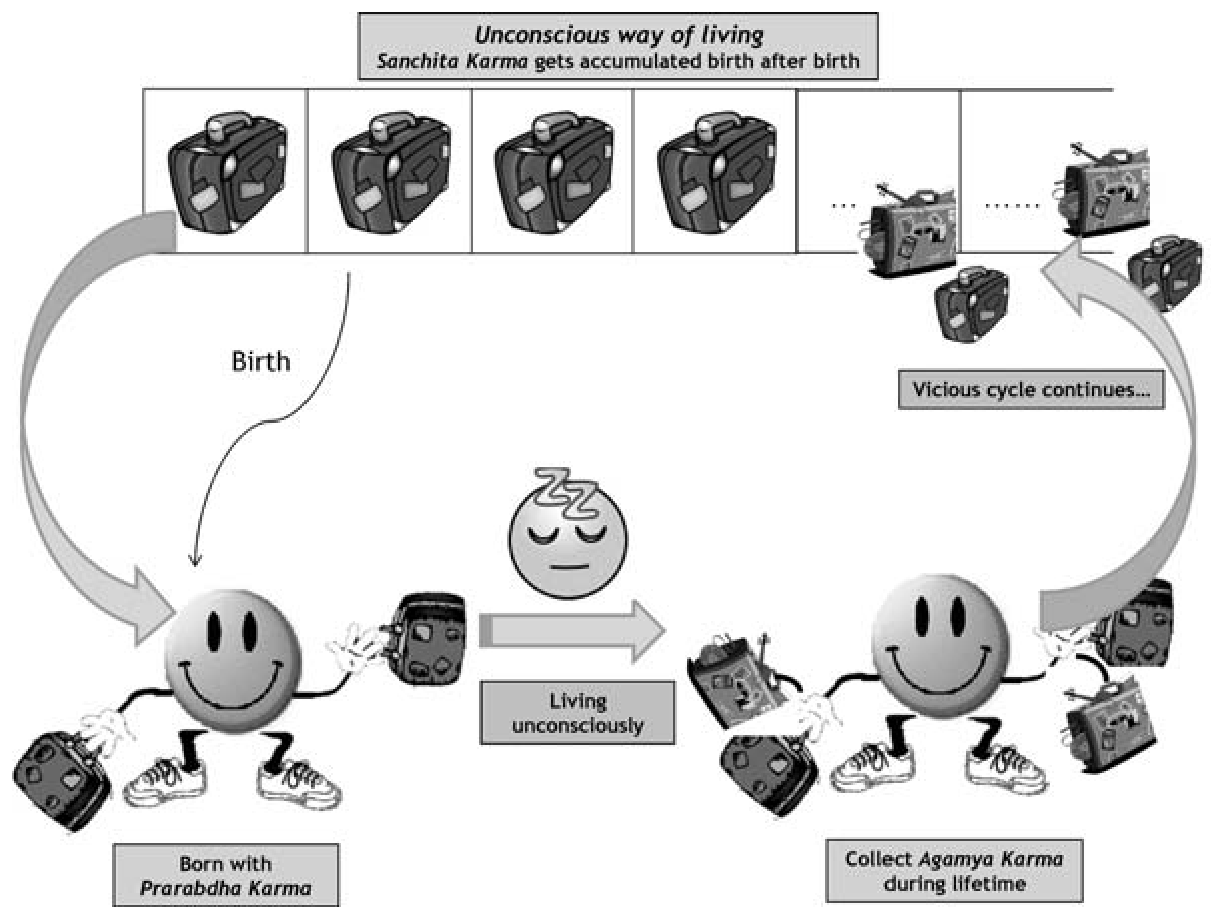
Figure 9: Collecting agamya karma
What will happen the next time you take the body? Your sanchita is now 1200 karmas - 200 karmas more than the last birth. Again you take ten out of it and come down; you collect some more and go back. This becomes a vicious circle. This is what we call janma marana chakra – life and death cycle: continuously taking a body and dying, again and again. Instead, while you are living, if somebody gives you the knowledge that you are not the body, you are not the mind, it is just these karmas that are influencing you, then the influence of these karmas over you will start decreasing and you will start exhausting the ten prarabdha karmas you came down with.
Understand: for example, you brought ten karmas with you when you took this body and came down. Suppose in these ten prarabdha karmas you have three karmas which will put you in depression, which means three samskaras or three engrams whose tendencies will put you into depression. These three depression engrams have got power over you to put you into depression.
If you continue to obey those engrams and fall into depression, these three will not remain just three. They will probably become ten because, out of the depression, you will make decisions and take actions that will increase your karma and trouble. The additional seven karmas are the agamya karmas. Whenever you cooperate with prarabdha, you collect agamya.
On the other hand, whenever these three engrams put you in depression, if you have learnt how to come out of the depression, then these three will start losing their power over you! So, of the ten karmas, three have gone or been exhausted! Whenever you reduce the influence of prarabdha on yourself, the chances of accumulating new karma, that is the agamya karma, will come down. Let us see how.
Whenever the prarabdha loses its influence over you, you stop collecting agamya. So when the influence of these ten engrams over you stops, the agamya collection will also stop.
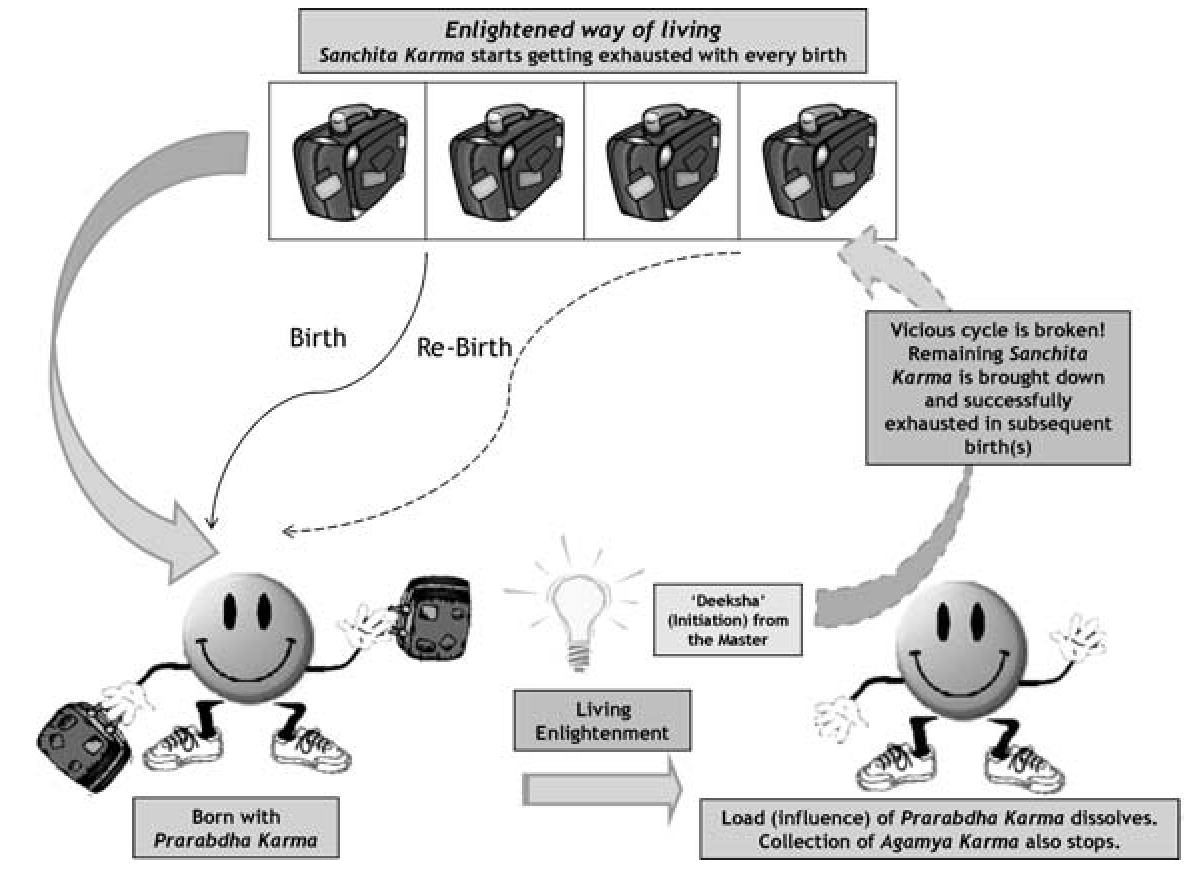
Figure 10: Dissolving prarabdha karma
Bringing yourself back to your inherent state of joy or your pure inner space - the unwavering, undisturbed inner space - not only reduces prarabdha’s influence over you, it also stops the number of engrams getting collected as agamya.
Initiation by the master is the ideas or knowledge given by him, which bring you out of these depressive thoughts, which brings you out of the clutches of your prarabdha. The knowledge which brings you out of the depressive thoughts, the influence of the prarabdha, is what we call the initiation or ‘click’.
Puja is a Reinforcement of Clicks... Burn Your Sanchita With It...
Puja is nothing but remembering, at least once, all the clicks that have happened to you everyday so that the necessary click will automatically come up whenever you have a problem.
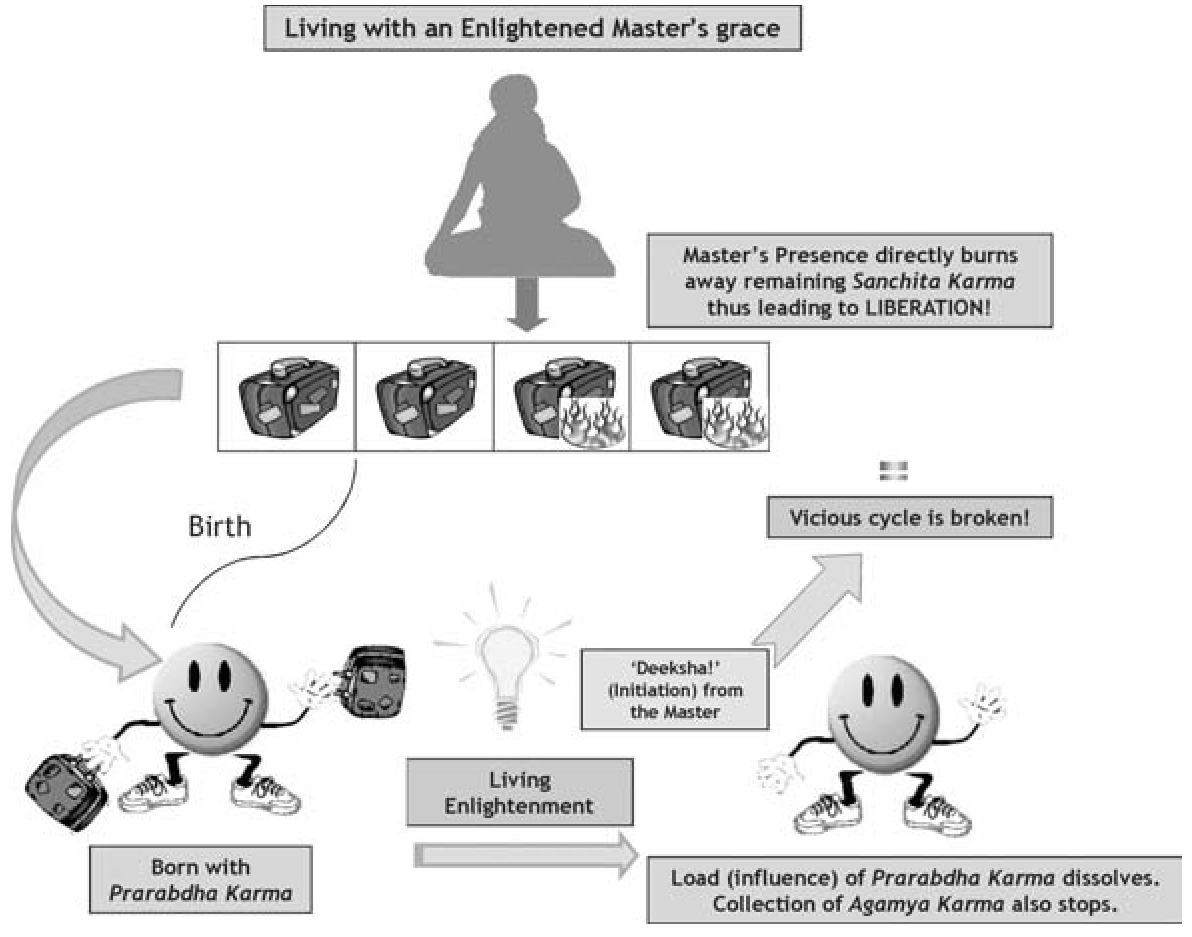
Figure 11: Deeksha by master burns sanchita karma
See: when a master teaches, it is not even a teaching, it is a powerful experience. When you don't use those shaastra-shastras (knowledge-weapons) repeatedlly, not only do they lose their power, you may not even be able to remember them again. That is the important thing to understand.
See, for example, let us say you have a cot. If you don't use this cot for two years, it is not that the cot will disappear. After two years, you can use it again. But the knowledge given to you, the initiations given to you, if you don't use them for two years, don't think they will be sitting in your bedroom; no! They will simply disappear, that's all.
So how do you remind yourself everyday of all the clicks that have happened in you? Everyday, sitting and reminding yourself of all the clicks which happened in you is what is puja or ritual.
Automatically, everyday, whether you want it or not, when you sit for the ritual, you will remember the initiation experiences, the clicks that happened with the master. The ritual brings you back to pure consciousness everyday. The engrams start losing their power over you. When the engrams with which you were born start losing their power over you, further collection of engrams stops. When the collection stops and when the existing karmas also lose their power over you, naturally the person who brings you back to the superconsciousness again and again, the master, appears when you leave the body, and burns the sanchita as well.
Understand: you can't do anything directly with sanchita. For sanchita, only guru kripa – grace of the master, will work. Only the master's grace can do anything with the sanchita.
For example, if your child sits and tries very hard to build a small home, what will you do? You will say, 'Alright, don't bother. I myself will build and give you.' When a disciple sincerely works to remove his own prarabdha and agamya, the Guru's grace simply happens!
You see, the guru's grace is not just dependent on me. Understand. Anybody who sincerely does sadhana (penance) or meditation, in spite of me, the grace has to land on him! It is not even dependent on me. It is an automatic mechanism!
Be very clear: it is just dependent on your receptivity, not on me. I am like an ocean - constantly available to whoever comes with whatever size vessel they carry. If you come with a coconut shell, you will carry back that much of me. If you come with a little bigger vessel, you will carry back the corresponding quantity of me in that. If you came with a still bigger container, you will carry back what that can hold. If you are intelligent… you will build a canal!
Initiation, or puja means, reminding yourself everyday of all the initiations, the great experiences that happened with the master, and bringing yourself back to the same high consciousness repeatedly. When you are ready with the same high spirit, it means that now you are ready for the next 24 hours’ drama! For the next 24 hours, you now have energy. That is the reason for doing puja.
MEANING OF MAANASA POOJA MANTRA
In the Guru puja – the offering to the master, just the maanasa puja mantra (verse which pays obeisance to the master through inner visualization) will remind you of all the clicks.
The first line of the maanasa puja mantra says, ‘Hridpadmam aasanam dadhyaat’ - my heart is a seat for You. This very line implies that our heart has to be clean! It is an inbuilt reminder, a click!
‘Sahasraar achutaamrutaihi | Paadyam charanayor dadhyaat’ –
sahasraara amruta means when you overflow with gratitude, you will have a deep sweet taste in your tongue, and in your throat. During Ananda darshan you can feel this. How many of you have felt? In Ananda darshans, you can see suddenly that whole throat becoming so sweet; that is what is sahasraara amruta – the nectar that happens out of deep gratitude. The nectar comes down from the sahasrara (your crown center) when you are feeling fulfilled and your whole throat will be filled with it. That very nectar is used as the paadyam or water, to wash the feet of the Divine! It means that when you sit at the puja everyday, in order to experience the nectar, remember the Ananda darshan experience, and you will bring yourself back to that same ecstatic state! If you don't experience that sweet taste in your throat, you can't offer puja. Because then you would be telling a lie! Only if you have that real feeling again are you authorized to use those words sahasraar achutaamrutaihi | Paadyam charanayor dadhyaat in the puja!
Manastu arghyam nivedayet – this means that you are offering your very mind as the food to the Lord. At the end of the NSP (Life Bliss Program Level 2 - Nithyananda Spurana Program), you offer all your samskaras or engraved memories into the fire. That is your manas, mind. So when you recite this line, you will automatically remember the action, ‘Yes! How I offered everything there, now I am offering everything at Your feet.’
Tena amrutena aachamaneeyam – With that same ecstatic nectar, I do the abhisheka (holy bath) for You. This line will pull you back to that Ananda darshan experience, that joy, that ecstasy in order to experience that nectar again. So in this way, every step of this mantra reminds you and brings you back to the clicks, the initiation experiences that happened in you.
It is such a beautiful concept! If you understand this, it is enough. Automatically, all unwanted thoughts, words and deeds will leave you, and the master's grace will descend upon you in no time. Once that happens, you are liberated.