THE 'IS' NESS
This text was machine-transcribed from the printed book and may contain errors. Select the words and choose “Report a mistake”.
In the deep roots of enlightenment, in the deepest layers of your Being, secrets will be revealed to you as an experience. But we don't reach to the deepest level, so we feel contradiction in ourselves. There is no contradiction on planet Earth ever. You don't know the missing link, you have not gone to the depth of understanding the missing link, that's all. The whole Existence is all about complementing, never contradicting. These are the Ultimate rules.
Whether it is spiritual life or material life or Life and Death, all complement each other. The more you grow superficially, the more contradictions you will find - the contradictions between tree and tree, branch and branch, leaf and leaf etc.... If you reach the zero level, you will understand that they are
one and the same. If you go deeper, you will know that they are not even 'non-dualistic', they are just 'same', that's all! We are in fact talking about not 'same' but just 'Is'ness. When you are in 'Is'ness, you are at ease!
Paramahamsa 2005, Himalayas, India
VIOLENCE
Stop defending
If you are established in non-violence, even wild animals if they face you will turn peaceful. You will radiate love and compassion. Patanjali says, 'If a man is established in non-violence, in his presence, enemies and animals will radiate love.'
We do not need to defend ourselves against anything. Defending is what creates the thought of offending. All countries say that they have armies only to defend themselves. Who then is offending? The more you try to defend, the more you enter into offense. Violence starts with defense.
Paramahamsa
Yoga - Eight Points to Ponder
14 April 2005, St. Louis, USA
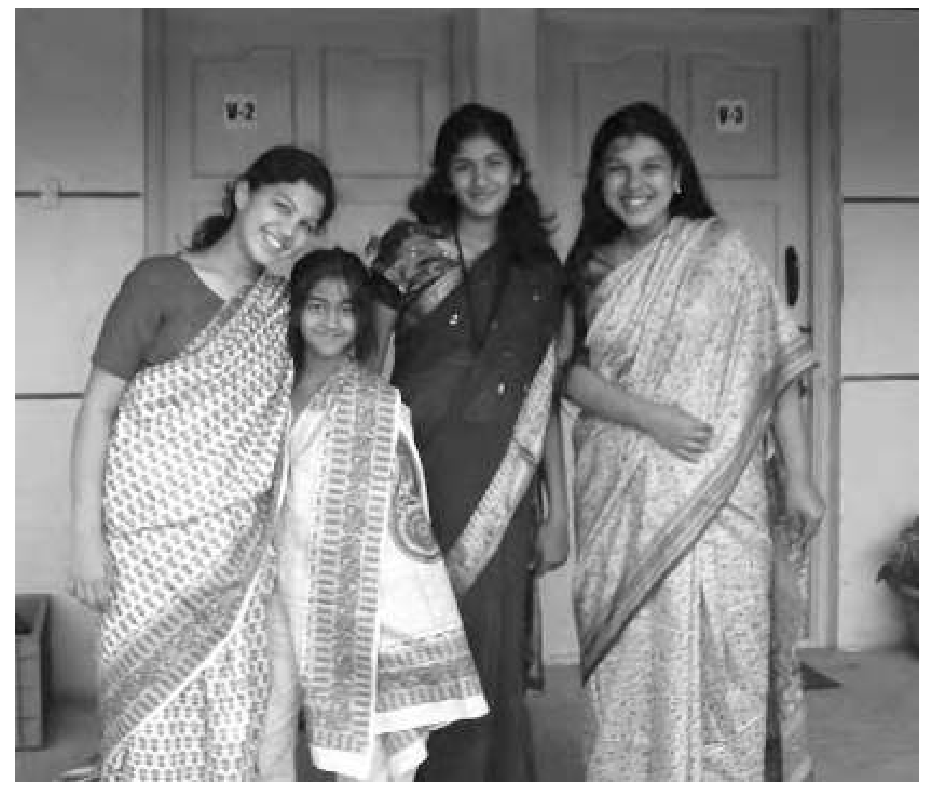
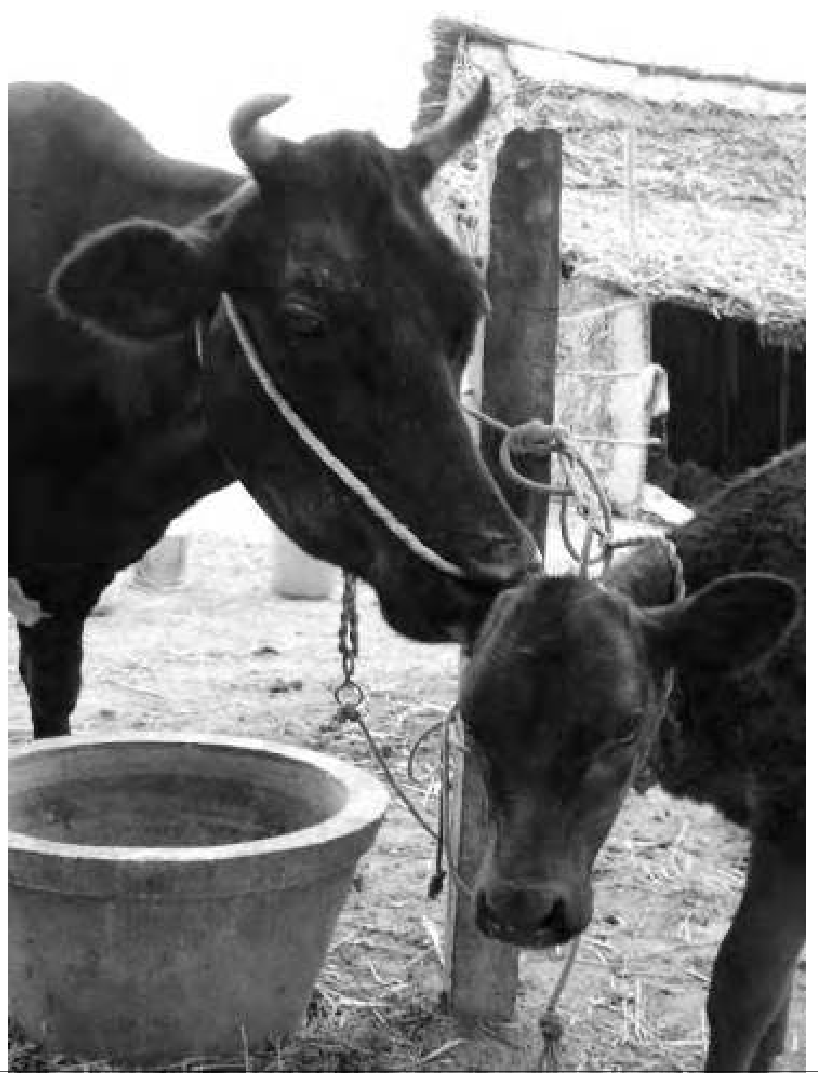
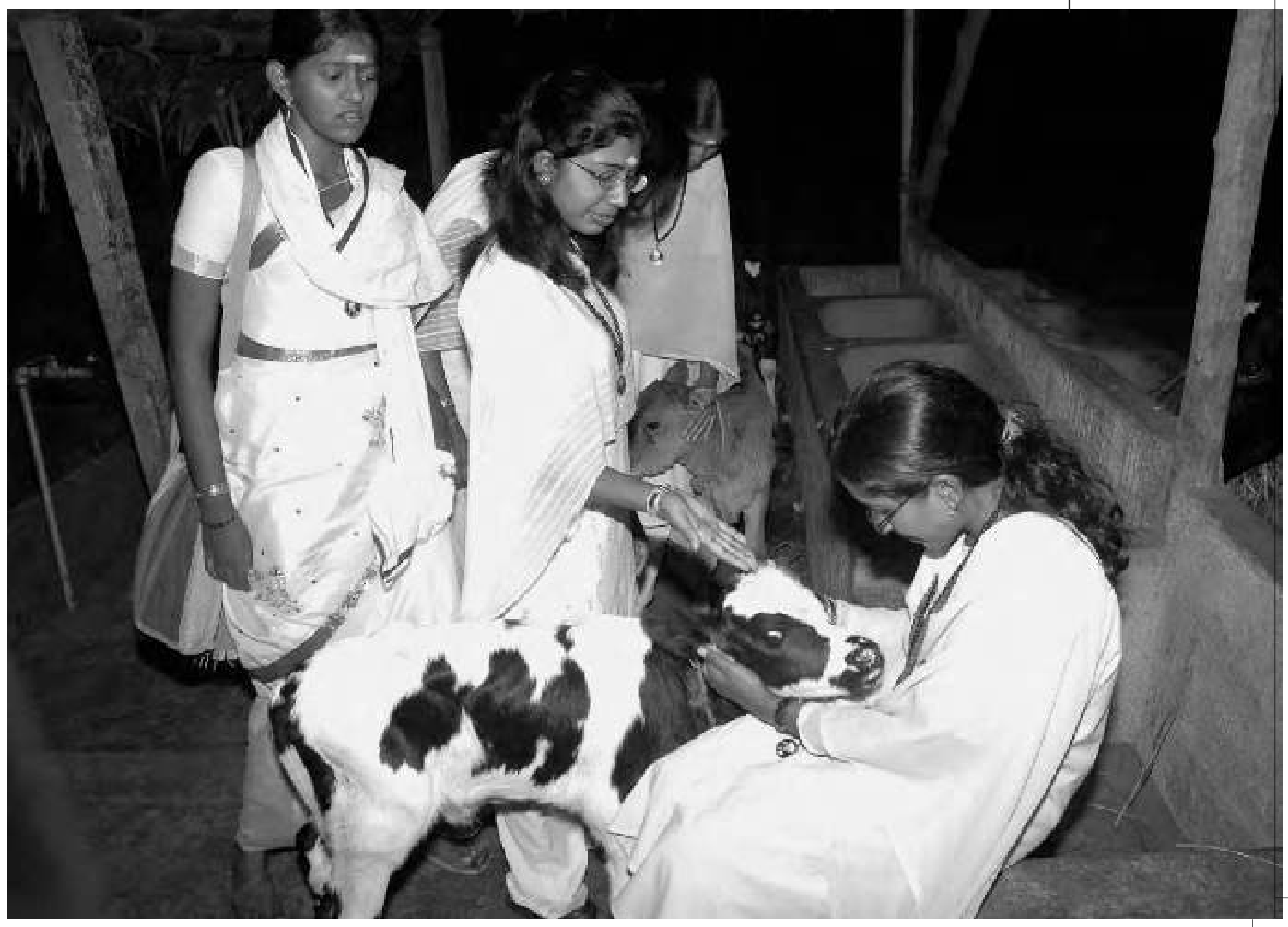
At the Goshala
(cow shelter).
Loving co-
existence in the
energy field of
the Master.
SATYA
Truthfulness
Satya - truthfulness. It is not 'fact'ual but 'truth'ful. It is living the truth, not just speaking the truth. An enlightened Master lived on the banks of the Ganges. He used to read the Bhagavad Gita - Lord Krishna's words - which was the only possession he had. It had become his life. One day, a poor man begged for something saying he had not eaten. The Master was deeply moved that someone was begging from him who had nothing! He gave the beggar his book and told the beggar to sell the book in the market place where one of his followers may buy it and give him money. The beggar took the book away. The next morning the Master prayed: God, I gave away your words to keep your word. Legend says that God appeared to him and blessed him as one who believed in the spirit, not just the letter.
There is so much corruption
because we think satya is factual, not
truthful. You have to live the truth by
living through your body language.
You have to think, speak and express
the truth in your life. You have to
observe all three dimensions to be in
real satya.
Paramahamsa
Yoga - Eight Points to Ponder
14 April 2005, St. Louis, USA
THE ULTIMATE QUESTION
Get to it
There are many types of questions we ask in our lives. The first type is out of innocence - we don't know the answer and we ask because we want to know. The second type is out of knowledge - we know the answer but we ask to see if the other person is saying the same thing. The third type is out of ignorance - we don't even know if we want to know the answer, but we ask. This type of question arises out of some deep dissatisfaction. The first type of question is what a child asks. The second type is asked just to express your knowledge. The third type of question simply expresses the deep confusion inside you. People come to me and ask me, 'Swamiji, tell us about God. How do we get enlightened?' I simply talk to them about various things, about their family etc. and even after an hour's time, they don't ask those questions again. This only means that the question was just a casual question, not a deep one, and not our own in that. Hence it simply disappears.
'Who am I?' is the ultimate question, because the moment you ask this, all other questions disappear and the questioning mind dissolves! Mind survives with the help of questions. As long as it survives, questions will arise. Questions themselves get provoked by the answers. The answers instead of quenching the questions, give rise to more questions. In the Bhagavad Gita, Arjuna asks Krishna, 'What is Brahman? What is the science behind Jeevan Mukta, Adyatman etc? What is it that makes the Jeevan Mukta react, age and respond to life?' Krishna tells him, 'If I ask you to repeat the question you have just asked, you will not be able to. It is not your own question. You have asked simply for the sake of asking!' Most often, we just express our deep confusion in asking these types of questions. We keep asking, 'Why is this?' But forget to ask, 'Who am I?' Until you know that, none of your questions are going to help, and until you realize the source from where these questions arise, the questions will not stop. If the source of the fountain is poisoned, the fountain will also be poisoned. If the source is pure, the fountain will also be pure. Unless you solve the source of the questions, the questions themselves will not be solved.
Paramahamsa
Who am I - the Ultimate Question
5 Aug 2004, Washington DC, USA
HOW TO ASK
The ultimate question
If you are asked who you are, you will reply that you are the father of someone or the mother of someone or the brother of someone. But who are you for yourself? Sit alone in a room and ask, 'Who am I?' Either you think that you are the body or you think that you are the soul. Actually, if you start deeply thinking, 'Who am I', you will slowly lose your base.
Your whole life is built on pseudo-identities, pseudo-personalities. You continuously associate yourself with relationships like father, son etc. You simply cannot exist without social identities. Even spiritual practices and religions are taken up to boost your social identity.
Your life is nothing but a bridge between two unknown points - birth and death. You don't know the secret of your birth; why you were born. You have no idea or clarity about it. If anyone asked Bhagavan Ramana Maharishi a question, he would simply ask them in return, 'Who is the questioner asking this question?' That's all, all the questions will end. We know about others but do not know about ourselves, our own Being.
We think we need to get a new car and therefore work hard and buy a car. Barely a few days later, the excitement of having gotten the car dies. What seems like a mountain before achieving becomes nothing after achieving it. People, relationships, career etc. seem indispensable before we achieve them, but after we achieve
them, there is no excitement. This is because, before achieving anything, you are a different personality than after achieving it. You are different, your identity changes. Your mental setup keeps changing. Till you know who you are, the question 'What you want' will never be answered. And till the question 'What you want' is answered, you will never feel peace, whatever you may achieve. You will achieve outer world comfort but no inner satisfaction. First you need to know 'I' and then 'What I want'.
People ask me, 'Swamiji, if we meditate or ask the question, Who am I, will our dreams come true?' I tell them, 'Meditating or asking Who am I will not make your dreams a reality, but will make you understand that reality is your dream!' To realize the first, you need shakti or energy. To realize the second, you need buddhi or intelligence. Meditation can give you deep intelligence to help you lead your life.
When you start asking, 'Who am I?' you will start feeling that you are not the body. If you are able to stand away from your body and see it, you will realize that you are not the person being observed but the person observing or seeing. Next, if you witness your thoughts, you can experience your mind objectively. You will be able to see it, in a state of depression or joy. You will realize that you are not your mind, since you are able to experience it objectively. Objective experience of emotion, body or intellect shows that you are neither of them. If you search deeply, the answer to this question is nothing but the pure awareness of what you call Atman or Brahman or Shiva or Vishnu.
Paramahamsa
Who am I - the Ultimate Question
5 Aug 2004, Washington DC, USA
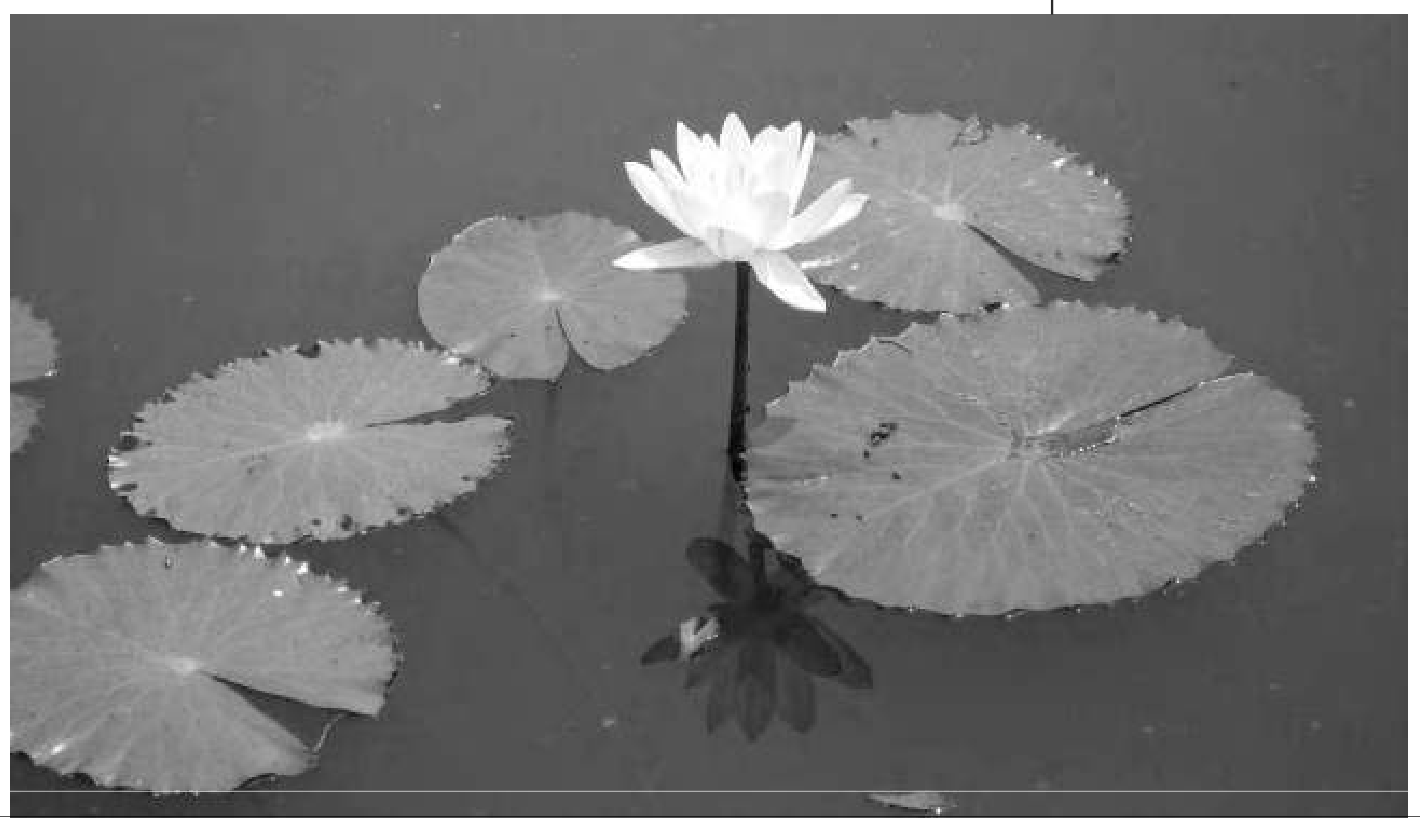
| Lily pond in the entrance to the ashram in Bangalore
- 2007.