QUANTITATIVE EEG (QEEG)
This text was machine-transcribed from the printed book and may contain errors. Select the words and choose “Report a mistake”.
STUDIES
The brain is essentially a bioelectric organ. The EEG or electroencephalogram has long been used to record and study the electrical activity of the outermost layer of the brain – the cerebral cortex.
A more advanced form of EEG has been developed, called quantitative EEG or qEEG, in which the electrical signal is converted to digital form and compared to a database of individuals without any known neurological disorder.
In this form of functional brain imaging, the brain’s electrical activity, as measured in 19 or 25 sites on the head, are analyzed using complex mathematical and statistical tools in comparison to norms or averages. The results of these analyses can then be presented in graphic form, resulting in topographical displays of brain electrical activity, sometimes called “brain maps”.
A fitted electrode cap with leads placed according to the International 10/20 System is applied to achieve a standardized 19 channel EEG recording.
The waveforms recorded reflect the level of arousal of the person: delta activity (2-4 cps) accompanies deep sleep; theta (4-7cps) states of drowsiness; alpha (8-11 cps) relaxed states. Beta range activity reflects an engaged or active brain, and, with very fast beta activity, an excited or urgent/emergency state of mind.
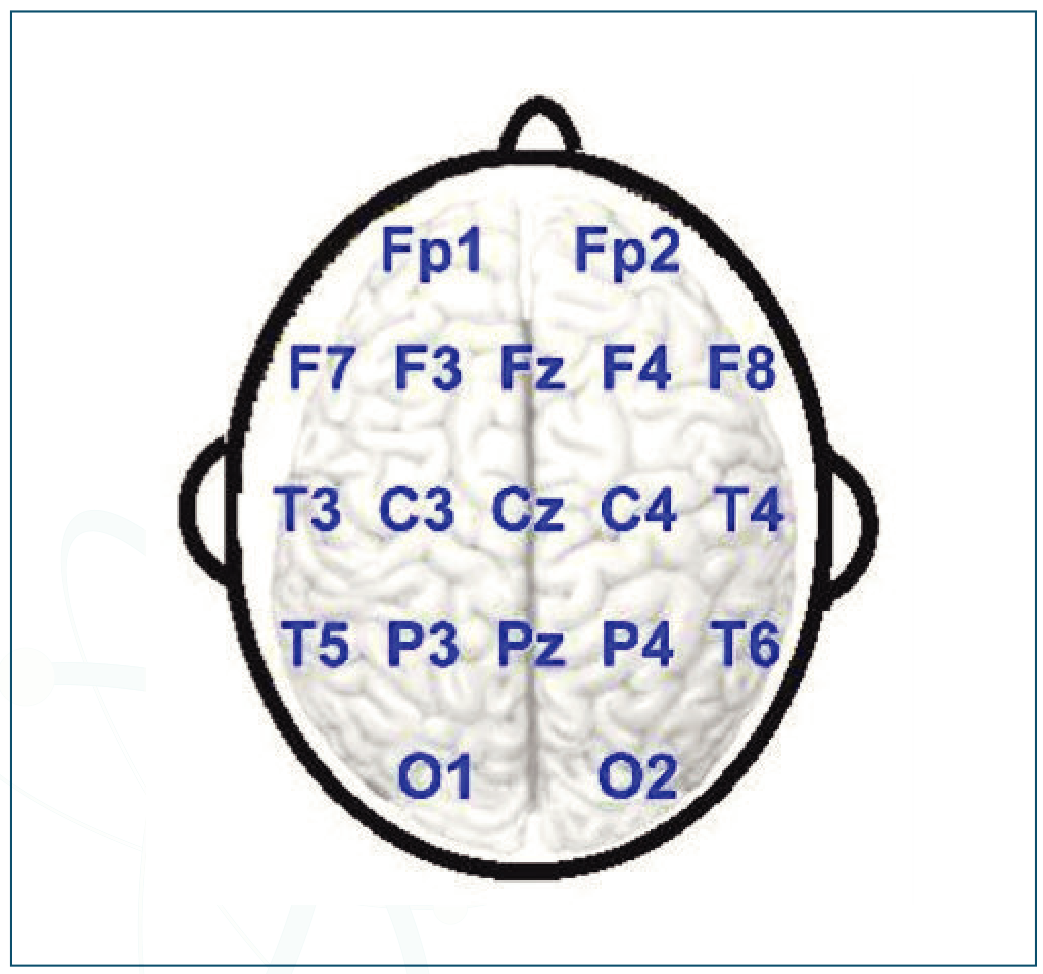
Fig: International 10-20 system for electrode placement on the scalp
QEEG studies were conducted on participants who had Kundalini awakening to study its effect on the brain. The qEEG's were reported by Dr Kanak Pandey, Neurologist.1 The participants underwent a series of standardized tests, basic recordings were done with open eyes and closed eyes and also when the Kundalini energy was activated by the Masters initiation. Data were analyzed; digitized data were subjected to an automatic artifact detection routine and supplemented by visual review and these were the observations made:
The values are dramatically high in most of the activated people. This may be indicative of very elevated, rapid, parallel
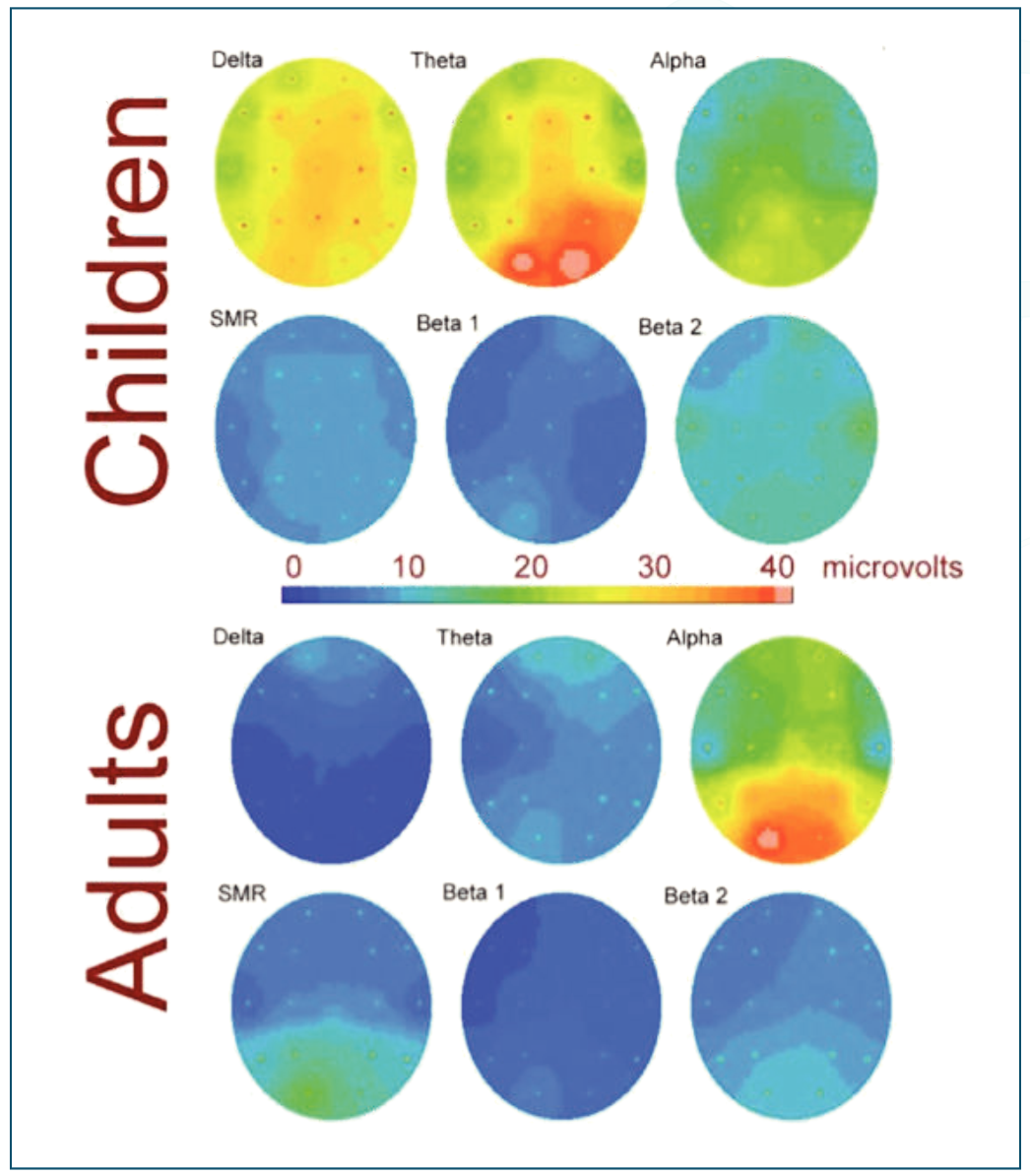
Figure: During eyes closed baseline rest, the theta rhythm (4-8 Hz) dominates the spectral energies of a child's brain whereas the alpha rhythm (8-12 Hz) dominates the adult brain.
1. Dr. Kanak Panday is the founder of Gunjan Human Karigar and Maxcellence—Peak Performance Solutions. She is a trained
psychologist having more than 23 years of experience as a behavioral psychological consultant with various reputed industrial and business concerns. She is trained and certified on EMDR (Eye Movement Desensitization and Reprocessing) from the Hong Kong Institute of EMDR. She is trained and certified in Biofeedback, Neuro-feedback, and QEEG (Quantitative EEG) from USA. She is:
- an international affiliate of American Psychological Association (APA)
- member and a certified trainer of LMI international
- member of Indian Psychological Association
- member of Psycho-Linguistic Association of India
- member of International Society for Neuronal Regulation (ISNR) processing. It may indicate enhanced cognitive and mental functioning; this can be calibrated by post activation assessment on various cognitive functions. These elevated changes may help a person develop better learning and executive abilities.
The probable positive impacts:
- Better focusing ability
- Better alertness and attentiveness
- Better short term memory
- Faster multi processing
- Better problem solving and decision making ability
- Warm and positive personality traits
PHYSIOLOGICAL DATA AND STATISTICS REPORT—MY CLINIC
(THE QEEG RECORDINGS OF ONE OF THE PARTICIPANTS)
Concise Client and Session information:
Client: Ma Nithya Nirantarananda [ID=00000045 ]
Session: p4
Date Time: 09:17:43 14-07-2011
Duration: 43 min 17 sec.
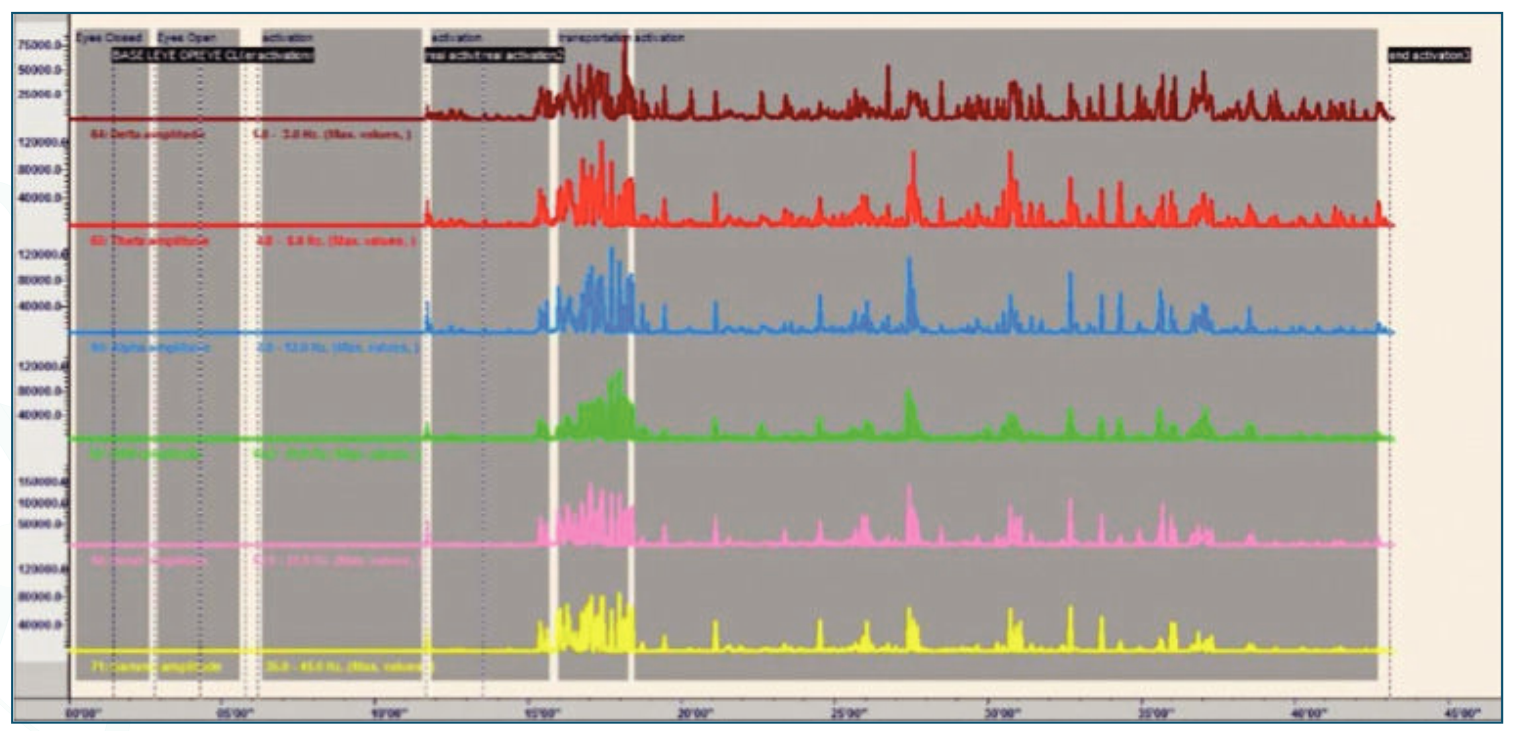
Statistics for 9: Eyes Open (1 segments/ Total: 6)
| Channel | Min. | Max. | Max. | Var. Std | Dev. | %>Th1. | %>Th2. |
|---|---|---|---|---|---|---|---|
| Delta amplitude | 8.68 | 351.29 | 59.90 | 1915.00 | 43.76 | 0.00 | 0.00 |
| Theta amplitude | 7.55 | 290.88 | 74.37 | 2149.71 | 46.36 | 0.00 | 0.00 |
| Alpha amplitude | 2.64 | 337.25 | 54.46 | 1345.48 | 36.68 | 0.00 | 0.00 |
| SMR amplitude | 3.15 | 161.59 | 34.90 | 461.86 | 21.49 | 0.00 | 0.00 |
| Beta1 amplitude | 7.50 | 199.93 | 61.89 | 803.68 | 28.35 | 0.00 | 0.00 |
| Gamma amplitude | 5.08 | 225.91 | 49.75 | 810.62 | 28.47 | 0.00 | 0.00 |
Statistics for 10: Eyes Closed (1 segments/ Total: 6)
| Channel | Min. | Max. | Max. | Var. Std | Dev. | %>Th1. | %>Th2. |
|---|---|---|---|---|---|---|---|
| Delta amplitude | 7.35 | 4446.57 | 134.22 | 227551.57 | 477.02 | 0.00 | 0.00 |
| Theta amplitude | 9.61 | 6626.05 | 108.14 | 125931.43 | 354.87 | 0.00 | 0.00 |
| Alpha amplitude | 4.88 | 4794.20 | 80.99 | 45907.20 | 214.26 | 0.00 | 0.00 |
| SMR amplitude | 2.79 | 2849.78 | 56.38 | 19336.69 | 139.06 | 0.00 | 0.00 |
| Beta1 amplitude | 8.23 | 4616.95 | 74.96 | 31172.69 | 176.56 | 0.00 | 0.00 |
| Gamma amplitude | 1.85 | 1578.41 | 86.88 | 6080.80 | 77.98 | 0.00 | 0.00 |
Statistics for 19: activation (3 segments/Total: 6)
| Channel | Min. | Max. | Max. | Var. Std | Dev. | %>Th1. | %>Th2. |
|---|---|---|---|---|---|---|---|
| Delta amplitude | 0.28 | 54160.00 | 4543.03 | 60676930.53 | 7789.54 | 0.00 | 0.00 |
| Theta amplitude | 0.28 | 105706.96 | 3728.19 | 75247550.27 | 8674.53 | 0.00 | 0.00 |
| Alpha amplitude | 0.28 | 115260.90 | 2538.26 | 49613798.63 | 7043.71 | 0.00 | 0.00 |
| SMR amplitude | 0.28 | 81638.19 | 1917.53 | 31331640.36 | 5597.47 | 0.00 | 0.00 |
| Beta1 amplitude | 0.28 | 138673.11 | 2483.76 | 75422637.19 | 8684.62 | 0.00 | 0.00 |
| Gamma amplitude | 0.28 | 76107.48 | 1006.80 | 18483111.32 | 4299.20 | 0.00 | 0.00 |
Statistics for 20: transportation (1 segments/Total: 6)
| Channel | Min. | Max. | Max. | Var. Std | Dev. | %>Th1. | %>Th2. |
|---|---|---|---|---|---|---|---|
| Delta amplitude | 276.12 | 85212.39 | 20889.91 | 294884317.27 | 17172.20 | 0.00 | 0.00 |
| Theta amplitude | 23.42 | 120867.08 | 21960.66 | 471117428.33 | 21705.24 | 0.00 | 0.00 |
| Alpha amplitude | 13.12 | 128822.14 | 18432.99 | 479787949.08 | 21904.06 | 0.00 | 0.00 |
| SMR amplitude | 8.21 | 140082.44 | 15265.83 | 349482559.32 | 18694.45 | 0.00 | 0.00 |
| Beta1 amplitude | 6.12 | 198443.95 | 21478.52 | 915510736.86 | 30257.41 | 0.00 | 0.00 |
| Gamma amplitude | 3.93 | 121867.55 | 10200.88 | 301556769.21 | 7365.39 | 0.00 | 0.00 |
In deep meditation, EEG studies have shown the simultaneous global presence of delta activity with increased beta presence in the pre frontal area. This signifies a state of ‘Restful Awareness’.
On the other hand, a direct transmission of energy (Kundalini energy in Vedic literature) clearly demonstrates cessation of superficial cortical activity and the presence of multiple high amplitude spikes, not correlating with the known alpha, beta, delta and theta rhythms, suggesting that the EEG machine is picking up intense activity from sub cortical areas from hypothalamus and limbic systems.
BRAINWAVE STUDY OF A YOGIC MASTER
Neurologist R. Murali Krishna recently reported an exploratory study with an Indian Swami and teacher of Nithya Yoga during a visit to his clinic in Oklahoma in 2005.
PET scans of the Swami’s brain during meditation revealed increased metabolic activity in the forward parts of his frontal lobe. As the Swami reported the experience of “opening his Third Eye,” the lower central region of his frontal lobe lit up with activity. In addition, EEG monitoring indicated that the Swami was able to voluntarily make a continuous transition between the various types of brain waves during deep meditation, suggesting that his brain was capable of voluntarily shifting between brain waves and their associated mental states.
A Glimpse Into the Meditating Brain, by Bryan Williams, University of New Mexico. Excerpt from an extended version of an invited talk given at the Morning Star Center for Spiritual Living, Norman, OK, June 7, 2009.http://earthvision.info/meditatingbrain.html .
The Indian Swami examined in Dr Krishna’s study was Paramahamsa Nithyananda, as can be verified by the reference to Nithya Yoga, which Nithyananda founded and presented to the world. Here we can see a template for the mental and spiritual state we aspire to: fully organized neurological activity, expanded use of the higher brain centers, and the ability to consciously transition at will from one level of amplitude to another.
CONTINUING BREAKTHROUGHS FOR THE NEW MILLENIUM
With the dawn of 2012 Nithyananda has extended his horizon for human possibility. Working first with a close group of devotees, and then as a public program, he has successfully launched the Nirahara Samyama, a voluntary 21-day meditation in which the body requires no food to function. Participants have been able to carry out normal daily activities and work without weakness, despite no nutritional intake. Those who felt symptoms of hunger were mandated to eat, and some opted to take juice from time to time. Many, however, took nothing, not even water, without experiencing any ill effects. They have even been able to cook for others without wanting to eat.
This landmark event in itself is remarkable. What truly breaks new ground is that Nithyananda has guided the public groups at a distance, and in unprecedented numbers. Some yogic masters have succeeded in the past with a few close disciples who live near them. But none has ever been known to sustain more than four hundred devotees over thousands of miles all over the world, solely by Internet connection.
Nithyananda's ability to heal and transmit initiation to those far away provides ever stronger evidence that energy is not limited by space, time or physical form. Furthermore, his capacity to awaken extraordinary powers in others proves the Vedic understanding that these siddhis are the birthright of all humans.
The world looks forward to a new evolutionary wave, guided by the wisdom and vision of Paramahamsa Nithyananda.