Indigenous Knowledge Library
This text was machine-transcribed from the printed book and may contain errors. Select the words and choose “Report a mistake”.
Indigenous Peace literature
Nobel Peace Laureate Nelson Mandela has said, “Education is the most powerful weapon which you can use to change the world.” Vedic Rishis (seers) have said that education is the most powerful weapon that can be used for peace or violence – a view shared by experts at UNICEF especially given the pattern of the weaponization of education in recent times.163 It is therefore extremely crucial for human civilization to focus on peace education. For more than the last ten thousand years, peace education has been a primary focal point for indigenous Hindu literature. This is precisely why all primary indigenous Hindu scriptures start and end with powerful peace declarations such as the Upanishads.
ॐ सह नाववतु । सह नौ भुनक्तु । सह वीर्यं करवावहै । तेजस्विनावधीतमस्तु मा विद्विषावहै॥
ॐ शान्तिः शान्तिः शान्तिः ॥
Om Sahanaa Vavatu Sahanau Bhunaktu | Saha Veeryam Karavaavahai | Tejasvi Naavadheetamastu Maa Vidvishaavahai | Om Shantih Shantih Shantih Aum, May we both together be protected, may we both be nourished and enriched. May we both bring our hands together and work with great strength, energy, and enthusiasm. May our study and learning together illuminate both of us with the sharp absolute light of higher intelligence. So be it. May we both not mutually dispute, have enmity or hate each other. Let there be peace, peace, peace. (Let there be peace in my inner space, peace in nature, peace in divine forces)
~ Shanti Mantra (the peace invocation) for the second primary Upanishad – Kathopanishad ~
During the past ten thousand years, the larger South Asian sub-continent, has been a source of a phenomenal volume164 of such peace literature with more than 100 million scriptures being in active use, of which only 20 million remain today with us. Several copies of these indigenous peace scriptures were destroyed by terrorists and tyrant invaders.
The Two faces of education in ethnic conflict, UNICEF, www.unicef-irc.org/publications/pdf/insight4.pdf
Klaus Klostermaier (2007), A Survey of Hinduism: Third Edition, State University of New York Press, ISBN 978-0-7914-
7082-4, pg. 49–50
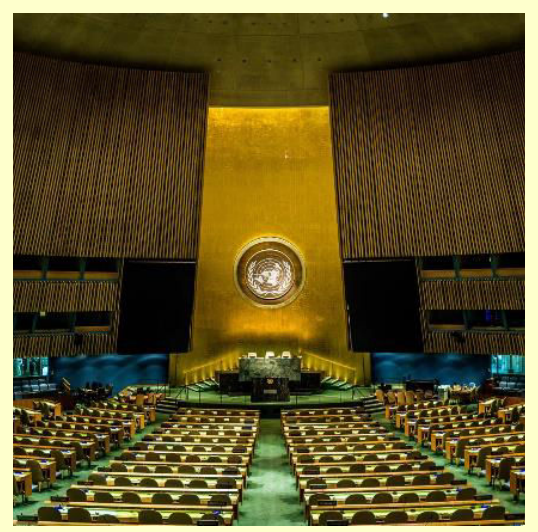
“Centuries of history of discrimination, exploitation, dispossession, and colonization have led to the loss of traditional knowledge. Traditional knowledge is under threat and is being misused and misappropriated ... ”
“Indigenous peoples’ traditional knowledge has been developed over generations through daily life practices and a close understanding of local environments. It can offer valuable responses to climate change, food insecurity, reducing inequalities and other challenges that we are trying to resolve ... ”
[18th Session of the United Nations Permanent Forum on Indigenous Issues (UNPFII)](https://www.un.org)
KAILASA’s Nithyananda Hindu Library is one of the most important libraries and institutions of indigenous scriptures in the world. The library contains important indigenous Hindu manuscripts and archives related to the history of 56165 indigenous Hindu nations of South Asia their politics, culture, art, literature, medicine, sciences, etc. It possesses over 70,000 titles in printed, soft, and palm-leaf manuscript forms.
These 56 Hindu nations have an important story to tell – the story of the Hindu Holocaust – the massacre of 400 million people166 over the last few thousand years. The story of the suffering of the Hindus has an important message for mankind today – it helps us realize the tremendous progress we have made in front of human rights, and it awakens us to the tremendous opportunity we have towards achieving global peace. Nithyananda Hindu Library (Jnanalaya) is a very critical part of KAILASA’s mission towards realizing inner peace, societal peace, and global peace.
The two world wars taught us an important lesson – war, especially one of aggression is not a solution to any human problem. This realization encouraged the creation of a united European Union where erstwhile countries at war are today cooperating for peace and shared prosperity. The Mahabharata war that ended around 3200BCE167 reminded the 56 indigenous Hindu nations of Asia of the important lesson of peaceful multilateralism – ‘वसुधैव कुटुम्बकम्’ (Vasudeva Kutumbakam) – “Entire world is my family”.
अयं बन्धुरयनेति गणना लघुचेतसाम्। उदारचरितानां तु वसुधैव कुटुम्बकम्॥
(i) Saktisangama Tantra, Chapter- Sundari Khandha, Saptam Patala, Verses 16-73, refer Saktisangama Tantra Vol III
https://archive.org/details/SaktisangamaTantraVolIIIGaekwadOrientalSeries/page/n83/mode/2up (ii) List of 56 nations https://docs.google.com/document/d/1H7OJADdrFjrdl8nR5KMuc7sJkG6zXOob0K6X5wbmBno/view
http://hindugenocide.com
(i) Ved Veer Arya, “THE CHRONOLOGY OF INDIA: From Manu to Mahabharata”, Aryabhata Publications, ISBN
8194321301 (ii) Nilesh Oak estimates the period as 5561BCE, “When Did The Mahabharata War Happen?: The Mystery of Arundhati”, ISBN 0983034400
Only the denigrated small-minded with a very pathetic outlook of life discriminate between kin and a stranger; while for the magnanimous, the entire world is a family. (Maha Upanishad Ch. 6, verse 71-73.)
The Jewish Holocaust shook the world and reminded us that the entire world is indeed one family. Nobel Peace Laureate Elie Wiesel shares this wisdom, “What all these victims need above all is to know that they are not alone; that we are not forgetting them, that when their voices are stifled, we shall lend them ours, that while their freedom depends on ours, the quality of our freedom depends on theirs ... Our lives no longer belong to us alone; they belong to all those who need us desperately.”168
The message of indigenous people of the erstwhile 56 indigenous Hindu nations of South Asia is no different, it is this very same peace message of Elie Wiesel, Sir Norman Angell (Ralph Lane), Alfred Hermann Fried, and many others that KAILASA’s Nithyananda Hindu Library is preserving as it gives hope and strength to persevere, especially to the weakest and most vulnerable sections of the society that are disproportionately impacted during these difficult times of terrorism and conflict in South Asia.
The profound impact of these indigenous scriptures on indigenous people who are victims of cultural genocide is not limited to South Asia. Canadian First nation citizens share similar experiences. Many Survivors told the Canadian Truth and Reconciliation Commission that reconnecting with traditional Indigenous spiritual teachings and practices has been essential to their healing, with some going so far as to say “it saved my life.”169
KAILASA’s Nithyananda Hindu Library is one of the most important libraries and institutions of indigenous scriptures in the world. Nithyananda Hindu Library (NHL) is the largest collection of ancient texts on religion, human rights, spirituality, and knowledge sciences of several extinct indigenous Hindu tribes and sects. NHL has organized, preserved, time-capsuled, decoded, and finally made several of these texts freely available and accessible through the internet.
NHL has the world’s largest archival record of indigenous genocide studies; this includes the largest archival records of Hinduphobic ‘hate literature’ which are evidence of systematic state-sponsored persecution of minority indigenous religious sects. The purpose of this collection is to inspire millions to stand for human rights, learn from our past mistakes and protect humanity from the recurrence of similar genocides.
Elie Wiesel’s acceptance speech for Nobel Peace Prize on 10 December 1986, in the Oslo City Hall, Norway.
https://www.nobelprize.org/prizes/peace/1986/wiesel/26054-elie-wiesel-acceptance-speech-1986/
(i) https://ehprnh2mwo3.exactdn.com/wp-content/uploads/2021/01/Executive_Summary_English_Web.pdf (ii)
Hamilton, Federal Indian Day Schools, 4–5; Fingard, “New England Company,” 30–32.
Destruction of Libraries by invaders, extremists, and neglect
The 56 Hindu nations of South Asia had several grand libraries and Universities that offered education as per indigenous Hindu and Buddhist traditions.
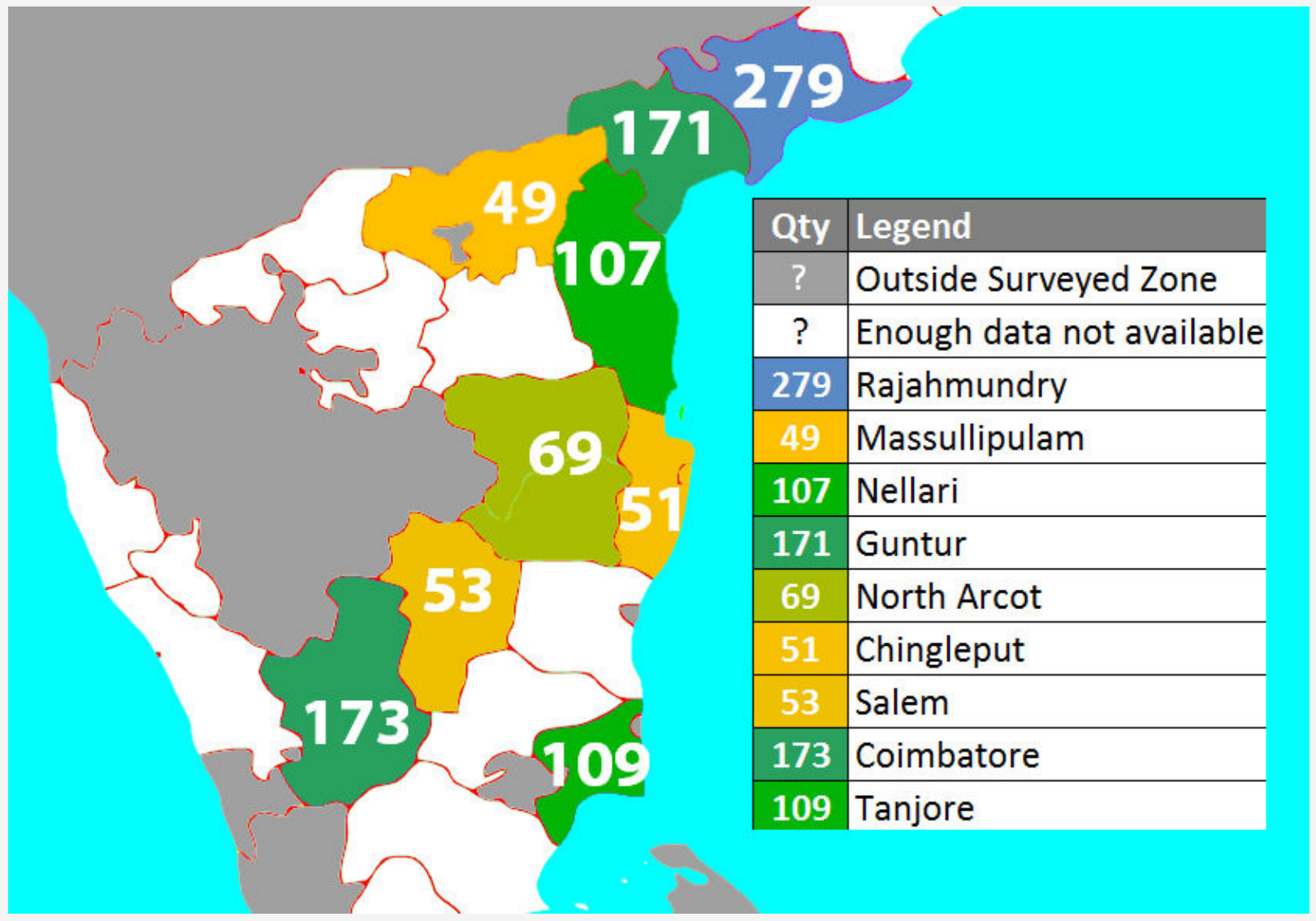
The picture above shows a map of Southern India, indicating the number of indigenous universities and colleges that were present in respective districts as per a report on the status of education in the Indian sub-continent in the 18ᵗʰ century that was commissioned by the state revenue department of the colonial government of the time.170 All these universities were shut down as a result of government education policies of that time. Over the last millennia, all Hindu Universities such as Nalanda, Taxashila, Vikramashila, and their libraries have been destroyed.
The Beautiful Tree, Indigenous Indian Education in the Eighteenth Century, Dharampal, (ISBN No.: 81-85569-49-5
republished ISBN-10: 8175310952).
https://nalanda.nic.in/en/history/
Minhaj-ud-Din 1881, p. 552.
Scharfe 2002, p. 151.
Ghosh 1965, p. 56.
The SPH Nithyananda Paramashivam describes the sacrifice of our human ancestors – “Even when we were cut into pieces, we continued to stand for peace. The strength we demonstrated even in the face of the sword – the peace we demonstrated even in the face of the violence – is the pride of Vedic civilization.”177
The manuscripts that survived these invasions and fires were taken by Hindu scholars and Buddhist monks that fled to Tibet178. Several Hindu and Buddhist scholars and masters such as Sugataśrī, (an expert in Madhyamaka and Prajñāpāramitā); Jayadatta (Vinaya); Vibhūticandra (grammar and Abhidharma), Dānaśīla (logic), Saṅghaśrī (Candavyākaraṇa), Jīvagupta (books of Maitreya), Mahābodhi,(Bodhicaryāvatāra); and Kālacandra (Kālacakra) went along to Tibet and imparted education on these scriptures to the next generation Tibetan Buddhist monks.179 Tibetan Buddhist tradition is regarded to be a continuation of the rich Hindu indigenous tradition of Nalanda. The 14ᵗʰ Dalai Lama, Tenzin Gyatso, a Nobel peace laureate, refers to Himself as a disciple of this lineage180 and has stated, “Tibetan Buddhism is not an invention of the Tibetans. Rather, it is quite clear that it derives from the pure lineage of the tradition of the Nalanda Monastery. The master Nagarjuna hailed from this institution, as did many other important philosophers and logicians...”.181
The Dalai Lama is not the only one who has been deeply moved and enriched by these indigenous peace scriptures, every single practicing Hindu and Buddhist in South Asia has tasted their nectar in one way or the other. However, during the Chinese Cultural Revolution, these manuscripts were under threat of complete destruction. Thanks to the efforts of the Tibetan community led by the Dalai Lama - The Library of Tibetan Works and Archives (LTWA) that was founded on 11 June 1970182 preserved some of these most endangered manuscripts. However unfortunately the same effort could never be realized by their Hindu counterparts,
Dutt 1962, pp. 157,379.
Sanyal, Sanjeev (15 November 2012). Land of seven rivers: History of India's Geography. Penguin Books Limited. pp. 130
- 1. ISBN 978-81-8475-671-5.
https://nithyanandapedia.org/wiki/June 27 2016
(i) Opening the Treasure of the Profound: Teachings on the Songs of Jigten Sumgon and Milarepa, Khenchen Konchog
Gyaltshen Rinpoche, Milarepa, Jigten Sumgon, Editor Khenmo Trinlay Chodron, Shambhala Publications, 2013 (ii) Jinah Kim, “Receptacle of the sacred – Illustrated Manuscripts and the Buddhist Book Cult in South Asia” p. 49-52 (iii) Buddhist Arts of the Himalayas, Asia Society (Archived)
Śākyaśrībhadra, b.1127 - d.1225, Alexander Gardner, July 2011 Archived 23 April 2016 at the Wayback Machine
The Seventeen Pandits of Nalanda Monastery, James Blumenthal, July-September 2012 (Archived)
Nalanda the source of the Tibetan Buddhist tradition, in Meditation on the Nature of Mind, Dalai Lama XIV Bstan-
c?dzin-rgya-mtsho, Jose Ignacio Cabezon, Simon and Schuster, 2011 p. 15
"Library of Tibetan Works and Archives". Government of Tibet in Exile. 1997.
until recently when this gap was filled by the SPH Nithyananda Paramashivam by creating Nithyananda Hindu Library (NHL).
The destruction of the library of Nalanda is one of the most famous examples of the destruction of indigenous literature – unfortunately, it is not an isolated incidence neither in geography nor in time. On the night of 1 June 1981, the Jaffna Public Library was set on fire by an organized extremist mob183; it was known as one of the most violent examples of ethnic biblioclasm of the century.184 At the time of its destruction, the Jaffna Public Library housed one of Asia’s biggest collections, containing over 97,000 rare books and manuscripts185, including rare Tamil manuscripts on Shaivism and several Hindu sects.
The situation of preservation and protection of ancient indigenous literature is alarming. During the last millennia, millions of indigenous scriptures from South Asia, particularly India have been stolen. Some of these have been archived in distant lands that are completely inaccessible to the indigenous people whose ancestors once wrote these. There are more than two million indigenous Hindu temples in India that once had a library, but today not even one of them has any ancient manuscripts or any library. The extent of this cultural genocide is such that most indigenous people are completely unaware that as per tradition, temples are supposed to have libraries.
“prāsādau caturdikṣu tadvidikṣvantarālake|bhaktoktasthānake vāpi vidyāsthānaṁ prakalpayet ||” Center for the scriptural (Veda-Agama) studies (libraries) should be constructed in all the four main directions of the temple, in the corner directions of the temple, in its inner enclosure, or the locations recommended for the installation of the images of Śaiva-devotees.
- 2ⁿᵈ Verse, 74 Chapter, Uttar Kamika Agama
There are about a thousand mutts (Hindu monasteries) that have their ancient libraries destroyed or poorly maintained. India has more than 5 million manuscripts in various libraries, mutts, and personal collections of various individuals. Most of these, however, are either getting destroyed or almost inaccessible to Hindu Scholars. Several institutes have done a phenomenal amount of work in protecting and preserving ancient knowledge – however, challenges are plenty. Some of these institutes have been attacked and vandalized by neo-Hindutva extremists186 with impunity. Others have witnessed a shortage of funds and a lack of public awareness in protecting and preserving these scriptures.
"Burning Of The Jaffna Public Library: Whodunit?". Colombo Telegraph. June 1, 2014.
"Destroying a symbol" (PDF). IFLA. Retrieved February 14, 2007.
(i) "Fire at Kandy public library". BBC. Retrieved March 14, 2006. (ii) Wilson, A.J. Sri Lankan Tamil Nationalism: Its Origins
and Development in the Nineteenth and Twentieth Centuries, p.125
https://timesofindia.indiatimes.com/city/pune/maratha-activists-vandalise-bhandarkar-
institute/articleshow/407226.cms
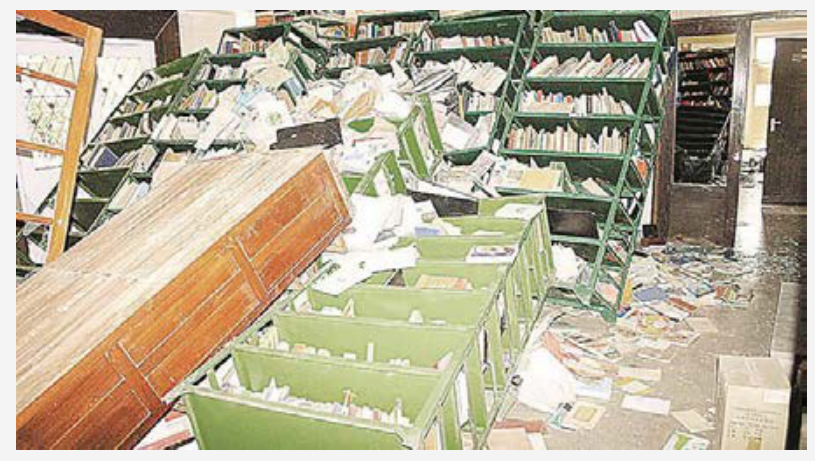
The oriental library Bhandarkar Oriental Research Institute was vandalized by neo-Hindutva extremist militants in 2004, which they justified as a reaction to “objectionable content published in the book” which who’s author was using references from this library. They were acquitted by the courts citing lack of evidence.187
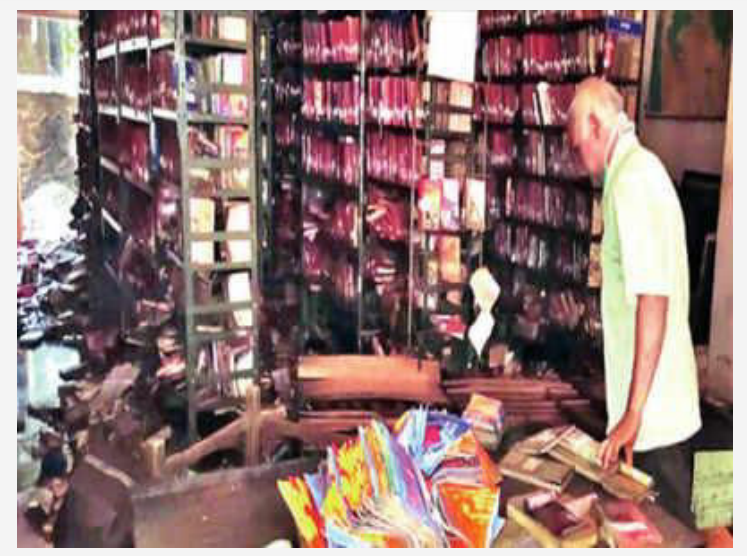
18 August 2019, centuries-old ancient manuscripts were destroyed in a 150-year-old library during a flood in Sangli. Local volunteers tried to protect them by drying them using hair dryers.188
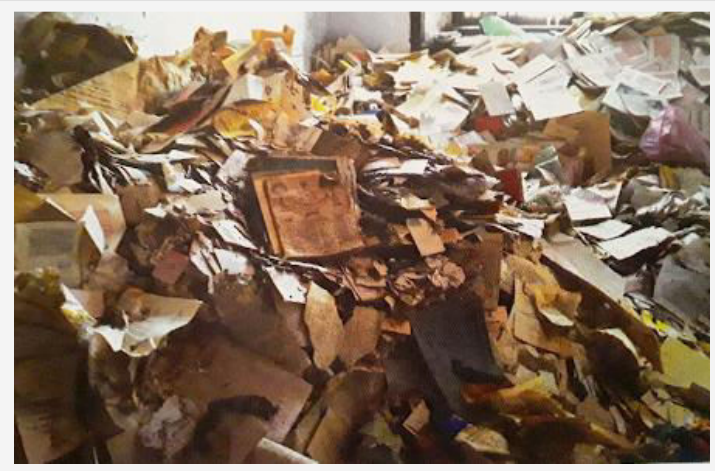
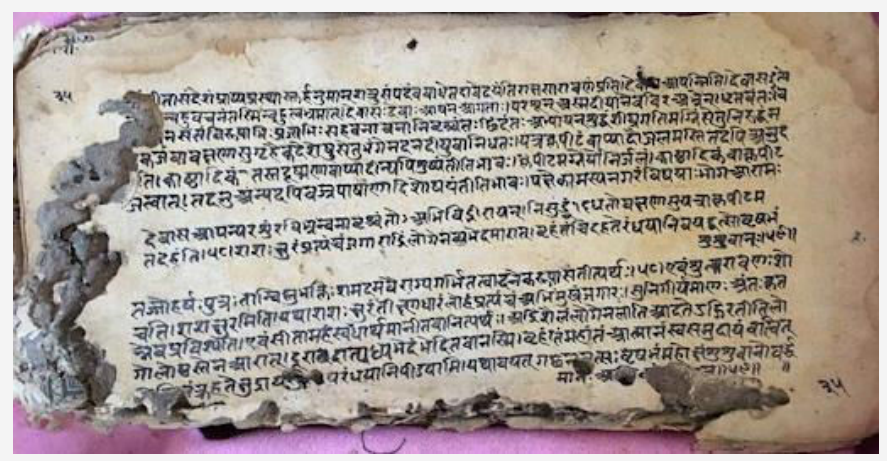
The two pictures above show the extremely vulnerable condition of original manuscripts in public and private libraries of India that complain of a shortage of funds and neglect of state officials. NHL has been working with several of these to fund and collaborate on the preservation work of these extremely valuable manuscripts.
The general apathy towards the protection of these scriptures is not a coincidence. Several knowledge communities (Brahmin Hindu scholars and monks) that have traditionally been protecting these manuscripts have been prime targets of persecution and cultural genocide. In the last few decades over 300,000, Adi Shaiva knowledge communities of Kashmir (Kashmiri Pandits) were forcibly displaced in seven exoduses189 because of terrorism and
https://indianexpress.com/article/cities/pune/maharashtra-bhandarkar-oriental-research-institute-vandalised-in-2004-13-yrs-after-attack-on-institute-all-68-accused-acquitted-4910035/
(i) https://indianexpress.com/article/india/damaged-by-floods-in-sangli-librarys-mission-to-save-75000-books-staff-students-6-hair-dryers-5970550/ (ii) https://timesofindia.indiatimes.com/city/kolhapur/floods-turn-rare-books-to-pulp-in-sanglis-150-year-old-library/articleshow/70719455.cms
http://www.ikashmir.net/exodus/index.html
genocidal attacks.190 Physical genocide is one in which people are killed; a cultural genocide is where people are annihilated by destroying their culture – their distinct cultural identity. Adi Shaiva knowledge communities of Kashmir are not the only ones who have faced genocides. The Adi Shaiva communities of Agama scholars and priests (Shivacharyas) in Tamil Nadu have endured a cultural genocide for the past one century under various anti-Hindu governments of Tamil Nadu.191
"South Asia :: India ┫The World Factbook - Central Intelligence Agency". www.cia.gov.
“The origin of the anti-Hindu caste system in India – a colonial-era census”, paragraph number 33 to 43
https://nithyanandapedia.org/images/7/77/Grand_Narrative_of_Hinduism-contributions_and_persecution.pdf
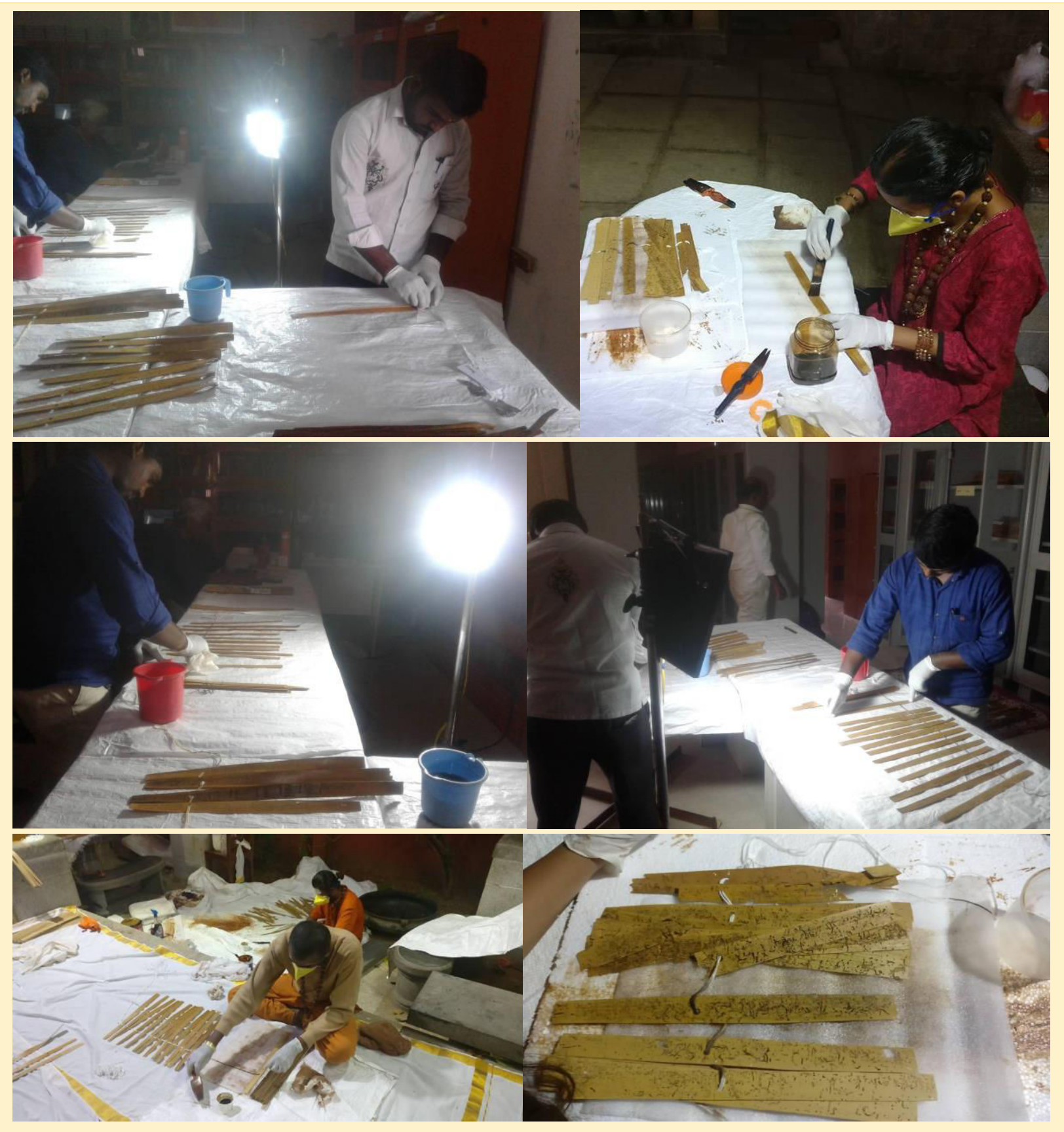
Volunteers of KAILASA’S NHL doing preservation work of rare books and palm-leaf manuscripts
The Vastness of indigenous knowledge corpus
The volume of indigenous source scriptures of Sanatana Hindu Dharma – the Veda Agamas – is massive192 – there are more than 100 million scriptures, most of which are lost and merely 20 million of which remain with us today. The mastery over these magnanimous volumes of Veda-Agamic scriptures is achieved by specializing in every sect, or branch of scripture over multiple generations. For this reason, the targeted persecution and cultural genocide of indigenous knowledge communities such as Kashmiri Pandits are especially worrisome. Indigenous Hindu tribes and schools specialized and systematically practiced only singular or a select number of branches of these Veda-Agamic scriptures and kept them alive over thousands of years.193 No single school of thought of scholars can master the Veda-Agamas (Hindu scriptures) in its entirety, let alone an individual. Each Hindu sect or school (Shakha or Sampradaya) is interdependent on other schools (Shakha) for the practice and application of the entirety of these indigenous peace scriptures of Hinduism. The loss of one lineage, or school (Shakha or Sampradaya) is not just a loss for the respective knowledge stream but a loss of the entire indigenous Hindu tradition. The destruction of the indigenous libraries destroys several thousands of years of scholarly research and practice of the indigenous Hindu scriptures. The indigenous Hindu scriptures are not just the repository of ancient spiritual and religious knowledge, they are a repository of a phenomenal volume of ancient Human knowledge and expertise, in various fields such as State Policies, Politics & Statecraft194, Law195, Banking & Accounting196, Architecture & Civil Engineering197, Performing Arts198, Medicine199, Surgery200, Botany201, Chemistry and Metallurgy202, Music203, Agriculture204,
Klaus Klostermaier (2007), A Survey of Hinduism: Third Edition, State University of New York Press, ISBN 978-0-7914-
7082-4, pg. 49–50
https://en.wikipedia.org/wiki/Shakha
Samrajya Laxmi Pithika, Niti Shashtra, Artha Shashtra, Manu Smriti
Dharmashastra, Manu Smriti, Parasara Smriti, Yagya Valk, Gautama, Mitakshara
Arthashashtra, Krisi-Parasara
Kamikagama, Mahaagama, and Suprabhedagama
Pancharatra Agama
Charaka Saṃhitā, Sham Raj, Nighant, Bhashya Parichehed, Madhava Nidan, Vagbhat
Sushruta Samhita
Vrukshayurveda, Bruhat Samhita, Sarngadhara's Vrukshayurveda, Parasara’s Vrukshayurveda
Rasahrudaya Agama, Rasendra Mangala, Rasarathnakara, Karshaputa, Lohasastra
Gandharva Veda
Krishi Parasara
Astrology205, Shipbuilding206, Manufacturing207, Food sciences208, etc. The Hindu knowledge in various fields is unique, unlike their modern counterparts. The indigenous Hindu scriptures enable not just excellence in a particular profession but the attainment of spiritual liberation even through the mere practice of the profession209. This is why, for example, the indigenous science of archery in Hinduism (Dhanurvidya), does not just deal with archery alone but also with the attainment of liberation. The science of Dhanurvidya is comparable to Kyūdō a Japanese martial art (budō), which is a form of meditation in action for moral and spiritual development – which has the supreme goal of kyūdō – the state of shin-zen-bi - which loosely translated as – when archers shoot correctly (i.e. truthfully) with virtuous spirit and attitude toward all persons and all things which relate to kyūdō (i.e. with goodness), beautiful shooting is realized naturally.210 There are primarily 32 such knowledge sciences (Vidya) and 64 such meditative arts (Kalaa) described in indigenous Hindu scriptures, most of which have lost their spiritual components in the contemporary era. The Acharyas (indigenous Hindu scholars and teachers) can transmit some portion of the domain expertise, but only the Guru guides into the science of liberation211 that is even realized while practicing a particular trade or profession212 without necessarily mandating additional spiritual practices. The destruction of indigenous Hindu libraries is an intellectual genocide, a cultural genocide of unprecedented scale and impact.
The following chart explains one of the structural organizations of scriptures done by the NHL (Nithyananda Hindu Library).
Siddbant Shiromani, Nil Kanthi, Mahurta Chintamani, Brihat Jatak, Shighra Bodh, Parasariya
Yukti Kalpa Taru
Nagalingayna-Kutha, Vishvakurma-Poorana, Kumalesherra Kalikamahata
Bhaga Shashtra
Ishavasya Upanishad, verse 2
Kyudo Manual, Volume 1, All Nippon Kyudo Federation (revised edition)
Guru Gita verse 1 to 11, https://www.hardlight.org/wordpress/images/Guru-Gita-complete.pdf
Bhagawat Gita Chapter 3 verse 9,17-20.
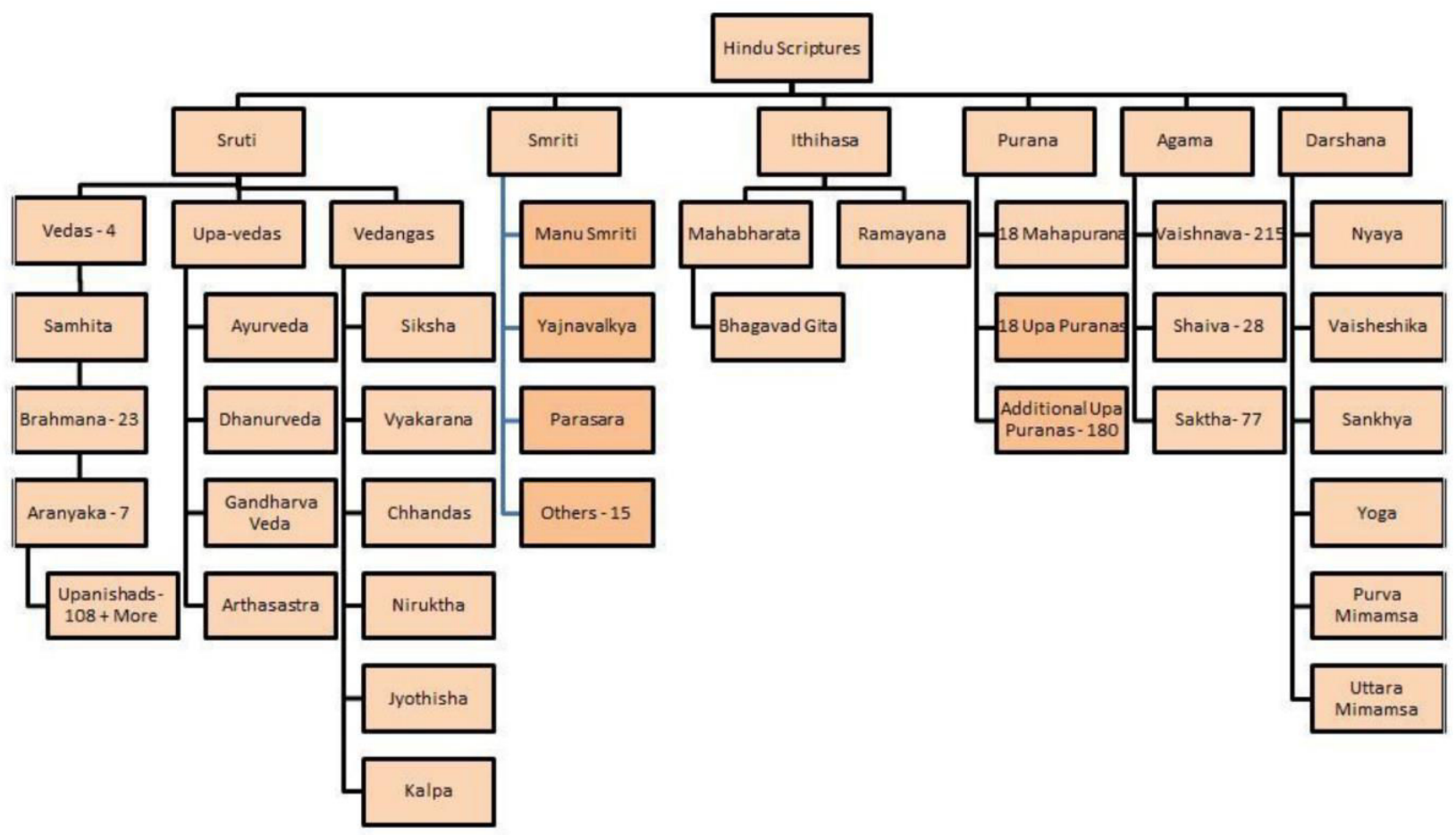
The magnanimity of the volume of written scriptures and the level of expertise required to master these seem almost impossible for a single generation of human beings. For instance, the Veda – the most ancient scriptures – comprise a total of 10,600 Verses213, which take a minimum of 24 to 40 years to master as per an indigenous school from 1542 CE that is still running.214 Compared to the Vedas, the Agama scriptures are far more voluminous. There are 28 main Agamas, and 202 Upa-Agama. The Kamika Agama alone is said to have more than one trillion verses.215 Similarly, there are 18 Major Puranas, 18 Upa-Purana, and other Puranas with more than 400,000 verses in major Puranas.
Although it might be ever impossible for humanity to comprehend this volume of scriptures that were written over time of several thousands of years, KAILASA’s Nithyananda Hindu Library (NHL), has attempted to provide a detailed structure and classification of these indigenous Hindu Source scriptures as ordained by Lord Paramashiva (Primordial Hindu Divinity). KAILASA’S NHL has developed the world’s first exclusive ‘Hindu library management system’ based on the ancient Vedic Scriptures classification tree. This classification system has more than 900 subject areas and more than 32 different levels of commentaries. NHL’s Indological knowledge classification system provides 30,000 different categories to catalog any book from Hinduism.
Avari, Burjor (2007), India: The Ancient Past, London: Routledge, ISBN 978-0-415-35616-9, pp. 77
http://rajavedapatasala.org/VedicSchool.html
Paramananda Agama (2nd chapter, Verse 7-10)
https://archive.org/details/64.tantraparamanandatantraraghunathmishra/page/n29/mode/2up
The important thing to realize is that several of these scriptures are very much alive – in terms of the knowledge they offer, their stories, anecdotes, their poetry, their sciences, etc. are very much part of day-to-day indigenous life. The indigenous knowledge communities – the Shivacharyas, Kashmiri Pandits, and various practicing Brahmin scholar communities, have spent their entire life and of several generations to protect these scriptures. Thus, their bodies are literally like a repository of ancient wisdom - something which Tibetan Buddhists understood and greatly appreciated. It is, for this reason, the Buddhist monks who fled the Nalanda University after several invasions took several scholars with them to Tibet and offered them refuge. The 14ᵗʰ Dalai Lama, Tenzin Gyatso, a Nobel peace laureate, had acknowledged the role of these knowledge communities in His personal life and refers to Himself as a disciple of this lineage216. Today Tibetan Buddhists led by the Dalai Lama are seen as the most tolerant and peaceful people on the planet, such is the potential of creating some of the best people that these indigenous scriptures hold for us.
The life of several spiritual leaders of Asia has been similarly touched by these scriptures and these scholars. The SPH Nithyananda Paramashivam has declared, "Book and Deities have made Nithyananda".217
The SPH Nithyananda Paramashivam received one such manuscript – Atma Puranam218 - at this age of 10219 and was given training in these early years of His life. The SPH Nithyananda Paramashivam stood for this knowledge, and in a mere five years of His public life was able to spread this knowledge science to 33 countries by hard work, His sheer devotion to the lineage of masters, and the intrinsic clarity these scriptures offer to humanity. The SPH Nithyananda Paramashivam has called these scriptures - New-Clear Bombs and credited great masters such Swami Vivekananda to have delivered these New-Clear Bombs to the world.220 Unlike nuclear bombs which take life and destroy several generations by radiation, these New-Clear bombs, these scriptures, give clarity about life and death, solve various problems of life contributing to several generations of people. During the last century, mankind has accumulated enough nuclear weapons to kill billions221, the SPH Nithyananda Paramashivam has rather focused His energy and of His people in protecting indigenous peace literature which are New-Clear Bombs of power thoughts with the potential to lead to world peace.
The Seventeen Pandits of Nalanda Monastery, James Blumenthal, July-September 2012 (Archived)
https://www.youtube.com/watch?v=sp6OKHFKALE
A Tamil translation of Atma Purnam – a compilation of four major Upanishad - Aitareya Upanishad, Isha Vasya
Upanishad, Brihadaranyaka Upanishad. The Sanskrit Devanagri version of the same of 1000 pages can be found here: https://archive.org/details/in.ernet.dli.2015.242346/page/n15/mode/2up
https://nithyanandapedia.org/wiki/May_26_2017
(i) https://nithyanandapedia.org/wiki/31_July_2015 (ii) https://youtu.be/kxjXtlBLc0I
https://ourworldindata.org/nuclear-weapons
However, it is not just in the field of literature that indigenous Hindu literature has contributed to the great minds. Several Nobel laureates in the field of physics, notable the quantum physicists such as Werner Heisenberg227, Erwin Schrödinger228, and Brian David Josephson229 have variously cited how they found spiritual wisdom in indigenous Hindu literature that even influenced their work in physics.
However, for indigenous scholars, these scriptures are not mere books or sources of knowledge – but living Deities – the manifestation of cosmic Divinity. Several indigenous sacred texts are worshipped daily as a lifestyle.
"Indian philosophers’ subtleties make most of the great European philosophers look like schoolboys", T.S. Eliot, 1933,
https://www.jstor.org/stable/1399046
Bernard Shaw, “The apparent multiplication of gods is bewildering at the first glance, but you soon discover that they
are the same GOD. There is always one uttermost God who defies personification. This makes Hinduism the most tolerant religion in the world, because its one transcendent God includes all possible gods.” https://citatis.com/a18035/269404/
V. S. Naipaul (1997), India: A Wounded Civilization, “The key Hindu concept of dharma - the right way, the sanctioned
way, which all men must follow, according to their natures - is an elastic concept.”
William Butler Yeats, “It was only my first meeting with the Indian philosophy that confirmed my vague speculations
and seemed at once logical and boundless.”
"William Butler Yeats papers". library.udel.edu. University of Delaware. Retrieved 30 October 2020.
Werner Heisenberg, “After the conversations about Indian philosophy, some of the ideas of Quantum Physics that had
seemed so crazy suddenly made much more sense.”, Pride of India (2006) by Samskrita Bharati. p. 56
Erwin Schrödinger (1951), My View of the World, (i) “In all world there is no kind of framework within which we can find
consciousness in the plural; this is simply something we construct because of the temporal plurality of individuals, but it is a false construction.... The only solution to this conflict in so far as any is available to us at all lies in the ancient wisdom of the Upanishad.”, (ii) “Vedanta teaches that consciousness is singular, all happenings are played out in one universal consciousness and there is no multiplicity of selves.”
Brian David Josephson, “The Vedanta and the Sankhya hold the key to the laws of mind and thought process which are
co-related to the Quantum Field, i.e. the operation and distribution of particles at atomic and molecular levels.”
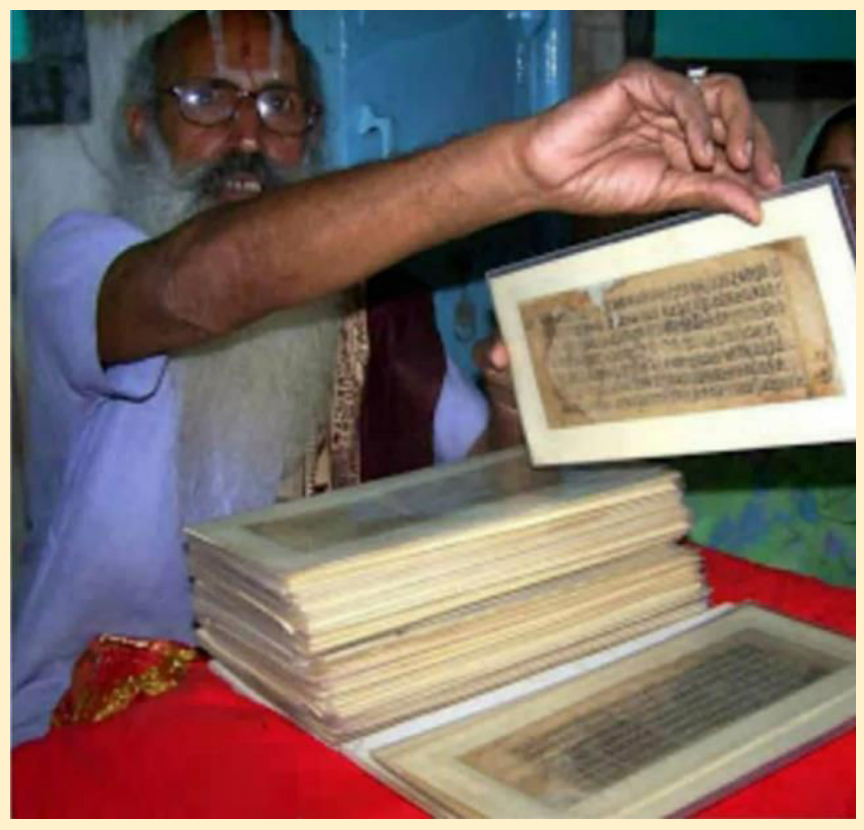
The original manuscript of Ramcharitmanas written by Tulsidas is well preserved even after 427 years in Tulsi Manas Mandir, Varanasi. These scriptures were protected by scholars with great care guarding against the destruction of several intolerant terrorists.
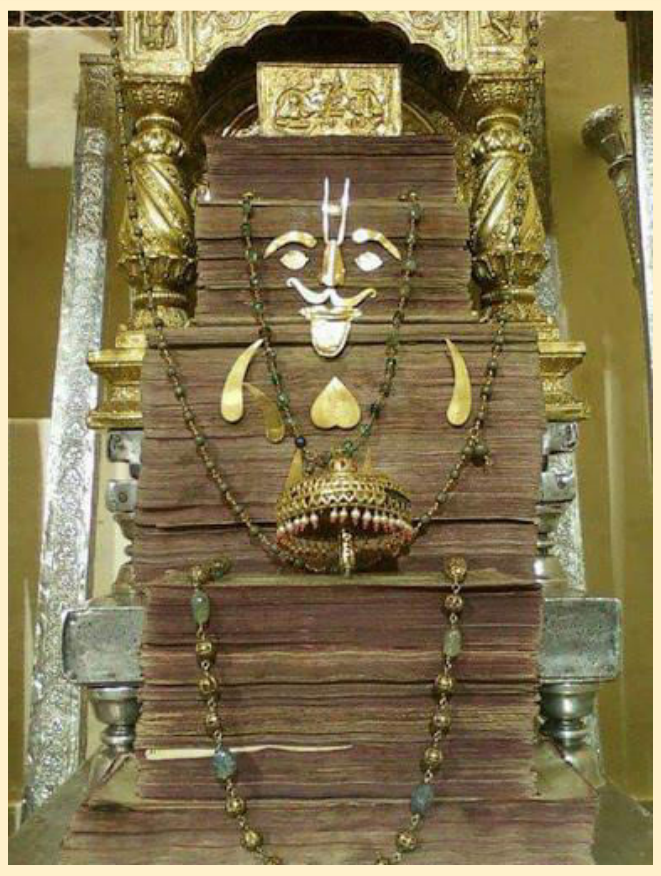
A Grantha Samadhi – indigenous scriptures worshipped as a Deity – 28 Agama Deity (Paramashiva), 108 Upanishads (Lord Rama), Purana (Ved Vyasa) made of palm-leaf, gold-leaf, silver leaf, copper, and other metals.
Though the Acharyas (indigenous Hindu scholars and teachers) can transmit some portion of the domain expertise of indigenous knowledge, it is but only the Guru who guides into the science of liberation230 that is even realized while practicing a particular trade or profession231 without necessarily mandating additional spiritual practices. In indigenous spiritual traditions lineages232 can be passed to the next generation only through lifelong, multi-generational233 spiritual practice, mentoring, and initiation by the Guru234. Hindu spiritual practices involve
Guru Gita verse 1 to 11, https://www.hardlight.org/wordpress/images/Guru-Gita-complete.pdf
Bhagawat Gita Chapter 3 verse 9,17-20.
Kularnava Tantra, 14th Ullasa, verse 8 – “तस्मात् सर्वप्रयत्नेन साक्षात्परशिवोदितम्। सम्प्रदायमविच्छिन्नं सदा कुर्यात् गुरुः प्रिये ॥ ८ ॥“
- “Therefore, O My Beloved! One should seek with all efforts to have a Guru of unbroken tradition originating from Para Siva Himself.”
Early Life Exposure to Environmentally Relevant Levels of Endocrine Disruptors Drive Multigenerational and
Transgenerational Epigenetic Changes in a Fish Model https://www.frontiersin.org/articles/10.3389/fmars.2020.00471/full
(i) Kāmikāgama Uttara Pada Chapter 25 verses 5-7, 8-11, 39-41
docs.google.com/document/d/1UB40gY9qADTdH5VrjIeejIesaDqzdX5nXxHaaXZQe3U www.himalayanacademy.com/media/books/kamika-agama-uttara-pada-part-2/kamika-agama-uttara-pada-part-2.pdf (ii) Regarding ādiśaiva the Kāmikāgama says that they are born in the family of sages such as Kauśika who were initiated directly by Śiva immediately after the creation of the world. Therefore, they are qualified to undertake all the rites [as
yogic processes which cause a conscious mutation at a physical, physiological, psychological, and neurological level, allowing practitioners to maintain meditative states of consciousness (Samadhi235) for prolonged durations.236 Some short-duration experiences of these meditative states are studied by contemporary western scientists in various groups of meditators237, martial artists238, and athletes239. Hindu spiritual processes and initiation by the enlightened Guru make the attainment of these meditative states of consciousness accessible to every practitioner, and not just to an accomplished group of people. As per the Hindu religious laws prescribed in Veda-Agamas (scriptures), only the ordained Guru can initiate their native Hindu community members into the practice of these yogic sciences, lifestyle sciences, knowledge system sciences, and sciences of ritual240.
One of the prime goals of the entire corpus of indigenous Hindu literature is to make these meditative states of consciousness (Samadhi) accessible to as many people as possible. It is this prime role, which today, is possible only by the SPH Nithyananda Paramashivam, who has dedicated His life to revive these scriptures as a living experience in the everyday lives of people throughout the world. One of the most read sacred indigenous texts, the Bhagavat Gita, cites the biggest challenge in this and how this knowledge has been lost time and again, "The supreme science was thus received through the chain of master-disciple succession and the saintly kings understood it in that way. In course of time, the succession was broken and therefore the science as it appears to have been lost."241 It is therefore extremely crucial for the SPH Nithyananda Paramashivam to be provided a safe place for Him to peacefully continue His mission of bringing these scriptures back to life in their complete form to their fullest.
Vision and Mission
Since 1988, starting with the book – Atma Puranam – the SPH Nithyananda Paramashivam has been collecting and protecting these sacred yet extremely vulnerable indigenous
prescribed in the āgamas] such as consecration, installation [in the temple], worship in public and expounding the [āgamas]
(vyākhyāna). The Kāraṇāgama and the Santānāgama also state that only the ādiśaiva is qualified to do these rites and if the rites are done by others it will bring only calamity. www.wisdomlib.org/definition/adishaiva https://en.wikipedia.org/wiki/Samadhi
Mystic Phenomena Scientific Data - ISBN: 978-1-934364-45-1 books.nithyanandatimes.org/product/mystic-phenomena-
scientific-data
Veltri, Michael (2017). The Mushin Way: How the Power, Clarity and Mindfulness of Aikido Can Bring Success in
Business and Life. John Wiley & Sons, Incorporated. ISBN 9781119285267.
Hyams, Joe. Zen in the Martial Arts. New York: Bantam Books, 1979
(i) Young, Janet A. & Pain, Michelle D. "The Zone: Evidence of a Universal Phenomenon for Athletes Across Sports".
(ii) ‘Do Top Athletes Experience the State of Pure Consciousness? Going Beyond Tiredness and Boredom’ - youtu.be/tNRUKLy0PMw
Pauskara Agama Vidya Pada, 1 Pati Patalah, 1 Chapter, 2nd Verse, www.himalayanacademy.com/view/pauskara-agama-
vidya-pada_v2. docs.google.com/document/d/1UB40gY9qADTDH5VrjIeejIesaDqzdX5nXxHaaXZQe3U
एवं परम्पराप्राप्तमिमं राजर्षयो विदुः । स कालेनेह महता योगो नष्टः परन्तप || Bhagavat Gita Ch. 4 verse-2 ||
scriptures. Since 2003, through KAILASA – the only Hindu nation – the SPH Nithyananda Paramashivam has with His team of monks, nuns, and volunteers have taken unprecedented efforts in organizing, preserving, time-capsule, decoding, and finally making these texts freely available and accessible through the internet. NHL has one of the largest collections of the most ancient Yoga manuscripts, for research, digitization, and publications. NHL has also developed an Indological classification system for the scriptures.
The SPH Nithyananda Paramashivam has declared that KAILASA’S Nithyananda Hindu Library (NHL) will be the epicenter for all Hindu scriptures, which will locate, acquire, collect, organize, publish, preserve, decode, and make relevant in daily life the indigenous Hindu scriptures. NHL will be housing 5 crores (50 million) books and manuscripts on Hinduism, Including Two Crores (20 million) sourcebooks on Hinduism.
Collection of Nithyananda Hindu Library as of 2021
• 1,000,000 digital books • 100,000 titles and physical books on Hinduism, which includes over 50,000 rare manuscripts on Hinduism, Performing Arts, Culture, Architecture, Hindu History, and Society. • More than 15TB digital Books and manuscripts, a special collection on Kashmir Shaivism, and various other rare manuscripts, books from ancient Mutts and Ashrams • It has an online repository242 of more than 14500 palm-leaf manuscripts online for free downloads • The library has identified and located more than 4,00,000 titles on Spirituality, Veda-Agama, Hindu Art and Architecture, Hindu Performing Arts, Hindu Sciences, and various other branches of Sanatana Hindu Dharma.
| 1 million+ Pages | 22,000+ Digital Books | 1000+ e-Text Books |
|---|---|---|
| 200,000 Sanskrit entries | 100,000 Article |
https://kailaasa.nithyanandajnanalaya.org
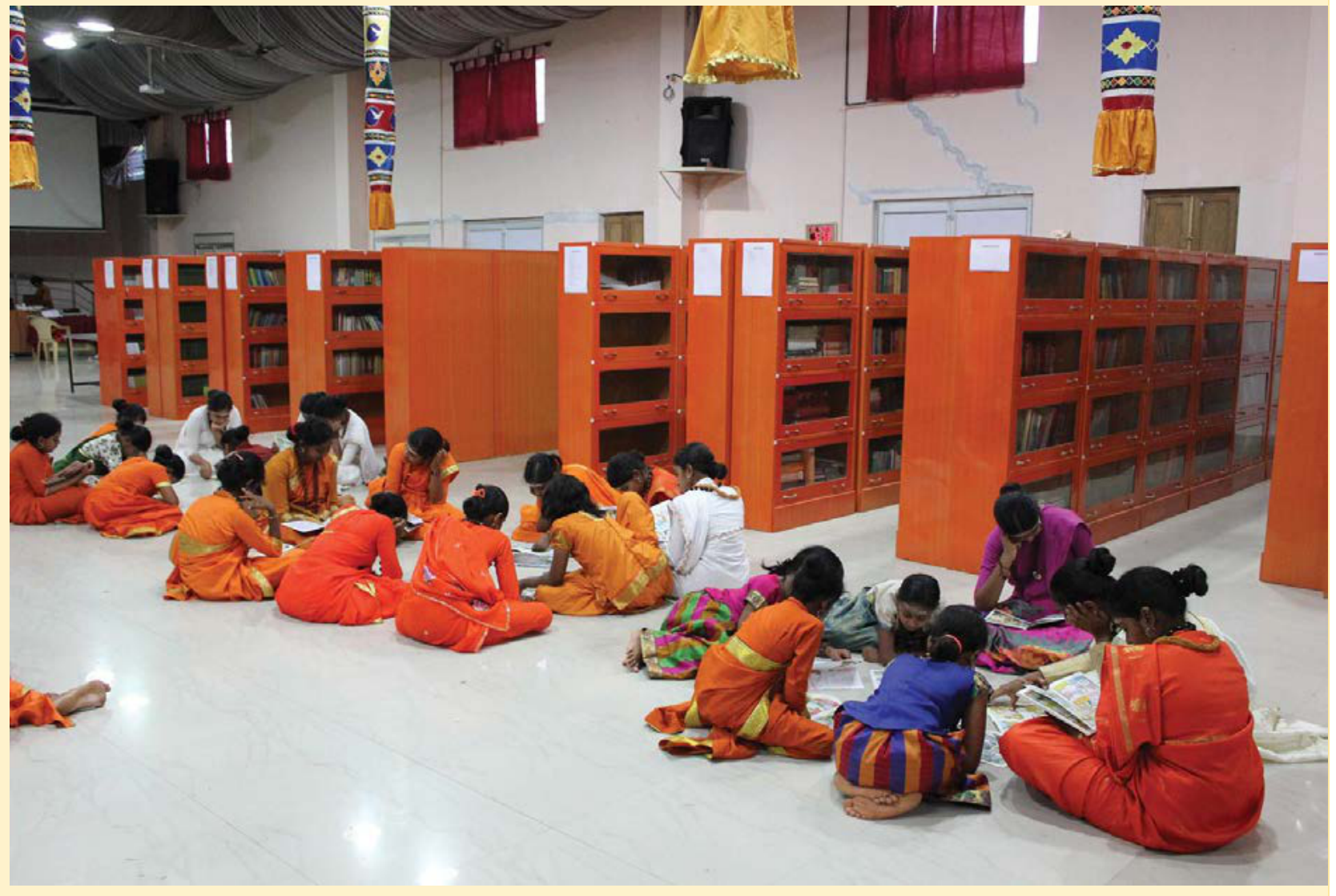
A section of the Nithyananda Hindu Library for students of Gurukul (indigenous Hindu schools).
The SPH Nithyananda Paramashivam has given magnanimous volumes of audio commentary on these scriptures which surpass 30,000 hours of playback time – a work realized over fifteen years. These commentaries and other video discourses total to more than a petabyte. The impact of even one hour of content delivered by the SPH Nithyananda Paramashivam has the potential to impact the world profoundly. One of these daily discourses243 of the SPH was edited and presented as a paper244 which was submitted to the United Nations to answer the questions245 and provide inputs to an independent UN expert for his report to the Human Rights Council and the General Assembly about the COVID-19 crises and multilateralism. In this particular paper, the SPH Nithyananda Paramashivam shared some wisdom of our ancestors on how multilateral treaties for common good were made amongst ancient indigenous nations based on a few Hindu principles. Yet these were just a few verses from the trillions of verses found in ancient indigenous scriptures. And these are not just ideas, they are backed with a history of experiences recording challenges, success, and failures seen along the way. This extremely crucial data containing the wisdom of our ancestors is made
https://nithyanandapedia.org/wiki/June_27_2021
https://www.ohchr.org/Documents/Issues/IntOrder/Multilateralism/AdiShaiviteMinorityTradition.pdf
https://www.ohchr.org/EN/Issues/IntOrder/Pages/cfi-covid19-multilateralism.aspx
accessible and available by the SPH Nithyananda Paramashivam in various ways which are directly relevant and useful to mankind.
At the same time, the commentaries on these indigenous scriptures have not been made abstract or too difficult for common people to understand. The SPH Nithyananda Paramashivam has chosen to simply several of these scriptures in the language of the common masses. The SPH Nithyananda Paramashivam has provided more than 10,000 hours of video discourses on YouTube alone, which attracted almost 81 million views and more than 50 million watch hours, serving more than 300,000 subscribers.
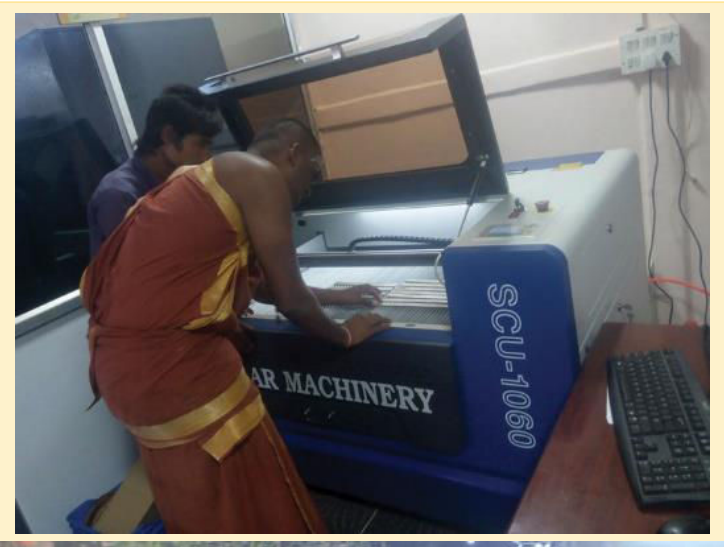
Various manuscripts which were endangered have been reprinted after scanning. Printed Palm leaves are used for various religious purposes and making worshipped Grantha Samadhis (Deities made from books and manuscripts). As of 2018, the printing of 140,000 palm leaves was in progress.
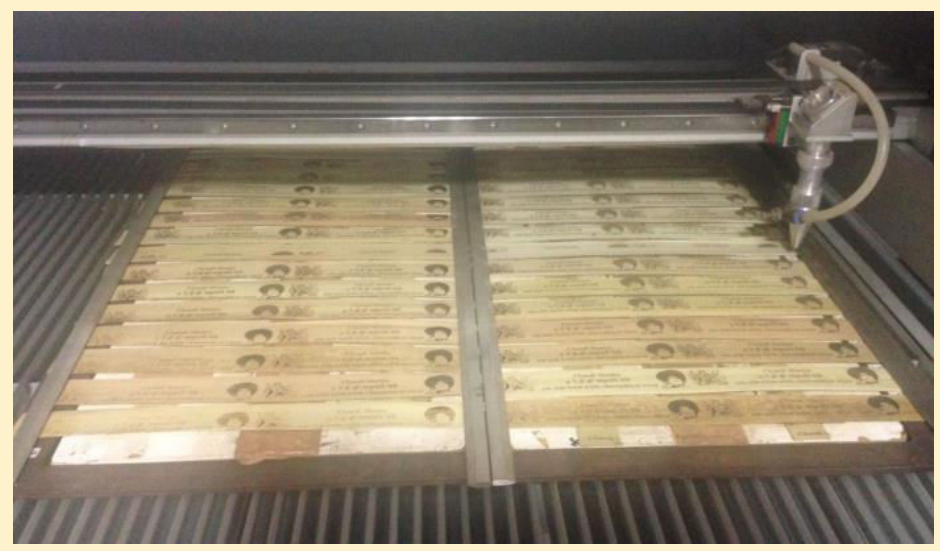

The SPH Nithyananda Paramashivam (right) inspecting the palm leaves after the application of a coating of protective chemicals.
The SPH Nithyananda Paramashivam has declared that millions of indigenous Hindu spiritual scriptures will be provided for download and kept for reference purposes, allowing people from all backgrounds can use these and refer. Even though the library is already providing digitized copies, NHL will be printing and providing hard copies. Traditional Grantha Samadhis (Deities made from books) will be made using traditional ancient and modern laser printed palm leaf manuscripts. The Grantha Samadhis would be of various indigenous scholars, masters, saints, and Avatars (incarnations) - honoring their contribution to Hinduism. All these books would be printed on non-tearing paper for long-term preservation with traditional rexine-grade binding of all books. For this, NHL has been setting up a large-scale digital printing unit at its library branch in Bengaluru.
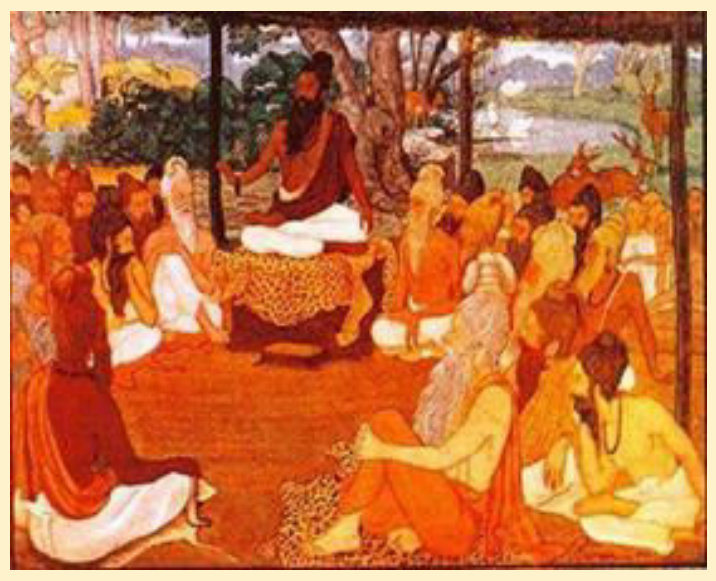
“In those days, anybody has any kind of conflict, problems, questions, they will go to Naimisharanya where all the scriptures are stored, and the rishis who have read all the scriptures are available who will refer immediately to the scriptures and give the answer to them, to the visitors. This is the Naimisharanya Project, reviving the Naimisharanya, the SarvajnaPeetha. I was sitting and spending some time with various manuscripts. I thank, sincerely, the various organization and the Shivacharyas for their amazing contribution, collecting, scanning, preserving, all the manuscripts related to Agamas, collecting, scanning, preserving all the manuscripts related to agama and ancient scriptures. I am spending days and nights with these huge collections. These are one step towards preservation and revival of Sanatana Hindu Dharma.”
The SPH Nithyananda Paramashivam on May 25, 2014
The SPH Nithyananda Paramashivam’s vision is to enable scholars and common people to easily access these scriptures and be able to apply the knowledge in their day-to-day life. For this, the library department has developed several software utilities, such as a search engine tool to phonetically search irrespective of the spelling of the text present in the content, a bi-lingual text recognition OCR (optical character recognition) that can simultaneously recognize more than one script from a document. The SPH Nithyananda Paramashivam has also released Kailasa’s Hindu Compliance Systems which brings an innovative solution to global challenges as per the indigenous Hindu scriptures (Veda-Agamas), in form of technical documentation called Hindu Standards.246
https://khcs.nithyanandajnanalaya.org