Becoming one
This text was machine-transcribed from the printed book and may contain errors. Select the words and choose “Report a mistake”.
chapter 11
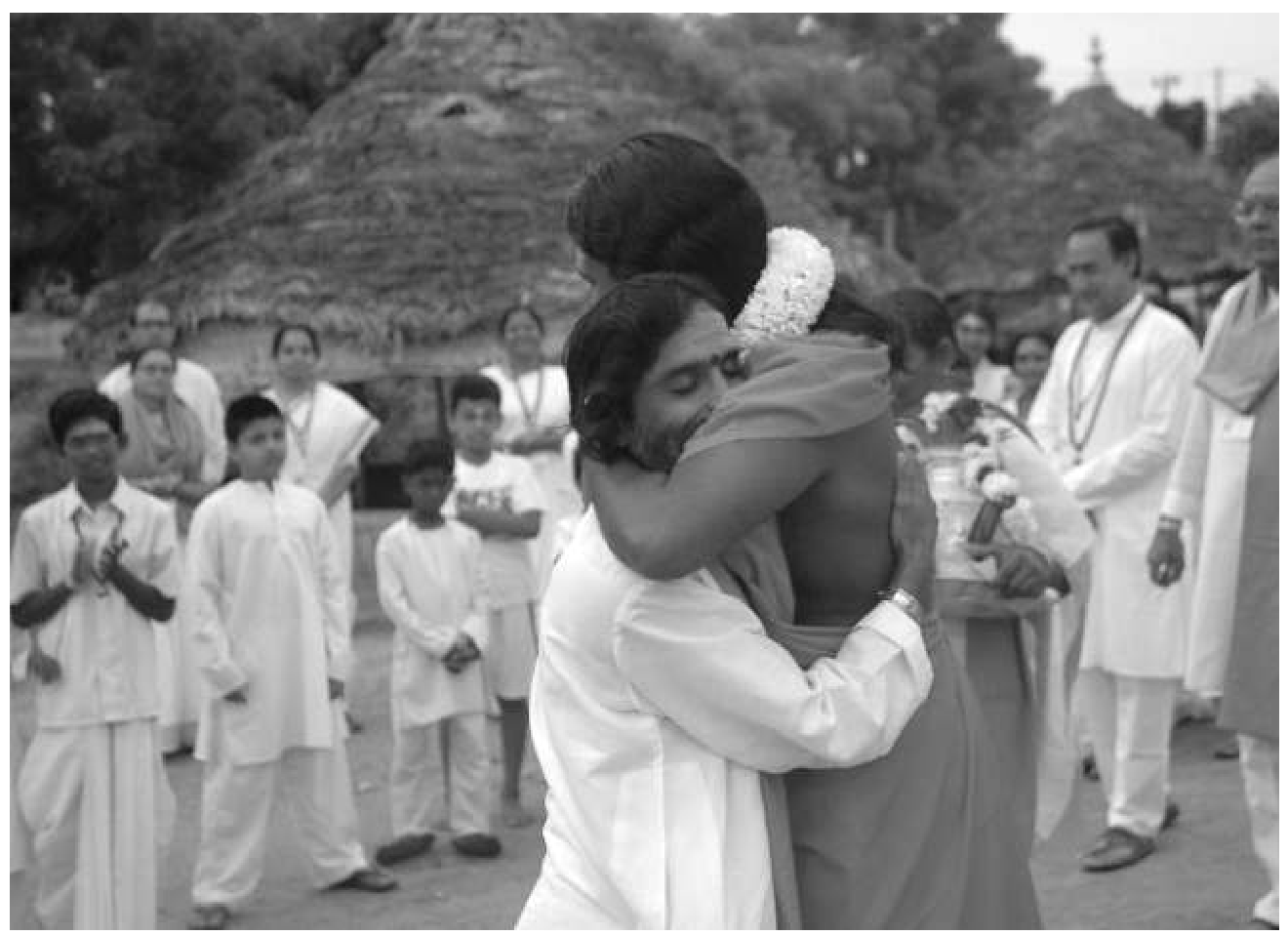
The moment you become my disciple, it means you are dropping all ideas of separation. In the beginning, you will drop the idea of separation from me; you will experience oneness. And soon, this oneness will grow and you will start feeling it with the whole of Existence. Then everything will be one; there will be no separation. There will only be one cosmic whole.
A small Zen story:
Kakua, a Japanese Zen Master went to China to study Zen. He lived in the mountains where he would continuously meditate. If people discovered his hideout and pestered him to speak, he would say a few words and move on to a less accessible place.
When he came back to Japan, the emperor sent for Kakua. He requested him to teach Zen to him and his subjects. Kakua stood in silence for some time. Then he took out his flute and blew one short note. After playing that single note of Zen he made a courteous bow and disappeared.
[Figure: Statues of Hindu deities]
You see, there are two things: communication and communion. You must understand the difference. Communication happens all the time; it is from the ego, the mind. But communion happens between two beings. It is a deep merging that comes from within.
Communication is the sharing of ideas; it is between two minds. But communion is a sharing of energy. It happens in complete silence. It is a merging where you lose your identity.
When you sit around me, after some time you will be shocked to see the watch. So many hours would have gone by! This is because when you are with me, there is a beautiful communion that is going on. This is the merging of the Master and disciple.
One more thing: you will never be my disciple. I am only a link. You can only be a disciple of the Divine; a disciple of Existence. You become a disciple through the Master. I am only the door, but the other side of the door is where you need to go.
The Master is only a visible form for the invisible. This is because the ego will not be able to relate with something which is not seen. Actually, the Master is both visible and invisible. When you initially come to me, you will know only the visible. But as time passes, the invisible becomes clear to you. You begin to feel the absence in the presence.
The closer you come to the Master, the deeper you go, the less you will be able to find him. As you move deeper, finally the invisible is revealed.
I am reminded of a story about Bodhidharma...:
Bodhidharma sat for nine years staring at a wall. This was his meditation. When disciples would come to him for guidance, he would simply tell them to sit and gaze at the wall. After a few hours, many would leave; what to do...? Simply sitting and gazing at a wall?
But those who stayed on and trusted the Master attained to the highest peaks that have been available to humanity. And the whole of Zen stands on Bodhidharma's ideology.
There is a small Zen story:
A Zen Master was becoming old and announced he was looking for somebody to whom he could pass on the monastery, and who would take care of the mission. He said he would choose the disciple who would submit the best poem showing his understanding of Buddhism. Everybody thought for sure that the chief monk Shen-hsui would be chosen. So they did not even try to compete. But Shen-hsui was not so sure of his understanding. He wrote an anonymous poem on the walls of the Master's quarters. It went like this:
The Bodhi Tree is the body
The mind is a shining mirror
Make sure that you wipe it
And let no dust stick to it
The next morning, when the Master read the poem he asked his disciples to burn incense before it and said that whoever practiced what was in the poem would realize their true nature. Shen-hsiu told him in private that it was he who had written the poem. The Master said, 'Your understanding is not yet perfect.'
The morning after that, another poem appeared beside Shen-hsiu's poem:
There never was a Bodhi tree.
There is no bright mirror.
Nothing exists.
So where is the dust to stick to it?
The Master knew that only Hui-neng, one of the junior most monks could have written it. He rubbed out the poem with his shoe and secretly called Hui-neng to his room. The Master told him to take care of everything after his death and told him to run away to the mountains and stay there until the monks got over their hurt feelings and were ready to receive Hui-neng's teachings publicly.
Hui-neng did so and went on to become one of the greatest Zen Masters ever.
Understand: I am not there and you are not there. There is only a great emptiness that is. It is this emptiness you have forgotten and it is this emptiness you are here to remember.