DISCLAIMER
This text was machine-transcribed from the printed book and may contain errors. Select the words and choose “Report a mistake”.
KAILASA's Rajavidya Nityananda Gurukul
All rights reserved. No part of this publication may be reproduced or stored in a retrieval system or transmitted by any form or by any means - electronic, mechanical, photocopying, recording or otherwise, without the written permission of the publisher.
All meditation techniques, practices and procedures described or recommended in this book, are suitable for practice only under the direct supervision of an instructor, trained and ordained by Supreme Pontiff His Divine Holiness Bhagavan Nityananda Paramashivam. Further, you should consult your personal physician to determine whether those techniques, practices are suitable for you in relation to your own health and ability. This publication is not intended to be a substitute for any personal medical attention, examination or treatment. Should any person engage in any of the techniques, practices described or recommended in this book, he/she would be doing so at his/her own risk. The authors and publisher advise readers to take full responsibility for their health and know their limits.
Readers understand that all blessings, instructions, initiations, teachings and suggestions made as part of any program/technique described in the book are purely in a spiritual capacity and are not intended to be any sort of guarantee or definitive statement about the past, present, or the future or any sort of medical advice, physical or mental. Readers understand that the author, publisher, co-collaborators with any or all of the programs/techniques, instructions, initiations, teachings described in the book do not make any claims, promises, or guarantees about the individual or group outcome of any or all the programs/techniques described in the book.
© 2020 Sri Nithyananda Paramashivam. All Rights Reserved.

The SPH Nithyananda Paramashivam
The Supreme Pontiff of Hinduism ("SPH") Nithyananda Paramashivam, is recognized as the 1008th living manifestation of Paramashiva, Paramavatar of Paramaśiva as per Sanatana Hindu Dharma ("Hinduism") and by His predecessors of enlightened masters and adepts. The Supreme Pontiff of Hinduism ("SPH") Nithyananda Paramashivam, is reviving Hinduism as the 1008th Acharya Mahamandaleshwar (the head for all spiritual leaders) of Atal Akhada (ancient apex body of Hinduism).
The SPH was coronated as Mahamandaleshwar (Supreme Spiritual Head) of Maha Nirvani Akhada (largest apex monastic order) and the youngest Mahamandaleshwar, ordained as the 233rd Guru Mahasannidhanam (Pontiff) of Thondai Mandala Aadheenam, ordained as the 293rd Guru Mahasannidhanam (Pontiff) of Shyamalapeeta Sarvajnapeetam, ordained as the 23rd Guru Mahasannidhanam of Dharmamukthi Swargapuram Aadheenam, and coronated as the 203rd Emperor of Suryavamsa Surangi The SPH Nithyananda Paramashivam is the reigning spiritual emperor of 20 ancient traditional Hindu kingdoms and the reviver of the most ancient, most peaceful, still-living and long-lasting demonstrable system that shows the possibility of peaceful co-existence amongst people.
© 2020 Sri Nithyananda Paramashivam. All Rights Reserved.
KAILASA
Hinduism is the most ancient, most peaceful, still-living and long-lasting demonstrable system that shows the possibility of peaceful co-existence amongst people despite fundamental differences in their preferences and realities.
Over the last 50 years, the effects of meditation and its significant impact on stress, crime rates, violence, political decision making and even war in local and global consciousness is well established. Hinduism was once practiced freely in over 56 nations across the continent from Afghanistan, India, Nepal, Burma, Sri Lanka, all the way to Singapore, Malaysia, and Cambodia and Indonesia, and in 200 states, 1700 samasthanas (provinces) and 10,000 sampradayas (traditions).
The KAILASA with de facto spiritual embassies operating across over 100 countries and having presence across the globe as the largest spiritual knowledge source on Hinduism is spiritually governed with the life positive, all-inclusive, universal policies sourced from Hinduism revived by The SPH Nithyananda Paramashivam.
Having enriched and enreached more than one billion individuals over the past 27 years the KAILASA raises the voice to protect Hindus, defend Hindus and preserve the Hindu narrative for the world.
© 2020 Sri Nithyananda Paramashivam. All Rights Reserved.
PUBLISHED BY
eN Galleria Nithyanandapuri, Off Mysore road Bidadi-562109,Bengaluru Karnataka state, India
Copyright © 2012 - 'Year of Sharing Enlightenment' Ebook ISBN: 979-8-88572-786-0 First Edition: 2012, July
All rights reserved. No part of this publication may be reproduced, or stored in a retrieval system, or transmitted by any form or by any means, electronic, mechanical, photocopying, recording or otherwise, without written permission of the publisher. In the event that you use any of the information in this book for yourself, the author and the publisher assume no responsibility for your actions.
Contact us at Nithyananda Dhyanapeetam, Nithyanandapuri, Off Mysore road, Kallugopahalli, Bidadi - 562 109. Mail us at [email protected]
OVERVIEW
Our Early childhood learning program is based on a process oriented curriculum that fosters each child's individual development. We emphasise the important role the BLISS curriculum plays through the development of the big picture, creativity and celebratory learning. The entire learning philosophy is founded on the principle that early childhood development must focus on the Bodily Kinaesthetic, Linguistic, Intuitive, Social Emotional, & Spiritual (BLISS) curriculum to ensure all-round development of the children.
The spontaneous learning is based on:
- Recognising the need for children to practice skills and consolidate their learning by providing opportunities for repetitive experiences and extension of their ideas
- Designing and establishing enriched activities that stimulate the imagination, promote creativity and enhance aesthetic development and appreciation of nature
- Providing opportunities for discovery, learning through self-selected activities, and encouraging the development of the child's abilities to observe, perceive, explore, investigate, imagine and solve problems
- Valuing the arts as symbol systems through which children discover and express meaning and make sense of themselves and the world around
- Valuing play as a medium for all aspects of development and learning
- Acknowledging and supporting children's individual learning styles
These books are specially designed to provide the children the right way of learning. This time tested and proven experiential learning methodology provides your child with a fun-filled opportunity to assimilate vast amounts of knowledge in a shorter time span.
WHOLE-BRAIN LEARNING FOR THE CHILD THROUGH THE BLISS CURRICULUM
BODILY KINAESTHETIC - Develop competence in using large and small muscles, taking care of and respecting our body, being aware of and practicing good nutrition habits, thereby develop overall physical fitness.
LINGUISTIC - Develop deep understanding of words and a sensitivity to the literal and figurative meaning of words. Added focus on oral and written communication skills, grammar rules, sensitivity to musical qualities and rhythms of words, uses for language such as persuasion, information or pleasure.
Develop the thinking mind(observing, recalling, comparing, patterning, classifying, generalizing, integrating and evaluating), constructing knowledge, developing memory skills, acquiring facts, and responding and communicating through (listening, speaking, writing and reading).
INTUITIVE - Develop sensory awareness, imagine and visualize, explore, create, respond and interpret; develop critical awareness, express and represent through a variety of forms.
SOCIAL & EMOTIONAL - Develop internal behaviour control, help, cooperate, respect and accept others, develop friendship, appreciate the culture and heritage of others, develop a positive realistic concept of self, accept and express emotions in socially appropriate ways, cope with change, develop decision-making skills, accept challenges, and develop independence.
SPIRITUAL - The Spiritual Quotient, SQ is based on the third neural system in the brain, the synchronous neural oscillations that unify and integrate the data across the brain. This process facilitates interactions between emotions and logic. It thus provides a meaning giving centre to the individual. It helps develop Self-awareness, Flexibility and adaptability, Ability and capacity to face, use and transcend pain and suffering, Vision, Values, Wisdom, not to harm or hurt others and self, Holistic approach and views, Appetite for seeking answers to fundamental questions by using "why" and "what if", Courage to work against conventions if necessary.
TABLE OF CONTENT
Paramahamsa Nithyanand - 03
Pet Animals - 07
Farm Animals - 25
Sea creatures - 43
Wild Animals - 60
Actions - 77
Insects - 92
Clothes - 109
Fruits - 125
Household Articles - 142
Season I - 155
People at Work - 169
Shapes and colors - 185
Family and Friends - 200
Body Parts II - 215
Body Parts I - 231
Emotion - 248
Plants and trees - 263
Vegetables - 279
Solar system - 297
Flowers - 315
Transportation - 331
Mammals - 347
Circus - 363
Reptiles - 378
Amphibians - 395
Birds - 411
Neighborhood - 427
India - 440
World Wonders - 455
Sports - 470
Teddy - 484
Opposite - 499
Beach - 514
Musical Instruments - 528
Rhymes - 542
Fairy tales and toys - 556
Season II - 570
Biomes - 584
Land forms and Water forms - 598
Appendix - 613
BLISS CURRICULUM
June Week – 1 Alphabets of the Month: A, B, C, and D
Theme: Pet Animals Color of the Month: Blue, Indigo, violet Shape of the Month: Triangle, Prism, cone
| Monday | Tuesday | Wednesday | Thursday | Friday | |
|---|---|---|---|---|---|
| CIRCLE TIME |

Pet show. Mystery bag. | Pet sounds. | Pets and babies. | Pet caring. | Pets and habitat. | | ART |
Thumb printing. Thread painting. | Smell painting. Cut and stick fish bowl | Collage with wool. Sponge printing. | Dog craft, origami (dog or cat) | Crayon coloring, making mini book. | | ACTIVITY |
Wrap and unwrap toy pets, matching animal sounds. | Texture matching, kaleidoscope | Quiet game, sand pouring, | Taste box, flour mixing. | Whistling, blowing, guess the animal. | | GYM |
Hop, crawl, creep, swim like an animal, jump on animal foot print. | Toss the ball on the pet, dog and the bone. | Basket ball, balancing | Copy cat, play with balloons. | Roll over, hopscotch. | | A-Z OF PET ANIMALS |
A-Algae, Aquarium / B-Bone, Bark / C-Cat, Cage / D-Dog / E-Egg / F-Fish / G-Guinea pig, Golden fish H-Hamster / I-Injection / J-Jump / K-Kennel, Kitten / L-Love Birds / M-Money / – Nestling O- Howling / P-Parrot, Pet / Q-Quarantine / R-Rabbit / S-Shop / T- Tail, Tongue / U- Rough / V- Vaccination W- Whiskers / X-Box / Y-Yarn / Z- Zigzag | | | | |

DAY: 1
Topic: Introduction and classification of pet animals
Vocabulary: pets, dog, hamster, rabbit, golden fish, ornamental fish, pet food, vet, collar, cage, kennel, aquarium, burrow.
Material required: pictures, fur toys of pets, mystery bag.
Presentation: • Dog, cat, parrot, fish, hamster, guinea pigs, love-birds. Introduce them to various pets using required materials. • Discuss why they are called pets. We can keep only pet animals at home. • Talk how we classify the animals. People keep pets as companions, helping them, sometimes simply to look and admire, cuddle and love them. • Tell them the animals that we can keep in our homes, feed and care for them are called as pet animals like dog, cat, rabbit, hamster, parrot, fish etc. • Talk about pet animals home like cat lives in the basket, dog in kennel, parrot in cage, fish in tank. • Talk about the various types of dogs. • Encourage them to talk about their pet, how do they take care, feed.
Assessment: • What are pet animals? • Name the birds which we keep as pets? • Where do we keep pet animals? • Where do cats live? • What do you call a dog's house? • What responsibilities come with owning a pet? • Which pet would you choose if you wanted? • What are the different types of dogs?
Closing: To help them understand about pet caring, loving, feeding etc, to take responsibility of owning a pet, understand which all animals are called pet animals, and increase their knowledge about pets.
Evaluation: • Cognitive skills by encouraging them to classify the animals. • Social/ emotional skills of telling them about the caring and owning of pet. • Receptive language skills of knowing the concept.
Extension: Play dough animals using the cutters. Mystery bag. Place different animals in a tray. Ask them to sort animals.
DAY: 2
Topic: Pet sound and feeding
Vocabulary: Animal cries, bark, meow, bone, carrots, milk, fishes, chilly, corn, guava
Material required: CD's supporting sounds. Animal sound book.
Presentation: ● Recall about the previous days topic. ● Animals communicate, by making different sounds, sometime by licking. ● Discuss how animals communicate. What sound or cries they produce. ● Puppies will not make sound like dog. ● Encourage them to tell why do dogs bark? ● Is there a difference between various sounds: when they are in pain or when they see a stranger? ● Tell them about how trainers work with pets especially dogs. ● How to do they follow the trainer's instructions. ● Cat is an omnivorous animal; it eats milk, fish, meat etc. ● Dog barks woof woof, cat meows meow meow. ● Rabbit eats carrot. ● Tell them about parrot and its talk, imitating sounds? ● Parrot favorite is guava, chilly, nuts etc. ● Dog eats bone, drink milk and it's an omnivorous.
Assessment: ● How do the pets communicate with its master? ● When do the dogs bark? ● What sound does the love bird make? ● Do birds make the sound after they sleep? ● Do puppies bark like dogs? ● What does cat feed on? ● What do rabbits eat? ● What is the favorite food of the parrot? ● What does the dog feed on?
Closing: To recollect the information about pet sounds and their food habits.
Evaluation: ● Cognitive skills -open ended question and answers ● Auditory skills-produce the sounds and ask them to guess. ● Expressive language skills-ask them to produce the sounds of various pets.
DAY: 3
Topic: Talk about pet and babies
Vocabulary: Puppy, kitten, chick.
Material required: Animals and their babies pictures or puzzle.
Presentation: ● Show them the pictures. Discuss about the young ones and what they are called. ● Cat- kitten, dog-puppy, parrot-nestling, fish-fry, rabbit-kits/kitten/bunny. ● Tell them about how dog will take care of puppies. ● Dog, cats, hamsters, guinea pig carry their young ones with their mouth to keep them in a safe place and protect them carefully till they are grown big. ● Talk whether they are born or come from eggs. ● Discuss about how the adult will take care. ● Birds take care of their nest very carefully and feeds young ones on time when they call or make sound. ● Discuss, match and play the games of animals and their babies puzzles.
Assessment:
● What is a young one of cat called?
● What is a baby dog called?
● What is baby rabbit called?
● What is a young one of fish called?
Closing: To make them understand about the young ones of pets.
Evaluation: Expressive and receptive language skills- by understanding the vocabulary and how well they explain the topic.
Extension: Work sheets based on animals and their babies
[Figure: TEACHER CREATED MATERIAL PETS HANDBOOK]
DAY: 4
Topic: Pet caring and texture book
Vocabulary: pet caring, veterinarian, signboard, safety, vaccination, fluffy furry, soft etc.
Material required: Pictures of pet shop, books, and texture books of pet.
Presentation: • Show them the pictures and talk about how to take care of pets. • Timely proper feeding, caring should be done. • When pets are unwell we need to go to a vet. • Regular vaccination to be given. • Tell them about the safety: always wash hands after touching the pet. • Discuss about how we feel when we are with them. • Talk about training, playing with them, dogs always like to play with ball, rings etc. • Trainer will give bath daily to the pets. Trainer gives training when they are babies by talking, by actions • Veterinarian- is a doctor to take care of the animals when they are sick. • Talk about the signboard that reads “beware of dog”. • Texture book of pets can be given to the children to feel the texture and can be explained about furry, fluffy, soft etc.
Assessment: • Do dogs and cats take bath daily like us? • What is vaccination? • Have you taken vaccinations? • Who trains a dog? • Have you seen dogs perform tricks?
Closing: To make them understand how to take care of pets through loving, enjoying and playing.
Evaluation: • Social/ emotional skills-caring for other, recognizing other feeling. • Sensory awareness- through touch books.
Extension: Pretend play using fur toys. Ask the children to take role of owners. Demonstrate the responsibility towards pets.
DAY: 5
Topic: Pet and their habitats
Vocabulary: Kennel, burrow, cage, aquarium.
Material required: Pictures of pet house, if possible to get a bird along with cage or an aquarium
Presentation: ● Show them pictures. Discuss about dog stays in kennel and fish lives in aquarium. ● Discuss their experiences with dogs, cats etc. ● Dogs wag its tail if it see its master and lick to show its love. ● Cats come and cuddle to show its love. ● Dog love bones, milk, biscuits and lives in the kennel. It guards our house. ● Cats love milk, fishes and lives in the basket and they love to play with yarn. ● When birds are used to the masters they will not fly away anywhere, they go out come back home correctly. We keep pet birds in cage.
Assessment:
● Where do dogs live?
● Where do the cats live?
● Where do the rabbits and mice live?
● Where do fishes live?
Closing: To make them understand about the pets and their habits.
Evaluation: Cognitive skills- applying knowledge, listening.
Extension: Play animal and their home puzzle. Make a kennel using juice cartons.
DAY: 1 ART
THREAD PRINTING
Material required: Thread of varying lengths, different poster colors, uncolored art sheet or plain sheet, paint pallet.
Procedure: Children can dip the thread in the paint and keep it on the art sheet and fold the art sheet. Holding firmly the or sheat on the table with one hand and pull the thread out after moving the thread in various directions with the other hand.
Skills developed: Fine motor skills of tripod grasp, eye hand coordination, cognitive skills of cause and effect.
THUMB PRINTING
Material required: Uncolored art sheet, paints of various colors, paint pallet
Procedure: Children are asked to dip their thumb the paint and do thumb print on the given picture. They can do thumb printing with various poster colors. Encourage the children to do the printing only inside the picture.
Skills developed: Fine motor skills, sensory skills cognitive skills of knowledge of various colors, cause and effect.
Variation: Children can use the thumb printing to make various designs and pictures. Instead Children can also finger printing .
DAY: 1 ACTIVITY
WRAP AND UNWRAP TOY PETS
Goals: To improve their fine motor skills, eye hand coordination, sensory awareness,
Material required: Color paper/ newspaper, small pet animal toys.
Introduction and Presentation: Present the activity by wrapping any pet animal toy with color paper or newspaper and then show how to unwrap gently and slowly. They can identify the pet animal toy which are wrapped blindfolded. Tell them for what occasion or purpose we wrap pet animal toys.
Assessment:
• Can we the see the wrapped objects.
• With what can you wrap things?
• Can you name the objects?
Evaluation: Evaluate each child's ability to wrap, unwrap and the coordination involved in the activity, and their creativity.
MATCHING ANIMAL SOUNDS TO ANIMALS
Goals: To improve their auditory skills, oral motor skills and cognitive skills.
Vocabulary: Chirp, bark, meows, roar, etc.
Materials required: Music book with animal sounds (if possible), animal toys or pictures.
Introduction and Presentation: • Make the children sit as a group. • Use music book to make animal sounds or mentors or children can make sounds like animals. • Ask the children to close their eyes and observe the sounds and they can name the animals or they can match it with the toy animals.
Assessment:
• What sound the bird makes? (Chirping).
• What sound lion makes? (Roaring).
• How dog barks?
• How horse neighs?
Evaluation: Evaluate them by making more animal sounds.
Skill development: Auditory, Cognitive, Oral motor if they make animal sounds.
Rhyme: “Old McDonald had a farm”.
Variation: “Guess the animal” Give clues to the children about animals and ask them to guess the animals.

DAY: 1 GYM
HOP, CRAWL, CREEP, SWIM LIKE AN ANIMAL
Goal: To develop their gross motor skills.
Presentation: ● Hop: Children are asked to stand on one foot and move from one place to another by hopping. ● Crawl: Children are asked to sit on their knee and to move using hands and knee. ● Creep: Children are asked to lie down on the floor, on their tummy and move using hands and leg in lying position (like snake). ● Swim: Children are asked to lie on their tummy on the floor and they are asked to move their hands and legs and do swimming action.
Skills developed: Develops their gross motor skills.
JUMP ON ANIMAL FOOT PRINT
Goal: To develop their gross motor skills, eye coordination and balance.
Presentation: Make some animal foot prints on the floor and ask the children to jump on the foot prints. We can ask questions about which animal foot print it can be.
Skills developed: Gross motor skills, balance and coordination.
DAY: 2 ART
SMELL PAINTING
Material required: Coffee powder or vinegar or different essence (e.g. vanilla), different aromatic substance, poster colors, uncolored picture, paint brush.
Procedure: Children are asked paint the picture with the poster colors mixed with coffee powder or vanilla essence etc. the children are encouraged to paint inside the picture. After the painting has dried they can smell the picture and identify the smell. Children can paint with brush or fingers.
Skills developed: Fine motor skills, sensory skills of olfactory discrimination.
CUT AND STICK FISH BOWL
Material required: Art sheet with fish bowl and fishes, color pencil or crayon, safety scissors, glue
Procedure: Children can color the picture provided and they can cut the picture of fish bowl and fishes on its outline using safety scissors and ask them to stick the fishes on top the bowl cut out with glue.
Skills developed: Fine motor skills, eye hand coordination, pre writing skills
© 2011 Copyright Nithya Gnanadhan Trust
[Figure: TEACHER CREATED MATERIAL PETS HANDBOOK]
DAY: 2 ACTIVITY
TEXTURE MATCHING
Goals: Familiarize them with different texture identification by tactile discrimination.
Material Required: Texture books, texture toys, various texture brushes, some blunt objects, cooked and uncooked noodles, jelly, texture cards, poky textured objects, play dough, rice flour and cornflower.
Introduction and presentation: Let them touch each texture and learn about each texture, ask them to match objects of the same texture. the can try it out blind folded
Assessment:
- Which is the opposite texture for rough?
- Which is the opposite texture for hard?
- What is tactile discrimination?
- Which texture we have to be careful?
- Name some materials which has silky texture?
- Which animal has very furry texture?
- Which animal have poky texture?
- How do we feel when we touch a rough texture?
- Which texture can retain to its original?
Closing: Analyze how many textures they are able to identify and name.
Evaluation: First evaluate with their eyes open and then let them identify the texture with their eyes closed. Some kids may be hesitant to touch few textures, talk to them and let them slowly involve in it in course of time. Record the observation for noting down the further progress. Reinforce the different texture when they eat lunch, snacks and when they play.
KALEIDOSCOPE
Goals: To improve their visual discrimination, eye hand coordination, sustaining attention
Vocabulary: Kaleidoscope, prism, cylinder, mirror, pattern and design
Material required: Kaleidoscope
Introduction and presentation: Show how to hold the kaleidoscope and then by closing one eye how we have to see through it. As we keep on turning the kaleidoscope we can see different designs that are formed with different colors. Inside the kaleidoscope there are small pieces of colored glass and the pieces are reflected in the mirror forming the designs and patterns.
Assessment: • What are the shapes of patterns that you see in the kaleidoscope? • What is there inside the kaleidoscope? • How does it make those designs? • Why do you close one of your eyes to see the kaleidoscope?
Closing: Talk about the designs formed, different shapes and, making of a kaleidoscope
Evaluation: Evaluate each child's ability to hold the kaleidoscope and see through it by closing one eye, their attention, and language skills. How are they able to explain what they see inside.
SEEING THROUGH GLASS PAPER
Goals: To improve their visual discrimination, understand cause and effect.
Vocabulary: Glass, color, paper, transparent, opaque, colored
Material required: Different colored glass paper
Presentation: Make each child sit at the table. To present the activity give each child the colored glass paper and make them hold it with both hands. Then make them see through the paper. Tell them the difference when we look through the colored glass paper. When we look through red glass paper everything around us look red. In the same way show them green, blue, yellow glass papers. Tell them that the glass paper is transparent for which we can see through it.
Assessment: • What happens when you see through colored glass paper? • Why can we see through the glass paper? • Is glass paper transparent or opaque? • Can we see through chart paper?
Variation: They can even use different colored glass paper, transparent items and objects.
Evaluation: Evaluate each child's ability whether they are able to recognize the colors of the glass paper, their language skills, and their visual discrimination.
Conclusion: Talk about the different colors and ask them the colors of glass paper. Tell them what transparent and opaque objects are. Use regular paper to show them it is opaque and they cannot see through it.
[Figure: Teacher Created Material Pets Handbook]
DAY: 2 GYM
TOSS THE BALL ON THE PET
Goal: To develop their eye hand coordination, fine motor skills, gross motor skills.
Presentation: • Ask the children to hold the ball firmly with one or both hands and toss the ball on the pet animal toy. • Encourage them to toss it correctly on the pet toy.
Skills developed: Eye hand coordination, fine motor skills and gross motor skills.
DOG AND THE BONE
Goal: - To stimulate their observing, auditory, gross motor and receptive language skills.
Presentation: • Children are divided into two groups with equal members. • They are numbered as 1-1, 2-2, 3-3 in both teams. • When any number is called (say for example - child numbered 3 from both the team with come and pick the object. • Whoever picks the object that team will get points.
Skills developed: This game develops their auditory skills, attention, gross motor skills, receptive language skills and observing skills.
Variations: The same game can be changed as bird and grains.
DAY: 3 ART
SPONGE PRINTING
Material required: Uncolored art sheet, paints of various colors, sponge cut in to various shapes.
Procedure: Children are asked to dip the sponge in the paint and do the sponge printing on the given picture. They can do printing with various shape or size or design sponges dipped in different colors. Encourage the children to do the printing only inside the picture.
Skills developed: Fine motor skills, sensory skills, cognitive skills of knowledge of various colors and cause and effect.
COLLAGE WITH WOOL
Material required: Different colored wool, pet animal picture.
Procedure: Children are asked to stick the wool on the pet animal picture. They can observe and feel the texture of wool. We can talk about the uses of wool. Children are encouraged to stick the wool correctly in the picture.
Skills developed: Fine motor skills, texture skills, cognitive skills of understanding the uses of wool.
DAY: 3 ACTIVITY
POURING
Activities: Pouring grains, liquid, pulses, sand, Rava from one container to another
Goals: To help to impart to their development of fine motor skills and eye hand coordination.
Vocabulary - Pouring, transferring, bowl, liquid, solid, full, half, empty, quarter, more, less, plenty, few, many etc.
Material required: Spoons, measuring cups, various grains, rice, pulses, sand, rava, various utensils, water.
Presentation: children can transfer the grains from one container to another or pour water from one container to another and they can learn which is; more, less, full, empty, half, full, quarter. Ask them which is full, half, empty etc.
Assessment: • Can we lift a bowl with one finger? • Can we pick a grain with one finger? • Can we count the rice grains? • Is it possible to carry water in hand without spilling? • Is it possible to carry grains in hand without spilling? • Can we pick the grain when spilled? • Can we pick water if it spills? • Which do you prefer more or less, few or many? • Which is more, half cup or full cup? • Can we fill an empty cup and make it full?
[Figure: Teacher Created Material Pets Handbook]
Variations: They can use tongs to pick grains like ground nut. They can pick mustard seeds with pincer grasp. They can use the funnel to pour the liquids. Use a sieve to filter or strain leaves from the water. While filtering we can ask why leaves are not passing through the sieve, we can close the end of the funnel and ask them why water is not flowing now?
Evaluation: Evaluate how each kid is transferring with or with out spilling, record the results for further analysis. Evaluate the terms they learnt. Ask them questions about the shape, size of the grains.
QUIET GAME
Goal: To develop their auditory skills.
Presentation: Children are asked to sit in a circle and to maintain silence. They are asked to observe the silence.
Skilled developed: Develops their auditory skills.
DAY: 3 GYM
BALANCING ACTIVITY
Goal: To develop their balance, gross motor skills.
Presentation: • Children are asked to walk on the low wedge to improve their balance. For safety place mats all the four sides of the wedge and beam.
• They can be directed to walk on low balancing beam and high balancing beam.
• Observe how well they are able to balance on wedge, low balancing beam and high balancing beam.
Skills developed: Gross motor skills, Hip muscle stability, Balancing skills.
Extension: They try balancing with an object on the beam or wedge.
BASKET BALL
Goal: To develop their eye hand coordination, whole hand grasp, gross motor skills, social skill of sharing, emotional skills of waiting and turn taking.
Presentation: Children are asked to form a line; each child is given turn to hold the ball and asked to throw it into the basket placed little higher than their level. They are asked to jump and try to drop ball in to the basket.
Skilled developed: Develops their eye hand coordination, whole hand grasp, gross motor skills, social/ emotional skills.
DAY: 4 ART
DOG CRAFT
Material required: A4 size plain sheet, poster color or water color, fevicol, cello tape, safety scissors.
Preparation: Take a plain sheet and draw all the shapes (given below) and separate each shape.
1. Half sheet for the body of the dog.
2. 7 * 5 cm of the head of the dog.
3. Oval shape.
4. Tongue and ears (point it in the pink color).
5. Rectangle shapes (3 * 7.5 cm).
6. Rectangle shapes (3 * 7.5 cm).
7. Rectangle shapes (10 * 2.5 cm).
8. Rectangle shapes (10 * 2.5 cm).
9. Thighs of the dog.
10. Thighs of the dog.
STEP: 1
Procedure:
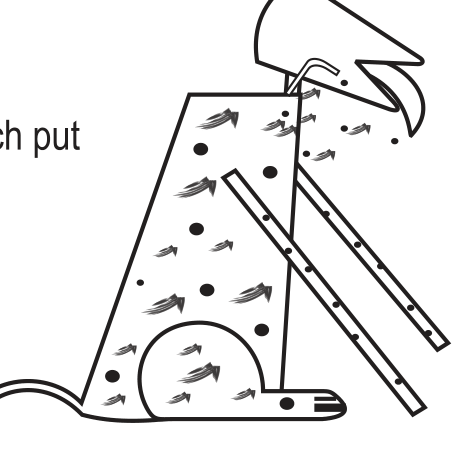
Step: 1:- Take sheet no:1 and roll it for the body of the dog, make it to stand little cross and cut the corners as in fig 1.

STEP: 2
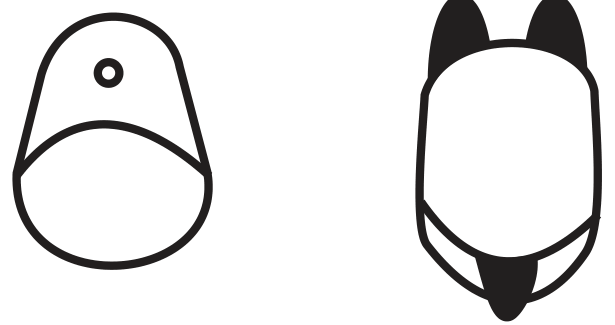
Step: 2:- Similarly take sheet no: 2 and roll it for the head of the dog (reduce the length if it is big). And then cut one corner for the mouth of the dog and then cover the other corner using sheet no: 3, stick it with cello tape as in fig 2.

STEP: 3
Step: 3:- Put small hole under the covered corner. Then stick the ears on the top and tongue inside the mouth as in fig 3.
STEP: 4
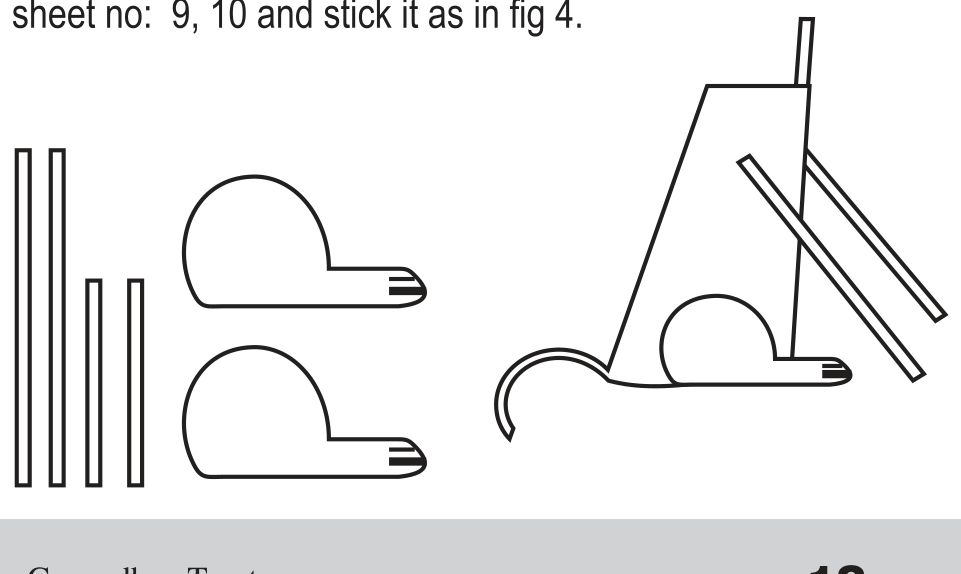
Step: 4:- Roll sheet no: 5, 6, 7, (very thin) for the legs and tail of the dog then stick it in the body of the dog and then cut the sheet no: 9, 10 and stick it as in fig 4.
© 2011 Copyright Nithya Gnanadhan Trust
[Figure: TEACHER CREATED MATERIAL PETS HANDBOOK]
STEP: 5
Step: 5:- Take the head of the dog and insert a hole in the sheet no: 5. using black sketch put some dots on dog as in fig 5.
Variation: We can use the colors instead of black sketch.
DAY: 4 ACTIVITY
FLOUR MIXING
Goals: To improve their Sensory awareness skills, Fine motor skills, olfactory skills
Vocabulary: Dough, flour, essence, wheat
Material required: Water, Flour (wheat/maida), Food color, Plates, Essence (if required), Small rocks or dried leaves (if required)
Introduction and Presentation: Get all the materials ready for the activity and give each child a plate and have them sit at the table. Put a small amount of flour on each plate and ask them to feel it. Add a small amount of food color and ask them to mix. Add little water and have them mix it with their fingers observe the color change and feel the texture. For good aroma add few drops of any essence to the dough.
Assessment: ● What is the texture of the dough? ● What is the color of the food color? ● What happen when you add color to the flour? ● Does the texture change when you add water to the flour? ● How does the dough smell when you add essence? ● How does the dough feel to touch soft or rough? ● Is it gooey and sticky or stiff and hard? ● What is the different smell?
Evaluation: To evaluate their sensory awareness skills, tactile skills, olfactory, whole hand grasp.
TASTE BOX
Goals: Familiarize them with different tastes, ability to differentiate and identify the different tastes. To make them aware of gustatory discrimination
Vocabulary - Taste, taste buds, gustatory sensation, bitter, sweet, sour, salty, spicy.
Material required: Different products with variety of tastes like mustard seed powder, asafetida, dry mango powder, turmeric powder, dry neem powder, salt, sugar, Tamarind powder, all kept in non - transparent boxes.
Presentation: Give them the different powders to taste and ask them to name the taste. Ask them to match the same tastes when the same items are given.
© 2011 Copyright Nithya Gnanadhan Trust
[Figure: Teacher Created Material Pets Handbook]
Assessment • Which organ is used for tasting? • Which is your favorite taste? • Which fruit tastes sour? • Do you like bitter taste? • Can we eat something that is too spicy? • Can we eat something that is too salty? • What is the taste of ice cream? • Can we enjoy a food which is not having any taste? • What is the taste of the water?
Variation: Introduce new taste with variety of objects. Reinforce the tastes whenever they eat. Ask them to identify the opposite tastes like sweet, bitter.
Evaluation: First do the activities with eyes open and then with eyes closed, note down how many taste each one identified, matched and named. What open ended questions they answered. Keep the record to note down the progress when the activity is repeated again. Ask them about the different taste of their lunch and snacks.
DAY: 4 GYM
COPY CAT
Explanation: • In this game select one child to be the leader. The other children stand facing the leader and copy the movements the leader does. • In this the children learn to do different actions or movements. • To make the game more challenging.
Skills: Visual discrimination, gross motor skills.
Variation: “Follow the leader” game is also played in the same way. Monkey sees, monkey does.
PLAY WITH BALLOONS
Goal: To develop their social skills, eye hand coordination, auditory skills.
Presentation: Children will sit in a circle form and they pass the ball or balloon or toy to each other and when the music stops whoever has the ball or balloon has to get up and do the action, or sing rhymes and then again they can pass the ball and other child will get turn..
Skilled developed: Auditory skills, Eye hand coordination, Concentration, Social skills.
Variation: They can pass different items according to the theme
© 2011 Copyright Nithya Gnanadhan Trust
DAY: 5 ART
MINI BOOK
Goals: To develop their eye hand coordination, fine motor skills, logical thinking skills.
Material required: Any materials, pictures related to the theme can be chosen, a small book with plain sheet has to be made, glue, crayons.
Introduction and presentation: Children are given one book each and they can be explained about theme and they can stick the pictures or materials or children can draw related to the theme in their book.
Skill developed: Develops their eye hand coordination, fine motor skills, logical thinking skills.
CRAYON COLORING
Goals: To stimulate their creativity, fine motor skills, eye hand coordination, tripod grasp, prewriting skills.
Material required: Art sheet, different color crayons.
Introduction and Presentation: Encourage children to sit around the table and give each child one art sheet and they can choose their colors from the crayon tray. Guide them to hold crayon using thumb, pointer and middle finger (tripod grasp). Encourage them to color inside the picture.
Skills developed: Develop their eye hand coordination, fine motor skills, tripod grasp, pre writing skills, creativity.
DAY: 5 ACTIVITY
GUESS THE ANIMAL
Goal: To develop their cognitive skills, receptive language skills, memory skills, auditory visual skills and gross motor skills, social skills.
Presentation:
• Divide the children into two teams call one children from one team and ask that child to do animals action (or) to make animals sound.
• The other team children have to identify which animal actions (or) to make animal sound.
• Both the team will take their turn's one after the other.
BLOWING
Goals: To enhance and improve their oral motor muscle power with various activities
Presentation: Demonstrate to them how to blow balloons, bubbles.
Vocabulary: blowing, whistles, funny face, beads, feathers, balloons

Assessment: • Can you show the action of blowing? • Name the person who blows the whistle in the bus? • What is a whistle? • Can we blow heavy items? • Can we blow balloons? • Why balloons or bubbles fly in air?
Material required: Whistles, paper bits, beads, feathers, balloons, grains, Seeds, bubble solution, bubble blower.
Evaluation: Evaluate each child's oral motor strength by asking them to blow different materials like whistle, bubbles, beads, feathers.
Variation: We can group the beads and ask them to blow the beads; they can count the beads that they moved, to what height they can blow the bubbles.
DAY: 5 GYM
ROLLING
Goal: To improve their spatial awareness and gross motor skills.
Presentation: • Children are asked to roll on the safety mat forward and backward. • They can also do rolling side ways on the wall. • Children can do rolling towards right or left listening to the instructions alternatively.
Skills Developed: Develops their spatial awareness, gross motor skills and listening skills.
HOPSCOTCH
Goal: To improve their balance, gross motor skills, eye and foot co-ordination, spatial awareness.
Presentation: A hopscotch box has to be drawn on the floor it can be simple or complex. Ask the children to hop on one foot and to jump, hop, jump, turn and do the same and go back to position. Observe them how well they are able to do it.
Skills developed: It develops their balance, spatial awareness when they hop on one foot and their gross motor skills while jumping. Develops their visualization skills if they are able to do with eyes closed.