Arunachala, the hill that beckons...
This text was machine-transcribed from the printed book and may contain errors. Select the words and choose “Report a mistake”.
While Arunachala is beyond the scope of human comprehension and calculation, how then, can one know It? Surrender and He will make Himself comprehensible to you. That is the only way!
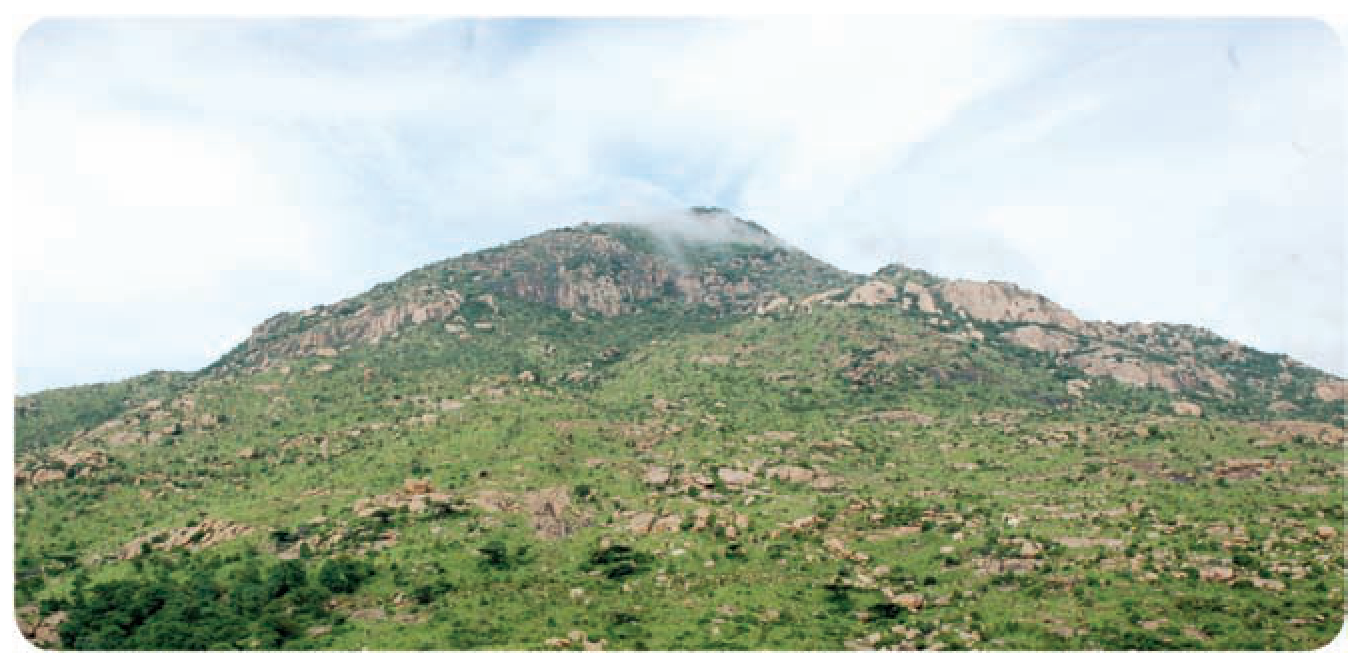
Charged with the Existential energy, Arunachala is the spiritual focal point of the entire universe. Seen here is the Arunachala hillock, which draws seekers from all over the world breaking divisions of religion, cult, creed or any dogma.
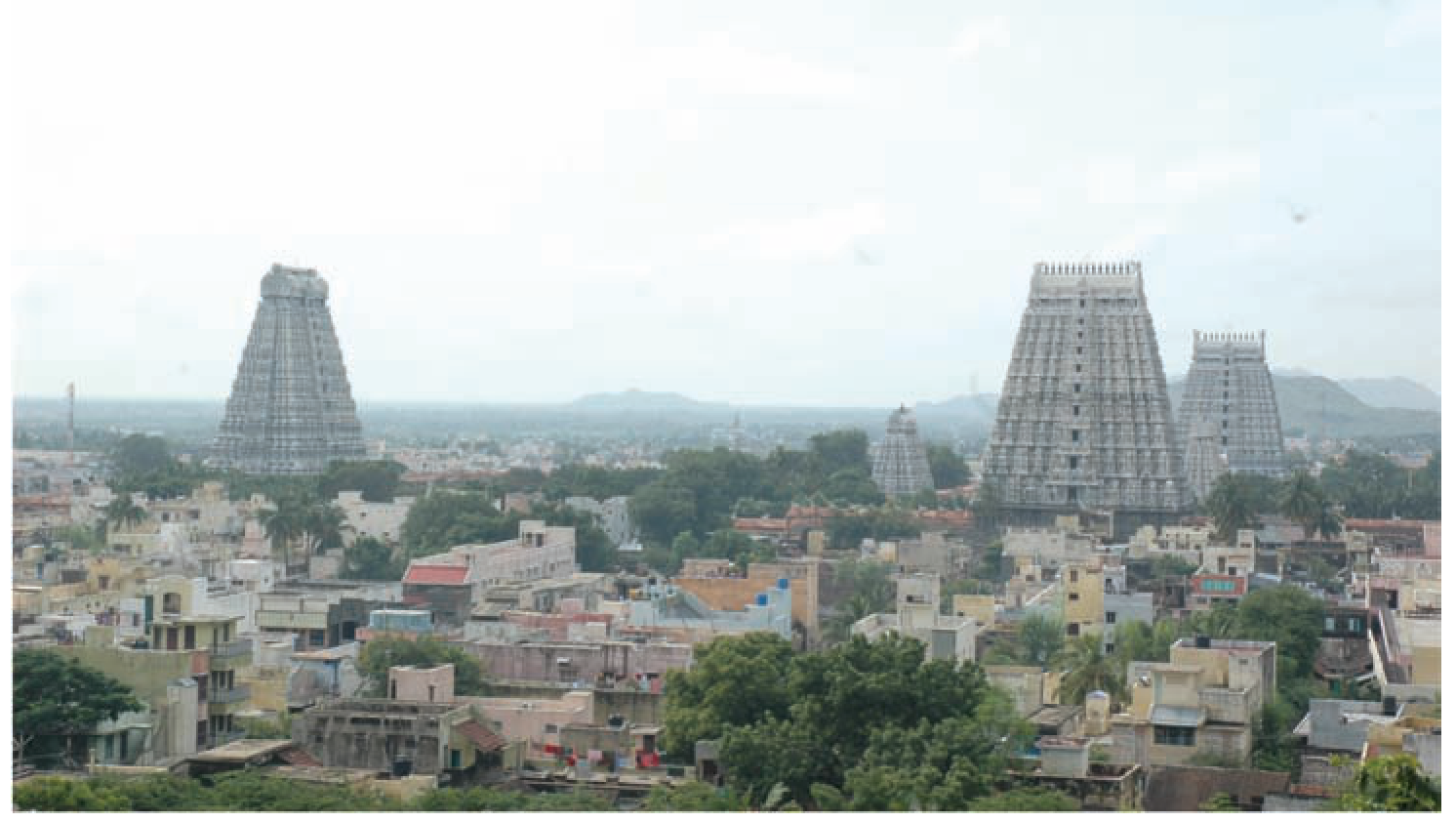
The sacred town of Tiruvannamalai (birthplace of Nithyananda) lies prostrate at the feet of the mighty Arunachala. The dwelling place of great Masters and mystics - known and unknown, this town is the most sacred pilgrimage spots ever.
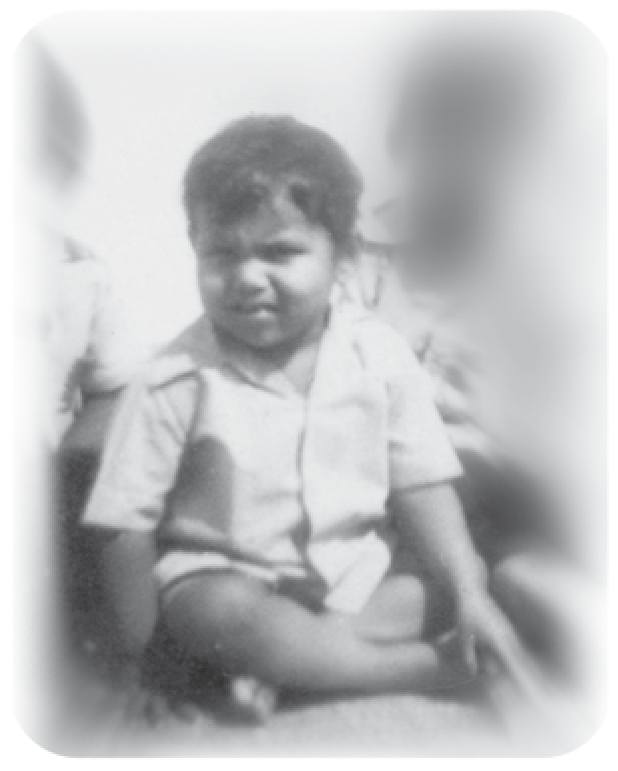
Nithyananda
as a baby - a charmer from
day one!
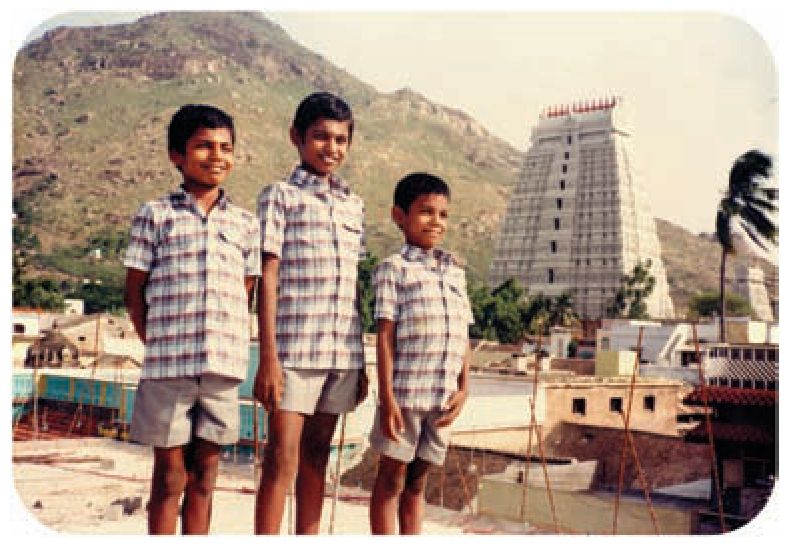
With his two brothers. In the
backdrop can be seen two of the
nine temple towers of the temple
of Arunachala. Wandering in the
vicinity of the temple was the
most enjoyable thing for him.
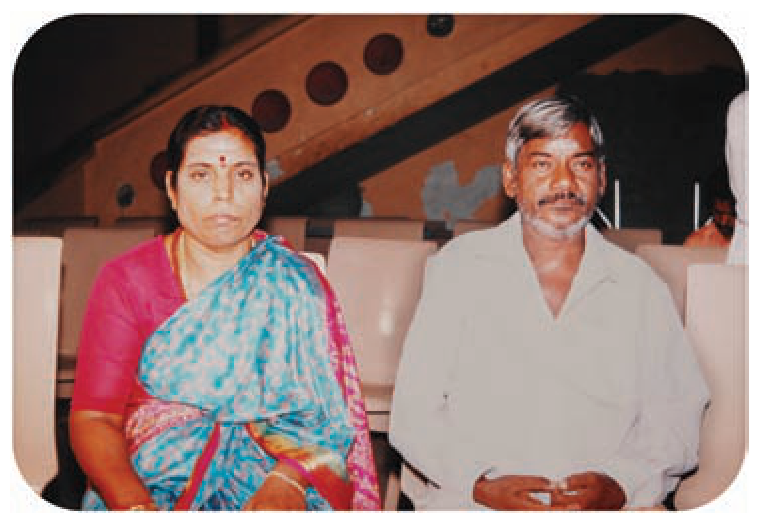
Mother
Lokanayaki
and
Father
Arunachalam
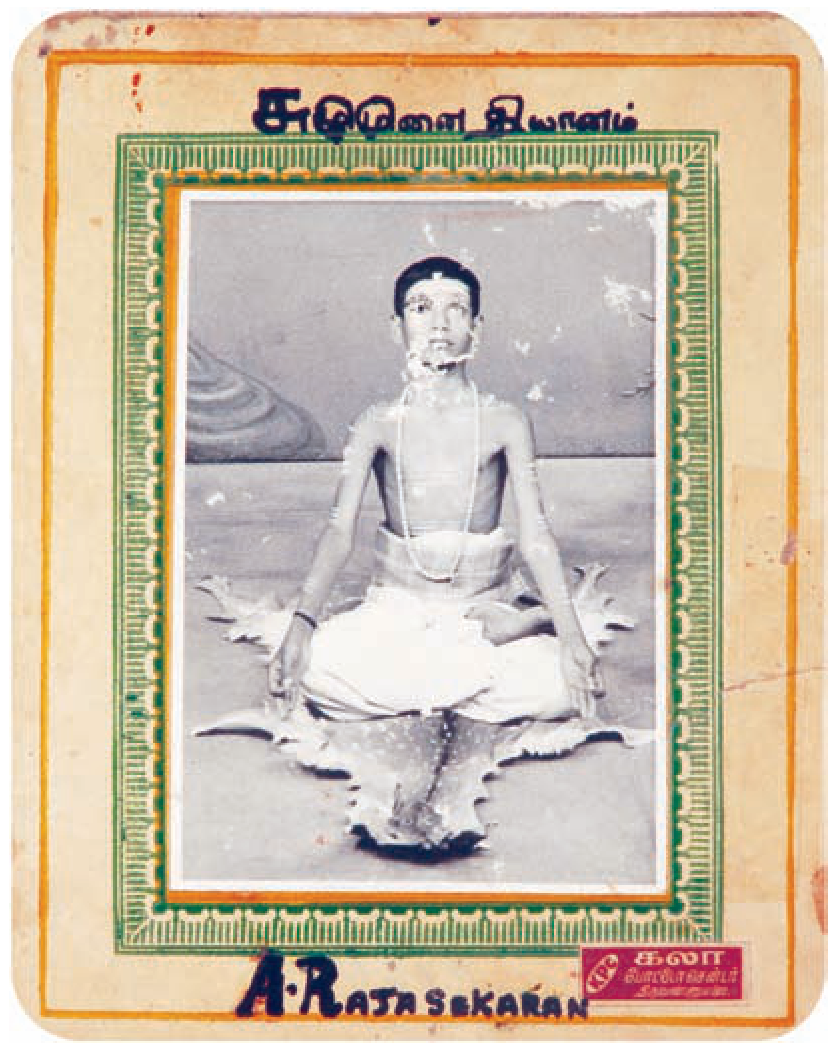
The earliest
picture of Nithyananda
taken while in
meditation, at the age
of 10
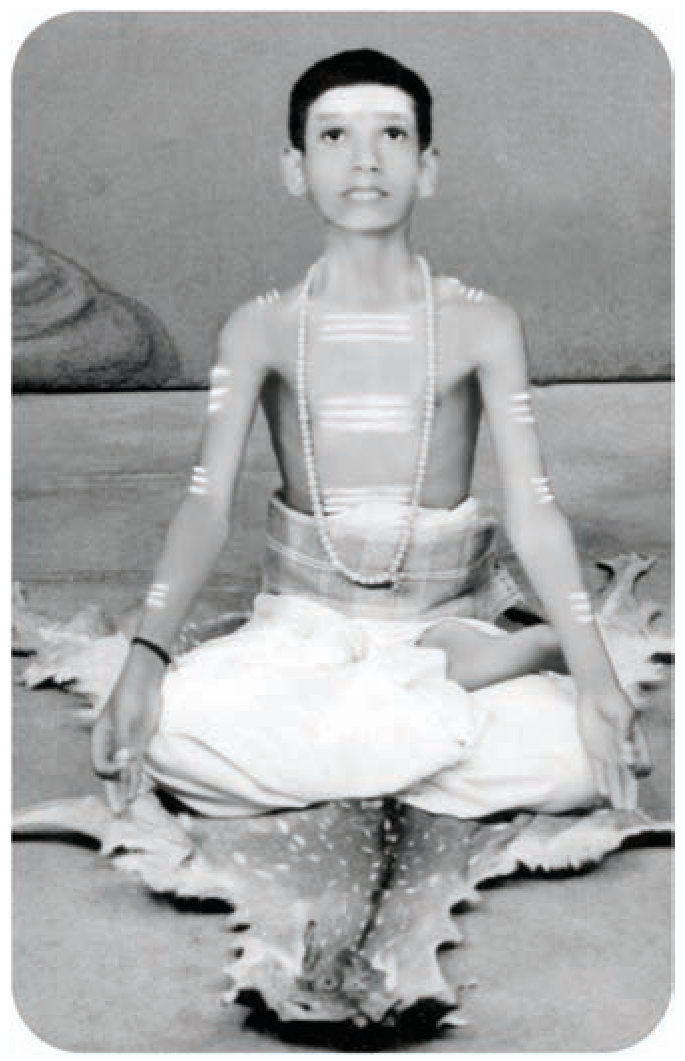
The same picture
as above touched
up for archival
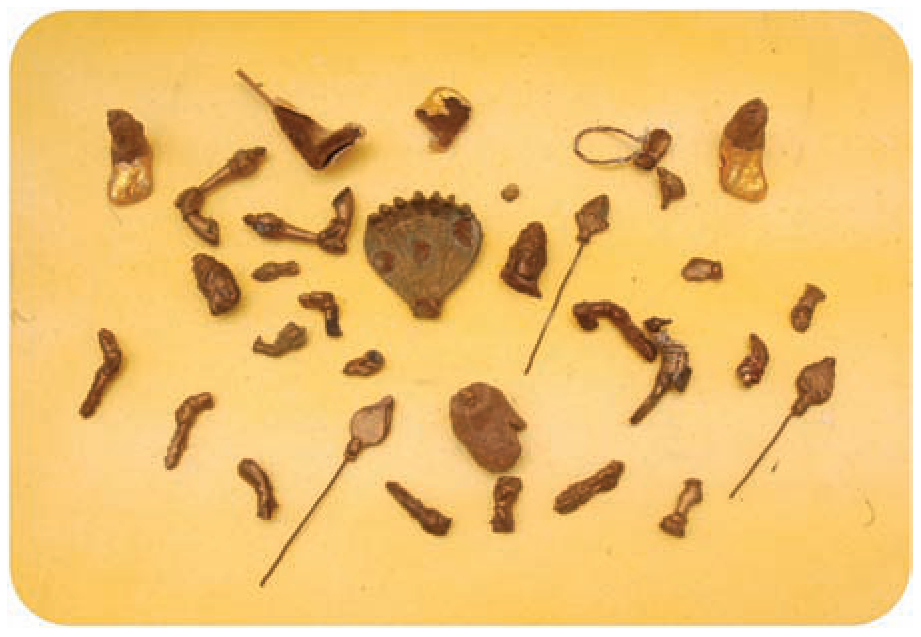
Parts of forms of deities.
With these, Nithyananda
would build idols with
different body structures
using wet earth as base
material, and decorate
them to his heart's
content.
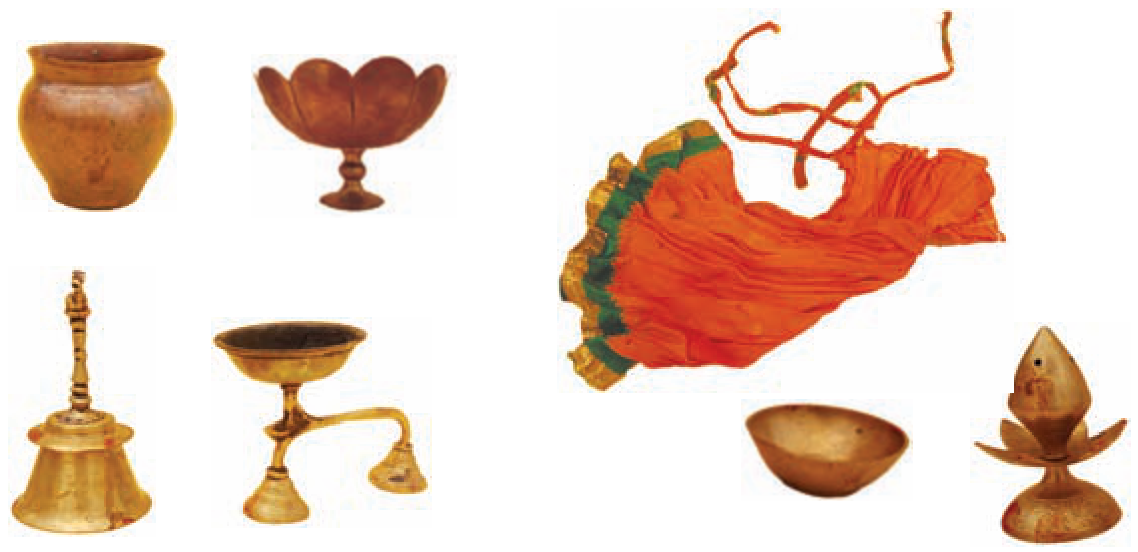
Some of the puja items and clothes of deities that he used for worship
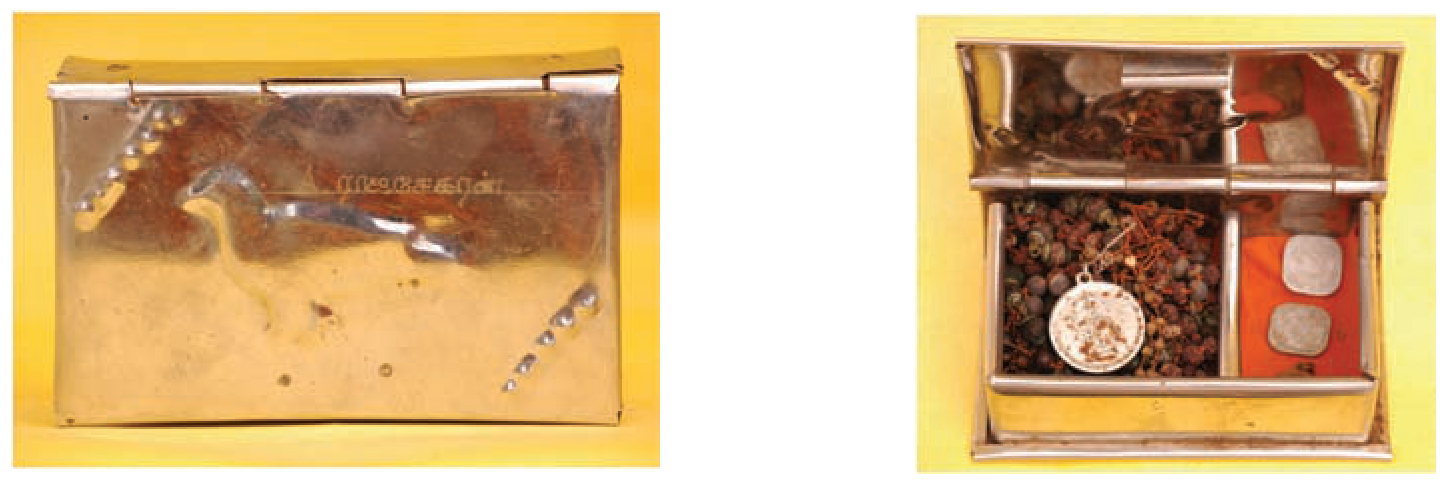
A box with the rudraksh mala (holy bead necklace worn by wandering mendicants) that he wore while taking the yearly pilgrimage to Sabarimala (a hill top temple dedicated to Lord Ayyappa). His pre-monastic name 'Rajasekaran' can be seen inscribed on it.
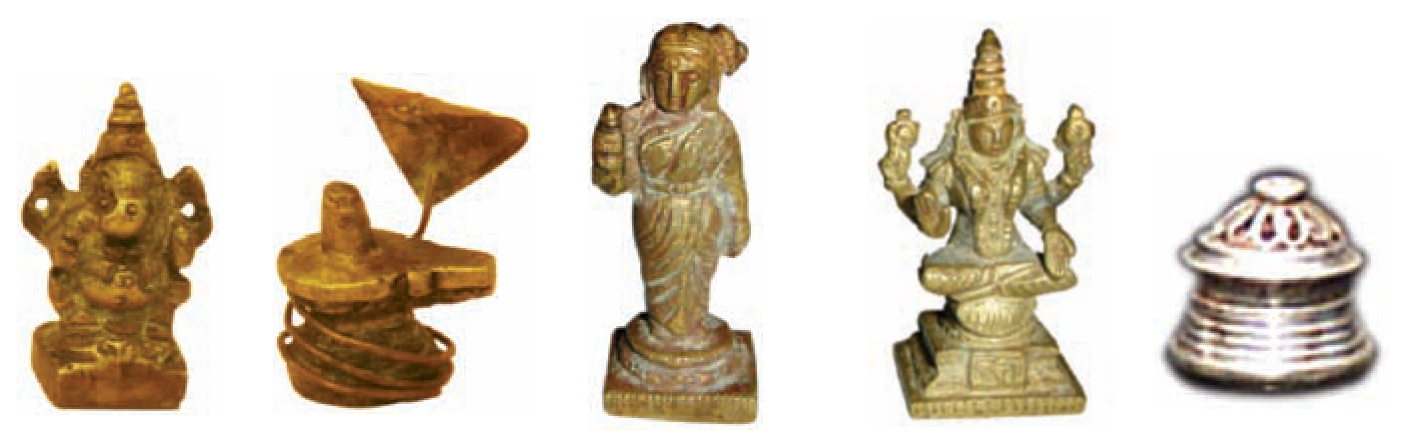
Nithyananda ardently worshiped deities, as live symbols of Existence. These above 5 deities, he carried with him everywhere he went and worshipped them.
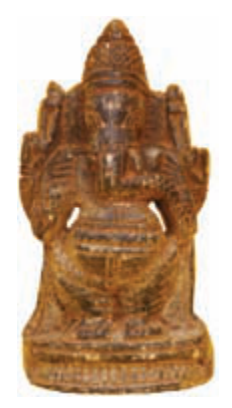
The Ganesha deity that ate the food served by Nithyananda after devoted persistence from him
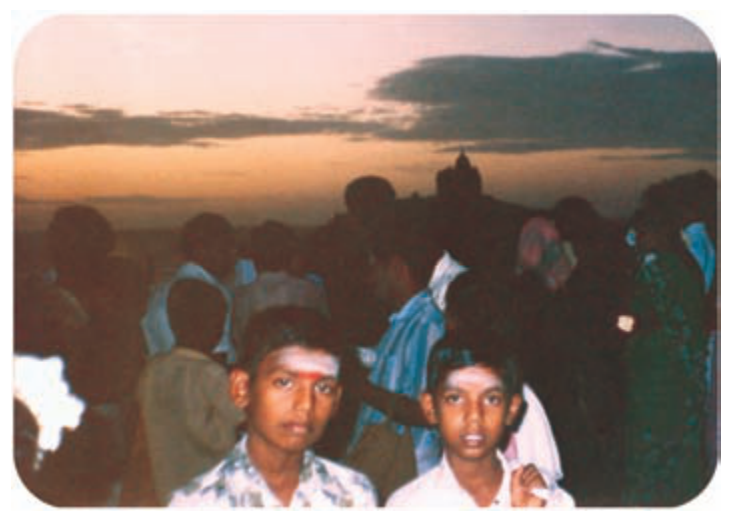
(To the left) On a family
pilgrimage to
Kanyakumari, tip of
India. Seen silhouetted
against the sunset sky is
the popular Vivekananda
rock.
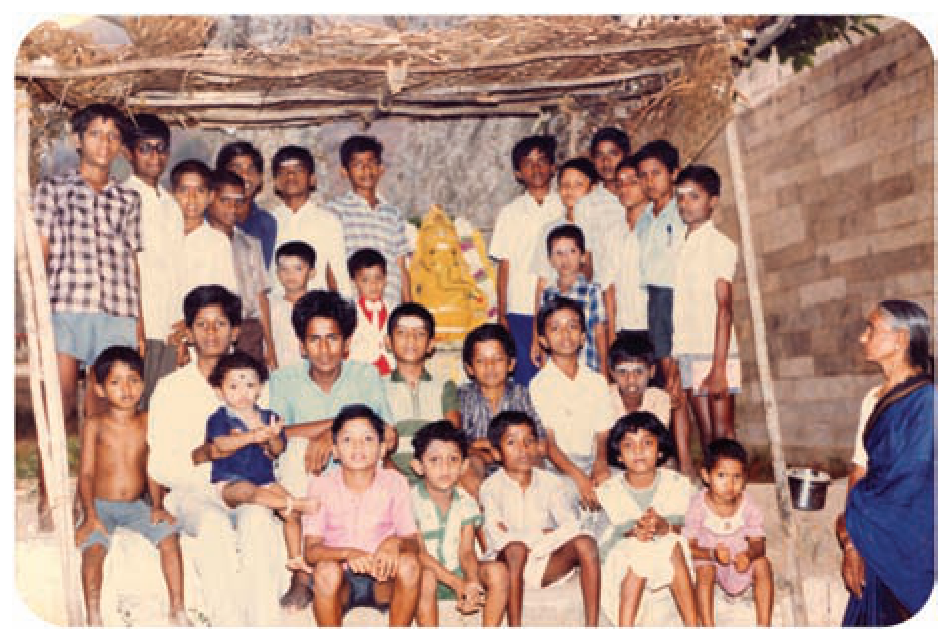
A group photo with one
of his favorite deities -
Lord Ganesha which he
decorated with
sandalwood paste
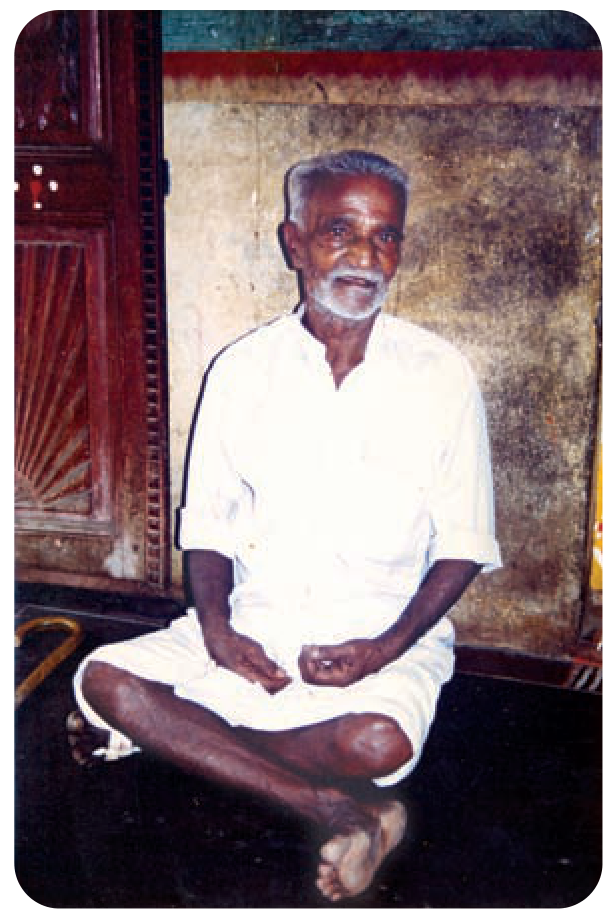
Raghupati Yogi, a
friend,
philosopher and
guide to
Nithyananda in
his spiritual
quest
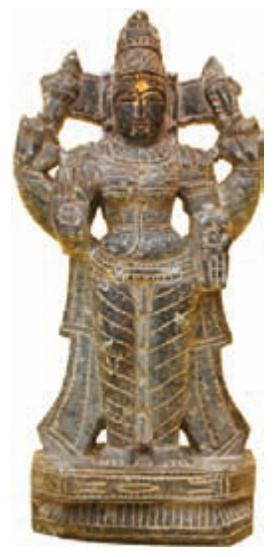
The deity Parasakti (female
personification of the Existential
energy), which appeared to him
as a vision, which he carved
out of soapstone
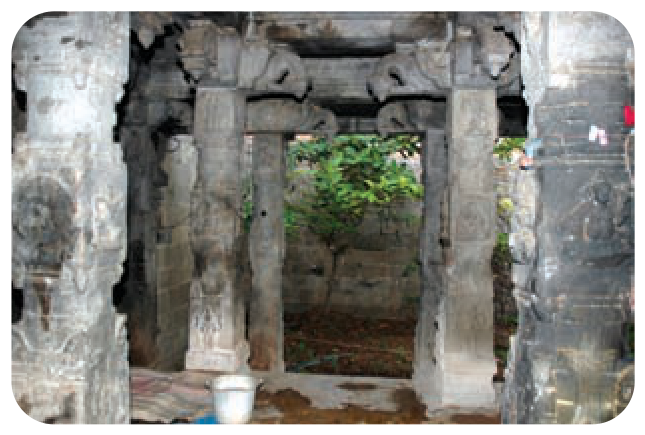
The Kritika Mandap inside the
Arunachala temple,
Tiruvannamalai, where Raghupati
trained him in rigorous exercises.
He would make him climb the
pillars several times, sometimes
with the support of just one hand!
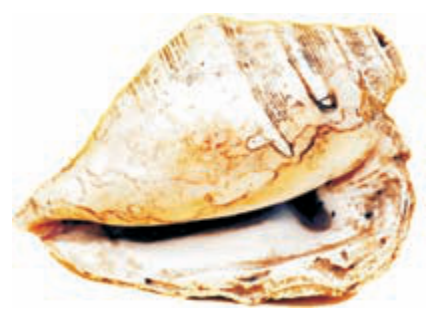
The conch teleported for him by Raghupati Yogi to demonstrate the concept of materialization
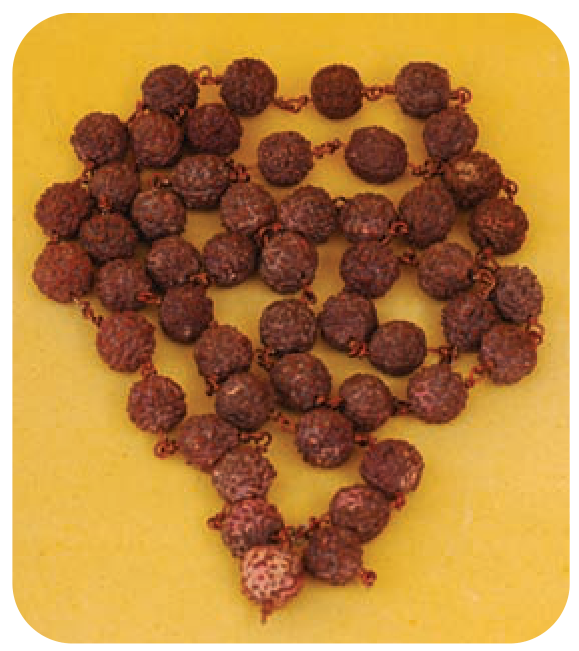
A rudraksh string materialized and given by Raghupati Yogi to Nithyananda, which he wore everyday. The smears of sandal paste and kumkum which got on to the string from his chest, can still be seen on it.
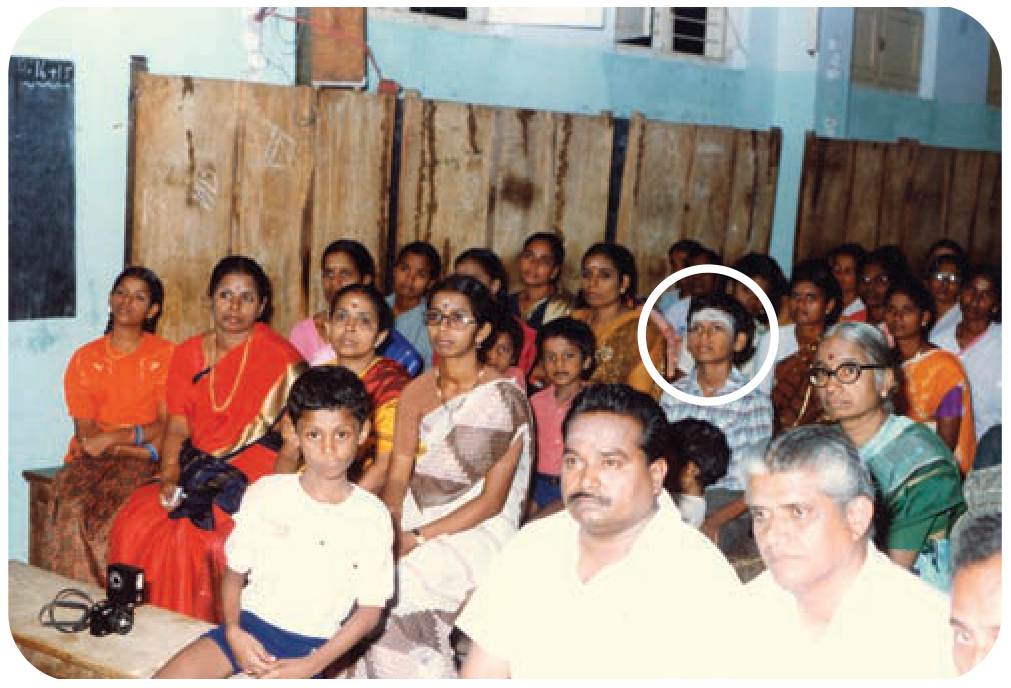
At a transcendental
meditation (TM)
workshop. With
blazing eyes, and
intense fervor,
young Nithyananda
listens to the
lecture
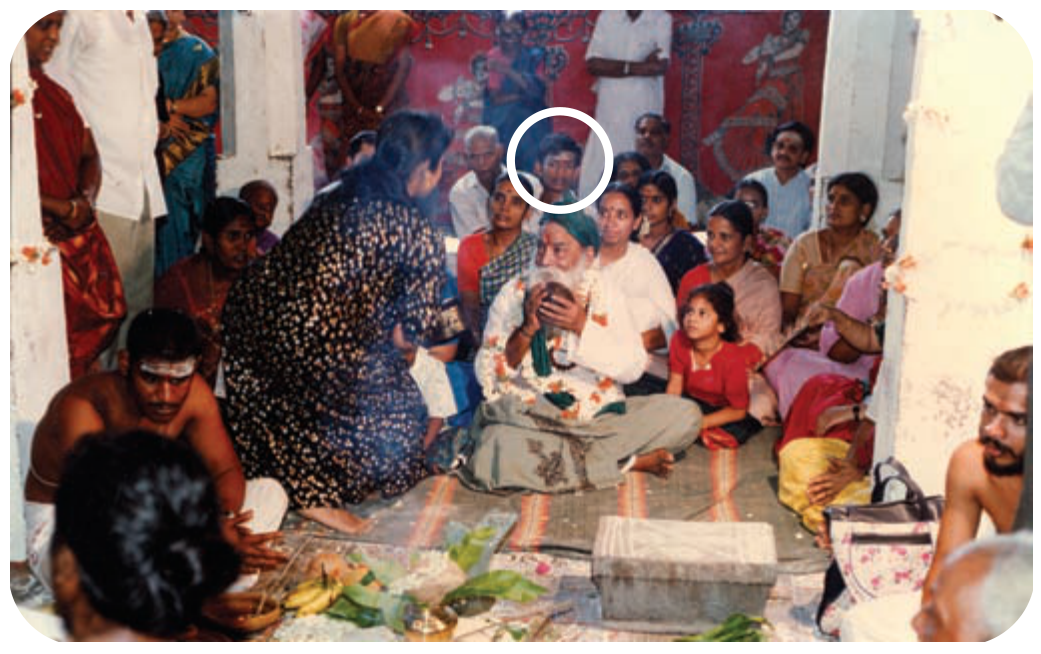
At a festival graced
by the Master - Yogi
Ram Surat Kumar,
in Tiruvannamalai
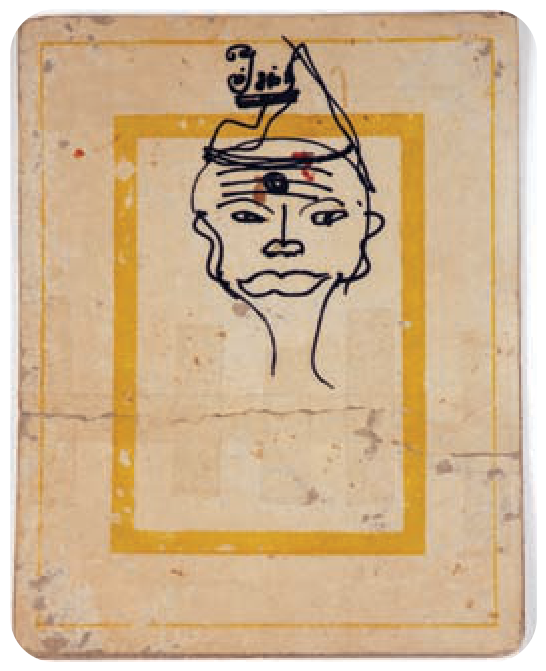
The picture that he drew of himself in a fit when asked what he would be like when he grew up. One can perceive the significance of this self portrait even in this childish and hasty representation!
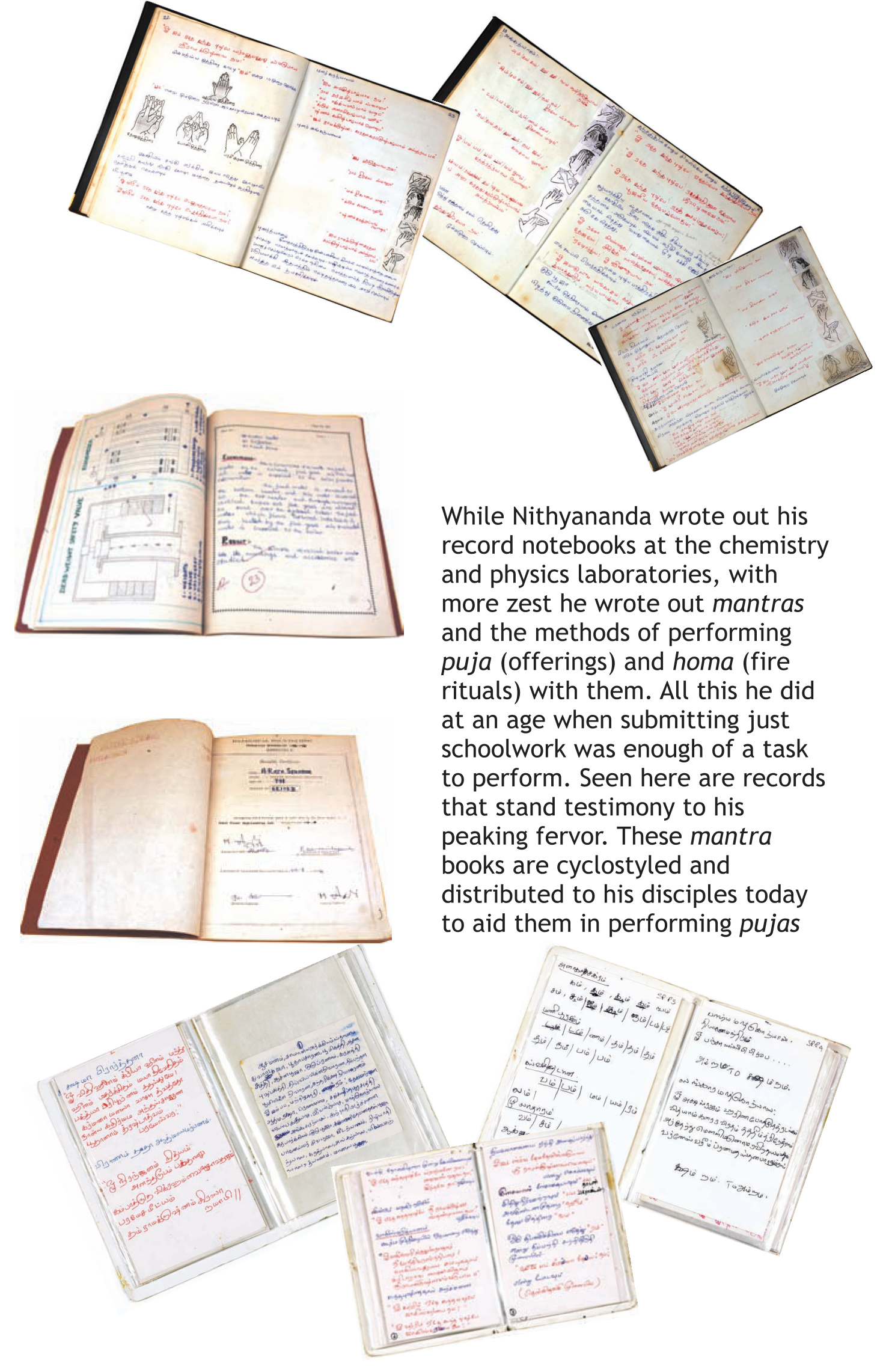
While Nithyananda wrote out his
record notebooks at the chemistry
and physics laboratories, with
more zest he wrote out mantras
and the methods of performing
puja (offerings) and homa (fire
rituals) with them. All this he did
at an age when submitting just
schoolwork was enough of a task
to perform. Seen here are records
that stand testimony to his
peaking fervor. These mantra
books are cyclostyled and
distributed to his disciples today
to aid them in performing pujas
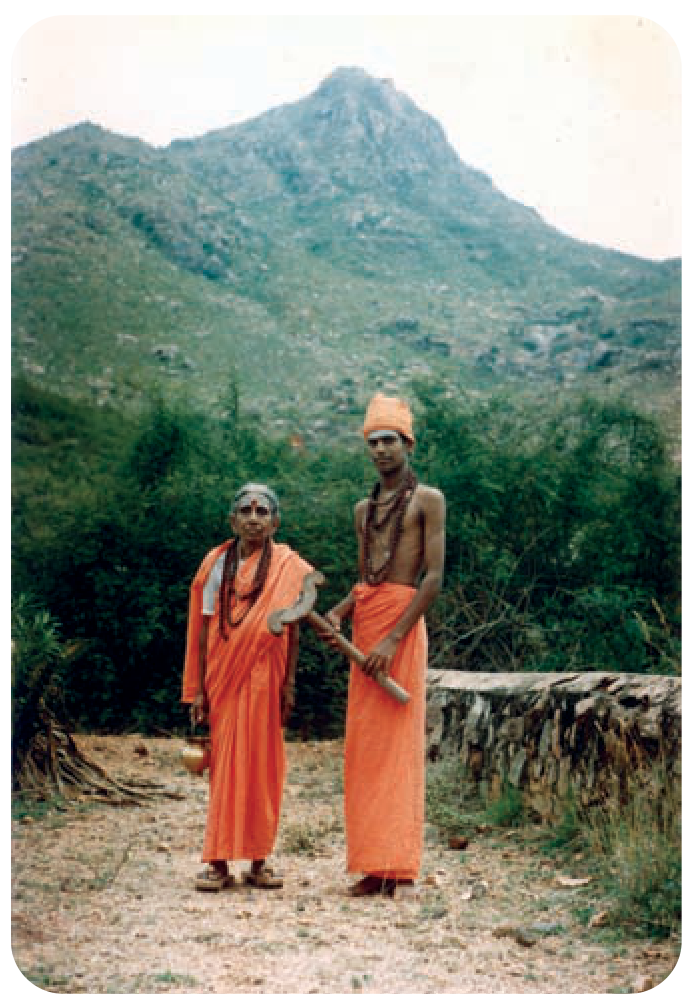
With Mataji Vibhudhananda,
spiritual guide and caretaker
during his days of wandering
in Tiruvannamalai
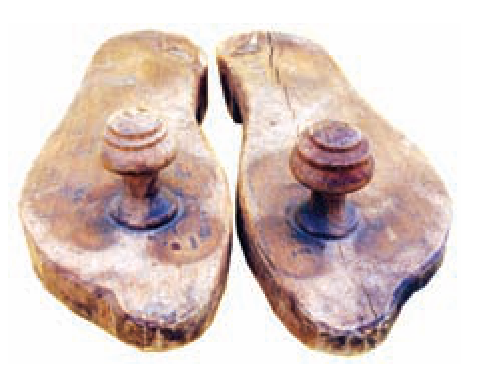
Paduka (wooden sandals
normally worn by holy
mendicants) given to him by
Mataji Vibhudhananda, which he
took a fancy to at a young age.
Today he laughingly recalls how
he would cause deafening clatter
at home wearing these in the
few hours he was there!
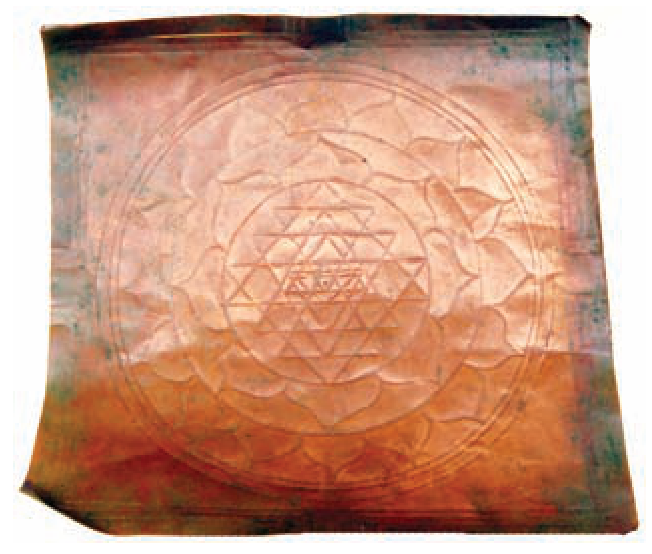
The sacred Sri Chakra carved by
him on a copper foil having had a
vision of it. When asked how he
managed to carve the complex
diagram so easily he explained,
'It is just nine triangles placed at
different angles to each other.
Once you understand the
concept it becomes easy!'
Letter of initiation (in Tamil) given by Mataji Vibhudhananda
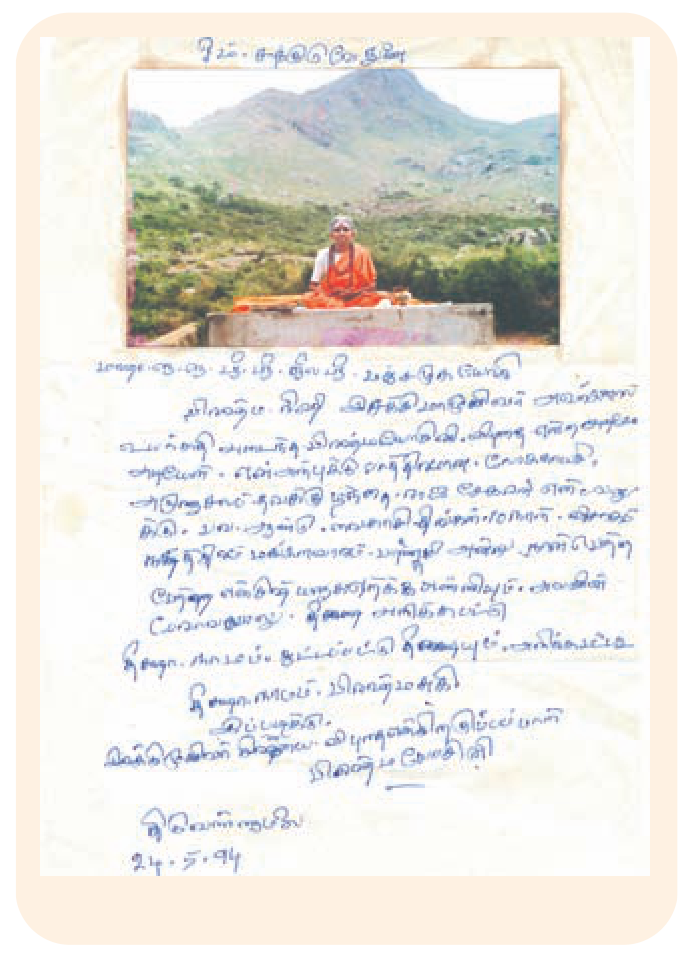
Brahma Yogini Vibuthai, who attained a high spiritual state by the grace of Maha Loo Loo Sri Sri Srila Sri Panchamukha Yogi Brahma Rishi Isakki Mahamunivar, is hereby initiating Rajasekaran, son of my loving Lokanayaki and Arunachalam, with a title, on this 10th day of the bhava year in the month of Vaikasi on Tuesday, Visakam star on Poornima (full moon) day, in response to his great enthusiasm, so he may experience the bliss that I have experienced.
Dheeksha title: Brahmasukhi
Yours,
Isakki Munivar's disciple, Viputhai alias Kuppammal Brahma Yogini
Thiruvannamalai 24.5.94
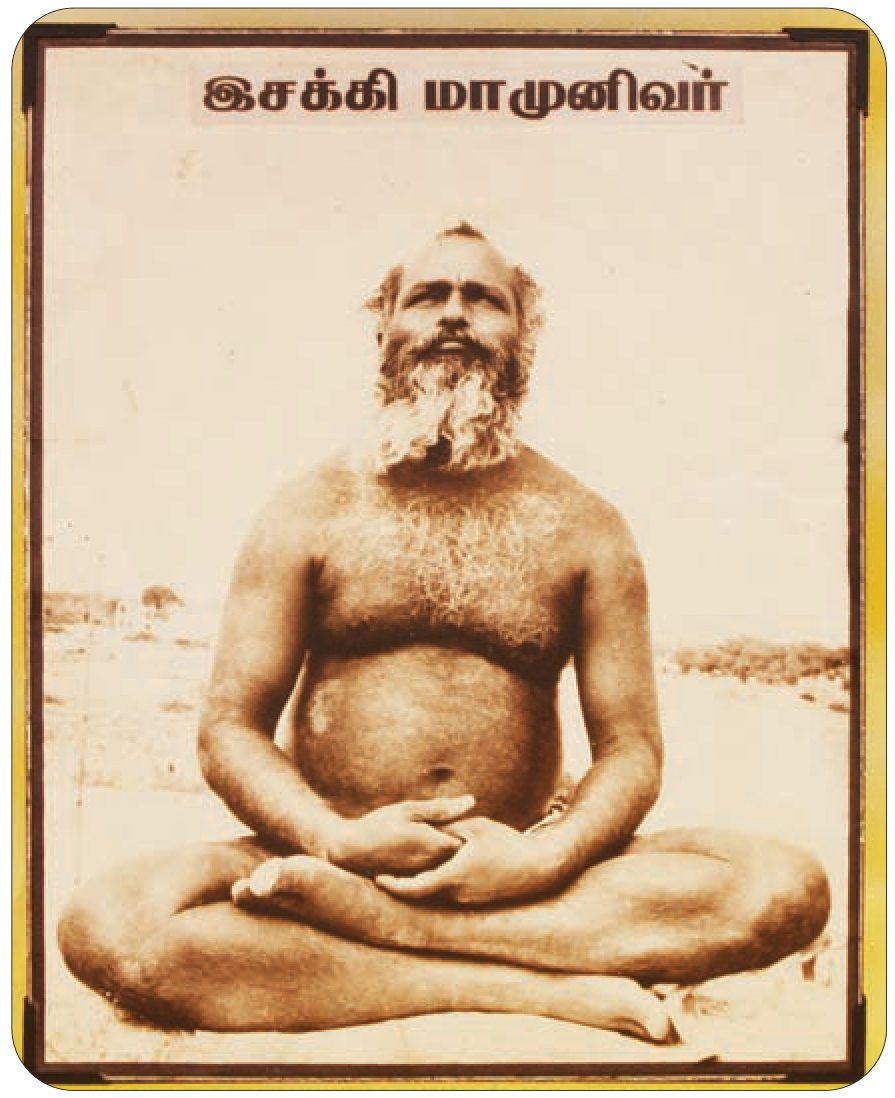
Isakki Swamigal, Guru
of Mataji
Vibhudhananda, who
fostered the spiritual
fever in Nithyananda
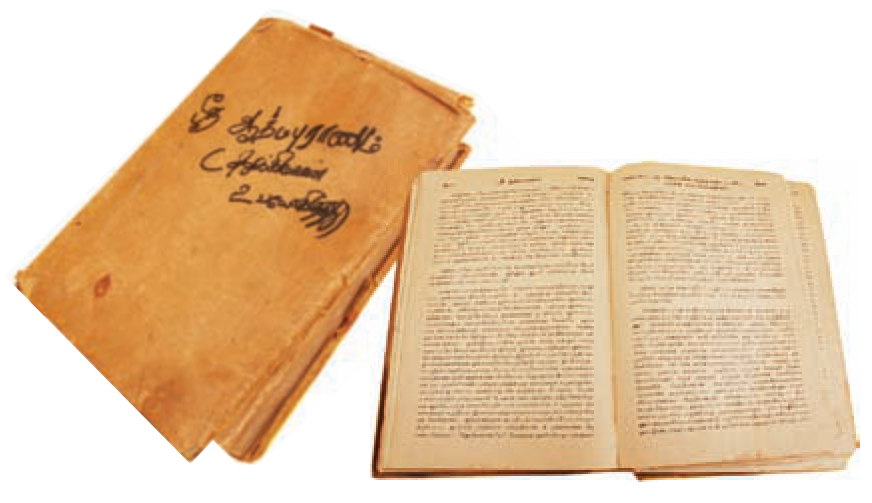
Atma Purana (a collection of Upanishad) gifted to Nithyananda by Isakki Swamigal; the first book on Vedanta that Nithyananda read
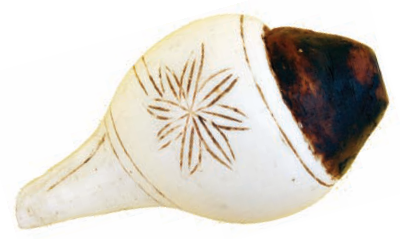
A conch, gifted by
Isakki Swamigal,
which Nithyananda
used to blow while
following the deity of
Arunachaleshwara in
procession, in the
streets of
Tiruvannamalai
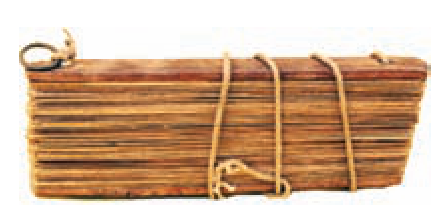
Olai chuvadi (a manuscript made of palm leaves) containing the rudram, chamakam and other vedic chants, given by Isakki Swamigal to Nithyananda
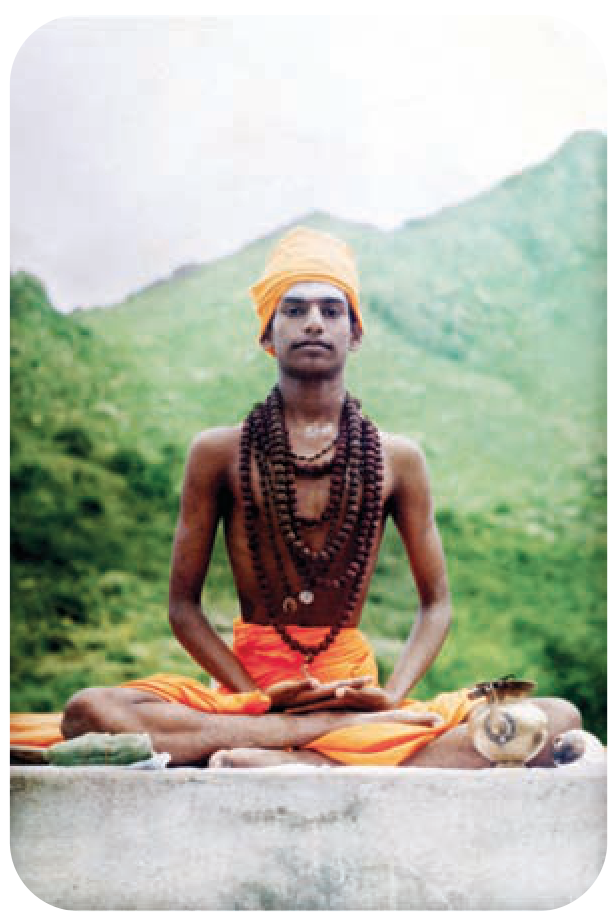
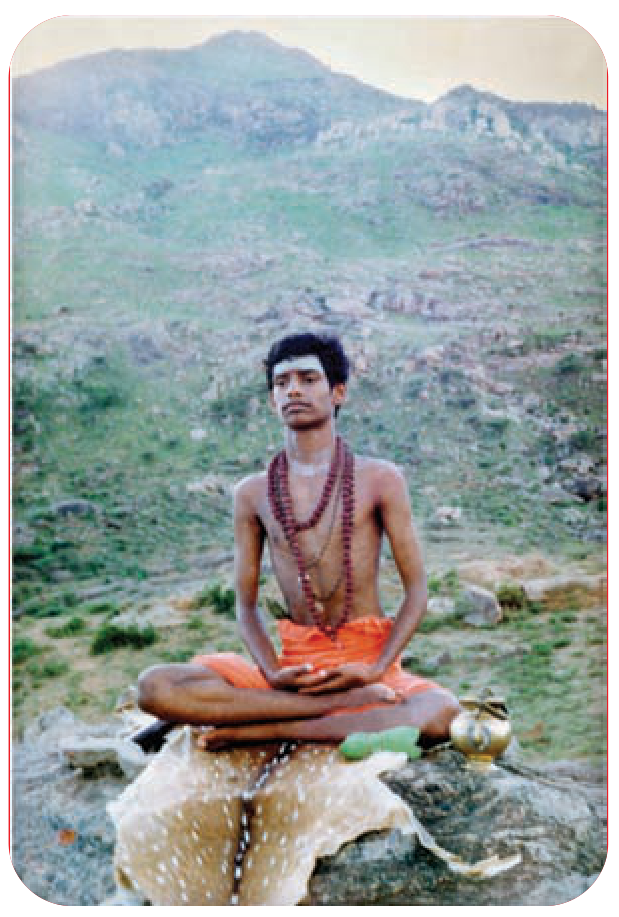
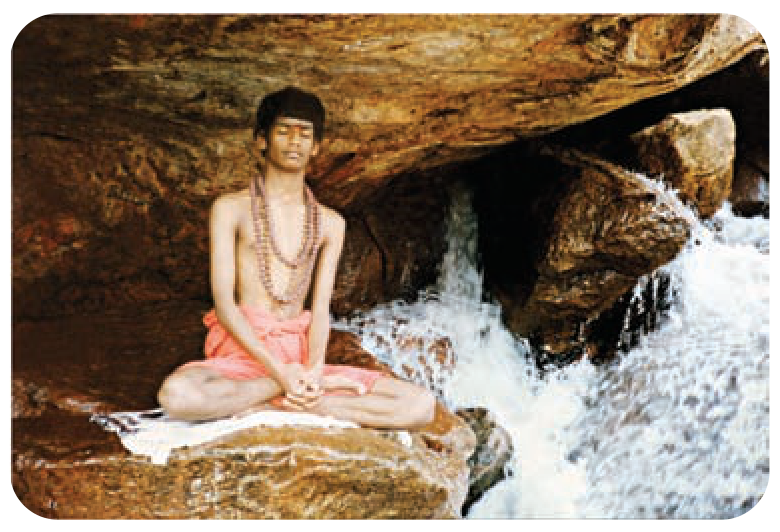
Arunachala was
Nithyananda's everything.
There was not a single
crevice or rock that had not
felt the fervor of his
yearning. In these pictures,
one can see him basking in
the glory of his beloved
Arunachala
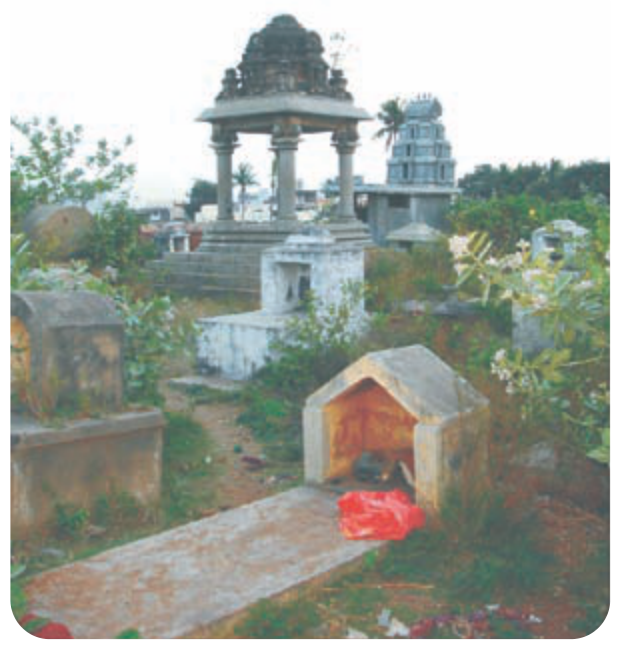
Crematoria of the holy town of
Tiruvannamalai - serene places of
meditation for Nithyananda.
He would return home in the
wee hours, unlocking the house
with the key given to him.
His parents never ever breathed
disapproval at his erratic timings
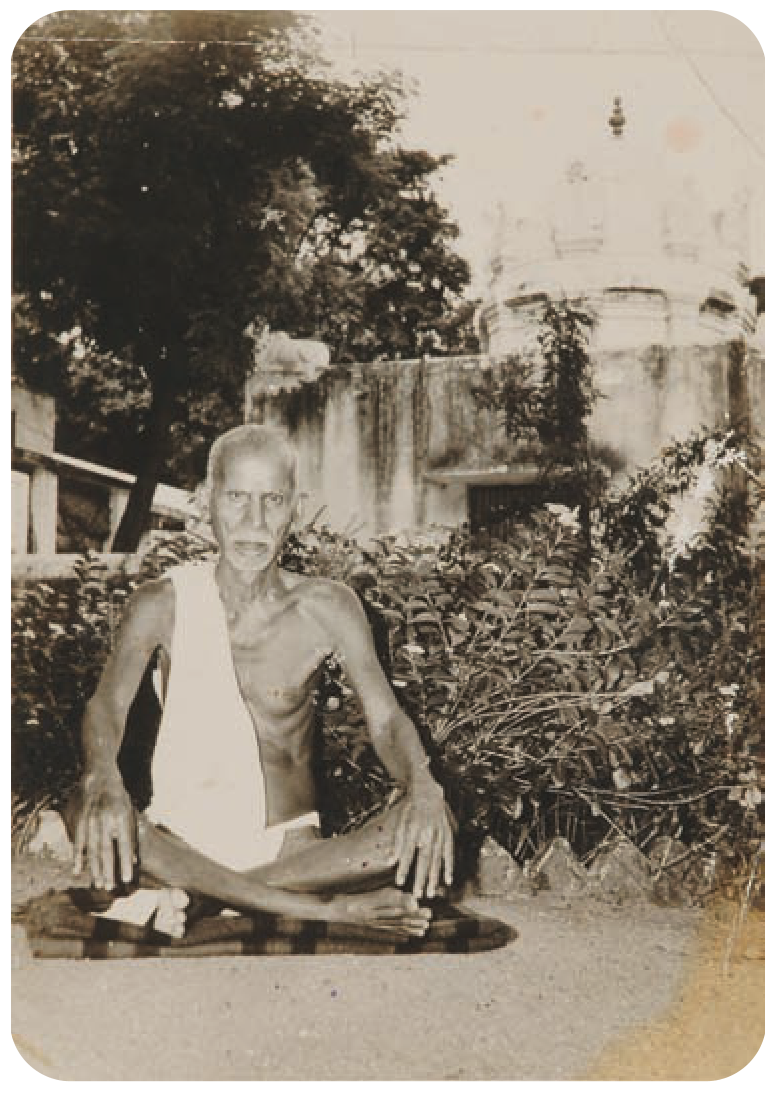
Annamalai Swamigal, disciple of
Bhagwan Ramana Maharishi, who
delivered the significant concept
of 'beyond the body and mind' to
Nithyananda in his quest for Truth.
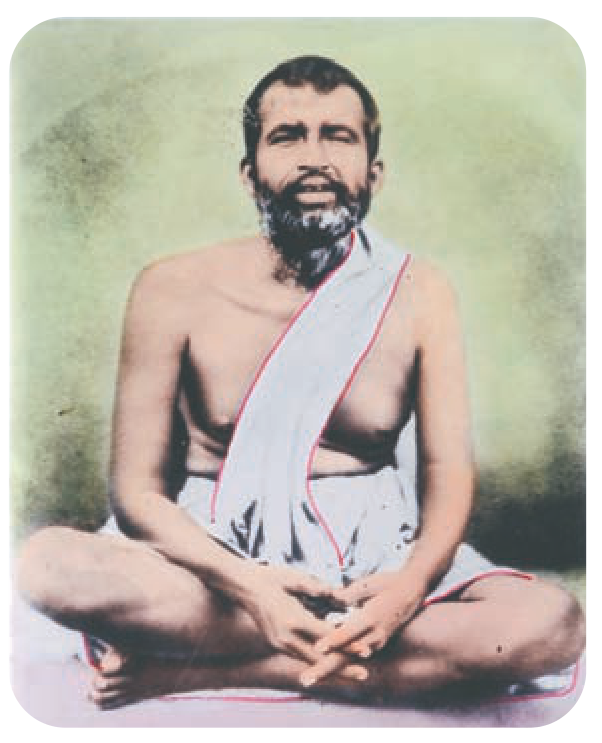
A picture of Ramakrishna
Paramahamsa, another
revered Master of
Nithyananda - which he
kept with him always
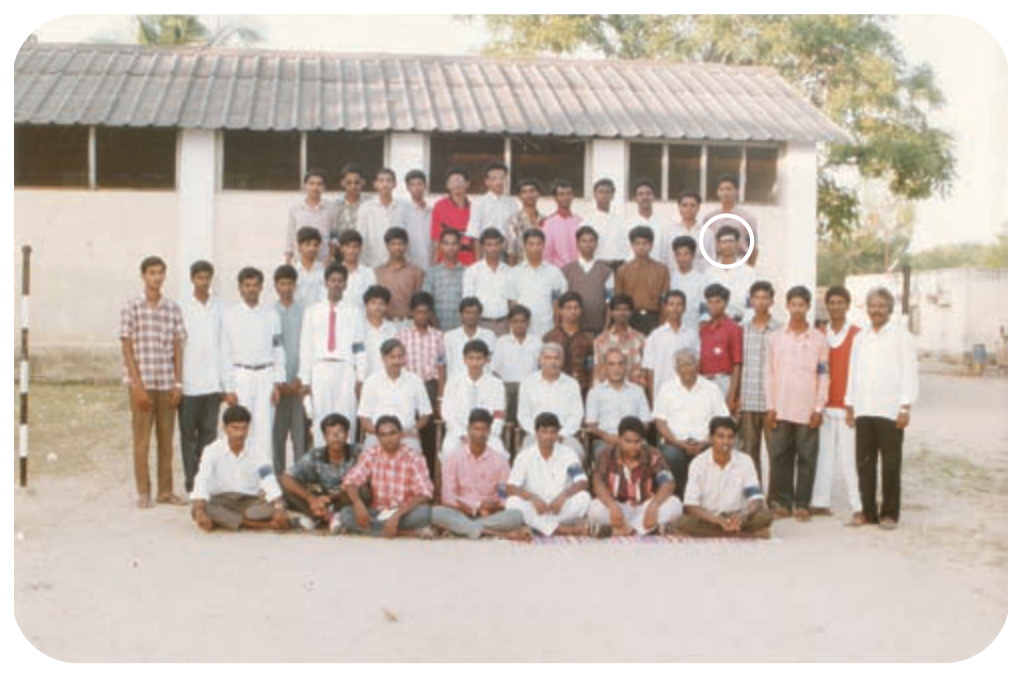
Nithyananda with
his batch while at
the Gudiyatham
college where he
did his diploma in
Mechanical
Engineering
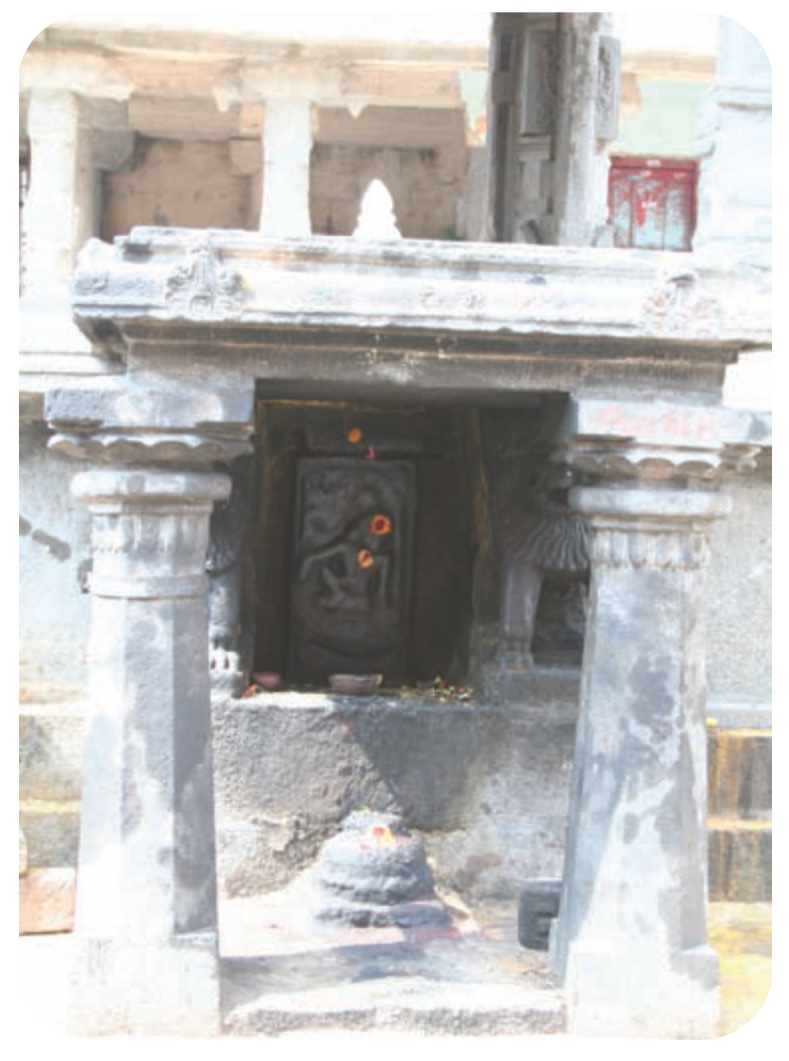
The dark corner in a mandap (enclosure with four pillars) at the rear of the main building housing the shrine of the deity Arunachaleshwara in the temple of Tiruvannamalai, Jiva Samadhi (place of final resting) of Arunagiri Yogiswara, out of which Yogiswara would emerge on Nithyananda's call everyday, which prompted young Nithyananda to think there was an opening there that probably was a cave
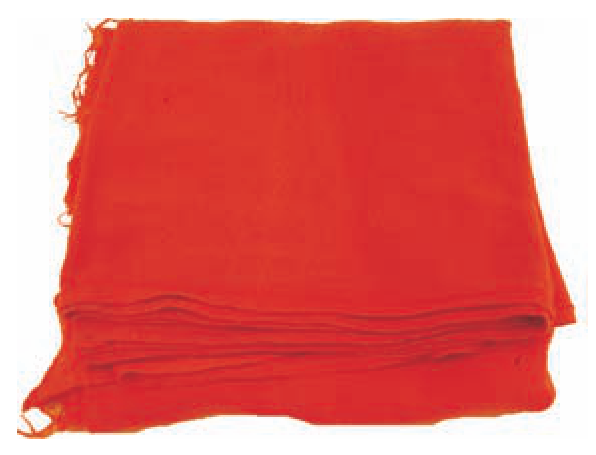
The saffron cloth that Arunagiri
Yogiswara gave Nithyananda
inside the metaphysical banyan
tree, which is part of the
archives in the ashram at
Bangalore today
Picture taken from the book 'Arunachala from Rigveda to Ramana' by A.R.Natarajan - I Edition, Dec 2002.
On one of his sojourns, he sighted a big banyan tree on a boulder and wished to discover more about it. What happened is described by him.
"As I was walking on the bed of a hillstream, I saw a big banyan tree on a boulder, with big leaves, and crossing the stream I wanted to get to the other bund and view from there this big tree. Then I accidentally put my left foot near a bush on the way to the other bank and disturbed a hornets nest there. The hornets clustered round my left leg up to the knee and went on stinging. They never did anything to my right leg.
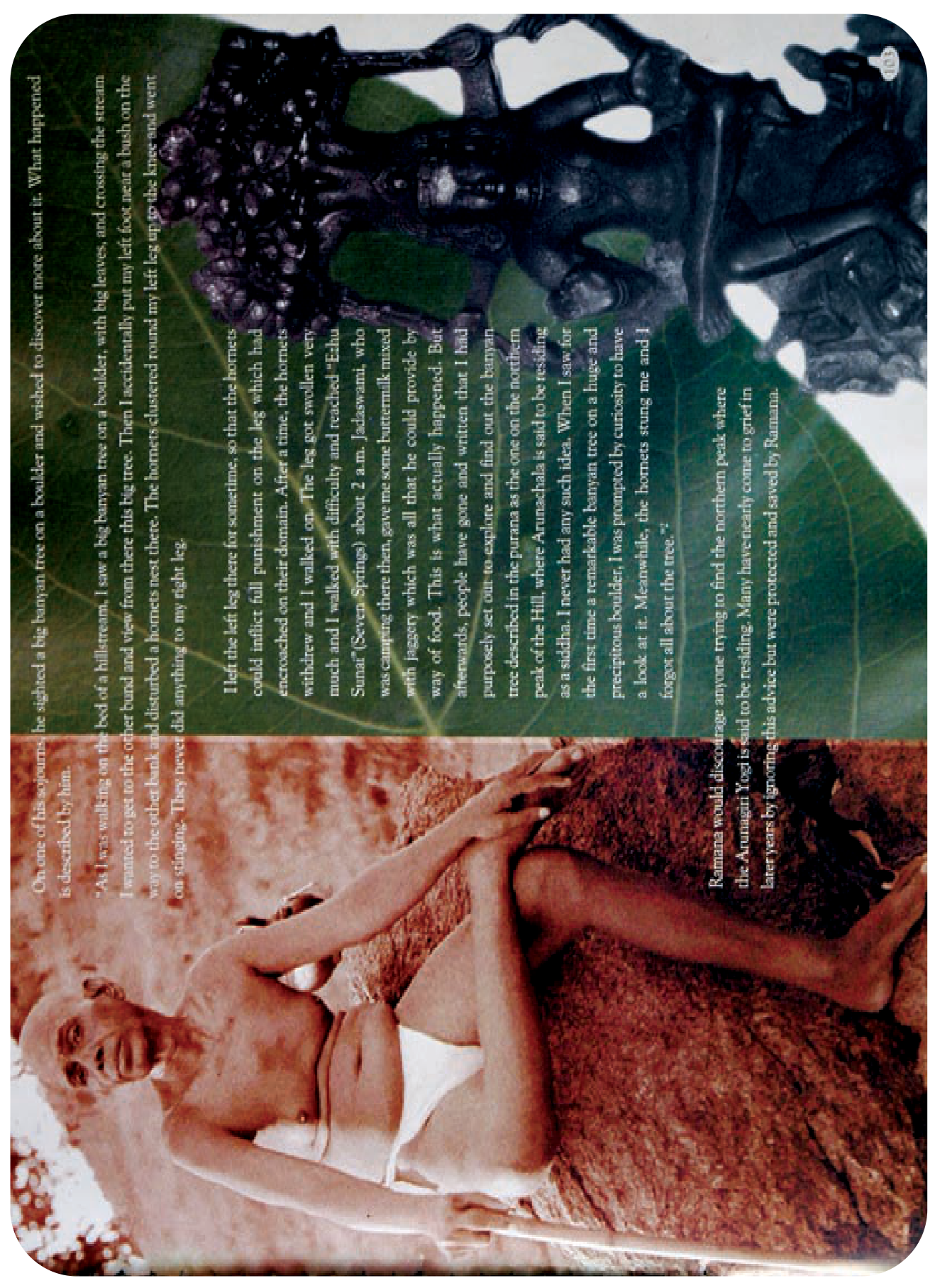
I left the left leg there for sometime, so that the hornets could inflict full punishment on the leg which had encroached on their domain. After a time, the hornets withdrew and I walked on. The leg got swollen very much and I walked with difficulty and reached "Ezhu Sunai" (Seven Springs) about 2 a.m. Jadaswami, who was camping there then, gave me some buttermilk mixed with jaggery which was all that he could provide by way of food. This is what actually happened. But afterwards, people have gone and written that I had purposely set out to explore and find out the banyan tree described in the purana as the one on the northern peak of the Hill, where Arunachala is said to be residing as a siddha. I never had any such idea. When I saw for the first time a remarkable banyan tree on a huge and precipitous boulder, I was prompted by curiosity to have a look at it. Meanwhile, the hornets stung me and I forgot all about the tree."²
Ramana would discourage anyone trying to find the northern peak where the Arunagiri Yogi is said to be residing. Many have nearly come to grief in later years by ignoring this advice but were protected and saved by Ramana.
This is the banyan tree that Ramana Maharishi talks about that he visited once in the Arunachala hill. He says that one day as he was walking on Arunachala hill, he was transported to a banyan tree and saw a young Yogi teaching far older disciples under it. By implication, Ramana compared this tree and the Yogi he saw, to Lord Dakshinamurthy, incarnation of Siva Himself.
This is the same banyan tree that Sankara sang about in his Dakshinamurthy Stotram; under which the South-facing young boy taught older sages in silence.
Nithyananda says:
'When I see all these references to this banyan tree under which this young Master taught older disciples, as Arunagiri Yogiswara or Dakshinamurthy, I am convinced that they refer to Shambhala, abode of the Sapta Rishis (seven sages), the cosmic energy center.
One can reach Shambhala from Tapovan, which is over 17,500 feet in the Himalayas beyond Gangotri and Gomukh. With the Master's help one can reach Shambhala from anywhere. The enlightened master can act as an airstrip to take you to that space at any time. The airstrips from where you can fly to Shambhala are called energy fields. The banyan tree at Bidadi (Nithyananda's ashram outside Bangalore) is one such energy field to take off.
However, Shambhala is not on this earthly plane. Shambhala is an experience that is spiritual. That is what Ramana saw and I saw with Arunagiri Yogiswara. The tree that we both saw is the same banyan tree at Bidadi in our ashram.
The banyan tree that Ramana Maharishi refers to, and the banyan tree at Bidadi, are like airports or helipads to take off and reach the spiritual plane where Arunagiri Yogiswara resides in pure consciousness, as Dakshinamurthy, 'Siva' Himself.'
This biographical account is a recount of incidents from the childhood days of Paramahamsa Nithyananda, an enlightened Master.
The story of the life of an enlightened Master, a Paramahamsa, can create within you the desire to evolve spiritually. It can be an inspiration for a change in lifestyle, towards a better quality of life; towards enlightenment itself.
Some excerpts:
. . . Nithyananda decided he would not eat if Ganapati did not eat. He placed some food in front of the idol and waited. When Ganapati did not eat, Nithyananda did not eat his food as well. He took the food from his mother, pretended he was going to eat, walked to the back of the house and dumped it in a drain. Nithyananda's parents did not realize what was going on. At the end of the third day, the food in front of the idol disappeared! The child was overwhelmed with love...
. . . 'I saw her, I saw the Goddess, Devi' he said to the Yogi, in wonder! The Yogi laughed: 'I am blessed, my child', he said, 'it takes years to see Devi. You are indeed a realized being. That's why you could have her vision just after initiation.' . . .
. . . In the midst of his meditation, Nithyananda felt something opening up within him, something was getting crushed, something else was getting created. It was like a vessel inside getting broken and a door opening, both together. It was a feeling of creation and destruction at the same time; and a very pleasurable feeling. A feeling of calmness descended on him. Even with his eyes closed, he could see all around him. He did not need his eyes to be open to see; not just that, he had a 360-degree vision with his eyes closed. With equal clarity, Nithyananda could see the hill in front of him, the temple behind him, the rock below him, the stars above him, the trees to the left, part of the hill to the left, all these were in his visionary field, without having to open his eyes...
Nithyananda says:
'At that moment, I awakened to the realization that I was one with the whole of Existence and everything was I!'
Published by Life Bliss Foundation