SHAKTI PRAMANAS
This text was machine-transcribed from the printed book and may contain errors. Select the words and choose “Report a mistake”.
(as on 22 july 2017)
No. 1 Power: Third Eye Topic: Destroy Pāpa, incompletions with Third Eye , Attain Param Padam Pramana: Shiva Samhita, 5.45, panchama patalah by Ishwara (Shiva)
शिरः कपाले रुद्राक्षं विवरं चिन्तयेद्यदा ।
तदा ज्योतिः प्रकाशः स्याद्विद्युत्पुञ्जसमप्रभः ॥
एतच्चिन्तनमात्रे ण पापानां संक्षयो भवेत् ।
दुराचारोऽपि पुरुषो लभते परमं पदम् ॥ ४५ ॥
45. When the Yogi constantly thinks that he has got a third eye-the Eye of Shiva – at the center of the forehead, he then cognizes a fire brilliant, illumined like lightening. Just by contemplating and having restful awareness on this light, all incompletions, negative thought currents are destroyed, and even the most wicked person obtains the highest, ultimate state, paramam padam – the state of Sadashivatva.
No. 2 Power: siddhānām darshanam, Experience and talk to Siddhas with power of Third Eye Topic: Experience Beings of Other Dimensions of Universe
Pramana: Shiva Samhita, 5.46 panchama patalah by Ishwara (Shiva)
अहर्निशं यदा चिन्तां तत्करोति विचक्षणः ।
सिद्धानां दर्शनं तस्य भाषणञ्च भवेद्ध्रुवम् ॥ ४६ ॥
46. If the experienced Yogi contemplates and places awareness on the light of the third eye day and night, he sees the Siddhas, the perfected enlightened beings [siddhānām darshanam], and can directly converse with them.
Nos. 3-4. Power: Becoming Etheric Body Topic: Absorbing in Chitākasha, the etheric inner space
Pramana: Shiva Samhita, 5.47-5.58; panchama patalah by Ishwara (Shiva)
तिष्ठन् गच्छन् स्वपन् भुञ्जन् ध्यायेच्छून्यमहर्निशम् ।
तदाकाशमयो योगी चिदाकाशे विलीयते ॥ ४७ ॥
47. He who contemplates on the space of infinity, where ‘no other exists’ (shunya), while walking, talking or standing, dreaming or walking, becomes completely etheric, and is completely absorbed in the chit-ākāsha – the etheric inner space.
एतज्ज्ञानं सदा कार्यं योगिना सिद्धिमिच्छता ।
निरन्तरकृताभ्यासान्मम तुल्यो भवेद्ध्रुवम् ॥
एतज्ज्ञानबलाद्योगी सर्वेषां वल्लभो भवेत् ॥ ४८ ॥
48. The Yogi who seeks to manifest the powers, should always obtain this sacred knowledge; by constant manifestation he becomes like Me (Shiva); through the sheer power of the sacred science of powers, he becomes the beloved of all.
Nos. 5-6
Power: Lord of Light, Conqueror of Death
Topic: Seeing the Cosmic Light
Pramana: Shiva Samhita, 5.50; panchama patalah by Ishwara (Shiva)
ज्योतिः पश्यति योगीन्द्रः शुद्धं शुद्धाचलोपमम् ।
तत्राभ्यासबलेनैव स्वयं तद्रक्षको भवेत् ॥ ५० ॥
उत्तानशयने भूमौ सुप्त्वा ध्यायन्निरन्तरम् ।
सद्यः श्रमविनाशाय स्वयं योगी विचक्षणः ।
शिरः पश्चात्तु भागस्य ध्याने मृत्युञ्जयो भवेत् ॥
भ्रू मध्ये दृष्टिमात्रेण ह्यपरः परिकीर्तितः ॥ ५१ ॥
50. The great Yogi beholds the light, as pure as the sacred mountain (Kailasa), and through the force of his existence in it, he becomes the Lord and guardian of light.
51. Stretching himself on the ground, let him contemplate on this light; by doing so all his weariness and fatigue are destroyed. By contemplating on the back portion of the head, the Yogi becomes conqueror of death.
Nos. 6-9 Power: Travelling in Universe, Revelation of Unknown Sciences, Conquering Death; Anima, Power of Laghima. Mahima... all 8 Naturally Super Powers Topic: Placing restful awareness on the Swadhistana Chakra
Shaastra Pramana: Shiva Samhita, 5.76-78; panchama patalah by Ishwara (Shiva)
यो ध्यायति सदा दिव्यं स्वाधिष्ठाना रविन्दकम् ।
तस्य कामाङ्गनाः सर्वा भजन्ते काममोहिताः ॥ ७६ ॥
76., He who daily contemplates on this Swâdhisthân lotus, becomes an object of love and adoration to all beautiful goddesses.
विविधञ्चाश्रुतं शास्त्रं निःशङ्को वै भवेद्भु वम् ।
सर्वरोगविनिर्मुक्तो लोके चरति निर्भयः ॥ ७७ ॥
77. He fearlessly recites the various Śâstras and sciences unknown to him before; becomes free from all diseases, and moves throughout the universe fearlessly.
मरणं खाद्यते तेन स केनापि न खाद्यते ।
तस्य स्यात्परमा सिद्धिगरिमादिगुणप्रदा ॥
वायुः सञ्चरते देहे रसवृद्धिर्भवेद्ध्रुवम् ।
आकाशपङ्कजगलत्पीयुषमपि वर्द्धते ॥ ७८ ॥
78. Death is eaten by him, he is eaten by none; he obtains the highest psychic powers like animâ, laghimâ, etc. The vâyu moves equably throughout his body; the humours of his body also are increased; the ambrosia exuding from the etherial lotus also increases in him.
Nos. 10-15 Powers:
- Pātāla Siddhi, becoming Lord of Desires, destroy sorrow, disease, death ;
- Paradehapravesham – entering into other bodies
- Power to make gold
- Siddhanām Darshanam – Vision of Siddhas (vision of other dimension beings)
- Aushadhi Darshanam – vision, revelation of sacred medicinal herbs
- Niddinām Darshanam – vision of great hidden cosmic treasures
Topic: Placing restful awareness on the Manipuraka Chakra, whose presiding deity is Rudra and Devi Lakhni
Shaastra Pramana: Shiva Samhita, 5.81-82; panchama patalah by Ishwara (Shiva)
तस्मिन् ध्यानं सदा योगी करोति मणिपूरके ।
तस्य पातालसिद्धिः स्यान्निरन्तरसुखावहा ॥
ईप्सितञ्च भवेल्लोके दुःखरोगविनाशनम् ।
कालस्य वञ्चनञ्चापि परदेहप्रवेशनम् ॥ ८१ ॥
81. When the Yogi contemplates on the Manipur lotus, he gets the power called the pâtâl-siddhi—the giver of constant happiness. He becomes lord of desires, destroys sorrows and diseases, cheats death, and can enter the body of another.
जाम्बूनदादिकरणं सिद्धानां दर्शनं भवेत् ।
ओषधीदर्शनञ्चापि निधीनां दर्शनं भवेत् ॥ ८२ ॥
82. He can make gold, etc., see the adepts (clairvoyantly), discover medicines for diseases, and see hidden treasures.
Nos. 16 Powers:
- Dṛṣṭādṛṣṭā phalam – Have direct vision of the seen Universe (dṛsta) and the unseen universe (adṛasta)
Topic: Placing restful awareness on the Anahat Chakra and the Banalinga within it Shaastra Pramana: Shiva Samhita, 5.83-84; panchama patalah by Ishwara (Shiva)
4. Anâhat Chakra.
हृदयेऽनाहतं नाम चतुर्थं पङ्कजं भवेत् ।
कादिठान्तार्णसंस्थानं द्वादशारसमन्वितम् ॥
अतिशोणं वायुबीजं प्रसादस्थानमीरितम् ॥ ८३ ॥
83. In the heart, is the fourth Chakra, the Anâhat. It has twelve petals designated by the letters k, kh, g, gh, ṅ, ch, chh, j, jh, ñ, ṭ, ṭh. Its color is deep blood-red; it has the seed of vâyu, यँ, and is a very pleasant spot.
पद्मस्थं तत्परं तेजो बाणलिंगं प्रकीर्तितम् ।
यस्य स्मरणमात्रेण दृष्टादृष्टफलं लभेत् ॥ ८४ ॥
84. In this lotus is a flame called vâṇliṅga; by contemplating on this, one gets objects of the seen and the unseen universe.
No. 17- 26
Powers: 10 Powers
- Jñānaṇcāpratimam – Immeasurable infinite knowledge (of anything)
- Trikāla Vishayam – Knowing anything from the 3 Times – Past, present, future
- Dūrashruti – Power to listen to anything at far-off great distances
- Dūrdṛisti – Power to have direct vision of anything at great distances, anywhere
- Khagatām – Power to walk, move in air by own will like a khaga (flying bird)
- Siddhanām Darshanam – Vision of Siddhas (vision of other dimension beings)
- Yogini Darshanam – Vision of Yoginis (vision of other dimension beings
- Khecari – Power of becoming adept in Khechari
- Khecarānam Jayanta – Power to conquer all who move about in the air element
- Bhucari – Power to travel and go anywhere in the Universe at will
Topic: Placing restful awareness on the Anahat Chakra, manifest 9 powers Shaastra Pramana: Shiva Samhita, 5.85-89 verse; panchama patalah by Ishwara (Shiva)
सिद्धः पिनाकी यत्रास्ते काकिनी यत्र देवता ।
एतस्मिन्सततं ध्यानं हृत्पाथोजे करोति यः ॥
क्षुभ्यन्ते तस्य कान्ता वै कामार्ता दिव्ययोषितः ॥ ८५ ॥
85. Its presiding adept is Pinâkì, and the Kâkini is its goddess. He who always contemplates on this lotus of the heart is eagerly desired by celestial maidens.
ज्ञानञ्चाप्रतिमं तस्य त्रिकालविषयम्भवेत् ।
दूरश्रुतिर्द्दूरदृष्टिः स्वेच्छया खगतां व्रजेत् ॥ ८६ ॥
86. He gets immeasurable knowledge, knows the past, present and future time ; has clairaudience, clairvoyance and can walk in the air, whenever he likes.
सिद्धानां दर्शनञ्चापि योगिनी दर्शनं तथा ।
भवेत्खेचरसिद्धिश्च खेचराणां जयन्तथा ॥ ८७ ॥
87. He sees the adepts, and the goddesses known as Yoginis ; obtains the power known as Khechari, and conquers all who move in the air.
यो ध्यायति परं नित्यं बाणलिंगं द्वितीयकम् ।
खेचरी भूचरी सिद्धिर्भवेत्तस्य न संशयः ॥ ८८ ॥
88. He who contemplates daily the hidden Bânalinga, undoubtedly obtains the psychic powers called Khechari (moving in the air) and Bhuchari (going at will all over the world).
एतज्ज्ञानस्य माहात्म्यं कथितुं नैव शक्यते ।
ब्रह्माद्याः सकला देवा गोपयन्ति परन्त्विदम् ॥ ८९ ॥
89. I cannot fully describe the importance of the meditation of this lotus ; even the gods Brahmâ etc, keep the method of its contempla-tion secret.
No. 27-31
Powers: 5 Powers
- Yogishwara – becoming the Lord of Yogis
- Caturveda Vibhasante – power to know all the 4 Vedas and all their hidden sacred secrets, get revealed
- Svasharirasya Shakti – power and strength in body for 1000s of years
- Vajra Sharira – power of body becoming as adamant and powerful like a Vajra, thunderbolt
- Varshasahastrāni tatkshanam manyate – Power to cognize 1000s of years in just a kshana, moment or the gap between the thoughts
Topic: Placing restful awareness on the Vishuddhi Chakra, manifest cosmic powers Shaastra Pramana: Shiva Samhita, 5.90-95 verse; panchama patalah by Ishwara (Shiva)
5. Vishuddha Chakra.
अथ विशुद्धचक्रविवरणम् ।
कण्ठस्थानस्थितं पद्मं विशुद्धं नामपञ्चमम् ।
सुहेमाभं स्वरोपेतं षोडशस्वरसंयुतम् ॥
छगलाण्डोऽस्ति सिद्धोत्र शाकिनी चाधिदेवता ॥ ९० ॥
90. This Chakra situated in the throat, is the fifth, and is called the Vishuddha lotus. Its color is like brilliant gold, and it is adorned with sixteen petals and is the seat of the vowel sounds (i.e., its sixteen petals are designated by the sixteen vowels—a, â, i, î, u, û, ri, rî, lri, lrî, e, ai, o, au, am, ah. Its presiding adept is called Chhagalânda, and its presiding goddess is called Sâkini.
ध्यानं करोति यो नित्यं स योगीश्वरपण्डितः ।
किन्त्वस्य योगिनोऽन्यत्र विशुद्धाख्ये सरोरुहे ॥
चतुर्वेदा विभासन्ते सरहस्या निधेरिव ॥ ९१ ॥
91. He who always contemplates it, is truly the lord of the Yogis, and deserves to be called wise; by the meditation of this Vishuddha lotus, the Yogi at once understands the four Vedas with their mysteries.
रहःस्थाने स्थितो योगी यदा क्रोधवशो भवेत् ।
तदा समस्तं त्रैलोक्यं कम्पते नात्र संशयः ॥ ९२ ॥
92. When the Yogi, fixing his mind on this secret spot, feels angry, then undoubtedly all three worlds begin to tremble.
तस्य न क्षतिमायाति स्वशरीरस्य शक्तिः ।
संवत्सरसहस्रेऽपि वज्रातिकठिनस्य वै ॥ ९४ ॥
94. His body never grows weak, and he retains his full strength for a thousand years, it becomes harder than adamant.
यदा त्यजति तद्ध्यानं योगीन्द्रोऽवनिण्डले ।
तदा वर्षसहस्राणि मन्यते तत्क्षणं कृती ॥ ९५ ॥
95. When the Yogi leaves off this contemplation, then to him in this world, thousands of years, appear as so many moments.
No. 32
POWER - mat samo bhavati – Become Shiva, the source of all powers.
Topic: Placing restful awareness on the AJNA Chakra, become SHIVA Shaastra Pramana: Shiva Samhita, 5.96-99 verse; panchama patalah by Ishwara (Shiva)
6. Ajñâ Chakra.
अथ आज्ञाचक्रविवरणम् ।
आज्ञापद्मं भ्रुवोर्मध्ये हक्षोपेतं द्विपत्रकम् ।
शुक्लाभं तन्महाकालः सिद्धो देव्यत्र डाकिनी ॥ ९६ ॥
96. The two-petalled Chakra, called the Âjñâ, is situated between the two eye-brows, and has the letters h, and ksh; its presiding adept is called Shuklâ Mahâkâla (the White Great Time); its presiding goddess is called Hâkinî.
शरच्चंद्रनिभं तत्राक्षरबीजं विजृंभितम् ।
पुमान् परमहंसोऽयं यज्ज्ञात्वा नावसीदति ॥ ९७ ॥
97. Within that petal, there is the eternal bîja (the syllable हुँ tham), brilliant as the autumnal moon. The wise anchorite, by knowing this, is never pulled down.
एतदेव परन्तेजः सर्वतन्त्रेषु मन्त्रितः ।
चिन्तयित्वा परां सिद्धिं लभते नात्र संशयः ॥ ९८ ॥
98. This is the great light held secret in all the Tantras; by contemplating on this, one obtains the highest success, there is no doubt of it.
तुरीयं त्रितयं लिंगं तदाहं मुक्तिदायकः ।
ध्यानमात्रेण योगीन्द्रो मत्समो भवति ध्रुवम् ॥ ९९ ॥
99. I am the giver of salvation, I am the third linga in the turiya (the state of ecstacy, also the name of the thousand-petalled lotus). By contemplating on this, the Yogi becomes certainly like me.
No. 33
POWER - Purvajanma karma vināsha – Power to destroy the Karma, unfulfilled actions of past births Topic: Placing restful awareness on the AJNA Chakra, find 3 more centers – BINDU, NĀDA, ŚAKTI in lotus of Ajna. Shaastra Pramana: Shiva Samhita, 5.110-112 verse; panchama patalah by Ishwara (Shiva)
आज्ञापद्ममिदं प्रोक्तं यत्र देवो महेश्वरः ।
पीठत्रयं ततश्चोर्ध्वं निरुक्तं योगचिन्तकैः ॥
तद्विन्दुनादशक्त्याख्यं भालपद्मे व्यवस्थितम् ॥ ११० ॥
110. The two-petalled Âjña-lotus has been thus described where dwells the God Maheshwara. The Yogis describe three more sacred stages above this. They are called Vindu, Nâda and Śakti, and are situated in the lotus of the forehead.
यः करोति सदाध्यानमाज्ञापद्मस्य गोपितम् ।
पूर्वजन्मकृतं कर्म विनश्येदविरोधतः ॥ १११ ॥
111. He who always contemplates on the hidden Âjña lotus, at once destroys all the karmas of his past life, without any oppostion.
इह स्थिते यदा योगी ध्यानं कुर्यान्निरन्तरम् ।
तदा करोति प्रतिमां पूजाजपमनर्थवत् ॥ ११२ ॥
112. Remaining in this place, when the Yogi meditates constantly, then to him all forms, worships and prayers appear as worthless.
No. 34 POWER – THIRD EYE ; Vashitva – Power to command and order beings from other dimensions of universe.
Topic: Beings from other dimensions of the Universes will serve his feet, obey his command Shaastra Pramana: Shiva Samhita, 5.113 verse; panchama patalah by Ishwara (Shiva)
यक्षराक्षसगन्धर्व्वा अप्सरोगणकिन्नराः।
सेवन्ते चरणौ तस्य सर्वे तस्य वशानुगाः ॥ ११३ ॥
113. The beings from other dimensions of the Universes such as Yakshas, Rakshasas, Gandharvas, Apsaras, and Kinnaras, all serve his feet (of the one whose third eye is awakened and who can place the restful awareness on the hidden Ajna Chakra stages of – Bindu, Nāda, shaki). They simply become obedient to his command.
No. 35-36
POWER:
- Be absorbed in Paramātma, Sadashiva when leaving body with awareness on Third Eye
- Be Free from Actions and Incompletions with Third Eye
Topic: Just by AJNA Chakra alone, manifest all the powers that come from 5 other lotuses. Shaastra Pramana: Shiva Samhita, 5.115-118 verse; panchama patalah by Ishwara (Shiva)
यानि यानि हि प्रोक्तानि पंचपद्मे फलानि वै ।
तानि सर्वाणि सुतरामेतज्ज्ञानाद्भवन्ति हि ॥ ११५ ॥
115. All the fruits which have been described above as resulting from the contemplation of the other five lotuses, are obtained through the knowledge of this one Âjña lotus alone.
यः करोति सदाभ्यासमाज्ञा पद्मे विचक्षणः ।
वासनाया महाबन्धं तिरस्कृत्य प्रमोपते ॥ ११६ ॥
116. The wise one, who continually practises contemplation of this Âjñalotus, becomes free from the mighty chain of desires, and enjoys happiness.
प्राणप्रयाणसमये तत्पद्मं यः स्मरन्सुधीः ।
त्यजेत्प्राणं स धर्मात्मा परमात्मनि लीयते ॥ ११७ ॥
117. When at the time of death, the Yogi contemplates on this lotus, leaving this life, that holy one is absorbed in the Paramâtmâ.
तिष्ठन् गच्छन् स्वपन् जाग्रत् यो ध्यानं कुरुते नरः ।
पापकर्मविकुर्वाणो नहि मज्जति किल्विषे ॥ ११८ ॥
118. He who contemplates on this, standing or walking, sleeping or waking, is not touched by sins, even if it were possible for him to do sinful works.
योगो बन्धाद्विनिर्मुक्तः स्वांयया प्रभया स्वयम् ।
द्विदलध्यानमाहात्म्यं कथितुं नैव शक्यते ॥
ब्रह्मादिदेवताश्चैव किञ्चिन्मत्तो विदन्ति ते ॥ ११९ ॥
119. The Yogi becomes free from the chain by his own exertion. The importance of the contemplation of the two-petalled lotus cannot be fully described. Even the gods like Brahmâ, etc., have learnt only a portion of its grandeur from me.
No. 37-42 POWER: SAHASRARA, the crown center
- Free from re-birth by knowing secret abode of Kailasa in Sahasrara
- Power to create or destroy the Creation
- power over aggregate elements
- Beyond diseases and power to subdue accidents
- Long Life
- Mrtyu Mukta – free from death -
Topic: Discover the secret abode, the Kailasa of Mahesha (Sadashiva) - SAHASRARA CHAKRA Shaastra Pramana: Shiva Samhita, 5.151-154 verse; panchama patalah by Ishwara (Shiva)
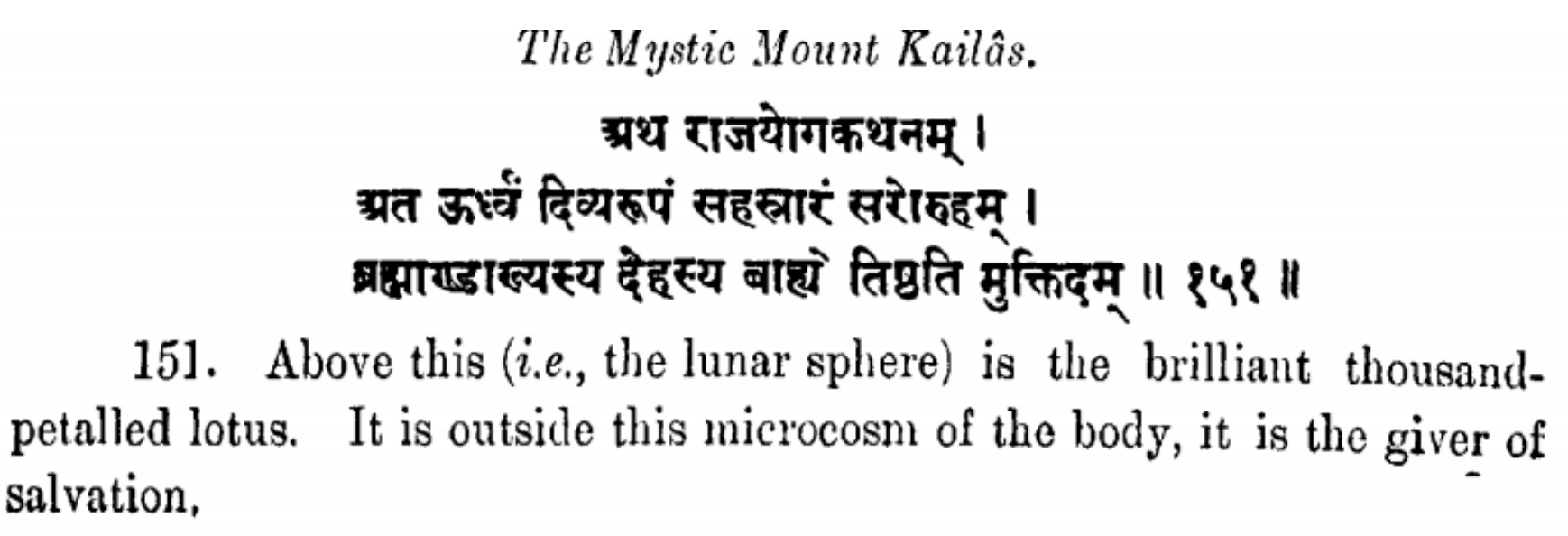
कैलासो नाम तस्यैव महेशो यत्र तिष्ठति ।
नकुलाख्योऽविनाशी च क्षयवृद्धिविवर्जितः ॥ १५२ ॥
152. Its name is verily the Kailâs mount, where dwells the great Lord (Shiva,) who is called Nakula and is without destruction, and without increase or decrease.
स्थानस्यास्य ज्ञानमात्रेण नृणां, संसारेऽस्मिन्सम्भवो नैव भूयः ।
भूतग्रामं सन्तताभ्यासयोगात्कर्तुं हर्तुं स्याच्च शक्तिः समग्रा ॥ १५३ ॥
153. Men, as soon as they discover this most secret place, become free from re-births in this universe. By the practice of this Yoga he gets the power of creating or destroying the creation, this aggregate of elements.
स्थाने परे हंसनिवासभूते, कैलासनाम्नीह निविष्टचेताः ।
योगी हतव्याधिरधः कृताधिवरायुश्चिरं जीवति मृत्युमुक्तः ॥ १५४ ॥
154. When the mind is steadily fixed at this place, which is the residence of the Great Swan and is called Kailâs, then that Yogi, devoid of diseases and subduing all accidents, lives for a great age, free from death.
No. 43-50
POWER
- Vaakshakti – the power of words
- Kāmachāri – transporting himself everywhere at will
- Dūrashruti – Power to listen to anything at far-off great distances
- Sukshma dṛisti – Power of subtle vision
- Parakāyapravesha – power of entering another’s body
- Svarnam–- turning base metals into gold’
- Adṛshya-karanam – power of becoming invisible
- Khechari – moving in the air Topic: Shaastra Pramana: Shiva Samhita, 3.54 verse; tritiya patalah by Ishwara (Shiva)
वाक्सिधिः कामचारित्वं दूरदृष्टिस्तथैव च ।
दूरश्रुतिः सूक्ष्मदृष्टिः परकायप्रवेशनम् ॥
विण्मूत्रलेपने स्वर्णमदृश्यकरणं तथा ।
भवन्त्येतानि सर्वाणि खेचरत्वं च योगिनाम् ॥ ३-५४ ॥
54. The Yogi manifests the following powers – vāk shakti, the power of words; transporting himself anywhere or everywhere at his mere will – Kāmachāri; clairvoyance or the power to direct see anything, anywhere – duradristi; clairaudience or the power to listen to anything at far-off great distances; the power of subtle vision - Sukshma dṛisti; and the power to entering another body – parakāyapravesha; the alchemical power to turn the base metals into gold by rubbing them with excrements and urine - svarnam; and the power to become invisible - adṛshya-karanam; and moving about in the air, khechari.
No. 51
Power: Power of Wind Energy, Vayu-Siddhi
Topic: Power that destroys darkness of the world
Shaastra Pramana: Shiva Samhita, 3.42
Vâyusiddhi.
योगी पद्मासनस्थोऽपि भुवमुत्सृज्य वर्तते ।
वायुसिद्धिस्तदा ज्ञेया संसारध्वान्तनाशिनी ॥ ४२ ॥
When the Yogi, through remaining in Padmasana, can rise in the air and leave the ground, then know that he has gained – vayu-siddhi, the power of wind element, which destroys the darkness of the whole world.
No. 52 -54
Power:
- Mrtyu Jāyati – power to winning death | The technique: Drinking the nectar
- Rogānasha - Power to destroy all diseases – power over body/matter
- Bhairava Bhavati – becoming Bhairava
- Jeetabhūtagaṇā – conquering all elements in length, breath and depth
Shaastra Pramana: Shiva Samhita, 3.76-78, tritiya patalah by Ishwara (Shiva)
दन्तैर्दन्तान्समापीड्य पिबेद्वायुं शनैः शनैः ।
ऊर्ध्वजिह्वः सुमेधावी मृत्युं जयति सोचिरात् ॥ ३-७६ ॥
76. When firmly closing the teeth by the pressing the upper palate on the lower jaw and placing the tongue upwards, the wise Yogi drinks the nectarine fluid very slowly, and within a short period, he conquers death – mṛtyu jayati.
षण्मासमात्रमभ्यासं यः करोति दिने दिने ।
सर्वपापविनिर्मुक्तो रोगान्नाशयते हि सः ॥ ३-७७ ॥
77. The Yogi who daily manifests this power (of drinking the sacred nectar) for just 6 months, is liberated from all incompletions and destroys all diseases, manifesting the power over the body physiology.
संवत्सरकृताऽभ्यासाद्भैरवो भवति ध्रुवम् ।
अणिमादिगुणाँल्लब्ध्वा जितभूतगणः स्वयम् ॥ ३-७८ ॥
78. When the Yogi continues to manifest the above powers for a year, he becomes a Bhairava (the independent cosmic power of Sadashiva, who is the Lord of completion and Time and Space); he obtains and expresses the powers of Anima, etc, which are the eight naturally super powers in oneness with Bhairava; and by his own self, conquers all elements in the length, breadth and depth dimension (jīta bhutagaṇa).
Power:
No. 55- :
- Power over the Body - disease, old age, Death
- Going beyond hunger, thirst, sleep and swoon; Becoming Kāmadeva
- lord of pleasures
- Svacchandacāri – becoming perfectly independent and freed from obstacles
- Sarvāpat – power to travel anywhere
- Enjoying with Suras, the Divine Beings (beings of other dimensions)
Shaastra Pramana: Shiva Samhita, 79-83
रसनामूर्ध्वगां कृत्वा क्षणार्धं यदि तिष्ठति ।
क्षणेन मुच्यते योगी व्याधिमृत्युजरादिभिः ॥ ३-७९ ॥
79. When the Yogi can remain for half a second with his tongue drawn upwards, he becomes free from disease (vyādhi), death (mṛtyu) and old age (jarā).
रसनां प्राणसंयुक्तां पीड्यमानां विचिंतयेत् ।
न तस्य जायते मृत्युः सत्यं सत्यं मयोदितम् ॥ ३-८० ॥
80. Truly, Truly, I tell you the truth that a person never dies who contemplates and remembers by pressing the tongue, combined with the vital life-energy fluid called Prana.
एवमभ्यासयोगेन कामदेवो द्वितीयकः।
न क्षुधा न तृषा निद्रा नैव मूर्च्छा प्रजायते ॥ ३-८१ ॥
81. Through this process and yoga, he becomes like a Kāmadeva, the pleasure-manifesting deity, who is without a second. He feels neither hunger, nor thirst, nor sleep, nor swoon.
अनेनैव विधानेन योगीन्द्रोऽवनिमण्डले।
भवेत्स्वच्छन्दचारी च सर्वापत्परिवर्जितः ॥ ३-८२ ॥
82. By acting upon these ordainments (by Me), the great Yogi (Yogindra) becomes in the world perfectly independent - svacchandacāri; and is freed from all obstacles, he can travel anywhere, sarvāpat.
न तस्य पुनरावृत्तिर्मोदते ससुबैरपि।
पुण्यपापैर्न लिप्येत एतदाक्षरणेन सः॥ ३-८३ ॥
83. By manifesting such powers, he is never reborn nor is tainted by virtue or vice, but enjoys for ages with the Divine Beings of other dimensions of existence.
No. 60-61 :
Power:
- Vaak Shakti – power of words
- Kaamchaaritvam - power to go everywhere by will.
Shaastra Pramana: Shiva samhita, 4.11
वाक्सिद्धिः कामचारित्वं भवेद्ग्यासयोगतः ॥
योनिमुद्रा परं गोप्या न देया यस्य कस्यचित् ।
सर्वथा नैव दातव्या प्राणैः कण्ठगतैरपि ॥ ४-११ ॥
4.11 Through the practice, one manifests the power of words (integrity) and make the words become reality, and the power of traveling everywhere through the mere will. This Yoni mudra should be kept secret, and not to be given to everybody. Even when threatened with death, it should not be given to others.
No. 62 :
Power:
Pratikopāsana – the invocation and power of shadow – brings victory, vayu shakti, power to travel anywhere
Shaastra Pramana: Shiva samhita, 15-18
Invocation of the shadow (pratikopâsana).
अथ प्रतीकोपासनम्।
प्रतीकोपासना कार्या दृष्टादृष्टफलप्रदा ।
पुनाति दर्शनादत्र नात्र कार्या विचारणा ॥ १५ ॥
15. The invocation of Pratika (shadow) gives to the devotee the objects seen as well as unseen; undoubtedly, by its very sight, a man becomes pure.
गाढांतपे स्वप्रतिबिम्बितेश्वरं निरीक्ष्य विस्फारितलोचनद्वयम् ।
यदा नभः पश्यति स्वप्रतीकं नभोऽङ्गणे तत्क्षणमेव पश्यति ॥ १६ ॥
16. In a clear sun-lit sky, behold with a steady gaze your own divine reflection; whenever this is seen even for a single second in the sky, you behold God at once in the sky.
प्रत्यहं पश्यते यो वै स्वप्रतीकं नभोऽङ्गणे ।
आयुर्वृद्धिर्भवेत्तस्य न मृत्युः स्यात्कदाचन ॥ १७ ॥
17. He who daily sees his shadow in the sky, will get his years increased and will never die an accidental death.
यदा पश्यति सम्पूर्णं स्वप्रतीकं नभोऽङ्गणे ।
तदा जयमवाप्नोति वायुं निर्जित्य सञ्चरेत् ॥ १८ ॥
18. When the shadow is seen fully reflected in the field of the sky, then he obtains victory; and conquering the vâyu, he goes everywhere.
How to invoke.
At the time of the rising sun, or by moon, let him steadily fix his gaze on the neck of the shadow he throws; then, after sometime, let him look into the sky; if he sees a full grey shadow in the sky, it is auspicious.
File no. 2
(july 23ʳᵈ 2017)
No. 1
Power: Third Eye Power to Move in Etheric Space - Akasha Khecara
Topic: Manifest Akashic travel, Sadashiva-Uma resides in Third Eye
Shaastra Pramana: Yoga-Tattvopa Upanishad (97-102)
धारयेत् पञ्च घटकिा वायुवद्व्योमगो भवेत् ।
मरणं न तु वायोस्तु भयं भवतियोगनिः ॥ ९७ ॥
आ भ्रूमध्यात्तु मूर्धान्तमाकाशस्थानमुच्यते ।
व्योम वृत्तं च धूम्रं च हकाराक्षरभासुरम् ॥ ९८ ॥
आकाशे वायुमारोप्य हकारोपरि शंकरम् ।
बन्िदुरूपं महादेवं व्योमाकारं सदाशिवम् ॥ ९९ ॥
शुद्धस्फटिकिसंकाशं धृतबालेन्दुमौलन्रिम् ।
पञ्चवक्त्रयुतं सौम्यं दशबाहुं त्रिलोचनम् ॥ १०० ॥
सर्व्वायुधैरृधृताकारं सर्वभूषणभूषितम् ।
उमार्धदेहं वरदं सर्वकारणकारणम् ॥ १०१ ॥
आकाशधारणात् तस्य खेचरत्वं भवेद् ध्रुवम् ।
यत्र कुत्र स्थितो वापि सुखमत्यन्तमश्नुते ॥ १०२ ॥
Transliteration
dhārayet pañca ghaṭhikā vāyuvadvyomago bhavet |
maraṇaṁ na tu vāyostu bhayaṁ bhavati yoginaḥ || 97 ||
ā bhrūmadhyāttu mūrdhāntamākāśasthānamucyate |
vyoma vṛttaṁ ca dhūmraṁ ca hakārākṣarabhāsuram || 98 ||
ākāśe vāyumāropya hakāropari śaṁkaram |
bindurūpaṁ mahādevaṁ vyomākāraṁ sadāśivaṁ || 99 ||
śuddhasphaṭikasaṁkāśaṁ dhṛtabālendumaulinam |
pañcavaktrayutaṁ saumyaṁ daśabāhuṁ trilocanam || 100 ||
sarvāyudhairdhṛtākāraṁ sarvabhūṣaṇabhūṣitam |
umārdhadehaṁ varadaṁ sarvakāraṇakāraṇam || 101 ||
ākāśadhāraṇāt tasya khecaratvaṁ bhaved dhruvam |
yatra kutra sthito vāpi sukhamatyantamaśnute || 102 ||
From the middle of the eyebrows on to the (other) end of the crest is said to be the region of Ether. Ether is the circle and is of the colour of smoke and is manifest as the syllable 'Ham'.
Forcing the vital air into the region of Ether 'Akasha' along with the syllable ' Ham', the Yogi should meditate on the great God Shankara of the form of the Bindu, of the form of Ether, Sadashiva of the colour of clear crystal and holding the crescent on his crest, with five faces, with a pleasing feature, with ten arms and (five sets of) three eyes, equipped with all weapons and decked with all jewels, with one half of his body shared by Uma, bestowing boons, and the prime-cause of all causes. By holding the vital air in Ether, for the Yogi, there will surely manifest the power of moving through etheral space. Wherever he may remain, he experiences immense Bliss.
No. 2
Power: Become One with Akasha – Mahakasha , Parakasha, Tattvakasha, Suryakasha
Topic: Becoming the changeless, primordial Ether beyond any quality.
Shaastra Pramana: Mandala Brahmanopanishad (Section II, verses 11-14)
प्रातश्चित्रादिवर्णसूर्यचन्द्रवह्निनिर्ज्वालावलीवत्तद्वहीनन्तरिक्षवत् पश्यति ॥ ११ ॥
तदाकाराकारी भवति ॥ १२ ॥
अभ्यासान्निर्विकारं गुणरहिताकाशं भवति ।
स्फुरत्तारकाकारगाढतमोपमं पराकाशं भवति ।
कालानलसमद्योतमानं महाकाशं भवति ।
सर्वोत्कृष्टपरमाद्वितीयप्रद्योतमानं तत्त्वाकाशं भवति ।
कोटिसूर्यप्रकाशसंकाशं सूर्याकाशं भवति ॥ १३ ॥
एवमभ्यासात् तन्मयो भवति । य एवं वेद ॥ १४ ॥
Transliteration
prātaścitrādivarṇa sūryacandravahni- jvālāvalīvattadvihīnāntarīkṣavat paśyati || 11 ||
tadākārākārī bhavati || 12 ||
abhyāsānnirvikāraṃ guṇarahitākāśaṃ bhavati |
visphurattārakākāragāḍhatamopamaṃ parākāśaṃ bhavati |
kālānalasamadyotamānaṃ mahākāśaṃ bhavati |
sarvot-kṛṣṭaparamādvitīya-pradyotamānaṃ tattvākāśaṃ bhavati |
koṭisūryaprakāśa-saṃkāśaṃ sūryākāśaṃ bhavati || 13 ||
evamabhyāsāt tanmayo bhavati | ya evaṃ veda || 14 ||
As regards intermediate introspection, He sees (not far off and in front of him, Ethereal space) with a halo of variegated and other colours, the (radiance of the) Sun, the cool beams of the Moon, the (dazzling brightness of the) flaming fire, and mid-ethereal space without (such halo). He becomes possessed of such aspects, assuming such aspects. By constant practice, he ' sees and becomes the changeless, (unevolved) primordial Ether (beyond any quality). He becomes the ultimate Ether resembling profound darkness, throbbing with the aspect of a star. He becomes the great (expanse of) Ether (mahākāsha) shinning. He becomes the Ether of Truth, the brilliant, all-supreme, transcendent and peerless one. He becomes the Ether of the Sun - Sūryākāsha, resplendent like the self-effulgence of a crore of Suns. Thus, by constant practice, he becomes entirely made of that (five-fold Ether). He who knows thus.
(The Yoga Upanishads, THE ADYAR LIBRARY, 1938)
No. 3-6
Power: All-knowing – sarvajnata; eternally unobscured knowledge- anādi bodha, absolute freedom – svatantrata; unfailing power (alupta shakti); infinite power (ananta shakti), eternally pure form (vishuddha deha) Topic: Powers of Shivatva, characterized by 8 cosmic qualities
Source: Sarvajnanottara Agama, from Sadashiva to Guha (Muruga), Shivanyayasākshātkār patalah, verse 56-57 chapter 2, vidya pada – The direct blissful experience of Absolute Oneness with Shiva.
vijñānamevam samupāsya vidvān
viśtyakāyam satatam niyuktaḥ |
sarvatragamī bhavatīha muktaḥ
taddharma dharmī bahiranta samsthaḥ || 56 ||
Upon such constant practice, he reaches a bodiless state and gets established constantly in that state. He reaches all directions and places simultaneously by virtue of his bodiless and pervasive nature; he becomes the Liberated Self. He becomes the possessor all the exalted qualities of Lord Shiva who presents Himself simultaneously within and outside the universe replete with moveable and immoveable existents.
सर्वज्ञता तृप्तिरनादिबोधः
स्वतन्त्रता नित्यमलुप्तशक्तिः।
अनन्तशक्तिश्च निरामयात्मा
विशुद्धदेहस्सशिवत्वमेति।।
sarvajn”ata’ tr’ptirana’di bodhah
svatantrata’ nityamalupta s’aktih/
anantas’atis’ca nira’maya’tma’
vis’uddhadehas sas’ivatvameti //
He attains the exalted state of shivatva characterized by the eight qualities:
power of all knowing (sarvajnata) eternal contentment (tripti) eternally unobscured knowledge (anādi bodha) absolute freedom (svatantrata) unfailing power (alupta shakti) infinite power (ananta shakti) undefiled by engaging in cosmic functions ( nirāmayātmā) eternally pure form (vishuddha deha)
note:
Svatantrya: This word literally means self-dependence. It is a technical word of the Agamas . It includes three important thought currents
- (1) absolute freedom to create, complete autonomy of Will, not depending on any external material or means for its activity, absolute sovereignty or lordship (aisvarya),
(2) Vimarsa or ever present Self-consciousness, a Self which is all- inclusive (knower, known and means of knowing)
(3) Jnana and kriya. The absolute freedom to create includes jnana and kriya (knowledge and activity).
Shiva in this system is not like the inactive Brahman of Vedanta. He has svatantrya, unimpeded Will, absolute knowledge, absolute power of creativity, and absolute Self-consciousness.
No. 7
Power: Power over elements, bhuta
Topic:. Yogi is just like Shiva
Shaastra Pramana: Shiva Sutra, Chapter 1.20
[?] [?] [?] [?] [?] [?] Bhutakancuki tada vimukto bhuyah patisamah parah
For him, five elements are only coverings. At that very moment, he is absolutely liberated, supreme and just like Shiva.
No. 8
Power: All Shaktis manifest through Shuddhavidya (Adishakti)
Topic:. Manifest all the powers of Shiva
Shaastra Pramana: Shiva Sutra, 1.21
Sutra - 21
शुद्धविद्योदयाच्चक्रेशत्वसिद्धिः ॥ २१ ॥
Suddhavidyodayaccakresatva-siddhih.
शुद्धविद्योदयात् = through the appearance of Suddhavidya; चक्रेशत्वसिद्धिः = full acquisition of mastery over the collective whole of the Saktis.
By the manifestation of the Pure Knowledge, shuddhavidya, is attained mastery over the collective whole of all the powers, Shaktis.
Explanation:
When the Yogi unites his consciousness, which is Sadashiva, with the Shakti through the restful awareness, then the manifestation of Shuddhavidya happens -by which the Yogi is succeeds in manifesting the supreme powers of Sadashiva through complete mastery over all the universal powers.
Note: Suddhavidya in this context is not the suddhavidya tattva which is above the maya tattva. It means the supreme consciousness in which everything appears, it is Adishakti Herself in the unmana avastha.
No. 9 Power: All knowingness Topic:. Seeing and knowing the Universe
Shaastra Pramana: Spanda Karika, 111, 11
(get Sanskrit verse)
"When the Yogi desirous of seeing stands fixed (in restful awareness) covering all objects with the light of his consciousness, (then he will experience the entire objective world in one sweep in himself), then what is the use of talking much, he will have the experience of universal knowing for himself."
No. 10 Power: Jnana Shakti, knowledge to know the sacred scriptures Topic:.
Shaastra Pramana: Paushkar Agama, vidya pada, 1.7
s'ivasya samaveta'ya' s'atirjn"a'tmika' amala' | saivajn"a'nam itiproktam s'a'bdam tadanuma'pakam ||
Being in inseparable relationship with Shiva, there is Shakti who is of the nature of pure consciousness. That Shakti is free from any defilement or obscuring factor. That Shakti herself is called Jnana.
By virtue of the power of this Jnana, the pure knowledge gained through the systematic study of the Agama becomes capable of granting more efficacious knowledge, which ultimately results in the attainment of Shivatva.
No. 11
Power: 8 Auspicious Lordly Powers Topic:.
Shaastra Pramana: Paushkar Agama, vidya pada, 6, 97-98
अथैश्वर्य विभेदोपि लक्ष्यते लेशतोऽधुना॥ ९७
बुद्ध्यात्मनोर्विभागेन स्थितमैश्वर्यं अष्टधा।
धर्मिणो ज्ञाननिष्ठस्य विरागेच्छश्च धीमतः॥ ९८
सत्त्वमुत्पादयेद्बौद्धं अणोरैश्वर्यं इच्छया।
athaiśvarya vibhedopi lakṣyate leśato'dhunā॥ 97
buddhyātmanorvibhāgena sthitamaiśvaryaṁ aṣṭadhā।
dharmiṇo jñānaniṣṭhasya virāgecchaśca dhīmataḥ॥ 98
sattvamutpādayedbauddhaṁ aṇoraiśvaryaṁ icchayā।
Next, the varieties of lordly powers (aishvarya) are told briefly in accordance with their internal divisions. Some lordly powers are related to the body and some others are related to the internal organs (antah karana). Such lordly powers are eightfold. To benefit a person who abides by the rules of righteous conduct, who is firmly established in perfect awareness, who is detached from worldly pursuits and who is with discriminative knowledge, the sattva-quality of the buddhi- tattva generates the lordly powers as desired by him.
No. 11-18
Power: 8 Aiswaryas, Extraordinary powers that come from Yogi's Inner Space or Mind - Topic:. Manifest the 8 Cosmic Powers of - Anima, Laghima, Mahima, Prapti, Prakamya, Isita, Vasitva, Garima
3 Aishwaryas, Extraordinary powers that manifest and express through the Yogi's physical body
Shaastra Pramana: Paushkar Agama, vidya pada, 6, 97-106
अणिमा परमाण्वादेरपिसूक्ष्मतरा स्थितिः॥ ९९
लघिमा शीघ्रवेगित्वं पंकादावप्यमज्जनम्।
महिमा व्याप्यचस्थानं बृहद्देहेन्द्रियादिभिः॥ १००
त्रितयं कायतस्सिद्धं ऐश्वर्यं अणिमादिकम्।
aṇimā paramāṇvāderapisūkṣmatarā sthitiḥ॥ 99
laghimā śīghravegitvaṁ paṅkādāvapyamajjanam|
mahimā vyāpyacasthānaṁ bṛhaddehendriyādibhiḥ॥ 100
tritayaṁ kāyatassiddhaṁ aiśvaryaṁ aṇimādikam|
Anima is the power to exist in a form which is subtler than the substrate-atom (parama anu) and such other minute objects.
Laghima is the power to move with exceeding swiftness, even through mire without getting sunk into it.
Mahima is the power to exist pervasively with the help of huge bodies, organs and such others.
These three lordly powers – anima, laghima and garima are expressed through body.
Topic: 5 Aishwaryas, Extraordinary powers that manifest from Yogi's internal organs, antah karanas
प्राप्त्यादयो गुणाः पञ्च योगिनः कारणात्मजाः ॥ १०१
मनसाऽभीष्ट संसिद्धिः प्राप्तिर्नाम गुणालयः ।
निर्माय स्त्री सहस्राणि क्रीडा प्राकाम्यं आशु या ॥ १०२
आज्ञा विधानं ब्रह्मादौ तत्पूजा चेशिता मता ॥
वशीकृतिर्वशित्वं स्याज्जगन्निर्माणं एव च ॥ १०३
भुञ्जानस्यास्य कर्माद्यैरबाधो गरिमा मता।
prāptyādayo guṇāḥ pañca yoginaḥ kāraṇātmajāḥ| 101
manasā'bhīṣṭa saṁsiddhiḥ prāptirnāma guṇālayaḥ|
nirmāya strī sahasrāṇi krīḍā prākāmyam āśu yā| 102
ājñā vidhānaṁ brahmādau tatpūjā ceśitā matā||
vaśīkṛtirvaśitvaṁ syājjagannirmāṇaṁ eva ca| 103
bhuñjānasyāsya karmādyairabādho garimā matā|
The five powers beginning with Prapti arise for the Yogis through the internal organs (antah karana) such as mind and others.
The power of attaining whatever is desired by the mind is called Prapti. It is declared to be the abode of all desirable powers (an abode which brings about all the desired qualities).
Prakamya is the power to create quickly thousands of women (with mind alone) and to play with all of them simultaneously.
Isita is the power to issue orders to Brahma and other Gods and the attainment of such a state as to be worshipped by them.
Vasitva is the power to attract the worlds and to create new worlds (for his own enjoymentor for the enjoyment of others). The power to remain untouched by the effects of karmas undertaken in respect of experiencing these enjoyments is considered to be Garima.
पिशाचानां यथोद्दिष्टं अणीमादि गुणाष्टकम्॥ १०४
रक्षसां द्विगुणं ज्ञेयं यक्षाणां त्रिगुणं भवेत्।
चतुर्गुणं तु गान्धर्वं ऐन्द्रं पञ्चगुणं भवेत्॥ १०५
सोमानां षड्गुणं सप्तगुणं स्यात्तु प्रजापतेः।
चतुष्षष्टि गुणं बौद्धं ऐश्वर्यं ब्रह्मणस्स्मृतम्॥ १०६
ततस्समासाद् ऐश्वर्यं चतुष्षष्टिगुणसम्मतम्।
piśācānāṁ yathoddiṣṭaṁ aṇīmādi guṇāṣṭakam|| 104
rakṣasāṁ dviguṇaṁ jñeyaṁ yakṣāṇāṁ triguṇaṁ bhavet|
caturguṇaṁ tu gāndharvaṁ aindraṁ pañcaguṇaṁ bhavet|| 105
somānāṁ ṣaḍguṇaṁ saptaguṇaṁ syāttu prajāpateḥ|
catuṣṣaṣṭi guṇaṁ bauddhaṁ aiśvaryaṁ brahmaṇassmṛtam|| 106
tatassamāsād aiśvaryaṁ catuṣṣaṣṭiguṇasammatam|
These are the eight powers – anima and others – mentioned above, belonging to the ghostly souls (Pisacas). It is to be known that these powers become twofold for the Rakshasas. For the Yakshas, these become threefold. For the Gandharvas, these become fourfold. For Indra, fivefold. For Soma. sixfold. For Prajapati, sevenfold. Sixty-four (64) lordly powers related to the buddhi tattva are considered to be with Brahma. In this way, the lordly powers are reckoned to be sixty-four (64).
No. 19-23
Power: 5 Great Mantra-Shaktis of Sadashiva and their nature and attributes
Topic: Just as Sadashiva is non-different from his Shaktis, even so these mantra shaktis are non-different from Sadashiva
Shaastra Pramana: Paushkar Agama, vidya pada, 58-64
आसां वीर्यं विभागश्च स्वरूपेणोच्यते द्विजाः ।
ईशानी परमाकाष्ठा शेखरत्वेन कल्पिता ।।
५८
जगत्पूरण हेतुत्वात्बिन्दोर्नादादि वृत्तिभिः ।
वक्त्रेण साम्यतस्तस्य पुमान्वक्त्रं इतीर्यते ।।
५९
घोरोमलादि संसारस्तद्विशोधयिता विभुः ।
अघोर इति विख्यातः सद्भावोयं सलक्षणः ।।
६०
हृदयश्चापि सद्भावो यस्मात्तस्मात्तदेव हि ।
वामोस्यतु रहस्यत्वात् सूक्ष्मत्वाद् दृक्रियात्मकः ।
६१
कर्ता विश्वस्य पुत्रादि कार्येषु जनकं यतः ।
वामो गुह्यस्ततश्चायं शास्त्रेऽस्मिन् संमतो बुधाः ।।
६२
स्वस्येच्छामात्रतस्तस्य स्वशक्ति प्रसरात्मिकाम् ।
मूर्तिमासादयेद्यस्मात् सद्योमूर्तिस्ततस्मृतः ॥
a'sa'm vi'ryam vibha'gam ca svaru'pen.ocyate dvija'h/
i's'a'ni' parama' ka's"t'ha' s'ekharatvena kalpita'//
jagatpuran.a hetutva'd bindornada'di vr'ttibhih/
vaktren.a sa'myatastasya puma'nvaktram iti'ryate//
ghoromala'di samsa'ras tadvis'odhayita' vibhuh/
aghora iti vikhya'tah sadbha'voyam salaks"an.ah//
hr'dayan"ca'pi sadbha'vo yasma'ttasma't tadeva hi/
va'mosya tu rahasyatva't su'ks"matva'ddr'kkriyatmakah//
karta' vis'vasya putra'di ka'ryes"u janakam yatah/
va'mo guhyastatas'ca'yam s'a'stresmin sammato budha'h//
svasyeccha' ma'tratastasya svas'akti prasara'tmika'm/
mu'rtima'sa'dayedyasma't sadyomu'rtis tatassmr'tah//
O, the twice-born Sages!, now I will tell you the greatness and inexhaustible power of these Shaktis and the process in which these Shaktis constitute different parts of the form of Sadashiva, with all the essential details.
Ishana is the unexcellable, unsurpassable and the ultimate sphere of the Lord Parameshvara. Therefore, this Shakti constitutes the ultimate part of a form, namely the head.
The Mantra-shakti that fills up and harmonizes the entire range of the universe through the proliferation and spreading of the sound principle (nada) arising from the bindu is known as Tatpurusha. By this virtue and by its quality of being equal to the facial portion, this Tatpurusha mantra is considered to constitute the face of that form.
The repeated phenomenon of birth-death which is due to anava mala and other bonds, is very dreadful. The Mantra-shakti that exists as alienated and beyond the dreadful worldly existence (samsāra) is known as Aghora (non-dreadful; calm). Such Shakti is pervasive. Its innate nature is to remain in its own existential awareness. Since the heart is of the nature of such existential awareness, Aghora-mantra is considered to constitute the chest (hrudaya) part of the form.
Vama mantra is of the nature of being very subtle, secret and unseen and of the power of knowing and doing. Moreover, this Vama is the enabling power for the creation of the world and the creative power behind the progeny and others. O, the learned Sages!, by virtue of these significant characteristics, it is maintained in this Agama that this Vama mantra constitutes the secret and privy part of the form of Sadashiva.
The mantra which, by its mere will, instantaneously assumes various forms is known as Sadyojata mantra. Its own Shaktis are spread and strewn in the forms assumed by this mantra. By virtue of this power of manifesting ‘form’ (murti), Sadyojata mantra is considered to constitute the feet and other parts of the form of Sadashiva.
एवं मन्त्रास्तु पञ्चैते यैर्निबद्धा तनुश्शिवा।
वस्तुतस्तु न भिन्नास्ते यतो नान्ये स्वशक्तितः॥ ६४
evam mantra'stu pan"caite yairnibaddha tanus's'iva'/
vastutastu na bhinna'ste yato na'nye svas'aktitah// 64
In this way, the auspicious and pure form of Sadashiva is constituted and well structured with these five mantras. Just as Sadashiva is non-different from his Shaktis, even so these mantras are non-different from Sadashiva.
मन्त्रास्तु सर्वएवैते शक्तयः परमेष्ठिनः ।
नित्यसिद्धाश्च ताः प्रोक्ताश्शक्तस्तद्योगतश्शिवः ॥ ७१
mantra'stu sarva evaite s'aktayah parames"t'hinah/
nityasiddha's'ca ta'h prokta's'saktastadyogatas's'ivah// 71
All these mantras, five brahma mantras (5) and six anga mantras (6), are, in reality, the Shaktis of the Supreme Lord. They are eternally established in their own sphere. When Sadashiva remains associated with these Shaktis, He becomes known as Saktah, the Lord of Shaktis.
HOW MANTRAS BECOME THE SHAKTIS;
SHIVA WITH SHAKTI IS ‘SHAKTIMAT’
यदा कार्यप्रवृत्तास्तास्तदोच्यन्ते तु शक्तयः ।
शक्तिशक्तिमतोर्भेदः प्रसंगादेवमीरितः ॥ ७२
yada' ka'ryapravr'tta'sta's tadocyante tu s'aktayah/
s'akti s'aktimator bhedah prasan'ga'devam i'ritah// 72
Generally these mantras are in luminous forms only. When they are engaged in their respective cosmic responsibilities, being perfectly in oneness and integrated to the cosmic will of Sadashiva, they are called Shaktis. Only from the standpoint of cosmic activities, a difference is assumed between Shiva and Shakti, Siva as the possessor and owner of Shaktis (Shaktimat) and the Shaktis acting according to the will of Shiva.
No. 24
Power: Teleportation, Materialization/Joining Elements and Separating Elements - Bhutasamdhana, Bhutaprthaktva, Visvasanghattah
Topic: Consciousness over matter
Shaastra Pramana: Shiva Sutra, 20
Sutra - 20
भूतसंधानभूतपृथक्त्वविश्वसंघट्टाः ॥ २० ॥
Bhutasandhana-bhutaprthaktva- visvasamghattah.
The other naturally super powers of the yogi are: (1) The power of joining or putting together elements or parts in all existents. i.e. uniting power - bhutasamdhana; (2) the power of separating elements of existents i.e. dispersion power - Bhutaprthaktva and (3) the power of bringing together everything (removed by space and time), manifesting or materializing it – Vishvasanghattah.
Note:
The Yogi who can unite his consciousness with the Divine Icchashakti can acquire the power of creating any kind of body according to his desire. The present sutra describes further naturally super powers of the yogi, e.g. power of joining together certain elements in a body or object for growth and nourishment (uniting power), the power of separating elements from a body or object (dispersion power), and the power of bringing back to consciousness all objects and events far removed in space and time – materialization; (the cosmic power of reading past events and knowing objects far away in space).
bhutasamdhana means the power of joining elements of existence for augmentation or promotion of growth.
Bhutaprthaktva means the power of separating of elements from body etc. for curing physical ailments, or from the objects. Visvasanghattah means the power of bringing together all (vishva) things removed by space and time, etc. by making them objects of his own knowledge.
SHAKTI PRAMANAS
(as on 25 july 2017, Tuesday)
No. 1 Power: Manifesting the Reality by fulfilling the desire Shaastra Pramana: Spanda Karika, section 3, verse 1-2
Text of the verse 1 and 2
यथेच्छाभ्यर्थितो धाता जाग्रतोऽर्थान् हृदि स्थितान् ।
सोमसूर्योदयं कृत्वा सम्पादयति देहिनः ॥ १ ॥
तथा स्वप्नेऽप्यभीष्टार्थान् प्रणयस्यानतिक्रमात् ।
नित्यं स्फुटतरं मध्ये स्थितोऽवश्यं प्रकाशयेत् ॥ २ ॥
Yathecchābhyarthito dhātā jāgrato'rthān hṛdi sthitān
Somasūryodayaṁ kṛtvā sampādayati dehinaḥ// 1
Tathā svapne 'pyabhīṣṭārthān praṇayasyānatikramāt/
Nityaṁ sphuṭataraṁ madhye sthito' vaśyaṁ prakāśayet// 2
TRANSLATION
As the sustainer of this universe (i.e. Śiva) when eagerly entreated with desire accomplishes all the desires abiding in the heart of the embodied yogī who is awake after causing the rise of the moon and the sun. 1
So also in dream, by appearing in the central nāḍī (madhye), does He surely reveal always and more vividly his desired objects to him who never desists from his zealous prayer. 2
Note: By causing the rise of the moon and the sun i.e. of jnanasakti, the power of knowledge, and kriyaSakti, the power of action. All that is thought about by the cognitive power (jnanasakti) is actualized by the operative power (kriyasakti). The great Lord entering the body of the yogi brings about various sorts of powers, e.g., transference through penetration etc. by the expansion of his apana and prana
Sakti of which the quintessence is the expansion of jnana and kriyasakti which are brought about by laying hold of the root (i.e. the spanda principle) intuitive knowledge of which is unfolded by his penetrative meditation (samavesa).
No. 2
Power: Manifesting Anything both in Waking and Dream State Shaastra Pramana: Spanda Karika, section 3, verse 3
Text of verse 3
अन्यथा तु स्वतन्त्रा स्यात्सृष्टिस्तद्धर्मकत्वतः ।
सततं लौकिकस्येव जाग्रत्स्वप्नपदद्वये ॥ ३ ॥
Anyathā tu svatantrā syāt sṛṣṭis taddharmakatvataḥ/
Satataṁ Laukikasyeva jāgratsvapnapadadvaye//3
Otherwise, the Creative power of the Divine according to its characteristics, is free in manifesting always all kinds of things (usual and unusual) (to the yogi also) both in waking and dream states as in the case of the common people of the world.
Note: According to its characteristics, the Divine Creative Power, Spanda of Shiva is quite free to manifest things as it likes both in the waking and dream states.
No. 3
Power: Going Beyond Hunger
Shaastra Pramana: Spanda Karika, section 3, verse 3
Text of the 6th verse
दुर्बलोऽपि तदाक्रम्य यतः कार्ये प्रवर्तते ।
आच्छादयेद्बुभुक्षां च तथा योऽतिबुभुक्षितः ॥ ६ ॥
Durbalo ’pi tadākramya yataḥ kārye pravartate/
Ācchādayed bubhukṣāṃ ca tathā yo’ti bubhukṣitaḥ//6
TRANSLATION
Just as a feeble person also by resorting to that power (of Spanda) succeeds in doing what has to be done, even so one who is exceedingly hungry overcomes his hunger.
note: By the power of Spanda, he who is excessively hungry overcomes hunger, thirst etc. by resorting to that power.
No. 4 Power: Omniscience, power of all-knowing Shaastra Pramana: Spanda Karika, section 3, verse 7
VERSE 7
TEXT
अनेनाधिष्ठिते देहे यथा सर्वज्ञतादयः ।
तथा स्वात्मन्यधिष्ठानात्सर्वत्रै वं भविष्यति ॥ ७ ॥
Anenādhiṣṭhite dehe yathā sarvajñatādayaḥ/
Tathā svātmany adhiṣṭhānāt sarvatraivaṃ bhaviṣyati//7
Just as all knowability, etc., in respect of the body occurs when it is pervaded by that spanda principle, even so when the yogi is established in his essential Self (in the space of oneness with the source, sadashiva), he will have omniscience, etc. everywhere.
Note: When the body is pervaded by this i.e. by the spanda principle which is one's own essential Self, the state of Sadashiva and the space of manifesting the power of Sadashiva, then as experiences of things suited to that state (i.e. the bodily state), such as states of all-knowability, all-doership (associated with the body) manifest themselves to the embodied being. then he acquires omni-science, and omnipotence—powers appropriate to Sadashiva everywhere.
No. 5
Power: Supernormal light, sound and taste Shaastra Pramana: Spanda Karika, section 3, verse 10
Text of the 10th verse
श्रतो विन्दुरतो नादो रूपमस्मादतो रसः।
प्रवर्तन्तेऽचिरेणैव क्षोभकत्वेन देहिनः ॥ १० ॥
Ato vindur ato nādo rūpam asmād ato rasaḥ/
Pravartante’cireṇaiva kṣobhakatvena dehinaḥ// 10
From this (unmesa) appear supernormal light, supernormal sound - nāda, supernormal form – rūpam, supernormal taste - rasa, in a short time, to the yogi who has not yet done away with the identification of the Self with the body, which, however, are only a disturbing factor (in the full realization of the Spanda principle).
Note: From it, i.e. from unmesa which is being practiced appear in a short time experience like the light of a star in the middle of the two eye-brows which is a generic light expressive of the en- tire objective world, sound which is unstruck (spontaneous) which is generic sound representing all undifferentiated words, (super-normal) form which is a glow shining even in darkness, transcendental taste experienced on the tip of the tongue. All these appear to the yogi whose identification of “I” or the Self with gross, subtle body, etc has not yet dissolved.
No. 6 Power: Seeing Shiva in all manifested bodies Shaastra Pramana: Sarvojnanottara Agama, verse 14
अद्वैतभावनाव्युक्तस्सर्वत्रात्मनि संस्थितः ।
सर्वगं सर्वदेहस्थं पश्यते नाऽत्र संशयः ।।
१४
advaita bhāvanāyuktas sarvatrātmani saṃsthitaḥ | sarvagaṃ sarvadehasthaṃ paśyate nātra saṃśayaḥ || 14
One who is with one-pointed meditation of such non-dual unity, advaita bhāvana, gets himself established within his own self, always and everywhere. Being established within himself, he directly sees the Lord who is within every soul and within every object and who presents himself in all the manifested bodies. There is no doubt about the occurrence such experience.
No. 7 Power: sarvajñatvam, all-knowingness in all its fullness Shaastra Pramana: Sarvojnanottara Agama, verse 15, Shivānanyasākśatkāra patālaḥ, The Direct Blissful Experience of Absolute Oneness with Shiva
एवमेकात्मभावेन संस्थितस्य तु योगिनः ।
सर्वज्ञत्वं प्रवर्तत विकल्प रहितस्य तु ।।
१५
evamekātma bhāvena samsthitasya tu yoginaḥ |
sarvajñatvam pravarteta vikalpa rahitasya tu || 15
Within such a yogi who establishes himself in absolute non-dual oneness with Lord Shiva and who keeps himself free from all sorts of differentiating notions, the exalted super power of all-knowing, sarvajñatvam gets unfolded in all its fullness.
No. 7 Power: Becoming Oneness with Shiva, Becoming Immortal, Realize Purity – manifest all powers from Oneness Shaastra Pramana: Sarvojnanottara Agama, chapter 2, verse 16-17, Shivānanyasākśatkāra patālaḥ, The Direct Blissful Experience of Absolute Oneness with Shiva
योऽसौ सर्वेषु शास्त्रेषु पठ्यते ह्यजं ईश्वरः ।
अकायो निर्गुणो ह्यात्मा सोहमस्मि न संशयः ॥ १६
अविज्ञातः पशुस्सोहि सृष्टिधर्म समाश्रितः ।
विज्ञातः शाश्वतश्शुद्धस्सशिवो नात्र संशयः ॥ १७
yosau sarves"u s'a'stres"u pat"yate hyajam i's'varah& |
aka'yo nirgun.o hya'tma' sohamasmi na sams'ayah || 16
avijñātaḥ paśussohi sṛṣṭ’i dharma samāśritaḥ |
vijn”a’taḥ śāsvataśśuddhas saśivo nātra samāayah || 17
He who is declared in all the authentic Scriptures as unborn, the creator and controller of the universe, the One who is not associated with body evolved from māyā, the One who is free from the qualities evolved from māyā and who is the self of all, is indeed Myself. There is no doubt about this non-dual oneness.
He who does not realize this truth will always remain as an eternally bound soul involved in the repeated phenomenon of being born again and again. He who realizes this truth gets immortalized and attains absolute purity. He becomes one with Lord Shiva Himself. There is no doubt about this.
No. 8
Power: sarvajña, power of being all-knower; sarvago – power of all-pervasiness
Shaastra Pramana: Sarvojnanottara Agama, chapter 2, verse 54-56, Shivānanyasākśatkāra patālaḥ, The Direct Blissful Experience of Absolute Oneness with Shiva
इत्येवं अधिकारेण सर्वज्ञेनाधिकारिणा ।
सर्वबन्धाद्विनिर्मुक्तस्सर्वज्ञस्सर्वगो भवेत् ।। ५४
ityevam adhikāren.a sarvajñenādhikāriṇā ।
sarvabandhādvinirmuktas sarvajñas-sarvago bhavet ॥54
In this way, the seeker who is fully qualified to manifest such supreme kind of meditation as instructed by the Guru well versed in this Sarvajña Agama, becomes completely disentangled from all the bonds, evolves into all-knower and becomes all-pervasive by the constant practice of non-dual restful awareness of Pure Oneness.
No. 9
Power:
- sarvatragami; presents simultaneously within and outside the universe
- vishatya kāya - reaching all directions and places simultaneously by bodiless pervasiveness -
Shaastra Pramana: Sarvojnanottara Agama, chapter 2, verse 54-56, Shivānanyasākśatkāra patālaḥ, The Direct Blissful Experience of Absolute Oneness with Shiva
तदागमान् संपरित्यज्य सर्वान्
शुद्धं गृहीत्वात्म समाधियोगम् ।
अस्मात्परं नान्यदिहास्ति किञ्चित्
ज्ञात्वैव संत्यज्य मनोविकल्पम् ।। ५५
विज्ञानमेवं समुपास्य विद्वान्
विशत्यकायं सततं नियुक्तः ।
सर्वत्रगामी भवतीह मुक्तः
तद्धर्म धर्मी बहिरन्त संस्थः ।। ५६
tada'gama'n samparityajya sarva'n
s'uddham gr'hi'tva'tma sama'dhi yogam।
asma'tparam na'nyadiha'sti kin"cit
jn"atvaiva santyajya manovikalpam ॥ 55
vijn"anamevam samupa'sya vidva'n
vis'tyaka'yam satatam niyuktah ।
sarvatraga'mi' bhavati'ha muktah
taddharma dharmi' bahiranta samsthah ॥ 56
Having set aside all those scriptures which contradict the truths enshrined in this Agama and having clearly understood the pure nature of the self as conceived in this Agama, the knower of this Agama, being refined and firmly resolved, should experience this non-dual space for the attainment Oneness with the Supreme Self. Having realized with all certitude that there is not even a single discipline here superior to this yoga of non-duality, samādhi yoga and having completed with all of his mental modifications and fluctuations (mano-vikalpa), he should manifest this supreme science of yoga. Upon such constant manifestation, he reaches a bodiless state and gets established constantly in that state. He reaches all directions and places simultaneously by virtue of his bodiless and pervasive nature, vishatya kāya; he becomes the Liberated Self. He becomes the inheritor all the exalted qualities of Lord Shiva who presents Himself simultaneously within and outside the universe, sarvatragami, replete with moveable and immoveable existents.
No. 10-11 Power: Shashvat Siddhi – Becoming eternal like Shiva Shristi dharma vivarjita - Power of being beyond cosmic phenomenon of creation and absorption.
Topic – Drinking the nectar of Shiva Jnana, become immortal
Shaastra Pramana: Sarvojnanottara Agama, chapter 2, verse 61, Shivānanyasākśatkāra patālaḥ, The Direct Blissful Experience of Absolute Oneness with Shiva
शिवज्ञानामृतं पीत्वा विचरन् स्वयमेव हि।
शिववच्छाश्वतस्सिद्धस्सृष्टिधर्म विवर्जितः ।। ६१
s'ivajn"a'na'mr'tam pi'tva' vicaran svayameva hi/
s'ivavaccha's'vatas siddhas sr's"t'i dharma vivarjitah// 61
Drinking the nectar of Shivajñāna, the pure knowledge of Shiva, and roaming about according to his own wish which is Shiva’s will – Shiva-iccha, he becomes eternal like Lord Shiva; he evolves into an accomplished yogi and becomes absolutely free from the cosmic phenomenon of creation and absorption, Shristi dharma vivarjita.
No. 12 Power:
Sarva vimalam pashyati – Power to completely purify, heal just by a look. Topic – Seeing all as pure manifestations of Shiva
Shaastra Pramana: Sarvojnanottara Agama, chapter 2, verse 63, Shivānanyasākśatkāra patālaḥ, The Direct Blissful Experience of Absolute Oneness with Shiva
विमलयति सर्वभावान् विमलात्मा विमलबुद्धिः ।
सर्वं विमलं पश्यति विमलो विमलेन भावेन ॥ ६३
vimalayati sarvabha'va'n vimala'tma' vimalabuddhih /
sarvam vimalam pas'yati vimalo vimalena bha'vena // 63
Being with absolute purity and pure consciousness, the supreme yogi of such an accomplishment purifies by his mere look all the manifested existent beings. He, being unbound and unshrouded, sees all things and all beings as pure expressions and manifestations of Shiva through his pure vision of Oneness.
No. 13 Power: Power to bestow all the fruits desired by the devotees – sarvakāma pradohyātmā
Shaastra Pramana: Sarvojnanottara Agama, vidya pāda, chapter 7, verse 5, Paramātma Prakaranam, The Nature of the Supreme Self
सर्वकामप्रदोह्यात्मा प्रोक्तष्षड्भेद विस्तरः।
भूतात्माह्यन्तरात्माच तत्त्वात्मा जीवसंज्ञकः ।। ५
मन्त्रात्मा परमाख्यश्च एकोऽपि बहुधा स्थितः ।
sarvakamapradohya'tma' proktas"s"ad'bheda vistarah।
bhu'ta'tma'hyantara'tma' ca tattva'tma' ji'va samn"akah।। 5
mantra'tma' parama'khyas'ca ekopi bahudha sthitah।
By meditating on the Supreme Lord, the sādhaka acquires such a high power as to bestow all the fruits desired by the devotees – sarvakāma pradohyātmā. He becomes the bestower of all. Even though he is one, he is seen in six different perspectives – bhutatma, antaratma, tattvatma, jivatma, mantratma and paramatma. Thus, the one and the same self presents itself in many spaces and dimensions of existence.
What is Bhutatma, Tattvātma, Mantrātma, Antarātma, Jīvātma
भूतात्मा भूतसंयोगात्तत्वात्मा तत्त्व संस्थितः ।। ६
मन्त्रात्मा मन्त्रयोगेन अन्तरात्मा गिरान्वितः ।
भोक्ता तु सुखदुःखानi प्रकृतिस्थो गुणान्वितः ।। ७
जीवस्तु जीवनस्तेषां एभिर्मुक्तः परस्तु सः ।
bhu'ta'tma' bhu'ta samyoga't tattva'tma' tattva samsthitah ।। 6
mantra'tma' mantrayogena antara'tma' gira'nvitah /
bhokta'tu sukha duhkha'na'm prakr'tistho gun.a'nvitah ।। 7
ji'vastu ji'vanastes"a'm ebhirmuktah parastu sah /
The bhutatma is the self which remains associated with a physical body which isthe outcome of the mixture of five principal elements. The same self becomes the tattvtma when it identifies itself with the tattvas which constitute the subtle body.the same self becomes mantratma, when it is in oneness with the form of mantra. The same self is called antaratma when it is associated with four modes of sound – para, pasyanti, madhyama and vaikhari.
When it becomes the enjoyer of pleasure and pain, being associated with the three gunas and when it perseveres in worldly life, it is called jivatma. The same self becomes Paramatma when it remains freed from all these adjuncts – bhuta, tattva, mantra, vak and bhoktrutva (enjoying state).
No. 14_Power:
- Sarvarupa, all-pervasive form of Shiva, established in eternity
- Aisvaryas - extraordinary mighty powers of Shiva to see all the forms and the worlds within his own self.
Shaastra Pramana: Sarvojnanottara Agama, vidya pāda, chapter 7, verse 8- 9, Paramātma Prakaranam, The Nature of the Supreme Self
सर्वरूपं यदैश्वर्यं नित्ययुक्तोह्यवाप्नुयात् ।। ८
प्राप्तोऽपि स द्विधाभावी पुनर्भवं अवाप्नुयात्।
प्राग्यत्नेन परीक्षेत क्षयात्पापस्य कर्मणः।। ९
sarvaru'pam yadais'varyam nityayuktohyava'pnuya't // 8
pra'ptopi sa dvidha' bha'vi' punarbhavam ava'pnuya't /
pra'gyatnena pari'ks"en.a ks"aya'tpa'pasya karmana.h // 9
The yogi who has elevated himself to the supreme state of being Sarvarupa, becomes all-pervasive form of Shiva and is established in eternity and is endowed with the extraordinary powers of Shiva (aishvaryas) to see all the forms and the worlds within his own self. But, once he slides down to hold the notion of duality, he creates for himself the chances of rebirth, even though he has been endowed with the supreme qualities of the Lord.
After taking birth, once again he takes efforts to elevate himself, such as offering services without expecting any reward, trying to know what is eternal and what is transient. When the effects of his previous deeds get annihilated and when he develops the state of looking at pleasure and pain or praise and abuse with equanimity, Guru`s grace descends on him.
No. 15 Power: - Chakreshvar – Becoming the Lord of All Shaktis Shaastra Pramana: Spanda Karika, section 3, verse 19
Verse 19
यदा त्वेकत्र संरूढस्तदा तस्य लयोदयौ।
नियच्छन्भोक्तृतामेति ततश्चक्रेश्वरो भवेत् ॥ १६ ॥
Yadā tvekatra saṃrūḍhas tadā tasya layodayau/
Niyacchan bhoktṛtām eti tataścakreśvaro bhavet// 19
When, however, the Yogi is firmly rooted in that supreme Spanda principle, then bringing the emergence and dissolution of the puryastaka entirely under his control, he becomes the real enjoyer and thenceforth the lord of the collective whole of the Shaktis.
Note: Khemaraja Commentary
Thenceforward he becomes the lord of the Shaktis i.e. of the collective whole of the rays of his essential Self. In other words, he attains to the highest lordship in this very body.
Puryaśhtaka
(Kshemaraja Commentary; page 169)
Man is a very complex being. He has not only a physical body but also a subtle one known as puryaśhtaka, which consists of the five tanmatras or the subtle aspects of the gross physical objects and buddhi, manas and ahamkara. The impressions of our desires and thoughts are deposited in this puryashaka. When a man dies, it is only his physical body that is dissolved. The puryaftaka remains as the subtle vehicle of the soul after his death. As has already been said, it contains the residual traces of the desires, etc. of the previous life. The desires and ideas deposited in the puryshtaka are not inert elements but tremendous psychic forces seeking expression. So in the next life, man gets a body suited for the expression of the desires, etc., deposited in the puryashtaka and is born in an environment suited for that expression. As verse 17 says, taduttham pratyayodbhavam, i.e. our ideas are largely determined in the present life by the constitution of our puryatfaka, and our future life is wholly determined by our puryastaka.
No. 16 -17 Power:
- Sadashiva Guna - endowed with all the space, qualities of Sadashiva
- Chakravartin - become endowed with the qualities of Ishvara, becoming most superior lords Shaastra Pramana: Paushkar Agama, verse 51- 53
सदाशिवगुणोपेता भोगाख्यं तत्त्वमाश्रिताः ।। ५१
मनोऽभिलषितान्भोगान् भुञ्जाना विविधानपि ।
पत्कृत्याधिकारेषु प्रवृत्ताः पत्युरिच्छया ।। ५२
ये प्राप्ताः तत्त्वमैशानं विशेषेण क्रियाधिकाः ।
अधिकारेगुणोपेता महान्तश्चक्रवर्तिनः ।। ५३
sada's'iva gun.opeta' bhoga'khyam tattvama's'rita'h।| 51
manobhilas"itaan bhoga'n bhun"ja'na' vividha'napi।
patikr'tya'dhika'res"u pravr'tta'h patyuricchaya'।| 52
ye pra'pta'h tattvamais'anam vis'es"en.a kriya'dhika'h।
adhika'ra gun.opeta' mahantas'cakravartinah।| 53
Those who have reached bhoga tattva become endowed with all the qualities of Sadashiva. They experience multitudinous enjoyments as desired by them – mano-abhilashita-bhogaan. As willed by Lord Shiva, they become very active in performing all the functions of the Lord.
Those who have reached ishvara tattva are specially endowed with an excess of conative power over their cognitive power in view of their works concerned with isvara tattva. They become endowed with the qualities of Ishvara who presides over the ishvara tattva. They evolve into the most superior lords (chakravartins), wielding their power in the regions pertaining to them.
No. 18 Power: Grahaṇaṃ - The power of cognition
Shaastra Pramana: Paushkar Agama, verse 5. 7-8. kalādi pāśa paṭalaḥ, chapter 5, On the Nature of Kala and Other Tattvas, the Binding Categories
ग्राहकत्वेन तत्सिद्धेर्नचतद् ग्रहणं विना।
ग्रहणाभावतस्तस्य ग्राहकश्शून्यवत् स्थितः॥ ७
6
तन्निवृत्यर्थमादौ तु मायातो जायते कला।
ततो विद्या कलातत्त्वादभूद्भोगार्थं आत्मनः॥ ८
grāhakatvena tatsiddhernacatad grahaṇaṃ vinā|
grahaṇābhāvatastasya grāhakaśśūnyavat sthitaḥ|| 7
tannivṛtyarthamādau tu māyāto jāyate kalā |
tato vidyā kalātattvādabhūdbhogārthaṁ ātmanaḥ || 8
The soul is associated with the power of cognizing, grahaṇam. The ability of cognizing is effected in view of the thing to be cognized. In the absence of the thing to be cognized, the ability of the soul to cognize would remain only as a void. For the sake of the removal of the obscuring substance known as mala, first kalā tattva originates from maya. Then, from the kalā tattva originates vidya tattva as the subsequent bondage of the soul. This bondage of vidya tattva is effected in view of the buddhi tattva where enjoyments are stored in subtle form.
No. 19 Power: Power to control any events
Shaastra Pramana: Mataṅga Pārameśvaram - Vidyā Pādaḥ
tasminnevesvare tattve samsthitah paramesvarah |
sivecchanumatah sarve jagatah prabhavisnavah || 5
sivasaktigunamoda krtsnonmilita saktayah |
ramante vividhairbhogairbhuvanesu mahatsu ca || 6
vidyvidyevarbhiste susobhbhiraninditah |
ittham guayutah sarve boddhrah paramesvarh || 7
In that isvara-tattva are the supreme Ishvaras. All of them are capable of controlling the events related to impure maya. They are functioning in accordance with the will of Lord Shiva. They are the pre-eminent Lords endowed with mighty powers. Their powers have been fully unfolded.
No. 20
Power: Existence of Pati (Shiva) is established through Shakti only (SHakti tattva)
Shaastra Pramana: Mataṅga Pārameśvaram - Vidyā Pādaḥ
vkyrka kiraaistvrai Sphuradbhiratibhsurai || 6
vibhurmrjitavnu munerbhrnyutthita tama |
sarva eva padrth syusattmtropalakit || 7
svadharmairavagamyante svgamokti nidarant|
dhmdagneryath patyu aktayo viddhi sdhanam|| 8
Upon such questions, the Supreme Lord dispelled instantly the darkness of ignorance generated by delusion in the mind of Matanga through the rays of meaningful exposition which are with excessive Luminosity and resplendence.
The Lord said: "All the principles from shakti tattva onwards are recognized to be ever existing. Basically, they are known to be ever-existents. Their existence is inferred through their qualities (dharmas). This has been declared and ascertained by the statements enshrined in the Agamas which have been revealed by the Lord Himself. Just as the existence of fire is established through the appearance of smoke, even so the existence of Pati is established through His own Shaktis.
No. 21
Power: Vama Shakti is holding control over the maya as well as the bound souls
Shaastra Pramana: Mataṅga Pārameśvaram - Vidyā Pādaḥ
vamdhah srota uddista yasmimiste paramanavah |
plavante'viralenaiva vasistah svena karmana || 52
samruddha saktayo mudha vamayatmasikrtah |
The Shakti known as Vama is called Adhas Srota (the downward stream), since that Shakti is holding control over the impure maya which gives rise to the evolution of tattvas from kala to prithivi. Innumerable souls which are in the field of maya are enmeshed in transmigration being bound by their karmic bond. Their essential powers being constricted and shrouded by anava mala, they are in the world as the ignorant beings. The Shakti by which such souls are taken possession of and controlled is known as Vama.
(Vama is holding control over the maya as well as the bound souls)