CHAPTER 5 - THE SUBTLE ENERGY BODIES
This text was machine-transcribed from the printed book and may contain errors. Select the words and choose “Report a mistake”.
The Pancha Koshas - Five energy layers
The concept of pancha koshas was given in the Taittiriya Upanishad. It is one such way to classify the mind-body-spirit system. We have five layers or energy sheaths called pancha koshas. They are symbolized as 5 concentric circles like the layers of an onion, with each layer having a different energy density which ranges from gross on the outermost layer to the subtlest in the center. These layers are not tangible except for the first layer called annamaya kosha. The pancha koshas can also be likened to a journey map showing our progressive spiritual journey towards the pure light of consciousness, the atman or true Self which is hidden by all these layers. The sheaths or layers act as a veil covering the light of the true Self. We will start to realize that all these layers are just illusory, a veil, maya, covering our true Self.
We develop awareness of the physical body in yoga asana practice. Awareness the ability to stand back and become the silent witness of what one's body and mind is doing. With the deepening of awareness, we start to perceive more layers of our existence.
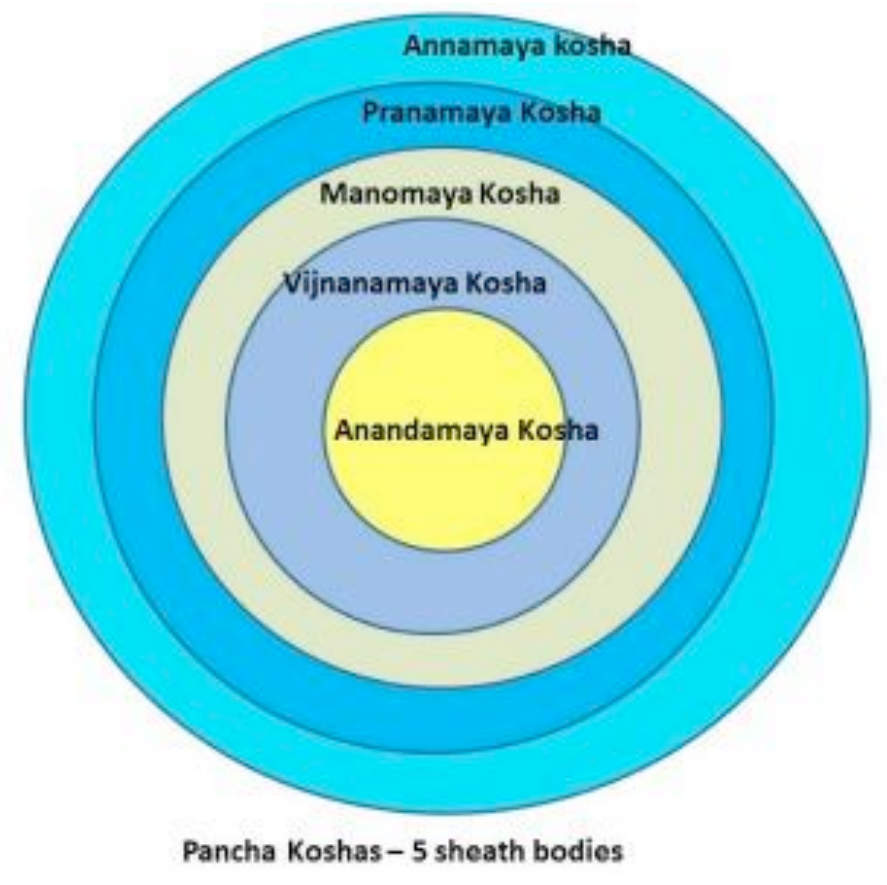
- Annamaya kosha is the sheath of the gross body. It is the actual physical body. (food body)
- Pranamaya kosha is the pranic energy layer, the vital energy layer or sheath. (breath body)
- Manomaya kosha is the mental sheath (mind body)
- Vijnanamaya kosha - intuitive sheath (intelligence body)
- Anandamaya kosha - this is the most subtle layer. It relates to bliss inside and is closest to our true Self which is eternally pure and unchanging. (bliss body)
The purpose of yoga and the ultimate purpose in human's life is to reach the highest levels of consciousness, beyond the bliss layer, beyond the five koshas.
Annamaya kosha – Physical layer
This layer represents the actual physical body; it represents the gross manifestation of energy as matter which you can see, touch, and feel. The gross body is called sthula sharira. Anna means food, and maya means comprised of. This layer is called the food sheath because the body needs food, water and air for its survival. This sheath is a composite of the five great elements – earth, water, fire, air and ether. If one is predominantly in this layer, he will identify strongly with the body and will be motivated by the desire for pleasure or what feels pleasant. It is our identification with this sheath which results in suffering.
It is essential to take care of this sheath or body and keep it in clean and in good health. It is through a healthy body that one can continue the journey into the deeper layers of awareness. Hatha Yoga through shatkarmas, asana and pranayama is essential to prepare both mind and body to perceive the subtle layers of its existence.
Pranamaya Kosha - Pranic sheath
Pranamaya kosha refers to the pranic energy field or pranic sheath. The pranic sheath is essential for life. If it is absent, there is no life. The prana in the body is part of the cosmic energy. The manifestation of prana is visible in movement, growth, activity, change. Pranamaya kosha can be looked upon as being responsible for all the physiological functions in the body - " breathing, blood circulation, digestion, heartbeat, all hormonal functions, communication between the brain and the cells of the body, etc.
Kirlian photography has captured and demonstrated the presence of this pranic field around the body. This pranic field has been seen to be affected by the health of the body. It was thus concluded that sickness and disease shows up in the pranic layer before it did in the physical body. Kirlian photography also showed mental and emotional states affect the pranic layer, which is something the ancient yogis have known thousands of years ago. Mind affects the breath. Inversely, breath also affects the mind. Positive thoughts and higher feelings lead to higher levels of prana.
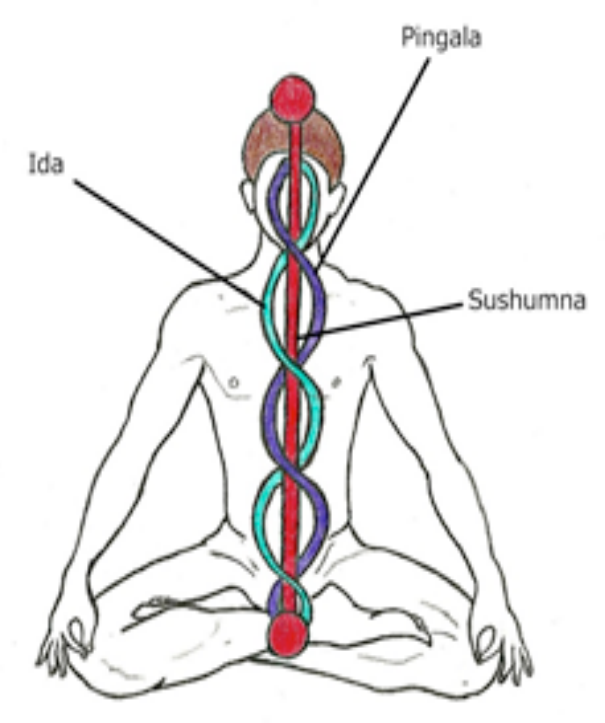
Prana is distributed throughout the body via the nadis which are subtle energy channels. There are three main nadis called ida, pingala and sushumna. The nadis are connected to the chakras or energy centers which distribute prana to the nadis.
Prana can be regulated consciously through the breath. The main Hatha Yoga practice to energize and vitalize the pranic layer is pranayama. Pranayama practice indirectly affects manomaya kosha. If the consciousness is predominantly in the pranamaya kosha, one identifies with power and vitality.
Manomaya Kosha – Mental sheath
Manomaya kosha is the mental sheath. This kosha is also known as the lower astral body. It comprises the mind (manas), and the five sense organs (eyes, ears, nose, tongue, skin). Mind is thought and thought is mind. There is no difference between mind and thoughts. The mind is nothing more than the collection of your thoughts, the continuous flow of ideas. Thoughts are no more than the words that you speak to yourself continuously. The mind continuously has thoughts of various things. This is the layer where the constant mental chatter happens.
The thought comes when you are aware of something. Thoughts are brought on by memories, beliefs, conditionings, and emotions. The mind receives input from the five senses, interprets them as good, bad, etc., and directs our actions. Thoughts are powerful and have a direct impact on our physiology moods, energy, and actions. We create impressions in both ourselves and others with these thoughts.
Patterns of thinking, beliefs and attitudes are in this kosha. They are influenced by societal, parental, religious and cultural conditioning. Man’s attachment to his ego, his self-identity, is because of the mind.
The mind is the cause of suffering, bondage and the feeling of distance or detachment from his fellow beings when it becomes rigid.
Nithya Yoga practice and techniques using pranayama, asana and the science of completion helps you to understand the mind and overcome the shackles of the mind, to move inward in the journey to the highest level of awareness.
Vijnanamaya Kosha – intuitive sheath
Vijnanamaya kosha is related to our feelings and emotions. It is the sheath for the higher intelligence, intuition and insight which leads to true wisdom. It is different from intelligence. This layer is also known as the higher astral body. Intuitive knowledge has no logic; it is simply an insight with clarity, a deep knowing. You don’t know the steps that lead you to the conclusion but you know for sure that your conclusion or decision is right. With intuition, you will have the energy not only to make the decision, but also to execute what you have decided.
When one is able to tap into this kosha, powers or siddhis may express. Telepathy, clairvoyance, experiencing colours and lights during your meditation and dreams during your sleep comes under this layer. This kosha is connected to the collective unconscious realm and is the link between the individual mind and the universal mind.
The practice of yoga especially meditation helps one to perceive this very subtle layer of existence.
Anandamaya Kosha – Bliss layer
This is the layer where one experiences bliss, our true nature. This is the causal or transcendental body. Deep states of meditation will lead one to experience this kosha.
The true Self lies beyond the five koshas. The brief and transitory experiences and glimpses of bliss is still an experience, a happening and thus still not the true Self.
The Chakras
Chakra is the Sanskrit word for wheel. They are also called psychic centers. These chakras are metaphysical representations; they belong to the auric body and not the physical body. Kirlian photography has enabled us to capture these chakras and prove their existence on the metaphysical plane.
Kirlian photography has shown that when a person is locked with a particular negative emotion, the chakra associated with that emotion shrinks to the size of a coin. But when the same person experiences positive emotions, the chakra expands to the size of a cartwheel! Our energy flow in these chakras becomes blocked by our negative emotions and we are totally unaware of it.
The openness and flow of energy through the chakras affects and is affected by our emotional balance and state of health. Disease is only an imbalance in any one of these chakras. If we keep these chakras in a healthy state, we can see a transformation happening in us at the mental and physical levels.
Chakras are storehouses of pranic energy located in the sushumna nadi which runs within the spinal column. Each chakra is associated with a nearby endocrine gland and nerve plexus in the physical body. They energize the entire body and affect the functioning and health of the associated gland and body system.
• swadhisthana chakra energizes the urinary system
• manipura chakra energizes the digestive system
• anahata chakra energizes the respiratory and cardiovascular systems
• vishuddhi chakra energizes the ears, eyes, nose and throat
• ajna chakra energizes the brain.
Every chakra corresponds to a specific aspect of human behavior and development. The lower chakras are associated with fundamental emotions and needs; the energy there vibrates at a lower frequency and is of a denser nature. The finer energies of the upper chakras corresponds to our higher mental and spiritual aspirations. Chakras vibrates at different levels relative to the awareness of the individual.
Chakras can be awakened by physical or mental stimulation, leading to a change in the level of consciousness. Each chakra has a point on the front of the body which if focussed on, lead to stimulation and awakening of that center.
Each chakra is associated with an element. The element becomes finer energetically as one moves up the sushumna nadi. The element for muladhara is earth and for vishuddhi is ether or space. Each chakra emits light of certain frequencies which have been seen in meditation, hence chakras have been associated with petals of lotus flowers of different colors and number of petals. The lotus lives in the mud, grows up through the water to reach the air and the sun. It is like man's journey from low states of awareness through the chakras to higher states of awareness.
There are seven major chakras in the sushumna nadi. The aim of Hatha Yoga is to awaken the kundalini shakti energy (cosmic energy) dormant in the root center and bring it up to unite with the pure consciousness, Shiva energy at the crown of the head. See diagram below.
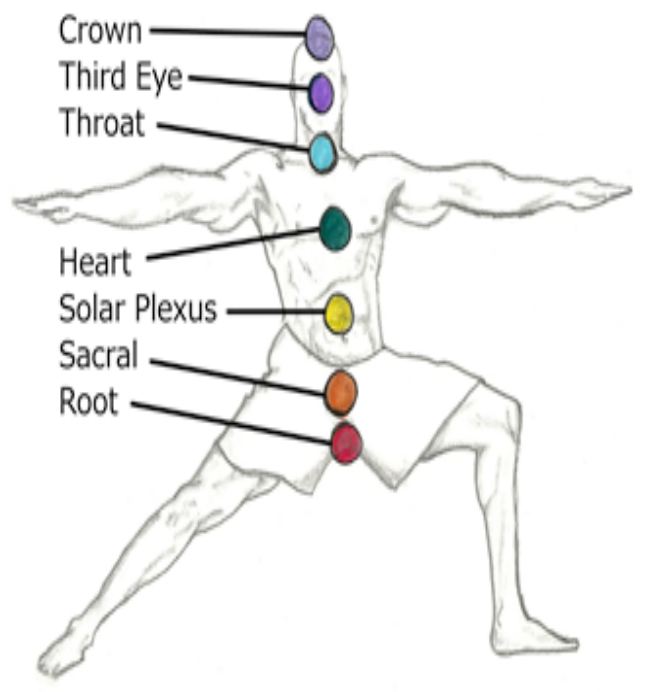
Chakras
Muladhara chakra – Root center
It is located at the base of the spine and associated with the sacral plexus. Also known as the root chakra. It is the seat of the dormant powerful kundalini energy.
Focus location: at the chakra. In the male, it is in the perineum between the scrotum and the anus. In the female, it is at the posterior rim of the cervix, where the vagina joins the uterus.
Positive Attributes: Vitality, Vigour, Growth
Blocked/Locked by: fantasy, greed. It flowers when you drop your fantasies and welcome reality.
Associated gland: Adrenals
Associated with: Annamaya kosha and unconscious mind Element: Earth
Deity: Ganesha
Bija mantra : Lam
Swadhisthana chakra – Spleen center
It is situated at the base of the spine at the tail bone. Seat of the collective unconscious and deep rooted instincts.
Focus location: At the level of pubic bone on the front of the body
Attributes: Security, pleasure seeking
Blocked/Locked by: Fear, especially fear of death. Made to flower by facing fear; by facing death itself.
Associated Gland: Testes in men; Ovaries in women
Element: Water
Deity: Subramanya
Bija mantra (seed sound): Vam
Manipura chakra - Navel / digestive center, storehouse of prana
In Sanskrit, manipura means ‘The City of Jewels’. It is situated in the spinal canal directly behind the navel. It is the center of vitality, controls our energy balance and seat of digestive fire.
Focus location: Navel
Attributes: self-confidence, clarity
Blocked/locked by: Constant worrying and negative thoughts.
Associated Gland: Adrenals
Element: Fire
Deity: Surya
Bija mantra: Ram
Anahata chakra - Heart center, seat of divine love
In Sanskrit, anahata means ‘unstruck’. It is the center of the unbroken sound, the cosmic sound experienced only in the highest state of meditation. It is found in the spinal column behind the heart
Focus location: Level of the heart behind breastbone
Attributes: Love, harmony, compassion, kindness
Blocked / locked by: Attention need. When you seek attention and love from outside. It flowers when your express selfless love without expecting anything in return.
Associated gland: Thymus
Element: Air
Deity: Venkateshwar
Bija mantra: Yam
Vishuddhi chakra – Throat center
The purification center. It harmonizes opposites. It is situated in the spinal cord behind the throat area. Vishuddhi means 'beyond purity and impurity
Focus Location: Base of the throat where there is a small depression
Attributes: purification of physical, mental and psyche level
Blocked/Locked by: comparison and jealousy. It flowers when we exhibit our individuality and express our capability, uniqueness and creativity fully without worrying about others.
Associated Gland: Thyroid and parathyroid
Element: Ether or space
Deity: Devi Anandeshwari
Bija mantra: Ham
Ajna Chakra - Third eye, center of intuition, cosmic browsing center, command center
Also called guru or command chakra. The ida, pingala and sushumna merge here and become one to rise up to sahasrara.
Focus Location: Eyebrow center or bhrumadhya.
Attributes: clarity and wisdom
Blocked/Locked by: seriousness and ego. Flowers by innocence, simplicity, and by shedding all forms of ego.
Associated Gland: Pineal gland
Element : ether or subtle mind
Deity: Anandeshwara
Bija mantra: Om
Sahasrara chakra – seat of supreme consciousness
Sahasrara means 'thousand pedalled'. It is the seat of pure awareness, the highest point in human evolution. When the kundalini reaches here, the yogi becomes realized. A great awakening is experienced.
Focus Location: Bindu.
Attributes: no quality or color. It is pure light
Blocked/Locked by: Discontentment and the attitude of taking life for granted. Can be made to flower by overflowing gratitude and contentment!
Associated Gland: Pituitary
Element: no element, no thought
Deity: Dakshinamoorthi
Bija mantra: none
Nadis
Nadis means flow. There are subtle energy flows which you are not able to see as they are not part of the gross body. They distribute pranic energy to every cell throughout the body through a complex and dense network. Hatha Yoga Pradipika and Goraksha Samhita state that there are 72,000 nadis, whereas Shiva Samhita states there are 350,000 nadis in the body. It is mentioned that ten major nadis are important but three are the most significant and are the main channels. These three are: pingala, ida and sushumna. All three are located within the spinal cord.
Sushumna is the middle flow and arises from the location of muladhara at the perineum while ida and pingala arise from the left and right side of sushumna respectively. Sushumna represents the neutral flow, the spiritual flow. Ida flow represents the negative force, the flow of consciousness. Ida is also known as lunar flow (chandra), as it brings about introversion, receptivity, creativity; the feminine aspects. Pingala known represents the positive flow, the flow of vital energy. It is also known as the surya or solar flow. Its flow brings about vigor, extroversion. and expressiveness; the masculine aspects. Ida and pingala correspond to the effects of the parasympathetic and sympathetic nervous systems respectively.
Pingala
Pingala nadi crosses ida nadi at each of the six chakras, the last one being ajna chakra. At Ajna, it goes straight up the sushumna to sahasrara at the crown of the head. Pingala governs the right side of the body. When the breath is predominant in the right nostril, pingala flow is dominant. Pingala predominates during the day hours although ida also flows then. Pingala is associated with the left brain processes which are logic and analysis. Pingala and the left cerebrum enable daytime work and thinking.
Pingala flow controls the annamaya and anandamaya koshas. The awareness in the deepest state of meditation and in samadhi is pingala energy. Physical vitality is pingala energy.
Ida
Ida also originates at the muladhara chakra and crosses pingala at each of the six chakras. Ida flow is associated with right brain processes like visual and intuitive processing. It also stimulates creative, artistic, musical abilities, psychic and extrasensory perception. Ida governs the left side of the body. It gives a calming effect on mind and body and predominates at night. When the breath is predominant in the left nostril, ida flow is dominant.
Sushumna
Sushumna nadi originates from the base of the spine at muladhara chakra and follows a straight path up the spinal column. It represents spiritual awareness. It is the pathway in which the kundalini energy flows. In most people, sushumna nadi is mostly dormant, with no flow or minimal flow till a higher state of evolution or consciousness is reached.
When there are no blockages in ida and pingala, when both the nostrils are flowing equally (they are harmonized), it means sushumna is flowing. When sushumna flows you can meditate without any difficulty. Awakening of sushumna, making sushumna nadi flow, is an most important process which precedes kundalini awakening. When the opposing forces of ida and pingala, the mental and vital sides of the personality meet in perfect harmony, kundalini shakti gets awakened and flows up sushumna to the brain. The entire brain gets activated and new states of consciousness are experienced.
Blocks in the nadis
Blockages in the nadis are energetic blocks which may be caused by the energy of tension, mental patterns, unconscious and subconscious negative thoughts, tamas and rajas. The blockage results in an impedance to the pranic flow forward causing dis-ease in the affected organs and body systems with time.
All hatha yogic practices purify the nadis through pranayama is the main technique. Pranayama purifies at the pranic level, but its effects are reflected in the physical and mental levels. Even if one is unaware of the blocks, regular practice of pranayama clears them up and keeps the pranic circuit flowing freely.
Kundalini Energy
Kundalini Shakti is the extraordinary, dormant, potential energy hidden in us. It is also called mahashakti. Kundalini literally means “coil”. It sits in the muladhara chakra and when awakened, arises from the muladhara chakra to ascend the sushumna nadi. Further awakening and energizing of the chakras, leads it up the sushumna to the crown of the head, ending at the sahasrara chakra.
Kundalini is present only in human beings. Animals do not have this. The awakened kundalini has a tremendous impact on human consciousness. 90% of our brain lies dormant. Kundalini energizes the many parts of the dormant brain to awaken non mechanical parts of the brain called the junk DNA or divine DNA. You will have the capacity to see the life with a larger understanding.
When kundalini is awakened, you feel the pure presence, without anybody present. You are brought to a different plane of existence. You will feel so much of energy overflowing in your body, that you will not feel like complaining about anybody. You will feel that everything is auspicious.
Kundalini energy energizes the mitochondria of the cell, whose activity levels rise as high as 1200 %, an unheard of value. Mitochondria is the powerhouse of the cell, supplying the cell with energy. No wonder the person feels tremendous energy, bliss and the face just glows.
Paramahamsa Nithyananda describes a verse from the Shiva Sutras - “by awakening the kundalini, let you achieve the same consciousness of mine. Shiva is not saying let you all worship me. No, he is saying, let you be me. Worshipping Shiva should just be an inspiration to become him, to realize his consciousness, his inner space“.
The degree of awakening and the particular areas of the brain awakened determines the expression of the “powers”. Some who develop psychic powers, become clairvoyant; others become great healers, artists, poets, writers, orators, leaders, materialize objects. One can become anything in life, overcome the limitations of the body, mind and emotion. He becomes the master of his destiny. The expansion of the scope of knowledge is beyond normal.
Kundalini can be awakened in many ways. They include having the right ideas about the Truths, having a witnessing presence continuously in everything you do, by the practice of kumbhaka (breath retention) in pranayama and Hatha Yoga. Paramahamsa Nithyananda says, simple will and instruction to you to awaken kundalini intensely is more than enough to awaken it. Your own potential energy can be awakened just by you. But the simplest and easiest method is to have it awakened by an enlightened master. By guru's grace when this sleeping kundalini is awakened, all the lotuses (chakras) and knots (granthis) are opened. (Hatha Yoga Pradipika 3:2)