CHAPTER 1 - IN THE LINEAGE OF PATANJALI
This text was machine-transcribed from the printed book and may contain errors. Select the words and choose “Report a mistake”.
Who is Patanjali?
There is complete uncertainty as to who Patanjali was. Some think of him as the divine incarnation of the serpent Ananta, who supports the whole universe and is simultaneously the bed of Lord Vishnu. Factually, next to nothing is known about him. It is believed that he was born in south India, in the holy town of Chidambaram, a place very deeply associated with Nataraja, the dancing expression of Lord Shiva. Hindu tradition identifies him with a famous grammarian of the same name who lived in the second century B.C.E.
The reason for this confusion is that India has known of several other Patanjali's. The name Patanjali is said to be given to Ananta because he wanted to teach Yoga on earth and fell (pat) from heaven, onto the palm (anjali) of Gonika, his mother.
Notwithstanding his origin, Patanjali is credited with the compilation of the great book, the Yoga Sutra. It is an exceptionally open and profound work on the nature of consciousness. It is considered more universal than any other book because it focuses only on the mind, its qualities, influences, fluctuations and the resultant disturbances that are obstacles on the path of the discovery of the Self. It clearly outlines the means to transcend the mind and live in the heightened state of awareness called samadhi. Because the mind is common to all of humankind, these sutras are, therefore, of interest to all.
A sutra is a style of writing, which has very few words, yet is full of essence, affirmative, universal in context and yet free from all ambiguity. These sutras, these aphorisms on Yoga are scientific, straightforward and to the core. This is the greatest book ever presented to mankind. Millions of books and many styles of Yoga have stemmed from this one book. The Yoga Sutra is so complete that not one single word more can be added to it.
Patanjali did not belong to any isms (religions). Patanjali was a saint and a scientist rolled into one. He declared universal truth for the benefit of all mankind. He left behind a strong energy, a strong understanding and a strong way for people to experience universal consciousness. Patanjali has either directly or indirectly influenced every spiritual master on planet Earth. One such Master was Raghupathi Yogi, from the small temple town of Tiruvannamalai, in south India.
Arrival of Raghupathi
When Paramahamsa Nithyananda was about three years old, a relative brought home a wandering mendicant, or sanyasi whose name was Raghupathi Yogi. Raghupathi Yogi lived on the same street as Paramahamsa Nithyananda and came to know the entire family. He was born and brought up in Burma (Myanmar) then a British Colony, where he had studied yogic procedures from Buddhist lamas. He was an adept in Yoga and related methods and could demonstrate many Yogic powers, including the ability to levitate at will which he mastered through a combination of yogic postures (asana) and breath control techniques (pranayama). Paramahamsa Nithyananda fondly remembers the numerous occasions when Raghupathi Yogi would levitate and playfully ask the children to crawl under him; it was an entertaining game that everyone enjoyed thoroughly! Raghupathi Yogi was an expert in Patanjali's Ashtanga Yoga methods and taught it diligently to his most ardent student, the young Nithyananda. Raghupathi Yogi noticed that the young Nithyananda, unlike boys of his age who played with toys and marbles, was engrossed in playing with little idols and statues of gods and goddesses. They seemed to be his companions and he was very comfortable playing with them. Being a man of deep wisdom, Raghupathi Yogi soon realized that the young Nithyananda was spiritually inclined. He remarked that the boy was a shining light in that household. Despite the huge age difference between them, the young boy was totally at ease in the company of Raghupathi Yogi. They seemed to share a deep bond where the need for communication did not matter.
Paramahamsa Nithyananda remembers Raghupathi Yogi with tremendous affection and respect and
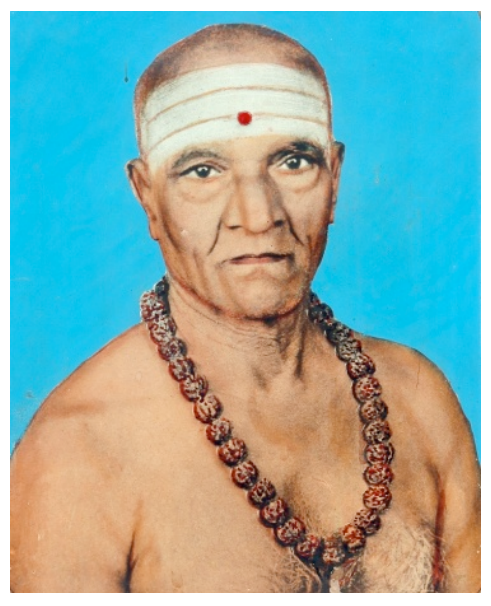
recalls: ‘I had the fortune to study yoga under a great master, Raghupathi Yogi. When I spent time around him he was around one hundred and four or five years old. He was a very healthy man who had mastered yoga and had experienced all aspects of Yoga not just in the physical level, but in a much deeper way. He would express many different powers of yoga. I remember very clearly when he would take a stone and make the sound of a hammer hitting the stone; the stone would break into two pieces. Sometimes he would make the sound of a stone flying and to my astonishment, I would see birds falling down as if they had been the targets! At other times he would create a particular vibration and snakes would come from the bushes! Similarly, he would create the sound of a dog and from all over dogs would gather around him. Just through sound, he was able to do anything he wanted”.
“He expressed so casually amazing strength and unimaginable physical power. He would tie an iron rope around his chest and when he exhaled deeply, the rope would break into pieces! Usually a logical mind cannot accept or understand that all this is possible, but this great Yogi made everything possible! I had the fortune to be around him and see him levitating, not once but at least twenty times. He would inhale deeply and hold the breath. The moment he did that the body would lift from the ground, like an inflated balloon!”
“From the age of three to thirteen I had the fortune to be under his feet, his guidance and care. Every day from morning till noon for at least 4 to 5 hours, he would make me do all the traditional yogic techniques including asana. He would instruct me to bend this way and that way, backwards and forwards. He would make me do all of the yogic cleansing techniques like neti, and dhauti. I would have to swallow that long cloth to clean the intestine and internal system. To tell you honestly, it’s only now that I feel happy about everything he made me do. Those days I used to hate him because my training which started from 6 am in the morning was practically like torture Any beginner in yoga can sympathize and understand with what I am talking about.”
Raghupathi Yogi came into Paramahamsa Nithyananada’s life for a purpose. Being a Yogi of many great skills and powers, he helped prepare the young boy’s body to receive and hold the tremendous energy of enlightenment. Paramahamsa Nithyananda says that retaining this tremendous energy is like squeezing four elephants in a small hut.
Paramahamsa Nithyananda says that the experience of satori (a glimpse of enlightenment or a no-mind state) is not a big thing; anybody can experience a satori. However, in order to stay in that level of consciousness and to actually express it, preparation of the body and mind is required. Raghupathi Yogi helped prepare the young Nithyananda’s body and mind through various yogic techniques. He enabled him to experience, remain and radiate the high energy of enlightenment.
Raghupathi Yogi would without fail come to the boy’s house every morning. Day after day, the Yogi would take him to the temple and make him practice yoga techniques for three to four hours.
Paramahamsa Nithyananda recalls affectionately: ‘The temple where Raghupathi Yogi used to teach me yogic techniques had a beautiful stone pillared mandapam (hall). He would instruct me to climb 20 to 30 pillars continuously! I was not allowed to use both hands when climbing the pillars. t. I could use only one hand! The other hand was to be kept behind my back or tied with a rope. To this day, I am still not able to find any reference to support why he made me climb the pillars. I have not read any Yogic literature which identifies that climbing pillars is a yogic technique!’
The boy obeyed Raghupathi Yogi, partly out of respect and partly out of affection. The Yogi insisted that he do this extended practice every day. He told the boy that he needed to keep his body fit, as he would need to do Herculean things in the future. After the yoga practice, he would take the boy to a nearby hotel to have breakfast. He was very loving and bought him candies and chocolates to keep the boy’s interest alive.
Over time, Raghupathi Yogi taught him all the eight parts of Ashtanga Yoga, including pranayama (breath control techniques) and asana (postures). Additionally, he taught mantra, dhyana (meditation) and various other yogic techniques. He was also given the invaluable knowledge of how to live without water and not feel thirst. He was to twist the tongue, and while sucking in air make the sound of the mantra ‘lam’. He also taught the young boy how to go without sleep, and not feel tired and how to live without food and not feel hunger by using a herb to draw a diagram on the skin over the liver.
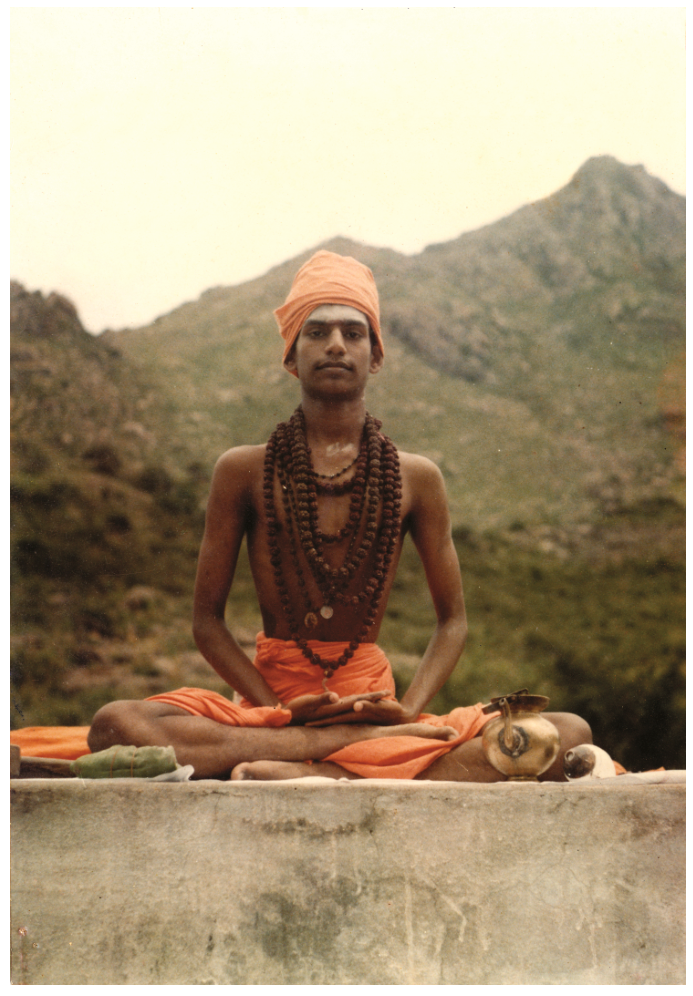
Paramahamsa Nithyananda was also taught how to play with light energy and how to create things through sound energy. These were of immense use to him during his wandering days and penance; but for these techniques and the strength built through yoga, his body-mind would have been unable to withstand the rigors of those years of tough ascetic life.
Raghupathi Yogi did a great service by preparing the young boy’s body and mind for his future endeavours and also got fulfilment doing so. As much as the young Nithyananda learnt from him, the Yogi said he learnt from the boy. He gave him the deerskin he used to sit on, which was given to him by his Master. This was treated and tanned with herbs and even after 60 odd years it has the original hair.
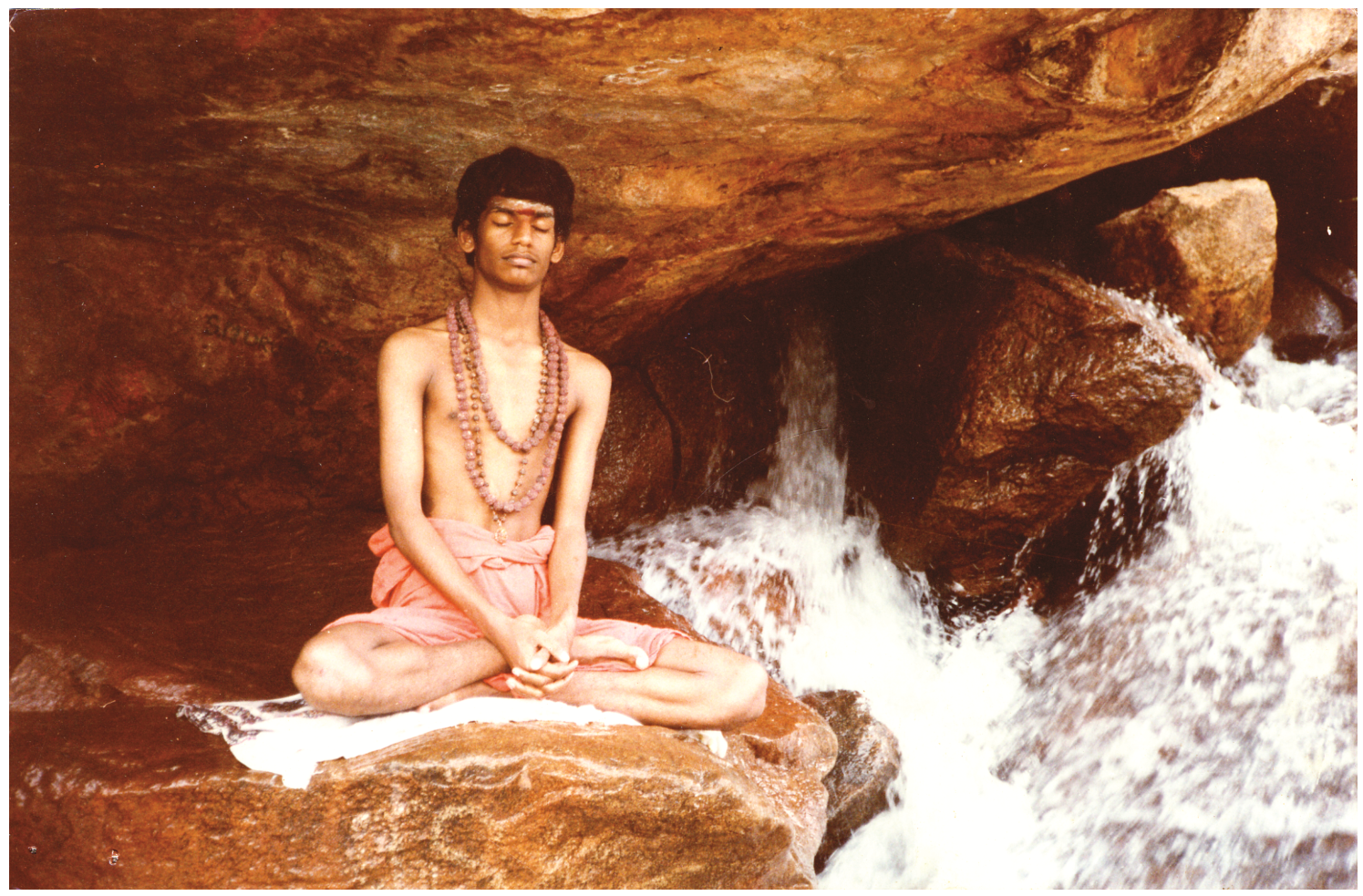
Raghupathi Yogi arranged for taking pictures of the young yogi in various meditative postures during his years with him. Photography was very expensive those days in rural India. Raghupathi Yogi would borrow money from a local hotel owner, Upadhyaya, for these photographs. When asked why he was doing it despite such expense, he just smiled and did not answer. When the photos were delivered, he wrote on them, ‘The whole world will one day thank me for these photographs.’ Raghupathi Yogi had photos taken of Paramahamsa Nithyananda alone as well as the two of them together, but none of himself alone. When questioned about this by the young boy, Raghupathi Yogi just smiled and said, ‘No one will want to have my photographs, but many will want to have yours!’
Importance of early training
Raghupathi Yogi told the boy that the best age to learn yoga is before the age of 14 and that was why he started him at 3 years of age. He had a total of eight full years to train the young boy.
Paramahamsa Nithyananda said that the rigorous training he underwent in the first eleven years of his life helped him sustain the tremendous energy of enlightenment. He remembers very clearly Raghupathi Yogi telling him that to bear fruit on the spiritual path you have to be trained from a very young age.
According to Vedic tradition, any kind of spiritual practice must be undertaken before sexual maturity so that it will be easy to live with reality and not fall prey to impossible and unreal fantasies. Otherwise, the whole process can be difficult and disheartening. Once puberty is attained, the fantasies and imagination that are thrust on the individual through the outside world, (in the modern context the media, peer pressure and social conditioning), play havoc with the hormones and the vital energies. It then becomes very difficult to begin the practice of Yoga for spiritual elevation. At best it can be viewed as the practice for granting physical and mental well -being.
During the Vedic times the practice of brahmacharya was all about learning to live with reality. Brahma means truth or reality and charya means to walk with. This correct understanding has to do with learning about and accepting reality. In no way did it mean forced celibacy, as many people have erroneously understood it.
This truth was very well known during the Vedic times. That is why in ancient India the gurukulam (the educational system) was highly regarded. When a child was about 3 years old, the parents handed the child over to the guru, who from then on became his father and mother.
Till the age of seven, children were allowed to roam freely, unclothed or wearing a single loose robe with no awareness of their gender. The energies were allowed to flow easily. Restrictions were not imposed on the children in this extremely natural atmosphere. Both boys and girls were taught the Gayatri mantra (sacred chant) so that the inner sun, their innate intelligence, would be awakened and expressed.
With such unique and caring guidance, most children would have some kind of spiritual experience by puberty. As the Guru had trained their body and mind so lovingly, they were capable of handling the subtle high voltage energies that coursed through their bodies.
Raghupathi Yogi's appearance in the young Nithyananda's childhood was indeed most propitious. He was very learned and would pass on many teachings to the young lad. It was as if he wanted to pour all his experience and knowledge into the boy in the little time that was available to him.
Paramahamsa Nithyananda remembers that at all times Raghupathi Yogi would play with snakes, which for him, was quite frightening initially. He would playfully guide thin snakes through his nostrils and take them out through his mouth in imitation of some yogic cleansing techniques. When Raghupathi Yogi saw the boy's fear, he would laugh and say that they would not do any harm, as they were a part of him, his family. He always wore a gold girdle around his waist like a coiled snake around a pillar.
It was only after enlightenment that Paramahamsa Nithyananda understood that Raghupathi Yogi was none other than an amsa (a part) of Patanjali himself. He realized that he had received his training and initiation in spiritual matters, especially in the Science of Yoga through none other than Patanjali in the form of his beloved master, Raghupathi Yogi.
What is Yoga?
In Sanskrit, the word "Yoga" actually means uniting or becoming one with. Many people today are unaware of this true meaning of yoga because they have their own perception of what yoga is. For some people, the word yoga triggers off a visual image of flexible, healthy bodies in various convoluted postures, or sitting in meditation, and they stay away from the practice thinking it is too much for them. Yoga is practised by modern people for a variety of reasons. Yoga is taken up a form of weight loss exercise by the obese. For the person with physical ailments, yoga is practiced as a therapy for healing the body. For the person suffering from stress and anxiety, yoga is a heaven sent practice to induce mental calmness and peace of mind. For people with unsatisfactory relationships at home or work, yoga presents a way to develop the right attitudes and cognitions to improve their relationships and life. For the seekers, yoga is the way to finding the meaning of life and existence. Yoga is all of the above and more.
The goal of yoga at the highest level is to prepare the body and mind for experiencing the highest states of awareness and consciousness. Good health, wealth, peace of mind, contentment and clarity of mind are among beneficial side effects of regular yoga practice.
The five paths of Yoga
There are many different paths or systems of yoga. Examples are Mantra Yoga, Kundalini Yoga, Swara Yoga, Bhakti yoga, Japa Yoga and Hatha Yoga. Each path takes the practitioner to the same source like the different roads that lead into a city or like how the different rivers flow into the sea, the destination is common but the experiences along the way can be quite different. All the paths of yoga aim at the elimination of the ego, leading to meditation. It is good idea to practice a combination of all the five paths. They are all closely connected, not rigidly separated, and the synergy experienced in such a multidimensional practice can accelerate the entry into higher states of consciousness.
The five Classifications of Yoga are:-
• Karma Yoga - path of action or activity • Bhakti Yoga - path of devotion • Jnana Yoga - path of enquiry • Raja Yoga - path of introspection • Hatha Yoga - path of balancing the physical, mental and pranic layers in the body
Karma Yoga
Karma yoga is the yoga of action. It is the path or system of yoga for developing awareness through activity. It is about performing actions done with intense awareness, non-detachment from the action itself and non-attachment to the fruits of actions. It is not what you do, but the attitude and state of awareness when doing it.
Work becomes meditation when the doer, the action and the thing done becomes one - this is the real Karma Yoga. This intensity of action reduces the ego’s power and increases effective action and efficient performance. When you are no longer the doer, but merely the instrument, every action becomes spiritual and the work becomes super-efficient. It is important to develop the ability to do the work, and at the same time, be a witness to the actions.
Bhakti Yoga
Bhakti yoga is the path of devotion. Bhakti is intense love for God. It appeals to the majority of people as God does not distinguish between color, social status and family. Kannappa, who is one of the nayanmars or Shaivite saints in Hinduism, was a hunter who did not know the traditional or proper ways to worship Shiva. Every day he would hunt and gather flowers and bring water for his beloved Shiva. He had no container for the water so he would bring it in his mouth and he would gather flowers and carry them in his matted hair. He would spit the water on the linga thereby bathing him and decorate him with the flowers that he had brought in his hair. Then he would entreat Lord Shiva to eat the meat that he had killed and brought. One day, after doing all this he saw blood and tears coming from Lord Shiva’s eye. He rushed to find healing herbs and medicines to stop the bleeding but nothing worked. In his burning devotion to Shiva, he took one of his arrows and gouged out his own eye and placed it in Shiva’s bleeding eye socket. The bleeding stopped but not for long. The other eye on the Linga started to bleed. Kannappa knew what to do. He placed his foot on the second bleeding eye so that he would be able to find the eye socket after he took out his other eye and became blind. He never hesitated for even a moment. He never once thought about himself or how difficult it would be to survive as a blind man. His heart was set on restoring the eyes of his beloved Lord Shiva He was preparing to gouge out his remaining eye when Shiva appeared. Moved by the devotion and sacrifice of Kannappa, Lord Shiva restored both his eyes and blessed him with enlightenment.
There is no right way to express ardent love and devotion to God. When this emotion reaches its zenith of intoxication, tremendous bliss and joy is experienced. This one-pointedness of mind and body, devoid of the attachment to the ego or self-identity, leads ultimately to the experience of merging with the beloved.
Jnana Yoga
Jnana means knowledge. This is the path of wisdom and enquiry. There are seven stages on the path of Jnana yoga. It starts when you have an intense desire and determination to get to the core of the truths of life and of existence. The knowledge learned is put into practice through the process of self-enquiry and meditation. As the mind slowly gets transformed through this process, worldly desires drop, allowing the yogi to spontaneously delve deeper and deeper into the practice. The mind becomes purer with time leading to the experience of bliss and contentment.
Eventually, a yogi reaches the state of complete detachment, the state of jivanmukti (liberation). The Jnana yogi becomes firmly established in the state of self-realization. This further deepens into the state of the absolute and ultimately expands to the state of superconsciousness where the consciousness is completely established in Brahman or cosmic consciousness, the state of Advaitha
Religion is no longer just written scriptures or intellectual knowledge; it has become the yogi's experience and reality.
Raja Yoga
This is the path of introspection, where the main practice is meditation. Raja Yoga is also known as the "Royal Road". This is the path described by Patanjali as Ashtanga Yoga or the Eight Limbs of Yoga. The practice of Raja Yoga consists of living the principles of yama, niyama, asana, pranayama, pratyahara, dharana, dhyana and samadhi. Ultimate success in Raja Yoga is the attainment of the state of samadhi. These principles in Ashtanga yoga are described in a later chapter.
Hatha Yoga
Hatha is made up of two Sanskrit words. Ha means the sun, tha means moon. Our body has two opposing energies - the dynamic active energy of the sun, which is symbolic of the vital energy prana, and the calm, cool and creative energy of the moon, which is symbolic of the mind (citta). Yoga means uniting. Hatha Yoga is the uniting of the prana, mind and Self (consciousness).
Hatha Yoga is also known as the science of purification of body and mind. It purifies the body and mind in preparation for the highest experience of Raja Yoga - samadhi. Hatha Yoga balances the opposing energies in the body, which are the mind and the prana (vital energy), through the powerful yogic practices of shatkarmas (six yogic cleansing techniques), asana (postures), pranayama (breath therapy), bandhas (locks), mudras (gestures) and dhyana (meditation).
Breath and mind are intimately connected. Ancient yogis found that mastery of the breath leads to mastery of the mind. Hatha Yoga uses prana or breath to bypass the mind so the yogi can enter into meditation. This is achieved through the practice of pranayama which teaches the breath that does not awaken thoughts
Asanas of various types, and the other various means of illumination should all be practiced in the Hatha Yoga system until success in Raja Yoga is attained. (Hatha Yoga Pradipika 1:67). Whether young or old, very old, sick or feeble, one can attain perfection in all the yogas by practicing. Perfection results from practical application. (Hatha Yoga Pradipika 1:6-65).
Regular Hatha Yoga practice balances the body's hormones, secretions, breath, brain waves and prana, life energy. The mind becomes ready for deep meditation. When body and mind are purified, pranic energy will flow unimpeded. This balance awakens the sushumna (central channel) and kundalini shakti (potential energy dormant in all human beings) will be awakened to move up the sushumna. When kundalini shakti awakens and ascends the sushumna to reach the sahasrara (crown center), yoga happens. When prana flows in the sushumna, the state of manonmani (consciousness without the mind) is experienced. (Hatha Yoga Pradipika 2:42).
Hatha Yoga has been proven to be successful as therapy in reversing cases of chronic ailments like high blood pressure, asthma, diabetes, rheumatism, hysteria and back pain as the practice balances the body's hormones, secretions, breath, brain waves and prana. The techniques utilized have been time tested and proven to be immensely effective to pave the way for deep meditation and the experience of samadhi.
There are several reliable classical Hatha Yoga treatises, which have provided the fundamental knowledge of the philosophy and the practice of Hatha Yoga. The main treatises are the Hatha Yoga Pradipika by Yogi Svatmarama, Goraksha Samhita and Siddha Siddhanta Paddhati by Yogi Gorakhnath, Gheranda Samhita by sage Gheranda, Hatharatnavali by Srinivasabhatta Mahayogindra and several others. There are also some references to Hatha Yoga in the Upanishads and the Puranas as well as the Srimad Bhagavatam.
What is Nithya Yoga ?
Nithya Yoga is a complete system of yoga leading the practitioner to living in the space of the highest possibilities in life. Developed by Paramahamsa Nithyananda from his direct experiences, Nithya Yoga is based on the authentic, ancient Vedic scriptures of yoga.
Nithya Yoga brings to life the system of yoga as Patanjali expressed in his revelations to the world in the Patanjali Yoga Sutras. Nithya Yoga also brings to life the sacred teachings of yoga from the Shiva Sutras and Bhagavad Gita updated by Paramahamsa Nithyananda and expressed in twenty-first century English for easy understanding and practice.
Nithya Yoga practice brings more than just physical and mental health. "Nithya Yoga is not just a body-building workout. It is muscle-memory and bio-memory building workout!" (Paramahamsa Nithyananda). All the patterns of thinking, responses to life and emotions that you accumulate and continue to accumulate, are "muscle-memory". Memories that stay in you and make you continuously respond in the same pattern unconsciously, again and again, are "bio-memory". If you function on just bio-memories, you are living in bondage. It is important to build the right muscle memories and bio-memories. Nithya Yoga helps with that process.
The practice of Nithya Yoga encompasses not only the traditional practices of asana and pranayama, but also the practice of Saptanga yoga, developed by Nithyananda based on the authentic Vedic scriptures. Saptanga Yoga emphasizes "intranalyzing" or manana, looking inwards to uncover the inadequate cognitions and unconscious thought patterns, feelings and responses from the past that one still carries about the self, life and others. These thought patterns and emotions cause powerlessness, conflicts and feelings of being stuck in life. They are called incompletions. Through intranalyzing or manana, incompletions are brought to awareness, completion and discarded, which builds the right muscle and bio-memories.
Nithya Yoga is a profound transformation tool to create a yogic body and a Vedic mind. The practice shows you a new way of thinking and living life. A yogic body is one that is well built, healthy, flexible, graceful and joyful. It is a body awakened to its peak capacity. A Vedic mind is one that practices liberated thinking, analyzing, finding solutions and expressing itself from the space of ultimate possibility.
Nithya Yoga incorporates all five of the main paths of yoga - Hatha Yoga, Jnana yoga, Karma Yoga, Raja Yoga and Bhakti Yoga. Daily practice of asana and pranayama techniques from Hatha Yoga builds build strong, flexible yogic bodies that do not tire easily. The practice harmonizes the body and mind bringing enhanced clarity and intelligence. Listening to Paramahamsa Nithyananda's discourses and daily practice of completion bring a clarity about self and life that removes the layers of delusion and fantasy separating us from Advaitha. Saptanga yoga emphasizes the importance of enriching people and helping to cause their reality. The expansion, which comes from continuously enriching self and others to the highest possibility, leads to the space of living Advaitha where you will effortlessly and spontaneously live and radiate the qualities espoused in Ashtanga yoga. Nithya Yoga starts and ends with the chant of gratitude and acknowledgement of the divine bringing the component. of devotion and sacredness into the practice.
The Founder of Nithya Yoga
In mid-2005, in a small hut called the Laughing Temple in Bidadi, India, Paramahamsa Nithyananda revealed some of the deepest truths and secrets of yoga to a small group of devotees. This was the birth of Nithya Yoga, which has evolved until the present time and is still evolving. Nithya Yoga is not a new yoga system. It is a rebirth of the traditional system that has its roots in the tradition of Patanjali, the Father of Yoga.
Paramahamsa Nithyananda was born on January 1ˢᵗ 1978 in Tiruvannamalai, Tamil Nadu, India. From the age of 3 up to 14 years, he studied and practiced under the care of a great yogi, Yogiraj Yogananda Puri, also lovingly called Raghupathi Yogi. He was the teacher responsible for preparing the young Nithyananda’s body and mind for the experience of enlightenment through time tested yoga techniques and the practice of Patanjali’s Yoga Sutras.
While sitting at the feet of the holy Arunachala Hill in Tiruvannamalai, the 12 year old Nithyananda had a profound spiritual experience - a glimpse of enlightenment. After this experience, his longing to pursue the spiritual path greatly intensified. For years, he practiced intense meditation, wandered all over India during his parivrajaka (spiritual wanderings), and finally became stabilized in the state of enlightenment or eternal bliss - Nithyananda.
With a special love for Temples and Sacred Arts, Paramahamsa Nithyananda initiated a global mission to revive the Great Vedic Tradition and share the inner science of enlightenment with the world. He established the headquarters of his international mission, Nithyananda Sangha, near Bangalore, India.
The role of the Guru
Guru in Sanskrit means, remover of darkness and ignorance. Guru removes the mental blocks and obstacles that stand in the way of your awareness and realization of your true Self. The shastra pramana (sacred scriptures) repeatedly mention the need for a guru.
Gurus use different ways to remove the mental blocks from disciples. These ways include personal guidance, instructions, teaching and scolding. Regardless of the method used, the goal is to raise the disciple to a state of higher awareness. The guru resides in the highest state of awareness and consciousness, so he is able to see where the disciple is stuck. It is essential that the guru be a true guru, one who is fully enlightened and with the highest vision. It is said that the guru appears in your life when the time is right.
There is a great need for an authentic, living master who can impart and most importantly, transmit the knowledge and experience of superconsciousness. All of the ancient scriptures such as the Brahma Sutras, Shiva Sutras, Bhagavad Gita, Patanjali Yoga Sutras, Hatha Yoga Pradipika and including the more recent masters like Paramahamsa Ramakrishna, Vivekananda, Ramana Maharshi and Paramahansa Yogananda, all stress the importance of the guru’s guidance as a vital component of any spiritual path.
Cosmic truths
Your nature is Bliss; you are Complete. What blocks you from experiencing it?
Your true nature is one of bliss, sat-chit-ananda (being-consciousness-bliss). But you forget this truth as you grow up and start searching for happiness or bliss outside, thinking material possessions, money, gourmet food and new relationships will bring back this bliss. They do bring a short-lived happiness, but do not bring lasting happiness. The only way out of this vicious cycle of chasing after bliss on the outside is to start looking inwards, and questioning your understanding of the self, and your beliefs about others and life.
With whatever intention, thought, or emotion you move your body, that experience gets deeply recorded into your muscle memory.
When you consciously bring awareness to your thoughts, feelings and inner space, and consciously create the space of positivity and possibility through visualization, that space becomes your muscle memory. When it happens continuously, it becomes your bio-memory and your very life. By this process, the body holds the highest energy frequency of positivity and possibility.
The mind creates the body
This truth which was known by the ancient yogis is becoming more widely accepted by today’s scientists. Try this simple experiment - think about a sour orange or something sour you have tasted. Spontaneously, you will see that you salivate in response to the thought. This is just a simple example of how the mind affects the body.
Emotions that are experienced repeatedly and intensely have a strong impact on the body. Different glands in the body release different chemicals in response to particular emotions. Over time, the constant release of these hormones creates an imbalance in the body leading to what is called disease. Negative emotions like anger and frustration trigger particularly toxic hormonal cascades in the body which show up at the cellular level and also becomes physically visible. What is the facial expression of someone who is constantly angry? What is the physical posture of someone who feels the burden of life? In comparison, what is the body language of someone who has full confidence and feels joy in life?
Every cell of our body is constantly replaced by new cells
This is a well-known fact in the scientific community. Over the course of a few years, every organ in your body is practically a new one! This has been proven in modern day allopathic medical science and described in Ayurveda, the ancient holistic system of medicine from the Vedic Tradition.
If new cells are being created, but you carry the same mind, you will carry the same disease in the new cells and in the new body!
You are responsible for carrying the old diseases. By its very nature, your whole being wants to experience fulfilment, joy and bliss. But unconsciously, you keep bringing back the same pain and suffering by connecting your past memories with future projections to the present moment. You never live in the present moment. Some part of the past or future is always with you, affecting how you think, feel and move.
An example is that if you think that you have had headaches continuously for the last 10 years, you will expect to have the same headache tomorrow as well. This is how your bio memory takes shape. This is how the mind creates the body. It remembers negative events and makes them into a chain or sequence that it continually re-writes into the future.
Nithya Yoga is for everyone
This is irrespective of age, culture, religion, fitness level and flexibility.
Yoga is now - Atha Yoganusaasanam
In one of his sutras, Patanjali says, "Atha Yoganusaasanam" - "now starts yoga". Paramahamsa Nithyananda explains: “Yoga is now. Come to now, this moment, and yoga will happen in you. Come down from your dreams and fantasies and enter into reality.”