YOUR YOGA QUESTIONS ANSWERED
This text was machine-transcribed from the printed book and may contain errors. Select the words and choose “Report a mistake”.
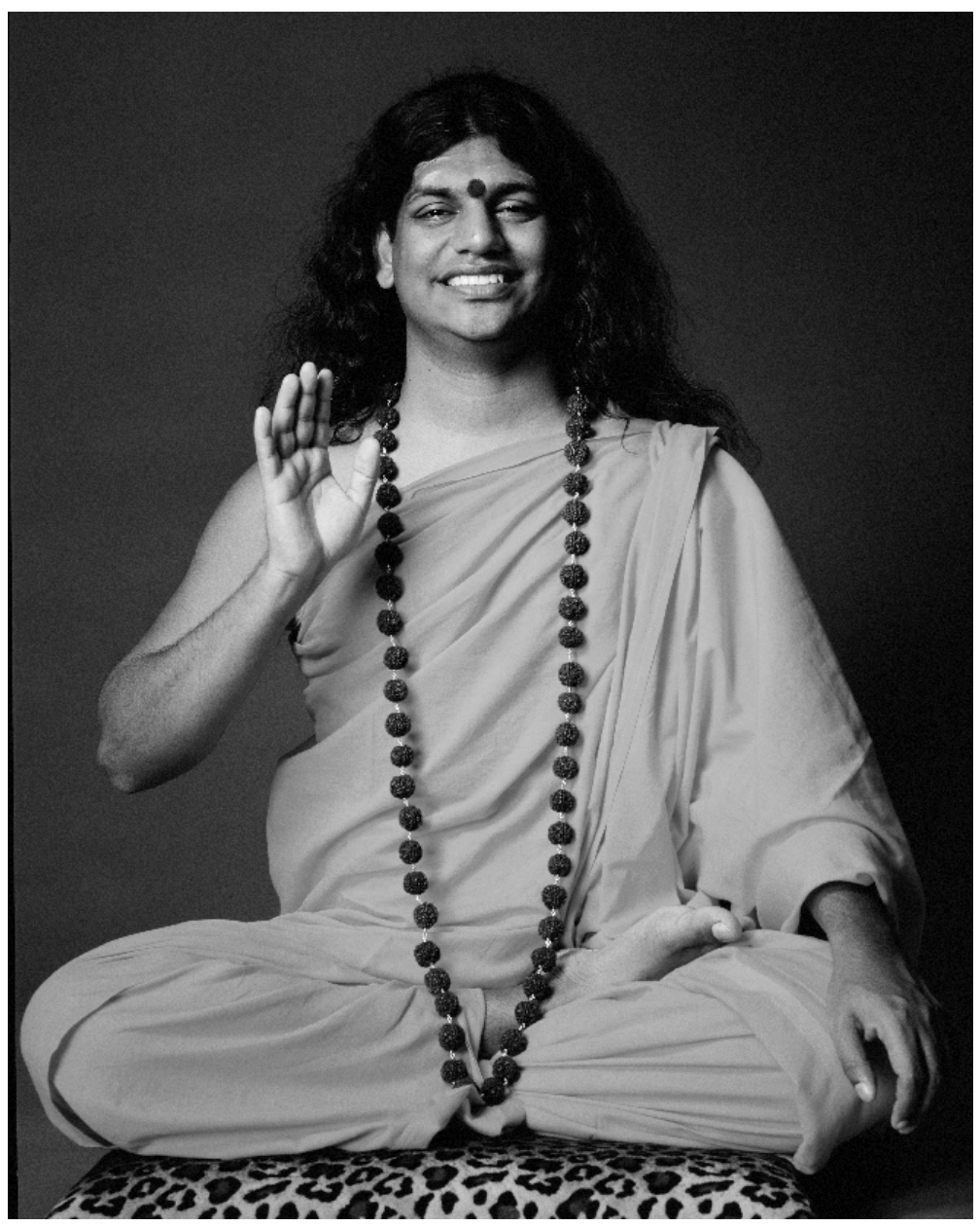
Question: The time you spent with Raghupati Yogi inspired you to create this system?
Nithyananda: Yes, I had the fortune of studying at his feet from the age of three. He chose me. He was born and brought up amongst Tibetan monks and lamas in Burma. Then he came and stayed in India to start his life and stayed in my native place.
I learnt yoga from him from the age of three. Whatever essence I imbibed from him, I have delivered it in this system called Nithya Yoga.
I wandered the length and breadth of India for nine years without any assurance of regular food, clothes or a place to sleep. This was possible because of the yogic body he helped me to develop. I was able to manage with the yogic body. Still this body does not ask for food.
Question: Can you say a little bit about your intention in this international mission that you lead?
Nithyananda: Yes. Just as the research in the outer science was going on in the West, in the East, the search in the inner world and the science of inner transformation was going on for the last ten thousand years. I am bringing all those things back to life. Because I myself have experienced that, I wanted to create a formula to reproduce the same inner experience for this modern society. I also want to preserve it and keep it alive for future generations.
We want to bring the vedic science, the science of inner transformation back to life. Our mission is to keep it alive by spreading it all over the world.
Question: Is there an essence, an important aspect in spreading that?
Nithyananda: Yes, meditation.
Question: In the past thousands of years we have had thousands of wars.
Nithyananda: Yes, in 3000 years we have had 5000 wars.
Question: So creating peace on earth, depending upon what side you are on, seems a pretty complex vision. I know it is a very central part of your teaching. Can you enlighten us about how you feel peace can happen?
Nithyananda: We have created 3000 wars in 5000 years just because we are always striving to change the world and others. We believe in revolution but any transformation can happen only as individual evolution, not as a revolution. Many individuals evolving will make a revolution happen. Otherwise, a revolution itself cannot happen. Whenever we try to create a revolution of the whole world or whole country or whole place, we create and entertain wars. So transforming individuals, which is individual evolution, is the only path. Do you understand the difference? Instead of trying to teach others, the revolution depends on each of us raising ourselves, completely cleaning ourselves, and putting more energy into purifying ourselves. Raising ourself is the method.
Question: Can you speak about the balance between tradition and the roots of yoga and this evolution? The roots sometimes are taught very traditionally with no variance and other people who are more evolved bring in more evolved teachings.
Nithyananda: The basic understandings should be kept alive but the way in which practice goes on can evolve. There is nothing wrong with that. The basic understanding, like 'Why?' and 'What?', those basic few things should be kept alive, otherwise the juice will be lost.
In the Eastern tradition there are two levels of scriptures, shruti and smriti. The basic truths in the yoga system itself have these two paths. Shruti means the basic truths. They are eternal and changeless. Shruti is the basic truth of philosophy that is universal and applicable to everyone. Smriti refers to the day-to-day way of practicing these truths. The basic software should be kept alive but the lifestyle can be changed. Truth should be kept alive. It's the lifestyle that can evolve and change according to the times. For example, using yoga mats or some instruments, straps or ropes. All of those things can evolve. There is nothing wrong in that. But the posture, the basic posture and the purpose for which it is done, must be retained and preserved. That's all. It's a very subtle balance.
In a way, every person will come and evolve his own system. That is the real purpose of Patanjali. He gives freedom for every person to evolve his own system of yoga. If you just catch the root, you can evolve in your own way. That should be the goal.
Question: In the West, Patanjali's Yoga Sutra is often considered the 'Heart of Yoga' and often the way it is translated is related to classical yoga system – different from Tantra and Vedanta. Some people feel that if they go More towards Tantra, they can't accept the Yoga Sutra.
Nithyananda: It is nothing like that. Tantra and yoga are not against each other. The idea exists that they are opposite paths. However, they actually compliment each other. Tantra leads you to enlightenment with a particular energy. Yoga leads to enlightenment with a particular energy. Yoga is like a beginning. It can appeal to everyone in the beginning. When you go deeper and deeper, even if you follow the yoga path, you will evolve. It's like steps! They are only steps. They are only paths. They are not something too completely different or opposite to each other. Surely tantra is not against yoga and yoga is not against tantra. They are two different trademarks. That's all.
Question: Can you say more about tantra because it is a word that is very misunderstood and misinterpreted in the West.
Nithyananda: Tantra means technique. Anything that you do can become a technique towards enlightenment when it is done with that purpose! With whatever reason you move your body, that idea will get deeply engraved into your body's cellular memory. For any idea that you carry in your heart while you move your body, that idea will become engraved. So any movement of your body, if you do it remembering that it is for enlightenment that will lead you to enlightenment. Masters understand that you may not be able to do what they are telling you to do. Out of sheer compassion they decided that you could do whatever you want to do. As long as you do it with the idea of enlightenment, you can grow. In that way you can grow and touch your enlightenment. That is the purpose of tantra.
Tantra is not just confined to sex. This is an important thing to understand. Tantra is not just sex! Through sex you can also achieve enlightenment. Tantra is like using all possible doors. People start using these doors. Basically, in yoga, you are given something to do. On the other hand, in Tantra, you can do anything. All you need to add to the doing is awareness. Both paths have the same purpose and lead to the same goal.
Question: Does Nithyananda and Sachitananda mean Samadhi? Are they the same thing?
Nithyananda: Yes nithyananda, sachitananda and samadhi are one and the same, all just different brand names. For example, just as we have so many brand names in yoga, it is the same with samadhi. Nithya means 'eternal'. Eternal means past, present and future all put together. You can touch the eternal or eternity only through the present. You can't touch it through the past or the future. You can only access it in the present. Eternal bliss means that this very moment you are supposed to be blissful. That is the method to become eternally blissful. Don't bother about whether you had bliss in the past or not. Don't bother about if you will have it in the future or not. Just be blissful now. You will see that you are experiencing nithya ananda, the eternal bliss.
Question: I am experiencing bliss and duality...
Nithyananda: Whenever you say that you are experiencing duality, bliss and coming back, be very clear that what you are experiencing is not bliss. You can only say that you are experiencing a state that is higher than your normal state. The very bliss itself is practically enlightenment. Maybe you are experiencing a higher consciousness than the normal level, but not the complete bliss that we call 'ananda'. The purpose with which I am using this bliss word is enlightenment. Once you experience this, you may not have this duality. When the duality is happening, experiencing a state that is higher than your normal state. The very bliss itself is practically enlightenment. Maybe you are experiencing a higher consciousness than the normal level, but not the complete bliss that we call 'ananda'. The purpose with which I am using this bliss word is enlightenment. Once you experience this, you may not have this duality. When the duality is happening, understand that bliss is not happening. Maybe you are going to a higher level of consciousness and coming down. This is because the body is not prepared to handle this energy.
Of the things that we are bringing to life, just try this one simple technique. It will help you. Visualize your body as a bliss bag. For ten minutes in the morning, move your body any way that you want to move, whether it is upside down, bending this or that way or this posture or that posture. For just ten minutes, visualize your body as a bliss bag and move it any way at all for those ten minutes. That is enough. You will see that your body becomes matured and holds that bliss for a long time and you will remain in that same higher state of consciousness for a longer period of time.
Question: When does one experience bliss? What does one use or do to experience eternal bliss?
Nithyananda: It is not just about getting away from the senses. It is getting away from your very self and what you think of as yourself. You go beyond your very self. This is bliss. Bliss is freedom from one's self. One's self is whatever you think of as you, both of your identities - the identity you show to the outer world and the identity that you carry in the inner world and believe to be you. Liberating yourself from both of these identities and all of the tension and inner chatter they create is what I call bliss. Going beyond both of the identities is bliss. Un-clutching or relaxing from creating a thought shaft is the best method. As of now you gather all of your thoughts and create a shaft. If you can relax from creating the shafts, suddenly you will see that you are beyond these two identities and will experience the bliss.
Question: Do we originate from bliss?
Nithyananda: Our original nature is bliss but we don't come from the bliss. When we come down, we are carrying a few desires to be worked out through this body. If we are already in bliss we don't have to take the body. You think that by using the body and mind bliss can be achieved. That is why you assume the body. When you realize the truth that you can experience bliss without using this body and mind, you just drop the need for this body. After that, if you are not alive, then you have left the body and became enlightened. If your body is still functioning then you are a living enlightened Master. Deciding 'I can experience bliss without the body and mind,' and experiencing it is enlightenment. After that your body may or may not be active. If it is not active it is called videha mukti. It means that you have left the body. If it is active, you are called a living Master, jeevan mukta - a living, enlightened one. So these are the different kinds of samadhi expressions.
Samadhi experiences are also categorized by Patanjali as savikalpa, nirvikalpa, sampragnada, and asampragnada – by many different words. Except one memory,call if all other memories have disappeared from your mind, it is called savikalpa samadhi. If that memory also disappears it is called nirvikalpa samadhi. If your presence does not have a body you are called videha mukti - the dead Master. If your presence has got a body then you are called a living Master, that's all.
Dead masters are not dead in the way that you think. Living Masters are not living in the way that you think. Don't think that dead Masters are dead. You can connect with them. Their presence does not have a body, that's all. Living Masters are not present as you think. Their absence has got a body. There is no personality or individual sense of self.
You need to understand this. It's a little tricky. The living Master is not a human being, present as you are present. As you are present, he is not present. In the same way, dead Masters are not absent as you understand the word absent. They are neither absent as you understand, nor present as you understand. Their presence does not have a body. My presence has got a body, that's all. Or I can say my absence has got a body because if I say the word 'presence' you will understand it according to your dictionary. You have an idea about presence. You know you are present but I am not present in that way. So my absence has got a body. In their case their presence does not have a body.
Question: What exactly does a Nithya Yoga class consist of?
Nithyananda: In a typical Nithya Yoga session we start with a simple two-minute centering meditation that gives time for the class to settle down. Then we move into a powerful, dynamic meditation called Nithya Dhyaan. This technique is like taking a daily bliss shower. It helps to flush out our physical and emotional toxins. It clears our inner space of psychological debris. It cleanses, energizes and empowers us. Then we begin the class in a state of lightness and inner bliss.
The Silent Belly Laughter (SBL) follows this for a couple of minutes to spread the energy of bliss into every cell in the body. We then set the intention for the class and follow it up with an intense visualization so that our logic and emotions are in sync with one another.
Next, we move into the practice of postures, be they the Sun Salutation (Surya Namaskar) or the chakra specific vinyasa sequences (intelligent placing of postures that can create a smooth flow in the body and breath). These asana (postures) are primarily to awaken our inner intelligence and allow it to guide our sessions. By working with the body and linking it with the breath we engage the mind. When this process happens, the body, breath, and mind move in one single, harmonious flow. Prathyahara, the withdrawal of the senses happens. The first turn from the outer to the inner begins.
This is followed by shavasana (relaxation pose) with an exhilarating difference. During this pose we offer gratitude to every part of our body. Finally, the whole session is deepened with a particular pranayama (breath control) technique and sealed with a meditative mudra (hand gesture). We move into the day with a deep affirmation and experience of who we are and of the space that we reside in.
The essence of Nithya Yoga is to make your whole life, every activity and every movement an expression of yoga - eternally blissful uniting.
Question: Can you explain pratyahara?
Nithyananda: According to Patanjali, pratyahara is moving away from the aharas. Ahahra means whatever you take in through the eyes, nose, ears, mouth and through touch. Ahara means what you eat through the five senses. Pratyahara means moving away, moving beyond the food that you take in through your five senses. That is what Patanjali means by the word pratyahara. Pratyahara means moving away from the memories and the experiences given to you by the five senses so that the higher level of consciousness can be awakened in you. This is a simple, direct experience of pratyahara.
We can give a lot of commentary but this is the meaning of the word pratyahara. There are thousands of techniques to experience pratyahara. Pratyahara means moving away from the food. Ahara means food. This does not mean only the bread and butter that you enjoy through the tongue. All sense enjoyments are aharas. Even the cold that you experience through the breeze is also one of the ahara. The scene that you are seeing is one ahara, the music that you listen to is one ahara. Everything that you experience through the senses is aharas. Moving away or going beyond the food, the experiences and memories given to you by all the senses is called ahara.
Question: If we practice pratyahara as we practice asana, will that take us into bliss?
Nithyananda: When I tell you to visualize yourself as a bliss bag and move the body, I mean only that. Whatever you visualize as bliss, the more you start visualizing it, you will start moving away from the sense memories. In the beginning you will visualize bliss as an experience of the senses. Suddenly you will see that the very visualization shows you that whatever you are experiencing through the senses is not Bliss. Practicing pratyahara during asana will take you to higher levels of your inner space, higher levels of your consciousness. This is the truth. Practicing dharana and pratyahara during the yoga will take you straight to enlightenment because for whatever reason you move your body, whatever you think when you move your body, those memories will get strongly inscribed inside your body. If you are moving your body for some purpose, that idea will get deeply inscribed in your system. If you are moving your body by concentrating it on some object with the purpose of one goal, your body will naturally start moving towards that goal, living for that goal and expressing that experience in your body.
Question: What are your thoughts on pranayama?
Nithyananda: In the West we are taught to inhale bliss and exhale negativity. This is not the correct way of teaching pranayama. Your very being is bliss! Therefore, you can only inhale bliss and exhale bliss. If you continuously tell yourself to exhale negativity two things can happen. The first is that you start to create the memory or samskara within yourself that you are filled with negativity. The second is that when you exhale negativity, you are exhaling it into Existence. Where does that negativity go? It goes into the Whole. So just hold bliss, exhale bliss and suddenly you will see pranayama brings a miraculous change in you. It is not just a breathing exercise. It is extremely rejuvenating and it brings about tremendous bliss in you.
Question: What is the process of healing? How does it naturally occur when we are in your presence?
Nithyananda: When the sun rises, the lotus blooms by itself. The fog disappears. In the same way, in the presence of the Guru, the enlightened person or the person who is connected to the Guru, just by his very presence the disease disappears. Their very presence radiates so much health and wellbeing. By being around that harmony or bliss, you will see that you simply start getting healed. You will start to catch that well being-ness. Health is infectious just as disease is. You can categorize diseases, some as infectious and some as non-infectious. However, health is simply infectious.
Question: How can we tell if we have become enlightened or not?
Nithyananda: This very question will disappear, 'Am I enlightened or not?' When you are enlightened, you will not have this question. There will be no doubt.
Question: You described the practice of Nithya Yoga as a 90-minute process inscribing new memories of...?
Nithyananda: No! Not new memories. You will be inscribing no memories. Bliss is not a memory. It is not a new memory. It is not inscribing the memory of the experience of bliss. When you inscribe the experience of bliss, the object of experience disappears. As long as you hold onto the object, you will not be able to inscribe the experience itself. The experience of bliss is different from the object of experience (the object through which you have the experience).
There is nothing wrong with experience getting inscribed in your system but the object of the experience getting inscribed is the problem. For example, you eat a sweet and experience The taste or the sweet feeling. The sweet is one thing and the experience of the sweetness is totally different from the sweet itself. The experience of the sweetness getting inscribed is not wrong. That will only lead you to your Self. However, the memory of the sweet getting inscribed will create a problem because that same sweet may not create the same sweet feeling. It's like the excitement once a couple gets married. That is why it is called a 'honeymoon' and not 'honeysun'! After a few days the same person may not give that same feeling of high excitement and fulfilment. This is where the problem starts.
Question: I am wondering, since we are here to be human to have this human experience, I would like to know how you think this bliss is still achievable by us?
Nithyananda: You are not a human being expecting or working for a divine experience. You are a divine being in the human body having a human experience. The very concept of saying we are human beings working toward having a divine experience is wrong. You are a divine being having a human experience. That is the truth. That is the very base. Naturally you will go back to your nature when you start working towards it. If you take the stand of the ego and say, 'I am a human being. How can I have a divine experience?' you will feel that the divinity is something new and being human is your nature. No! Being human is something new. Being divine is your nature.
Question: Why do we have the human experience?
Nithyananda: Because you chose! You chose to have the human experience. Why you chose you have to ask yourself. I Asked! Therefore, I am very clear why I chose, and enjoyed it. Now I am very clear that I don't want to have that experience anymore. And you should ask yourself why did you choose and what are you going to do. Only that will solve the problem.
Question: Do you see the yoga tradition constantly evolving from Patanjali to now?
Nithyananda: I can say that the expression of the teaching methods has evolved but not the original system itself. The original system itself can never be evolved. He is a Master, such a great Master. He created a system for beings that was, is and will always be. You can't develop and you can't add a single word to his yoga sutra. Maybe you can use the website or visual presentations, different examples, and different theories to support and express his yoga sutra. The method can evolve but the very experience or the truth itself can't be evolved.
Question: The evolution is the process of passing on the methods of experience?
Nithyananda: With Nithya Yoga, I only developed the expressing method of that truth. I've done it in the way that people will be most able to relate. Otherwise, the truth itself is not developed and can't be developed. How can you develop the truth? You can't develop the truth.
Question: Do you teach Nithya Yoga yourself or do your teachers offer it?
Nithyananda: No I have teachers that teach. I might not be able to spend so much time because we have developed ten or Twenty meditation programs. And I'm refining and bringing all these things back to life by scanning them with my inner consciousness or my experience. So that itself takes a lot of time. I don't have the time to constantly teach.
Question: Swamiji, there are a lot of yoga teachers here in the US and a lot of them would be interested to teach this Nithya Yoga.
Nithyananda: Yes, we conduct intensive Nithya Yoga Teacher Trainings in India and the United States. It is available for people who are serious and want to experience and share yoga as Patanjali intended it. The dates are posted on the Nithya Yoga website – www.nithyayoga.org.
Question: Did you say earlier that visualization is the power to manifestation? Is it a powerful way to create manifestation?
Nithyananda: Yes, it is a powerful way to create manifestations. That's right. Anything you manifest, you visualize. Anything you visualize you manifest.
Question: So if I visualize that I don't want to come back, will it manifest?
Nithyananda: Yes, naturally. If you work towards not coming back, you will not come back.
Question: Could you share with us your reason why you chose to have the human experience?
Nithyananda: Oh, that is a very intimate question, Ma. Maybe I love some of you and want to be around some of You, to enjoy all of you. Maybe that is the reason. Otherwise, I don't see any serious reason. That's why I am not doing anything serious in my life. I may act as if I am doing something serious but actually I don't do anything serious.
Question: Can you project the feeling of the state of being blissful onto others? Nithyananda: Yes, reproduction is possible. That's why all these systems and meditation techniques and all those things are created. Reproduction is possible. We have successfully done the reproduction of what I call eternal bliss or nithyananda in at least a handful of beings.
Question: As an enlightened being, are you still learning and growing? It sounds like you are already perfect.
Nithyananda: Enlightenment is the ultimate experience but it is not final. The ultimate is happening every moment. I can say that I started learning only now after becoming enlightened. Until enlightenment you always have arrogance that 'I know' or the ego that 'I know'. You never learn. Only after enlightenment can you start really learning. At least from my experience, I started learning only after enlightenment. Before that I never learned. I always thought, 'I know.' When I became enlightened, I started learning. Until then I only had the idea, 'I am learning.' An enlightened person also constantly learns. A constant learning process goes on within them. Another beautiful thing with enlightenment is that the more learning happens, the more you feel it is coming only from within, not from outside. The revelations start happening from within.
Question: So you learn until you get a solution? Is the journey like that?
Nithyananda: No. All of your solutions are done when you are enlightened. When you are enlightened, the solution, practice, learning, everything is done, over. After that, when I say 'the learning' it is sort of an expression, expressing in your own system. You always thought you had an idea that learning should happen only when you felt that you are not full. But I tell you, after you feel fulfilled will a different kind of learning will start happening in you. You will experience that only after enlightenment. You are full. But simply you are learning for no reason. You don't know why. And that becomes your life.
Question: How does a person leave here singing your song and start singing their own song?
Nithyananda: If you understand and appreciate that I am having some beautiful songs in me and I am really singing, that very appreciation will inspire you. Swimming can't be taught but you can learn to swim. It can't be taught. You simply can't read a book, 'How to Swim' where it says, 'Move your right hand four times, move your left hand three times, move your left leg six inches, move your right leg seven inches', and after reading that you can jump into a river and swim. Actually, these 'How To' books are the greatest problem creators on the planet earth. I am really surprised at how many 'How To' books there are in this country. For anything there is a 'How To' book. I was shocked.
Anyhow, you can learn to swim. But it can't be taught. When You see somebody swimming you will first discover the possibility within yourself that man can float in the water. 'Oh, man can float in the water.' The second thing is the inspiration that you get. 'When he can do, why not me?' The third thing is that you will gain the courage to do it yourself. 'Let us jump!' These three will only happen in you when you see someone swimming. In the same way, when you see someone who is enlightened, if you can smell his presence, these three will happen. Man can become enlightened. The possibility exists. You now have the assurance of the possibility. The second thing is the inspiration. 'If he can become enlightened, why not me?' The third thing is the courage. 'Let me start.' That's all. You can learn. It can't be taught.
Question: Do you believe in Ramayana? Do you believe they happened?
Let me clear up this big question that has been going on for thousands of years. The core of the story, the pandava and gaudava, when the poetic versions are written, there are a few things added, that's all. Otherwise, the core itself is true.
Question: Was Rama God?
Nithyananda: Whoever has experienced the enlightenment consciousness is called God in India. Because Rama experienced that enlightenment, He is called God. Because Hanumanth experienced enlightenment, He is called God. Ganapathi experienced enlightenment, so He is called God. If you want to follow the path in which Ganapathi was enlightened, you choose Him as your idea, your God. If you choose the path in which Rama became enlightened, you Choose Rama as your God. There are so many people who have become enlightened, experienced God consciousness. They became God. So you choose the path in which you want to become enlightened and the one who used that path becomes your God. All Gods existed in flesh and bone, in the human body. In the course of time, maybe one or two things about their description may have changed because of poetic expression.
Question: Are you God?
Nithyananda: Now he has put me in trouble! I am God when you are in love with me. That's the truth. When you fall in love with somebody, the other person will be God for you. When you are in love with me, I am God. You will see that all the divine qualities are simply expressing through me. If you talk with my close disciples, many times they will tell, 'Oh he does this miracle and that miracle. He has expressed himself in this way and that way. He appeared to me in my house. He spoke to me like this. He healed me.' They will recall all these incidents. There are hundreds of incidents.
People come and ask me, 'Master, can you show me some miracle? Can you show me some extraordinary things?' I tell them 'No, what happened for that disciple was only because that disciple was in love with me and he felt that I am God. So that dimension was expressed to him. That dimension was experienced by him'. You can also experience this when you are truly in love, not in a commercial or professional way. That Godliness cannot be expressed in order to impress you. If you are already impressed it can be expressed! Do you understand the difference? It can't be expressed to impress you. It can express if you are already impressed.
I think that I have somehow escaped this question. He almost caught me! But somehow I slipped through. Every Master falls flat with this question because it is a big one: 'Are you God?' Every Master falls flat with this question. They can neither say 'Yes' nor 'No'. If they say 'No', the disciples who are already there with him will run away. If they say 'Yes', they are in big trouble and they have to prove it. It's a big problem.
Question: Is that why you chose to be in this plane?
Nithyananda: To tell you honestly, I did not even choose with a big reason. It was just a casual thing. Do you see how casually I came here today? I did not have a big plan. I didn't bother about where I was going. When we reached here, we went inside the back room, relaxed for a few minutes. They came and asked me if there was anything they could arrange. I said, 'There is nothing. I will go there and let's see how things turn out.' There is no big reason for doing this. It is just a casual joy. There is no big mission or any big thing to be achieved.
The yogis always suffer with one problem and that is the idea that they have too much to achieve. This enters you when you start reading all of the yogic literature. The words in this literature may be very difficult. However, the lifestyle itself is very easy. I always tell people, 'If you start living the life without learning the words, it will be much easier.' You can never speak English by learning English grammar step by step systematically. Try that way. You will see it is so difficult. Try to learn English in a systematic way. Learning grammar, then vocabulary, then starting to use the expression, then experimenting with your friends, then speaking in public, will you ever finish? Never! At least you will not finish in one Lifetime. Simply start living and expressing. Suddenly you will see that it is happening. The same is true with yoga also. If you learn systematically and start one point by one point you will feel that these things are too difficult.
People come and ask 'Is bramacharya very difficult? The celibacy? Is it difficult?' I tell them, 'It is neither difficult nor easy'. The moment you say it easy, it is difficult. It is neither easy nor difficult. It's the way of life, that's all! It's a simple way of expression, that's all. I am sitting here. Can you say sitting here is difficult or easy? No! If I stood for a long time, sitting like this is very easy. However, it is only comparison, a comparative reality. Surely sitting like this is neither easy nor difficult. It is just a way of sitting. It is a way of being, that's all.
Yoga is a way of Being. It is neither easy nor difficult. When you learn more words and want to go through a kind of system that fulfils the ego, which gives ego fulfilment, you will find things very difficult. And ego is fulfilled only when you do difficult things, not simple things. Ego will never feel fulfilled with simple things.
Question; It sounds like you had the chance to study with an enlightened master?
Nithyananda: No, I can't say I had the opportunity to study with an enlightened Master who was in the body. Even when I was young, the yogi I studied with had not achieved complete enlightenment. He could have achieved it, but he himself said, 'I want to remain here to do one or two simple things. I do not want to enter into samadhi.' Of course, he became enlightened before his death. That is true. Maybe he was waiting to do one or two different jobs. So Raghupati Yogi Had not become completely enlightened but he was a master of the whole art and science.
Question; You have had darshan from MahavatarBabaji?
Nithyananda: Yes, I had the great fortune to be inspired and blessed by Mahavatar Babaji. The name that I have is given by him. I had the fortune to have his darshan in Gaurikund in the Himalayas.
I tell people to believe but I myself don't actually believe anything. That's the truth. I inspire people to believe but I myself am not the believer kind. I also can't believe that someone is alive in the body on planet earth for 2500 years. So when I saw him, the first thing I did was that I started checking his body. Is it a body or am I just hallucinating? You may not be able to believe but I have to tell the truth. His body is literally a physical body. He was not standing on the ground but he was standing about one foot in the air. When I started checking his body, he started laughing.
Usually in India whenever you meet an enlightened being or a great person you touch their feet. That's the tradition. But I did not even do that! What I am supposed to do? I did not even do that! I was only holding his hand and poking his body. Just imagine if the moment I enter the hall, you just catch my hand and start poking your hand into my body? How disrespectful would it be? This is exactly what I did to Maha Babaji! I did not even touch his feet or bow down to him. He started laughing, then he said 'Paramahamsa Nithyananda.' I though he was telling me to go to meet someone called Paramahamsa Nithyananda. I didn't understand what he meant when he said that. Then I experienced the essence of The name he had given to me, the initiation from the great Master.
Question; I was doing some meditation and sending love to my children with my cards and giving them meditation. Then suddenly I felt somebody was around here, around me. Can you call this an experience?
Nithyananda: You see, there are so many kinds of experiences that happen when you are in meditation. All I tell you is not to be stuck with meditation experiences. Just witness them. If they are solid experiences they will stay with you. If they are not, they will disappear. So just go with witnessing all the experiences. Let them take you to the deeper and deeper dimensions of your being. That's all I can say. It's the truth.
Question: In the Life Bliss Program and Nithyananda Spurana Program it was mentioned to forget everything you know about meditation or what you think you know to this point. Then you said that it is the act of awareness and the act of witnessing the thoughts (you can explain this better than I am, of course).
Nithyananda: That is what goes on with the techniques. I just help you to have a deep catharsis so that the witnessing consciousness can go on within you. Meditation doesn't have to be taught or forced on you. You are doing so many things that are not meditation. I just take them out and then meditation will naturally happen in you. What I am doing is not giving you anything. I am just taking things out of you that block the experience of your natural meditative state.
Question; I love sitting on the floor but my legs usually fall To sleep within 15 – 30 minutes. What can I do about this? Should I consider sitting on a chair? Is that an option?
Nithyananda: If your leg is numb just touch this part five to six times. (Nithyananda takes hold of his own foot and presses the point where each toe is connected to the foot). Suddenly you will see the whole thing becomes allright. This is the point (gestures again). These are all secrets of yoga. If you have any sitting problem, whenever you feel like your leg has become numb or dead, just touch this point five times. Suddenly you will see it becomes all right.
Question: I have had a few out of body experiences and I am afraid that one day I may not come back into my body.
Nithyananda: As long as your prarabdha (the memories inside your body) are remaining, you don't have to be afraid at all about not coming back. You can't go out permanently. Even if you go out, the disconnection will not happen as long as the prarabdha is there. Prarabdha means the desires that are to be enjoyed through the body.
When you came down and assumed this body you may have come down with one hundred desires. As long as these desires are there and until the one hundred desires get exhausted, you will never have the disconnection. You will be made to come back again and again and again. If you have an attachment to somebody or some object or some job or for something, don't be afraid. You will come back.
Never coming back, no it will never happen! I can say that if you keep a little food that you like near you and then enter into meditation or the out of body experience you will simply Come back. That is what Ramakrishna used to do. He used to always keep a jalebi in one corner of the room. Jalebi is a kind of sweet that is made in Bengal, in the Eastern part of India. He used to always keep it in one corner. Whenever he used to come down from samadhi, he used to say, 'Hey, get me my jalebi.' People used to wonder whether he was meditating on God or jalebi. You don't know!
When you have a desire or prarabdha, you will come back. You don't have to have the fear, 'If I don't come back what will happen?' If at all you don't come back you are in samadhi, that's all! It never happens as long as you have the prarabdha or desires that you have yet to experience and live out through your body. Even enlightened Masters come back if they have to do something through the body.
Question: If an ordinary student asks 'What is bliss?' can you give an example in our ordinary life where we accidentally felt blessed so that we can compare the rest of life's events with what is bliss.
Nithyananda: It's a wonderful question. Bliss means that it will not be the same when it happens a second time. If you already accidentally felt bliss a second time, when it happens it will not be the same. If it is the same, it won't be bliss. Ananda (bliss) means 'new'. Nithya means 'eternal'. Eternal does not mean 'old'. Understand, eternal does not mean old. Eternal means 'present'. You need to understand this important, basic truth about the bliss happening. If it repeats it will never be bliss. It is just pleasure. Anything that you try to reproduce again through the same path or the same method will only be pleasure, never bliss. Meditation leads you to new, new moments of bliss. It is not reproducing the same moments of Bliss over and over. True bliss will never be the same. It will be new. So you can't give an example. If I give any example I will have started a shop - The Bliss Shop. That is not the truth so we can't give an example as you are asking for. We can't. That is the problem.
Question; In the West, especially in California, the word bliss can bring up images of new age people - spacey, airy, not creative. Can you talk about the qualities of the word bliss for those who believe that this word is 'new age'?
Nithyananda: This new age problem is just because of drug addicts. Bliss means the intense excitement that happens in you without taking anything from the outer world, whether it is through touch, seeing, intake, smelling, hearing or by any other method that is hereby mentioned or not mentioned. That is bliss.
Question: In Nithya Yoga we say all the eight parts of yoga happen together. I can see how parts fit in. But how do Yama and Niyama happen?
Nithyananda: Yama and Niyama happen when you start un-clutching. Yama and Niyama mean discipline in the inner space and in the outer space or in your actions in the world. Inner space disciplines are yama. Outer space disciplines are niyama. Don't bother about yama and niyama too much. They will just happen. Please just relax.
Question: Master, is it true that yoga is independent of religion and does not require us to belong to any religion?
Nithyananda: I do not accept that statement because yoga is dependent upon religion. Nithya Yoga is dependent upon Religion, on vedic dharma. Nithya Yoga is from that source and I feel gratitude towards that source. Nithya Yoga is not independent of religion. It is not just physical exercise as you've been led to believe. It is an entire lifestyle!
I declare today that anything that comes out of me is dependent upon the Vedic religion. It is rooted strongly on Vedic dharma. I don't agree that yoga is independent of religion. It is as if you take property from your parents and then you don't respect them, offer gratitude or even remember them. Of course, I am not asking you to follow dharmas or theories of the Vedic religion. I am not asking you to do anything like that but I can't say that we are separate from it. It is our responsibility to feel grateful to Patanjali and to feel grateful to Shiva. It is our responsibility to feel grateful to all the people who preserved these sciences for thousands of years. So I don't agree with the idea that yoga is independent of religion.
We gave our whole life for Vedic dharma! All of my ancestors gave their lives to maintain the science and practice of yoga and meditation. Otherwise, they would have built better bridges like the Western countries did. We would have built bigger dams and we would have had bigger bridges and a big infrastructure. Our ancestors spent their energy maintaining all this yoga and meditation. So they have the right to demand our gratitude. They have given the greatest gift that it is possible to give humanity!
We should all be obliged to be grateful to them. Our ancestors have the right to expect gratitude, as does every Indian. These great truths are in the very air and blood of India and the Indian culture has preserved them and made them available for everyone's benefit.
For anyone who has experienced some benefit through any of my teachings or any of my techniques, you are indeed indebted to the Vedic tradition. I can't say that we are independent of religion. To say that would be abusing the great Masters who spent their time and energy, their very lives, preserving this great technology.