CURE FOR ULCERATIVE COLITIS AND CROHN'S DISEASE
This text was machine-transcribed from the printed book and may contain errors. Select the words and choose “Report a mistake”.
Disease Description
Crohn's disease, also known as regional enteritis, is a type of inflammatory bowel disease that may affect any part of the gastrointestinal tract from mouth to anus, causing a wide variety of symptoms. It primarily causes abdominal pain, diarrhea (which may be bloody if inflammation is at its worst), vomiting (can be continuous), or weight loss, but may also cause complications outside the gastrointestinal tract such as skin rashes, arthritis, inflammation of the eye, tiredness, and lack of concentration.
Crohn's disease is caused by interactions between environmental, immunological and bacterial factors in genetically susceptible individuals. This results in a chronic inflammatory disorder, in which the body's immune system attacks the gastrointestinal tract possibly directed at microbial antigens.
Crohn's disease has traditionally been described as an autoimmune disease, but recent investigators have described it as a disease of immune deficiency.
There is a genetic association with Crohn's disease, primarily with variations of the NOD2 gene and its protein, which senses bacterial cell walls. Siblings of affected individuals are at higher risk. Males and females are equally affected. Smokers are two times more likely to develop Crohn's disease than nonsmokers. Crohn's disease affects between 400,000 and 600,000 people in North America. Prevalence estimates for Northern Europe have ranged from 27–48 per 100,000.
Crohn's disease tends to present initially in the teens and twenties, with another peak incidence in the fifties to seventies, although the disease can occur at any age. There is no known pharmaceutical or surgical cure for Crohn's disease. Treatment options are restricted to controlling symptoms, maintaining remission, and preventing relapse.
STEPS TO BE FOLLOWED
- VAJRA ASANA
- BHASTRIKAA KUMBHAKA
- TRISHOOLA KUMBHAKA
- TRINETRA KUMBHAKA
1. VAJRA ASANA GHERANDA SAMHITA, UPADESHA 2, VERSE 12
॥ अथ वज्रासनम् ॥
जङ्घा यां वज्रवत् कृत्वा गुदपार्श्वे पदावुभौ ।
वज्रासनं भवेदेतत्द्योगिनां सिद्धिदायकम् ॥
Janghaabhyaam Vajravath Kruthvaa Gudha-Paarshve Padhaavubhau |
Vajraasanam Bhavedethad Yoginaam Siddhidaayakam ||2.12||
TRANSLATION Having hardened the thighs like steel, and placing both the legs on the sides of the anus is called Vajra asana, which gives great extraordinary powers.
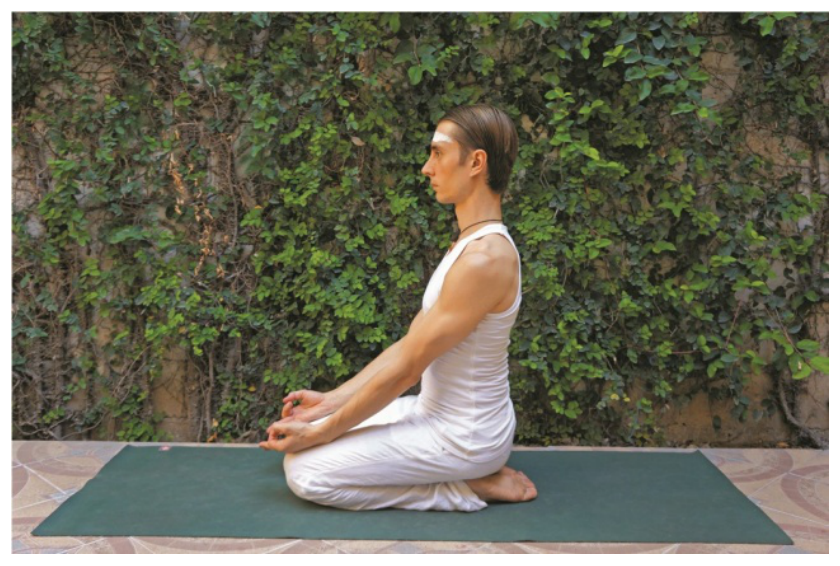
TECHNIQUE
- With knees, ankles and big toes touching the ground, stand on a kneeling position.
- Sit erect with the heels under your buttocks
- Erect in this asana 30 seconds
IN VAJRA ASANA, NEXT-
2. BHASTRIKAA KUBHAKA KUMBHAKA PADDHATI, VERSES: 164& 165
भस्त्रेव लोहकारस्य रेचपूरौ श्रमावधि ।
वेगेन स्तनयोरूर्ध्वं ततःपूरोऽर्कवर्त्मना ॥
जालन्धरं दृढं बध्वा कुम्भितं चन्द्रवर्त्मना ।
रेचयेद् भस्त्रिकाकुम्भः शरीराग्निविवर्द्धनः ॥
Bhastreva Lohakaarasya Rechapoorau Shramaavadhi |
Vegena Sthanayoroordhvam ThathahaPooro(a)rkavarthmanaa ||164||
Jaalandharam Dhrudam Badhvaa Kumbhitham Chandra-Varthmanaa |
Rechayeth-BhasthrikaaKumbhaha Shareeraagni-Vivarddhanaha ||165||
TRANSLATION One should rapidly inhale and exhale similar to the bellows of a blacksmith till he becomes fatigued. Followed by this he should inhale through the right nostril and then having held the breath with the jaalandhara Bandha, he should exhale through the left nostril. This is Bhastrikaa Kumbhaka that increases bodily heat.
TECHNIQUE
- Rapidly inhale and exhale like the bellows of the black smith until you become fatigued
- Then inhale through the right nostril
- Press the chin on the chest so that the throat is locked
- Hold the breath as long as you can judiciously
- Relax the chin and exhale through left nostril
- Do this for 7 minutes
N VAJRA ASANA, NEXT-
3. TRISHOOLA KUMBHAKA
KUMBHAKA PADDHATHI, VERSE: 193
घोणा यां च मुखेनापि युगपत् पूरयेत् सदा ।
त्रिशूलिना त्रिशूलाख्यः कुम्भ उक्तस्त्रिशूलनुत् ॥
Ghonaabhyaam Cha Mukhenaapi YugapathPoorayethSadhaa | ThrishoolinaaTrishoolaakhyaha KumbhaUkthas-Trishoolanuth ||193||
TRANSLATION Always inhale through the nostrils and mouth together at a time. This is called the Trishoola Kumbhaka – the remover of triple sufferings – as explained by the Thrishooli Shiva.
TECHNIQUE
- Inhale through the nostrils and also through the mouth simultaneously
- Hold the breath as long as you can judiciously
- Now exhale through the nostrils slowly and relax
- Do this for 21 times
N VAJRA ASANA, NEXT-
4. TRINETRA KUMBHAKA
KUMBHAKA PADDHATHI, VERSE: 192
सकृच्चन्द्रेण चापूर्य धार्य सूर्येण पूरयेत् ।
नियम्य पूरयेन्नो यां धारयित्वा यथाविधि ॥
त्रिनेत्रकुम्भकः प्रोक्तः त्रिनेत्रेण त्रिसिद्धिदः ॥
SakruthChandrenaChaapoorya DhaaryaSooryenaPoorayeth |
NiyamyaPoorayennobhyaam DhaarayithvaaYathaa-Vidhi ||
Thrinethra-KumbhakahaProkthaha ThrinethrenaThrisiddhidhaha ||
TRANSLATION
Inhale through the left nostril and retain, inhale through the right nostril and retain and then inhale through both the nostrils, retain the breath (all these in one shot before exhalation). This is the Trinetra Kumbhaka – the giver of three siddhis – as explained by the three-eyed Shiva.
TECHNIQUE
- Inhale through the left nostril
- Hold the breath as long as you can judiciously
- Without exhalation, inhale through the right nostril
- Hold the breath as long as you can judiciously
- Again without exhaling, inhale through both the nostrils
- Hold the breath as long as you can judiciously
- Now exhale through both the nostrils slowly
- Do this 21 times
END OF KRIYA
Kriya Date
25-Feb-2012