CURE FOR INSOMNIA
This text was machine-transcribed from the printed book and may contain errors. Select the words and choose “Report a mistake”.
Disease Description
Insomnia (or sleeplessness) is most often defined by an individual's report of sleeping difficulties. The term insomnia is often defined as a positive response to either of two questions: "Do you experience difficulty sleeping?" or "Do you have difficulty falling or staying asleep?"
Thus, insomnia is most often thought of as both a sign and a symptom that can accompany several sleep, medical, and psychiatric disorders, characterized by persistent difficulty falling asleep and/or staying asleep or sleep of poor quality. Insomnia is typically followed by functional impairment while awake or marked distress for more than a month.
Insomnia can be classified as transient, acute, or chronic depending on how long it has persisted.
Sleep studies using polysomnography have suggested that people who have sleep disruption have elevated nighttime levels of circulating cortisol and adrenocorticotropic hormone.
STEPS TO BE FOLLOWED
- BHADRA ASANA
- JAALANDHARA BANDHA
- NABHO MUDRA
- BHASTRIKAA
Instructions Please have some water beside you. For best results, practice this kriya before falling asleep and after immediately finishing the kriya have some water and go to sleep.
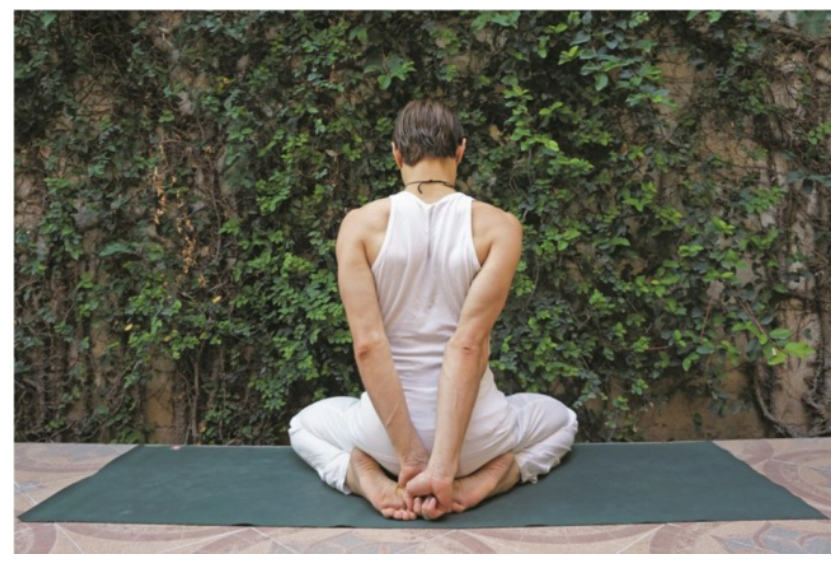
1. BHADRA ASANA GHERANDA SAMHITA, UPADESHA 2, VERSES: 9 & 100 अथ भद्रासनम्
गुल्फौ च॒ भध्रथभह्रभधरभभकभभध्र॒ रभद्द्रग्रिह्रटभभ्रहभ समाहितः।
पादाङ्गुष्ठौ म्द्रूभपरभभगचभ धृत्वा च पृष्टदेशतः॥
जालन्धरं समासाद्य नासाग्रमवलोकयेत्।
भद्रासनं भवेदेतत् सर्व्वव्याधिविनाशनम्॥
Gulphau cha Virushanasyadho vyuthkramena samaahitaha | Paada-angushtau karaabhyaam cha Dhrutvaa cha prushta-deshataha ||2.9||
Jaalandharam samaasaadya Naasaagram avalokayet|
BHADRA ASANAm bhavet etat Sarva-vyaadhi-vinaashakam ||2.10||
TRANSLATION Place the heels crosswise under the genitals attentively; cross the hands behind the back and take hold of the toes of the feet . Fix the gaze on the tip of the nose, having previously adopted the mudra called Jaalandhara (explanation comes next). This is Bhadra asana which destroys all sorts of diseases.
TECHNIQUE
- Bend both the legs to the back, keep the feet facing up and Sit on it
- Take both your hands to the back and hold your right toes with the left hand and left toes with the right hand
- Do Jaalandhara bandha, contract your throat, bend your chin and rest it on your chest
- Concentrate your gaze on the tip of your nose
- Remain in this pose for 30 seconds and release the Jaalandhara bandha
IN BHADRA ASANA, NEXT-
2. JAALANDHARA BANDHA GHERANDA SAMHITA, UPADESHA 3, VERSE 12
॥अथ जालन्धरबन्धकथनम् ॥
कण्ठसङ्कोचनं कृत्वा चिबुकं हृदये न्यसेत्।
जालन्धरे कृते बन्धे षोडशाधारबन्धनम्॥
Kanta-sankochanam krutvaa Chibukam hrudaye nyaset |
Jaalandhare krute bandhe Shodasha-aadhaara-bandhanam ||3.12||
TRANSLATION Contracting the throat, place the chin on the chest. This is called Jaalandhara Bandha. By this bandha the sixteen adharas are closed.
TECHNIQUE
- Remain in same asana
- Inhale fully
- Place the chin on the chest and contract the throat
- Fix the Gaze at the tip of the nose
- Hold as long as possible judiciously
- Release the throat lock and exhale slowly, when you feel you can't hold anymore
- Do this 16 times
IN BHADRA ASANA, NEXT-
3. NABHO MUDRA
GHERANDA SAMHITA, UPADESHA 3, VERSE 9
नभो मुद्रा
यत्र यत्र स्थितो योगी सर्वकार्येषु सर्वदा ।
ऊर्ध्वजिह्वः स्थिरो भूत्वा धारयेत् भवनं सदा ।
नभोमुद्रा भवेदेषा योगिनां रोगनाशिनी ॥
yatra yatra sthito yogee sarvakaaryeshu sarvadaa |
oordhvajihvaha sthiro bhootvaa dhaarayet bhavanam sadaa |
nabhomudraa bhavedeshaa yoginaam roganaashini ||
TRANSLATION Wherever the yogi may be may be, he should always, in everything he does, be sure to keep the tongue turned upwards and constantly hold the breath. This is Nabho mudra, the destroyer of diseases for yogis.
TECHNIQUE
- Turn the tongue upwards. Roll it and push it up
- Hold the breath with closed eyes
- Hold as long as you can then, relax
- Do this Nabho mudra at least 16 times
IN BHADRA ASANA, NEXT-
4. BHASTRIKAA
GHERANDA SAMHITA, UPADESHA-5, VERSES 75- 77
॥ अथ भस्त्रिकाकुम्भकः ॥
भस्त्रैव लोहकाराणां यथाक्रमेण संभ्रमेत्।
तथा वायुम् च लभधधभभपरभभटमद्द्रपभभपरभमत्र चालयेच्छनैः॥
एवंविम्शतिवारं च कृत्वा कुर्यांच्च कुम्भकम्।
तदन्ते चालयेद्वायुं पूर्वोक्तं च यथाविधि ॥
त्रिवारं साधयेदेनं भस्त्रिकाकुम्भकं सुधीः।
न च रोगो न च क्लेशं आरोग्यं च दिने दिने ॥
Bhastraiva lohakaaraanaam Yathaa-kramena sambhramet |
Tathaa vaayum cha naasaabhyaam Ubhaabhyaam Chaalayet shanaihi || 5.75 ||
Vimshati-vaaram Cha Krutvaa Kuryaachcha Kumbhakam |
Tadante Chaalayet Vaayum Poorvoktam Cha Yathaavidhi || 5.76 ||
Trivaaram SaadhayetEnam Bhastrikaa-Kumbhakam Sudheehi |
Na Cha Rogo Na Cha Klesha Aarogyam Cha Dhine Dhine || 5.77 ||
TRANSLATION As the bellows of the ironsmith constantly dilate and contract, similarly let him slowly draw in the air by both the nostrils and expand the stomach; then throw it out quickly (the wind making sound like bellows).
Having thus inhaled and exhaled twenty times as stated above, then let him perform Kumbhaka and then let him expel it by the previous method (this completes one round of Bhastrikaa). Let the wise one perform this Bhastrikaa(Bellows-like) Kumbhaka thrice; he will never suffer any disease and will be always healthy.
TECHNIQUE
- Inhale slowly expanding the stomach
- Exhale slowly
- Do this 21 times
- After 21 times, Now inhale slowly
- Hold the breath as long as you can
- When you feel you cant hold quickly expel the air with the sound of bellows. At this moment the stomach should contract to touch the back (This is one Bhastrikaa)
- Do this complete sequence three times
END OF KRIYA
Kriya Date
29-Oct-2011