CURE FOR INFECTION
This text was machine-transcribed from the printed book and may contain errors. Select the words and choose “Report a mistake”.
Disease Description
Infection begins when an organism successfully colonizes by entering the body, growing and multiplying. Most humans are not easily infected. Those who are weak, sick, malnourished, have cancer or are diabetic have increased susceptibility to chronic or persistent infections. Individuals who have a suppressed immune system are particularly susceptible to opportunistic infections.
Entrance to the host generally occurs through the mucosa in orifices like the oral cavity, nose, eyes, genitalia, anus, or open wounds. While a few organisms can grow at the initial site of entry, many migrate and cause systemic infection in different organs. Some pathogens grow within the host cells (intracellular) whereas others grow freely in bodily fluids.
Infections are usually considered to be caused by microorganisms or micro parasites like viruses, prions, bacteria, and viroids, though larger organisms like macro parasites and fungi can also infect.
The symptoms of an infection depend on the type of disease. Some signs of infection affect the whole body generally, such as fatigue, loss of appetite, weight loss, fevers, night sweats, chills, aches and pains. Others are specific to individual body parts, such as skin rashes, coughing, or a runny nose.
STEPS TO BE FOLLOWED
- GARUDAASANA (version 1)
- PLAAVINEE KUMBHAKA
- MOORCCHANAA KUMBHAKA
- GARUDAASANA (version 2)
- KAMALA KUMBHAKA
- KUMUDA KUMBHAKA
- KRAMA NETRA KUMBHAKA
1. GARUDAASANA (version 1) YOGAASANA MAALAA SACITRA, VERSE: 90
आसन कौ गुण धमभमभ्र आदी दे बिष व्यापै नही ॥
Aasana Kau Guna sarpa Aadhee De Bisha Vyaapai Nahii ||90||
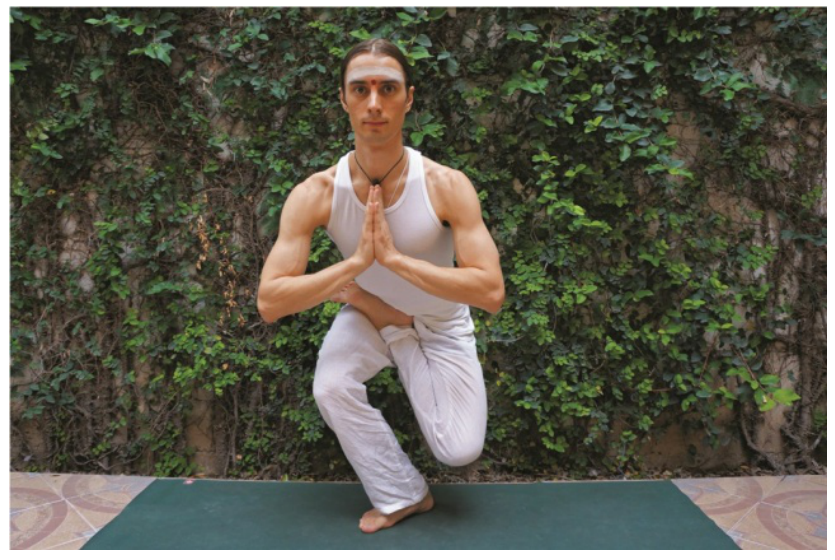
TRANSLATION-cum-TECHNIQUE
- Stand straight on the ground
- Balance yourself and place your left foot at the root of the left thigh
- Bend a little your right knee
- Bring the left knee close to the right ankle
- Fold the hands in prayer position and place it near the chest
- Settle in this posture for 30 seconds
IN GARUDAASANA 1,
NEXT-
2. PLAAVINEE KUMBHAKA
KUMBHAKA PADDHATHI
VERSE: 171
यथेष्टं पूरयेद्वायुं बद्धे जालन्धरे दृढे ।
हृदि धृत्वा जले सुप्त्वा प्लाविनीकुम्भको भवेत् ॥
YatheshtampoorayethVaayum BadhdheJaalandhareDhrude | HrudhiDhruthvaaJaleSupthvaa Plaavinee-KumbhakoBhaveth ||171||
TRANSLATION One should fill in the air sumptuously in his lungs and then adopt Jaalandhara Bandha firmly. If one lies on water it is called Plaavinee Kumbhaka.
TECHNIQUE
- Stay on same posture
- Inhale completely
- Contract the throat and rest your chin on the chest
- Retain the air inside as much as you can possible
- When you can't hold anymore, Release the throat lock and exhale slowly
- Do this 21 times
IN GARUDAASANA 1, NEXT-
3- MOORCCHANAA KUMBHAКА
KUMBHAKA PADDHATHI
VERSE: 170
॥ अथ मूर्च्छनकुम्भकः ॥
आपूर्य कुम्भितं प्राणं बध्वा जालन्धरं शनैः ।
रेचयेन्मूर्च्छनाकुम्भो मनोमूर्च्छा सुखप्रदा ॥
Aapoorya Kumbhitham Praanam Badhvaa Jaalandharam Shanaaihi | Rechayeth Moorcchanaa-Kumbho Mano-Moorcchaa Sukha-Pradaaa ||170||
TRANSLATION One should retain the inhaled breath by performing Jaalandhara Bandha. Then he should slowly exhale in this Jaalandhara Bandha itself. It is called Moorcchanaa kumbhaka. It conferes bliss by reducing the (Thoughts Per Second) TPS level.
TECHNIQUE
- Sit in same asana and close the eyes
- Inhale slowly and deeply through both nostrils
- After inhaling, immediately do Jalandhara Bandha by putting your chin on the chest and locking the throat
- Hold the breath as long as you can.
- When you can't hold anymore, Exhale through both nostrils in a very controlled manner in Jaalandhara bandha itself
- Do this 21 times NEXT-
4. GARUDAASANA (version 2) YOGAASANA MAALAA SACITRA, VERSE: 72
डावो पग मोडि येडि माहिलाँ गूलफ मूलद्वार नीचै दे ।
बैसै जीमणी पगथली धरती टेकि गोडो ंचौ उभौ राषै ।
पगथली माहिली कोर डावा गोडा अरू पीडी माहिली ।
कानी लगावै हाथ दोउ गोडा उपरि राषै द्रिष्टि नासा अग्र ।
आसण कौ गुण कहि भाति धात जाति होई तथ मै ।
Daavo Paga Modi Yedi Maahilaum Goolpha Mooladvaara Neechai Dhe | Baisai Jeemanee Pagathalee Dharathee Teki Godo Oonchau Ubhau Raashe | Pagathali Maahilee Kor Daavaa Godaa Aroo Peedi Maahili | Kaanee Lagaavai Haatha Dovu Godaa Upari Raashai Dhrishti Naasaa Agra | Aasana Kau Guna Kahi Bhaathi Dhaatha Jaathi Hoyee Thatha Bhai ||72||
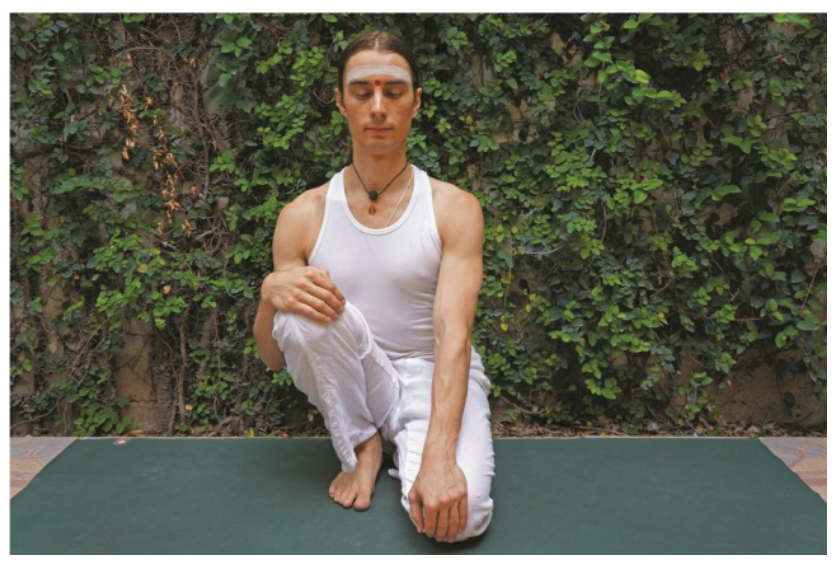
TRANSLATION-cum-TECHNIQUE
- Be seated on the ground
- Bending the left leg, place the left heel under the anus
- Fold the right leg and keep it upright placing the right foot close to the right buttock
- Keep your hands on the respective knees
- Fix the gaze at the tip of your nose.
- Settle in this posture for 30 seconds
IN GARUDAASANA 2,
NEXT
5. KAMALA KUMBHAКА
KUMBHAKA PADDHATHI
VERSE: 189
॥ अथ कमलकुम्भकः ॥
पूरयेदर्कनाड्यासु कुम्भयित्वा यथाविधि ।
रेचयेच्चेन्दुनाड्यासु कुम्भकः कमलाभिधः ॥
PoorayethArka-Naadyaasu KumbhayithvaaYathaa-Vidhi | Rechayecchendu-Naadyaasu Kumbhakaha Kamala-abhidhaha ||189||
TRANSLATION One should inhale through the right nostril and hold the breath properly and exhale through the left nostril. This is called Kamala Kumbhaka.
TECHNIQUE
- Inhale through the right nostril
- Retain the breath as long as you can judiciously
- Exhale through the left nostril
- Do this 21 times
IN GARUDAASANA 2,
NEXT-
6. KUMUDA KUMBHAKA
KUMBHAKA PADDHATHI, VERSE: 190
॥ अथ कुमुदकुम्भकः ॥
पूरयेच्चन्द्रमार्गेण धारयित्वाध्वजायुधे ।
रेचयेत्तमुभा यां चेत्कुमुदः कुम्भकः स्मृतः ॥
Poorayeth Chandra-Maargena DhaarayithvaaDhvajaayudhe |
RechayethThamUbhaabhyaam ChethKumudaha Kumbhakaha Smruthaha ||190||
TRANSLATION The breath should be inhaled through the left nostril. After retaining the breath, if the exhalation is done through both the nostrils, it is called Kumuda Kumbhaka.
TECHNIQUE
- Inhale through the left nostril
- Hold the breath
- Exhale through both the nostrils
- Repeat this 21 times
IN GARUDAASANA 2, NEXT-
7. KRAMA NETRA KUMBHAKA KUMBHAKA PADDHATHI, VERSE: 191
॥ अथ क्रमनेत्रकुम्भकः ॥
सकृत्सूर्येण चापूर्य धार्यं चन्द्रेण पूरयेत्।
धारयेच्च प्रयत्नेन रेचयेत् क्रमतस्तथा ॥
नेत्रकुम्भक इति ख्यातः क्रमतो व्युत्क्रमादपि ॥
SakruthSooryenaChaapoorya DhaaryaChandrenaPoorayeth |
Dhaarayeth Cha Prayathnena RechayethKramathas-Thathaa ||191 ||
TRANSLATION One should take the breath in through the right nostril, hold the breath and then again inahale through the left nostril. He should with effort hold the breath again and exhale in the same order. This is known as krama-netra kumbhaka. This is also done in the reverse order.
TECHNIQUE
- Inhale through the right nostril
- Hold the breath
- Inhale through the left nostril
- Hold the breath
- Exhale through the right nostril
- Hold the breath
- Exhale through the left nostril
- Hold the breath
- Do this 21 times
END OF KRIYA
Kriya Date 26-Nov-2011