CURE FOR HYPOTHYROIDISM
This text was machine-transcribed from the printed book and may contain errors. Select the words and choose “Report a mistake”.
Disease Description
Hypothyroidism is a condition in which the thyroid gland does not make enough thyroid hormone.
Iodine deficiency is often cited as the most common cause of hypothyroidism worldwide but it can be caused by many other factors. It can result from a lack of a thyroid gland or from iodine-131 treatment or a deficiency in stimulating hormones from the hypothalamus or pituitary, and can also be associated with increased stress, which can be environmental stress as well as lesser-considered homeostatic stress such as fluctuating blood sugar levels and immune problems.
Hypothyroidism can be associated with the early symptoms of increased sensitivity to cold, Constipation, Weight gain and water retention, Bradycardia (low heart rate – fewer than sixty beats per minute), fatigue, decreased sweating, muscle and joint pain, dry, itchy skin, thin, brittle fingernails, Depression, female infertility, any kind of problems with menstrual cycles, etc.
Late symptoms include Goiter (swelling in the thyroid gland), Slow speech and a hoarse, breaking voice, dry puffy skin, especially on the face, thinning of the outer third of the eyebrows (sign of Hertoghe), abnormal menstrual cycles, low basal body temperature.
STEPS TO BE FOLLOWED
- PARVATA ASANA
- TRINETRA KUBHAKA WITH JAALANDHARA BANDHA
- TRISHOOLA KUMBHAKA WITH JAALANDHARA BANDHA
- PASHCHIMOTTA ASANA
- KRAMA NETRA KUMBHAKA WITH JAALANDHARA BANDHA
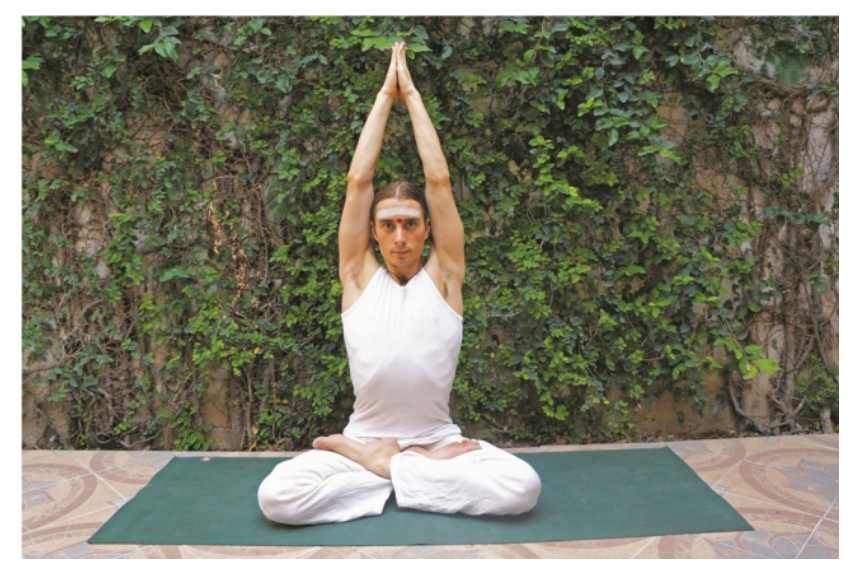
1. PARVATA ASANA YOGA RAHASYA, CHAPTER 5, VERSE: 22
मूत्रपिण्डयकृत्प्लीहवपाशुद्धये निरन्तरम् ।
उपविश्य च सुप्ताघ पर्वतासनम यसेत् ॥५-२२॥
Moothrapindayakritpleehavapaa-Shuddhaye Nirantaram | Upavishya Cha Supthaagha Parvathaasanam Abhyaseth ||5.22||
TRANSLATION cum TECHNIQUE
- Place the right foot on the left thigh
- Now place the left foot on the right thigh
- Keep both the arms raised above the head and join the hands
- Settle in this posture for 30 seconds (This should be practised in both sitting as well as Lying conditions. But now we will do the following kumbhakas in sitting pose only)
IN PARVATA ASANA, NEXT-
2. TRINETRA KUMBHAKA WITH JAALANDHARA BANDHA
KUMBHAKA PADDHATHI VERSE: 192
सकृच्चन्द्रेण चापूर्य धार्यं सूर्येण पूरयेत् ।
नियम्य पूरयेन्नो यां धारयित्वा यथाविधि ॥
त्रिनेत्रकुम्भकः प्रोक्तः त्रिनेत्रेण त्रिसिद्धिदः ॥
SakruthChandrenaChaapoorya DhaaryaSooryenaPoorayeth | NiyamyaPoorayennobhyaam DhaarayithvaaYathaa-Vidhi || Thrinethra-KumbhakahaProkthaha ThrinethrenaThrisiddhidhaha ||
TRANSLATION Inhale through the left nostril and retain, inhale through the right nostril and retain and then inhale through both the nostrils, retain the breath (all these in one shot before exhalation). This is the Trinetra Kumbhaka – the giver of three siddhis – as explained by the three-eyed Shiva.
TECHNIQUE
- Inhale through the left nostril
- Place the chin on the chest and contract the throat, hold the breath as long as you can judiciously
- Without exhalation, release the throat lock and inhale through the right nostril 4. Place the chin on the chest and contract the throat, hold the breath as long as you can judiciously
- Again without exhaling, release the throat lock and inhale through both the nostrils
- Place the chin on the chest and contract the throat, hold the breath as long as you can judiciously
- Now release the throat lock and exhale through both the nostrils slowly
- Do this 21 times
IN PARVATA ASANA, NEXT
3. TRISHOOLA KUMBHAKA WITH JAALANDHARA BANDHA
KUMBHAKA PADDHATHI VERSE: 193
घोणा यां च मुखेनापि युगपत् पूरयेत् सदा ।
त्रिशूलिना त्रिशूलाख्यः कुम्भ उक्तस्त्रिशूलनुत् ॥
Ghonaabhyaam Cha Mukhenaapi YugapathPoorayethSadhaa | ThrishoolinaaTrishoolaakhyaha KumbhaUkthas-Trishoolanuth ||193||
TRANSLATION Always inhale through the nostrils and mouth together at a time. This is called the Trishoola Kumbhaka – the remover of triple sufferings – as explained by the Thrishooli Shiva.
TECHNIQUE
- Inhale through the nostrils and also through the mouth simultaneously
- Place the chin on the chest and contract the throat, hold the breath as long as you can judiciously
- Now release the throat lock and exhale through the nostrils slowly and relax
- Do this 21 times
NEXT
4. PASHCHIMOTTA ASANA
GHERANDA SAMHITA, UPDESHA 2, VERSE: 26
॥ अथ पश्चिमोत्तानासनम् ॥
प्रसार्य पादौ भुवि दण्डरूपौ संन्यस्तभालं चितियुग्ममध्ये ।
यत्नेन पादौ च धृतौ करा यां योगीन्द्रपीठं पश्चिमोत्तानमाहुः ॥
Prasaarya Paadau Bhuvi Dhanda-Roopau
Samnyastha-Bhaalam Chithi-Yugma-Madhye|
Yathnena Paadhau Cha DhruthauKaraabhyaam
Yogeendra-Peetam Pashchimoththaanam Aahuhu ||2.26||
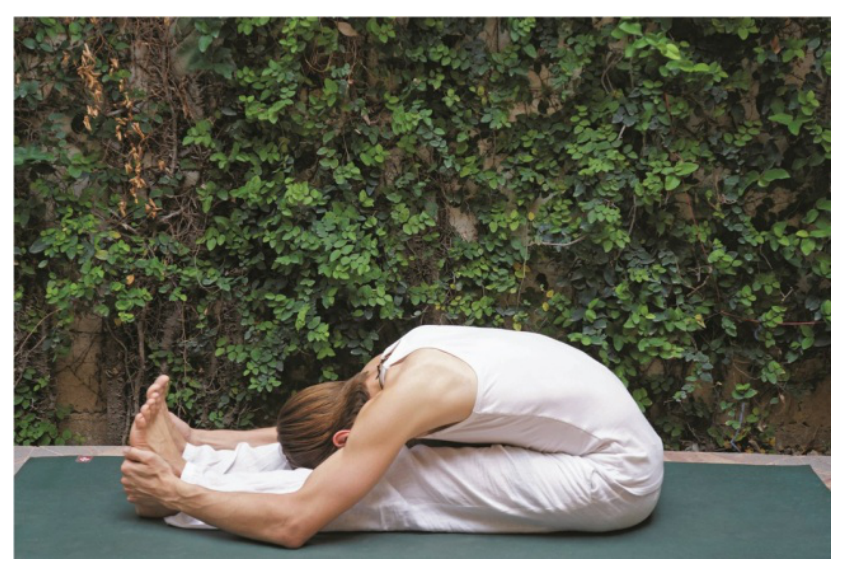
TRANSLATION Having spread both the legs on the ground stiff like a stick, the heels not touching, one should bend forward and rest the forehead on the knees and hold the feet with the hands.
TECHNIQUE
- Sit with the legs stretched, the heels not touching one another.
- Bend forward
- Place your forehead on the knees
- Catch hold of the feet with your hands
- Remain in this pose 30 seconds
IN PASHCHIMOTTA ASANA, NEXT –
5. KRAMA NETRA KUMBHAKA WITH JAALANDHARA BANDHA
KUMBHAKA PADDHATHI VERSE: 191
॥ अथ क्रमनेत्रकुम्भकः ॥
सकृत्सूर्येण चापूर्य धार्यं चन्द्रेण पूरयेत्।
धारयेच्च प्रयत्नेन रेचयेत् क्रमस्तस्तथा ॥
नेत्रकुम्भक इति ख्यातः क्रमतो व्युत्क्रमादपि ॥
SakruthSooryenaChaapoorya DhaaryaChandrenaPoorayeth |
Dhaarayeth Cha Prayathnena RechayethKramathas-Thathaa ||191 ||
TRANSLATION
One should take the breath in through the right nostril, hold the breath and then again inahale through the left nostril. He should with effort hold the breath again and exhale in the same order. This is known as krama-netra kumbhaka. This is also done in the reverse order.
TECHNIQUE
- Inhale through the right nostril
- Place the chin on the chest and contract the throat, hold the breath
- Without exhalation, release the throat lock and Inhale through the left nostril
- Place the chin on the chest and contract the throat, hold the breath
- Release the throat lock and Exhale through the right nostril
- Place the chin on the chest and contract the throat, hold the breath
- Without inhalation, release the throat lock and Exhale through the left nostril
- Do this 21 times
END OF KRIYA Kriya Date 25-Dec-2011