CURE FOR ANGER
This text was machine-transcribed from the printed book and may contain errors. Select the words and choose “Report a mistake”.
Disease Description
Anger is an emotion related to one's psychological interpretation of having been offended, wronged or denied and a tendency to undo that by retaliation. Anger is described as an emotion that involves a strong uncomfortable and emotional response to a perceived provocation.
Anger may have physical correlates such as increased heart rate, blood pressure, and levels of adrenaline and noradrenaline. Some view anger as part of the fight or flight brain response to the perceived threat of harm. Anger becomes the predominant feeling behaviorally, cognitively, and physiologically when a person makes the conscious choice to take action to immediately stop the threatening behavior of another outside force.
Modern psychologists point out that suppression of anger may have harmful effects. The suppressed anger may find another outlet, such as a physical symptom, or become more extreme
Physiological responses to anger include an increase in the heart rate, preparing the person to move, and increase of the blood flow to the hands, preparing them to strike. Perspiration increases (particularly when the anger is intense).
STEPS TO BE FOLLOWED
- EKAPAADA ASANA
- UDDEEYAANA BANDHA
- JAALANDHARA BANDHA
- BHASTRIKAA KUMBHAKA
- SEETHKAAREE PRAANAAYAAMAA
- SHEETHALEE KUMBHAKA
1. EKAPAADA ASANA
YOGAASANAM, VERSE: 5
दक्षांघ्रिं वामपादस्य जङ्घोपरि निधाय च ।
द्व्यः पाणिं जानुपार्श्वयोः स्पृशेत्कुमितराङ्घ्रिणा ॥
एवंविधासनं यत्र तत्रैकाङ्घ्र्यासनं भवेत् ।
ॅह्मशभ्रद्व्तूलभभ्रलभ धरमभेभूलमभशभत्र चभ टभद्रसभभित्र ञ्ञ
Dakshnaanghrim Vaama-Paadhasya Janghopari Nidhaaya Cha Dvyaha Paanim Jaaupaarshvayoho Sprusheth-kumitharaanghrinaa | Evamvidhaasanam Yathra Thathraikaanghryaasanam Bhaveth | Rakthashuddhiranena syaajjvaranaasham cha moolataha ||5||
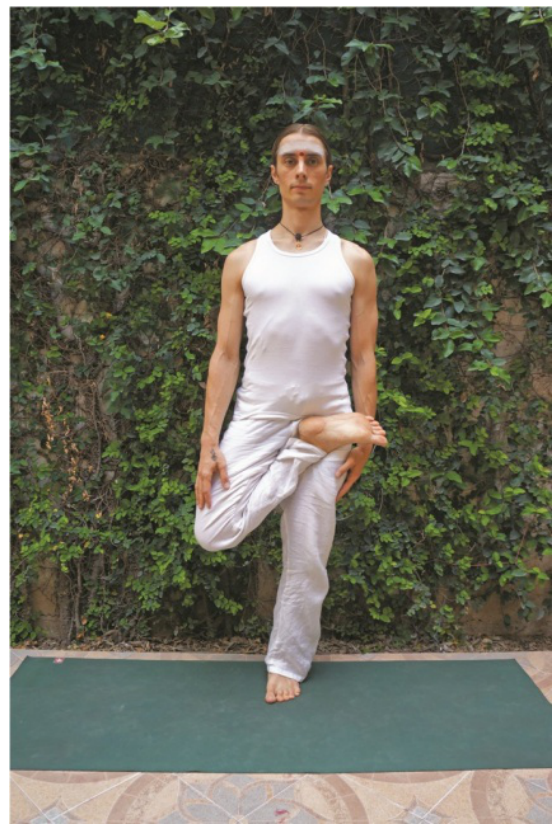
TRANSLATION Having placed the right foot on the left thigh (in the standing posture) one should place both the hands adjacent to and touching the knees. This is called Ekapaada asana.
TECHNIQUE
- Stand up
- Balance yourself and place the right foot on the left thigh
- Touch the knees with the respective hands.
- Continue to balance yourself in this pose and remain in this posture for 30 seconds
IN EKAPAADA ASANA, NEXT-
2. UDDEEYAANA BANDHA
GHERANDA SAMHITA, UPADESHA-3, VERSE: 10
॥ अथ उड्डीयान-बन्धः ॥
उदरे पश्चिमं तानं नाभेरुर्ध्वं तु कारयेत्।
उड्डानं कुरुते यस्मादविश्रान्तं महाखगः।
उड्डीयानं त्वसौ बन्धो मृत्यु-मातङ्ग-केसरी ॥
Udare pashchimam taanam Naabheroordhvam tu kaarayet |
Uddaanam kurute yasmat Avishraantam mahaakhagaha |
Uddeeyaanam tvasau bandhao Mrutyu-Maatanga-Kesaree || 3.10 ||
TRANSLATION
One should contract the bowels above and below the navel so that the abdominal organs touch the back. The one who practices this uddeeyaana bandha continuously becomes a conqueror of death. The great bird (Kundalini) flies up in the Sushumna and flies there itself constantly.
TECHNIQUE
- Stay on same asana and Keep the spine straight. Head should be up and eyes open
- Take a deep breath in and exhale completely, but do not be forceful
- After exhaling, perform jalandhara bandha by moving the chin down to the chest and raising the shoulders
- Pull the abdominal muscles inward so that the organs of the abdomen touch the back muscles
- Hold as long as you can
- When you can't hold anymore, Before inhaling, relax the stomach and abdomen, release jaalandhara bandha by raising the head
- Then inhale through the nostrils slowly
- Before repeating another round, breathe normally for a minute or two
- Initially start with 3 times and gradually increase upto 10 times
IN EKAPAADA ASANA, NEXT
3. JAALANDHARA BANDHA
GHERANDA SAMHITA, UPADESHA 3, VERSE: 12
॥अथ जालन्धरबन्धकथनम्॥
कण्ठसङ्कोचनं कृत्वा चिबुकं हृदये न्यसेत्।
जालन्धरे कृते बन्धे षोडशाधारबन्धनम्॥
Kanta-sankochanam krutvaa Chibukam hrudaye nyaset |
Jaalandhare krute bandhe Shodasha-aadhaara-bandhanam ||3.12||
TRANSLATION
Contracting the throat, place the chin on the chest. This is called Jaalandhara Bandha. By this bandha the sixteen adharas are closed.
TECHNIQUE
- Remain in same asana
- Inhale fully
- Place the chin on the chest and contract the throat
- Hold as long as possible judiciously
- When you can't hold anymore, Release the throat lock and exhale slowly 6. Do this 21 times
IN EKAPAADA ASANA, NEXT-
4. BHASTRIKAA
GHERANDA SAMHITA, UPADESHA-5, VERSES 75- 77
॥ अथ भस्त्रिकाकुम्भकः ॥
भस्त्रैव लोहकाराणां यथाक्रमेण संभ्रमेत्।
तथा वायुम् च लभभधभभपरभभटभद्गपभभपरभभत्र चालयेच्छनैः ॥
एवंविम्शतिवारं च कृत्वा कुर्याच्च कुम्भकम्।
तदन्ते चालयेद्वायुं पूर्वोक्तं च यथाविधि ॥
त्रिवारं साधयेदेनं भस्त्रिकाकुम्भकं सुधीः।
न च रोगो न च क्लेश आरोग्यं च दिने दिने ॥
Bhastraiva lohakaaraanaam Yathaa-kramena sambhramet | Tathaa vaayum cha naasaabhyaam Ubhaabhyaam Chaalayet shanaihi || 5.75 ||
Vimshati-vaaram Cha Krutvaa Kuryaachcha Kumbhakam | Tadante Chaalayet Vaayum Poorvoktam Cha Yathaavidhi || 5.76 ||
Trivaaram SaadhayetEnam Bhastrikaa-Kumbhakam Sudheehi | Na Cha Rogo Na Cha Klesha Aarogyam Cha Dhine Dhine || 5.77 ||
TRANSLATION As the bellows of the ironsmith constantly dilate and contract, similarly let him slowly draw in the air by both the nostrils and expand the stomach; then exhale slowly.
Having thus inhaled and exhaled twenty times as stated above, perform Kumbhaka and then let throw it out quickly (the wind making sound like bellows). This completes one round of Bhastrikaa. Let the wise one perform this Bhastrikaa Kumbhaka thrice; he will will never suffer any disease and will be always healthy.
TECHNIQUE
- Inhale slowly expanding the stomach
- Exhale slowly
- Do this 21 times
- After 21 times, now inhale slowly 5. Hold the breath as long as you can
- When you feel you can't hold quickly expel the air with the sound of bellows. At this moment the stomach should contract to touch the back (This is one Bhastrikaa)
- Do this complete sequence three times
IN EKAPAADA ASANA, NEXT
5. SEETHKAAREE PRAANAAYAAMA
HATHA PRADEEPIKAA, UPADESHA 4, VERSE 43
सीत्कां दद्यात् सदा वक्त्रे घ्राणेनैव विसर्जयेत् ।
एवमभ्यास योगेन कामदेवो द्वितीयकः ॥
Seethkaam dadyaath sadaa Vaktre Ghraanenaiva Visarjayet |
Evam Abhyaasa-Yogena Kaamadevo Dviteeyakaha ||4.43||
TRANSLATION
By drawing the breath in through the mouth, make a hissing sound, without opening the mouth, and exhale through the nose. By practicing this, one becomes a second Kaamadevatha (god of love).
TECHNIQUE
- Stay in same asana
- Press the lower and upper teeth together and separate the lips as much as comfortable
- Breath in slowly through the gaps of the teeth
- Listen to the sound of the breath as the air is being drawn in
- Close the mouth at the end of the inhalation
- Exhale slowly through the nose
- Do this 21 times
IN EKAPAADA ASANA, NEXT
6. SHEETHALEE KUMBHAKA
GHERANDA SAMHITA, UPADESHA 5, VERSES 73 & 74
जिह्वया वायुं आकृष्य उदरे पूरयेत् शनैः ।
क्षणं च कुम्भकं कृत्वा नाशाभ्यां रेचयेत् पुनः ॥
सर्वदा साधयेत् योगी शीतली कुम्भकं शुभम् ।
अजीनं कफ-पित्तं च नैव तस्य प्रजायते ॥
Jihvayaa Vaayum Aakrushya Udare Poorayet Shanaihi |
Kshanam Cha Kumbhakam Krutvaa Naasaabhyaam Rechayet Punaha || 5.73 || |
Sarvadaa Saadhayet Yogee Sheethalee-kumbhakam Shubham |
Ajeernam Kapha-Pittam Cha Naiva Tasya Prajaayathe || 5.74 ||
TRANSLATION Draw in the air through the mouth (with lips contracted and tongue thrown out), and fill the stomach slowly. Retain it there for a short time. Then exhale through both the nostrils. Let the Yogi always practice this Sheethalee Kumbhaka, giver of bliss; by so doing, he will be free from digestion, phlegm and bilious disorders.
TECHNIQUE
- Continue to sit in same asana
- Close the eyes and relax the whole body
- Extend the tongue outside the mouth and roll the sides of the tongue up so that it forms a tube
- Inhale slowly through the tongue and fill the abdomen slowly
- At the end of inhalation, roll the tongue in, close the mouth
- Retain it there for a short time
- Then exhale through both the nostrils
- Do this 21 times
END OF KRIYA
Kriya Date
24-Nov-2011