CARE FOR MIGRAINE
This text was machine-transcribed from the printed book and may contain errors. Select the words and choose “Report a mistake”.
Disease Description
Migraine is a chronic neurological disorder characterized by moderate to severe headaches, and nausea. It is about three times more common in women than in men.
The typical migraine headache is unilateral (affecting one half of the head) and pulsating in nature and lasting from two to 72 hours; symptoms include nausea, vomiting, photophobia (increased sensitivity to light) and phono phobia (increased sensitivity to sound); the symptoms are generally aggravated by routine activity.
Approximately one-third of people who suffer from migraine headaches perceive an aura—transient visual, sensory, language, or motor disturbances signaling the migraine will soon occur. The severity of the pain, duration of the headache, and frequency of attacks is variable.
The underlying cause of migraines is unknown.[21] There are, however, many biological events that have been clinically associated with migraine.
Migraines may be induced by triggers, with common triggers quoted are stress, hunger, and fatigue.
Steps to follow:
- GIRIDHARA ASANA
- KUMBHA RAAJAA
- SHEETHALEE KUMBHAKA
- SEETKAAREE PRAANAAYAAMAA
1. GRIDHARA ASANA MATSYENDRIYA SAMHITA, VERSES 25-27
॥ एतस्याङ्गुष्ठयोर्मूले कर्पूरे सन्निवेशयेत् ।
परिवर्त्य करौ स्पृष्ट्वावाङ्गुलीतलगोपिता ॥
अङ्गुलीपृष्ठयोर्हेतु चिबुकं सन्निधापयेत् ।
अङ्गुष्ठौ सरलो कृत्वा तालुमूलसमाश्रितौ ॥
धृत्वा स्थिरमना भूत्वा गृध्रासनमिदं परम् ।
सर्वदोषक्षयकरं सर्वोपद्रवनाशनम् ॥
Etasyangustayormoole karpoore sanniveshayet | Parivarttya karau saprustavaavanguleetala gopitaa||25|| Anguleeprushthayo hetu cibukam sannidaapayet| Angushtau saralo krutvaa taalumoola-samaashritau||26||
Dhrithvaa sthiramanaa bhootvaa grdharaasanam idam param| Sarvadoshakshayakaram sarvopadrava-nashanam||27||
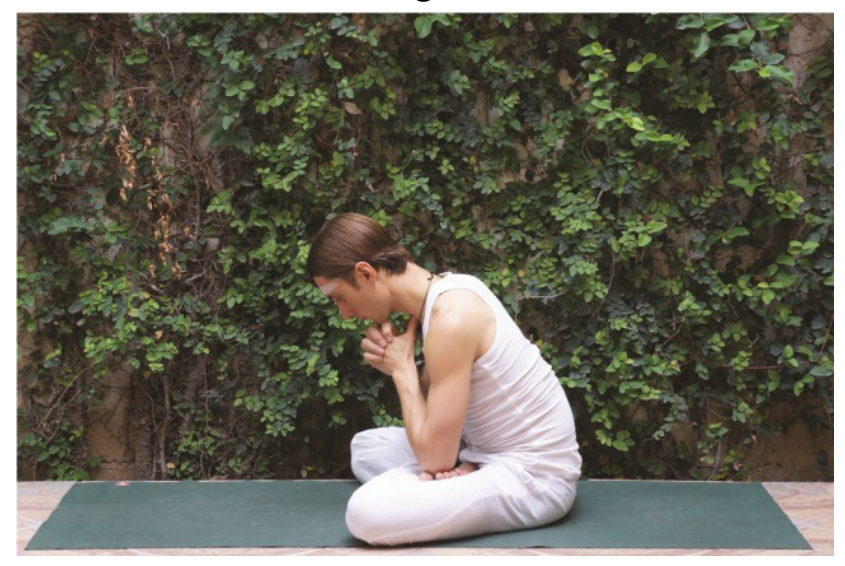
TRANSLATION Adopt Padma asana. Place the elbows on toes Interlock the fingers. Place the chin on the knuckle. Press the thumbs against the throat.
TECHNIQUE
- Sit in Padma asana, place the elbows on toes.
- Interlock the fingers.
- Place the chin on the knuckles.
- Press the thumbs against the throat.
- Remain in this posture for 60 seconds
IN GRIDHARA ASANA, NEXT-
2. -KUMBHA RAAJAA
KUMBHAKA PADDHATHI, VERSE 134
बलादाकर्षयेद्वायुं यावत् घ्राणसमुद्रणम्।
कुम्भयेच्च तथा वायुं कुम्भराजोऽयमीरितः ॥
Balaadhaakarshayeth Vaayum Yaavath Ghraana-Sumudranam| Kumbhayechcha Thathaa Vaayum Kumbharaajo'yameerithaha||134||
TRANSLATION One should forcefully inhale air till the lungs are full and hold the breath. This is called Kumbha raajaa.
TECHNIQUE
- Inhale forcefully
- Hold the breath to the maximum capacity by closing the nostrils
- Exhale when you feel you can not hold more.
- Do this 21 times
IN GRIDHARA ASANA, NEXT-
3. SHEETHALEE KUMBHAKA
GHERANDA SAMHITA, UPADESHA 5, VERSES 73 & 74
जिह्वया वायुं आकृष्य उदरे पूरयेत् शनैः ।
क्षणं च कुम्भकं कृत्वा नाशाभ्यां रेचयेत् पुनः ॥
सर्वदा साधयेत् योगी शीतली कुम्भकं शुभम् ।
अजीनं कफ-पित्तं च नैव तस्य प्रजायते ॥
Jihvayaa Vaayum Aakrushya Udare Poorayet Shanaihi |
Kshanam Cha Kumbhakam Krutvaa Naasaabhyaam Rechayet Punaha || 5.73 || |
Sarvadaa Saadhayet Yogee Sheethalee-kumbhakam Shubham |
Ajeernam Kapha-Pittam Cha Naiva Tasya Prajaayathe || 5.74 ||
TRANSLATION Draw in the air through the mouth (with lips contracted and tongue thrown out), and fill the stomach slowly. Retain it there for a short time. Then exhale through both the nostrils. Let the Yogi always practice this Sheethalee Kumbhaka, giver of bliss; by so doing, he will be free from digestion, phlegm and bilious disorders.
TECHNIQUE
- Continue to sit in same asana
- Close the eyes and relax the whole body
- Extend the tongue outside the mouth and roll the sides of the tongue up so that it forms a tube
- Inhale slowly through the tongue and fill the abdomen slowly
- At the end of inhalation, roll the tongue in, close the mouth
- Retain it there for a short time
- Then exhale through both the nostrils
- Do this 21 times
IN GRIDHARA ASANA, NEXT
4. SEETKAAREE PRAANAAYAAMAA
HATHA PRADEEPIKAA, UPADESHA 4, VERSE 43
सीत्कां दद्यात् सदा वक्त्रे घ्राणेनैव विसर्जयेत् ।
एवमभ्यास योगेन कामदेवो द्वितीयकः ॥
Seethkaam dadyaath sadaa Vaktre Ghraanenaiva Visarjayet | Evam Abhyaasa-Yogena Kaamadevo Dviteeyakaha ||4.43||
TRANSLATION By drawing the breath in through the mouth, make a hissing sound, without opening the mouth, and exhale through the nose. By practicing this, one becomes a second Kaamadevatha (god of love).
TECHNIQUE
- Stay in same asana
- Press the lower and upper teeth together and separate the lips as much as comfortable
- Breath in slowly through the gaps of the teeth
- Listen to the sound of the breath as the air is being drawn in
- Close the mouth at the end of the inhalation
- Exhale slowly through the nose
- Do this 21 times
END OF KRIYA
Kriya Date
09-Nov-2011