CARE FOR MEMORY PROBLEMS
This text was machine-transcribed from the printed book and may contain errors. Select the words and choose “Report a mistake”.
Disease Description
One of the key concerns of older adults is the experience of memory loss, especially as it is one of the hallmark symptoms of Alzheimer's disease. However, memory loss is qualitatively different in normal aging from the kind of memory loss associated with a diagnosis of Alzheimer's (Budson & Price, 2005). Research has revealed that individuals' performance on memory tasks that rely on frontal regions declines with age.
Older adults tend to exhibit deficits on tasks that involve knowing the temporal order in which they learned information; source memory tasks that require them to remember the specific circumstances or context in which they learned information; and prospective memory tasks that involve remembering to perform an act at a future time.
STEPS TO BE FOLLOWED
- MATSYA ASANA
- NAADA KUMBHAKA
- TRINETRA KUMBHAKA
- TRISHOOLA KUMBHAKA
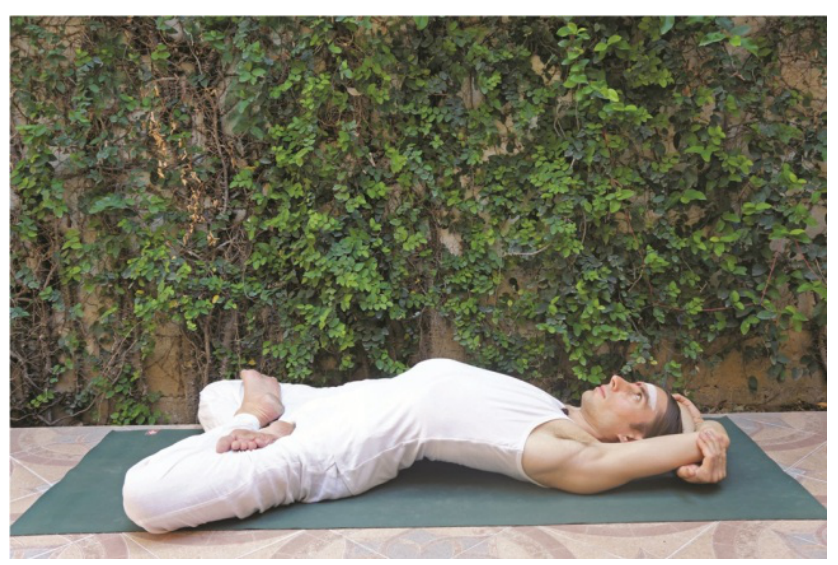
1. MATSYA ASANA GHERANDA SAMHITA, UPADESHA-2, VERSE: 21
॥ अथ मत्स्यासनम् ॥
मुक्तपद्मासनं कृत्वा उत्तानशयनञ्चरेत्।
कूर्परा यां शिरोवेष्ट्य मत्स्यासनन्तु रोगहा॥
Muktha-Padmaasanam Kruthvaa Uththaana-Shayanam Chareth | Koorparaabhyaam Shiro Veshtya Mathsyaasananthu Rogahaa ||2.21||
TRANSLATION Having performed the Padmaasanam one should lie down on his back. Matsya asana, the destroyer of diseases is formed by holding the head with the elbows in this posture.
TECHNIQUE
- Place the right foot on the left thigh
- Now place the left foot on the right thigh
- Now lie down on your back
- Cling on to your head with your elbows
- Settle in this posture for 30 seconds
IN MATSYA ASANA, NEXT
2. NAADA KUMBHAКА HATHA SANKETA CHANDRIKA
TRANSLATION Seated in Padma asana and having inhaled deeply, chant the Omkara in a feeble tone for prolonged time so that the Omkara Naada arises travels from the Navel and reaches the Brahma Randhra.
TECHNIQUE
- Sit in the same posture
- Now chant the sacred sound "OM" slowly in a low tone
- Elongate the chant as much as possible
- Feel the sound produced from the navel and travelling through the heart, throat and brow centers and reaching the crown of your head.
- Exhale slowly with Omkara
- Do this 21 times.
IN MATSYA ASANA, NEXT
3. – TRINETRA KUMBHAKA KUMBHAKA PADDHATHI, VERSE: 192
सकृच्चन्द्रेण चापूर्य धार्यं सूर्येण पूरयेत् ।
नियम्य पूरयेन्नो यां धारयित्वा यथाविधि ॥
त्रिनेत्रकुम्भकः प्रोक्तः त्रिनेत्रेण त्रिसिद्धिदः ॥
SakruthChandrenaChaapoorya DhaaryaSooryenaPoorayeth | NiyamyaPoorayennobhyaam DhaarayithvaaYathaa-Vidhi || Thrinethra-KumbhakahaProkthaha ThrinethrenaThrisiddhidhaha ||
TRANSLATION Inhale through the left nostril and retain, inhale through the right nostril and retain and then inhale through both the nostrils, retain the breath (all these in one shot before exhalation). This is the Trinetra Kumbhaka – the giver of three siddhis – as explained by the three-eyed Shiva.
TECHNIQUE
- Inhale through the left nostril
- Hold the breath as long as you can judiciously
- Without exhalation, inhale through the right nostril
- Hold the breath as long as you can judiciously
- Again without exhaling, inhale through both the nostrils
- Hold the breath as long as you can judiciously
- Now exhale through both the nostrils slowly
- Do this 21 times
IN MATSYA ASANA, NEXT-
4. TRISHOOLA KUMBHAKA
KUMBHAKA PADDHATHI, VERSE: 193
घोणा यां च मुखेनापि युगपत् पूरयेत् सदा ।
त्रिशूलिना त्रिशूलाख्यः कुम्भ उक्तस्त्रिशूलनुत् ॥
Ghonaabhyaam Cha Mukhenaapi YugapathPoorayethSadhaa | ThrishoolinaaTrishoolaakhyaha KumbhaUkthas-Trishoolanuth ||193||
TRANSLATION Always inhale through the nostrils and mouth together at a time. This is called the Trishoola Kumbhaka – the remover of triple sufferings – as explained by the Thrishooli Shiva.
TECHNIQUE
- Inhale through the nostrils and also through the mouth simultaneously
- Hold the breath as long as you can judiciously
- Now exhale through the nostrils slowly and relax
- Do this 21 times
END OF KRIYA
Kriya Date 13-Nov-2011